

Why Does Time Speed Up as You Get Older?
On this page· 17
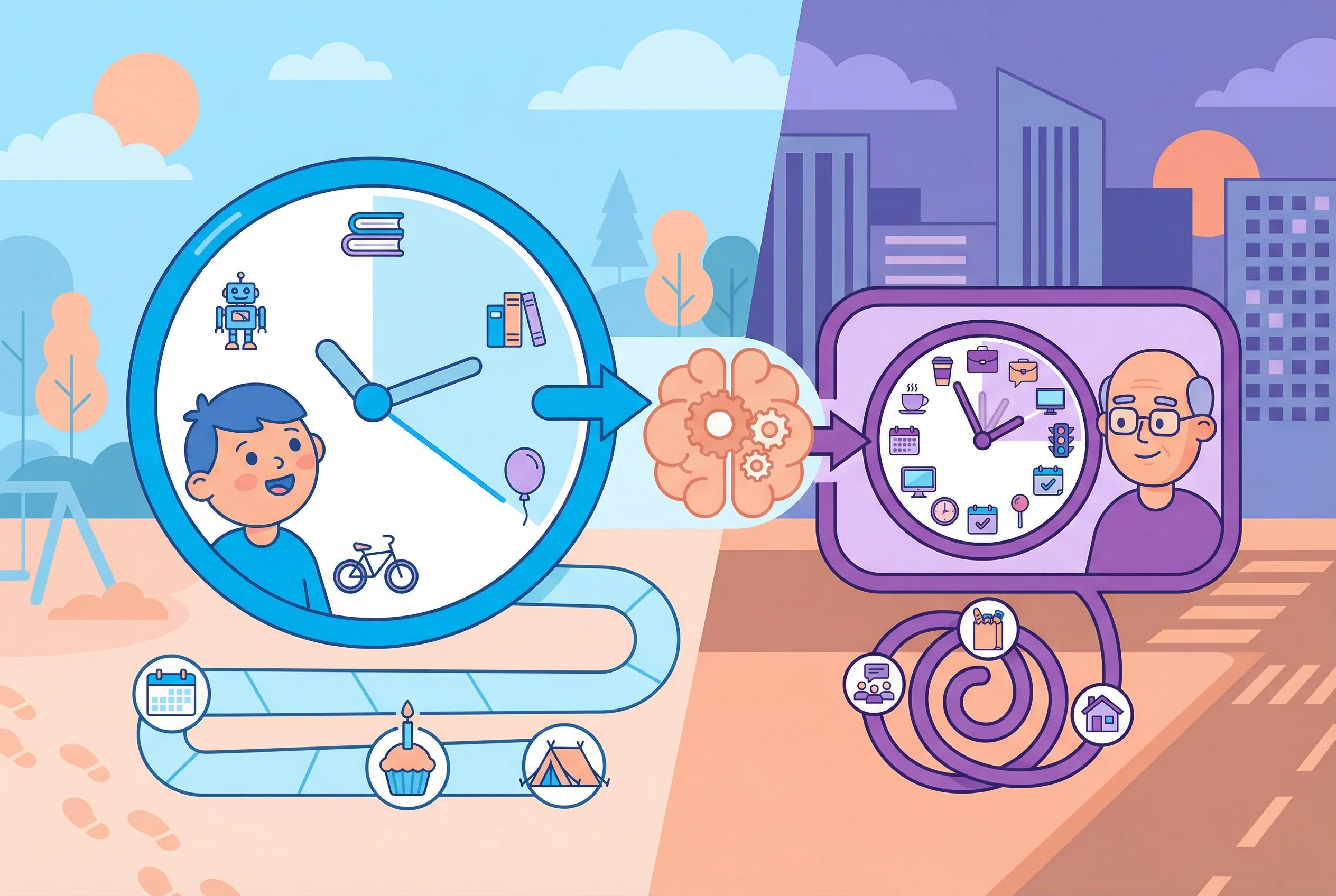
Why does time speed up as you get older? The clock is not getting sneakier, but your brain is changing what counts as a unit of lived time. Childhood is packed with firsts: first school, first streets you can navigate alone, first friendships that feel huge. Adulthood often runs on repeat. Fewer moments ask your brain to stop, update the map, and say, "Wait, this is new."
TL;DR
Time feels faster with age because several mechanisms stack together: each year becomes a smaller fraction of your life, routine creates fewer memory landmarks, attention filters familiar days more aggressively, and brain systems involved in timing and event segmentation change with age. The useful part is that the effect is not purely fate. Novelty, attention, learning, and real curiosity can make periods feel richer in memory.
Short answer: time speeds up subjectively because your brain is not measuring life like a stopwatch. It estimates duration through proportion, attention, memory density, emotion, prediction, and neural timing. Research on subjective time perception, cognitive aging, dopamine, and event segmentation points to the same broad idea: a year full of distinct, attended events feels longer in retrospect than a year blurred by routine.
Curious? Try one 👇
Why is the sky blue?
Jump into the daily quiz →Everyone feels it, but not for one simple reason
The familiar version is mathematical: when you are 10, one year is one tenth of your remembered life; when you are 50, one year is one fiftieth. That proportional idea is old and still useful. It explains why a summer could feel enormous when you were small and oddly compact now. The unit is objectively the same, but it sits inside a much larger personal timeline.
But proportion is not the whole story. If it were, every adult year would speed up in a smooth curve no matter what happened inside it. Real life is messier. A year with a move, a new job, a new child, a difficult illness, or a strange new obsession can feel huge in memory. A calmer year can vanish. That tells us the brain is also counting landmarks, not just fractions.
University of Michigan psychologist Cindy Lustig puts the distinction clearly in public explainers: our sense of days, weeks, and years depends partly on whether we are experiencing the moment or looking backward on it (University of Michigan). A boring hour can crawl while you are in it, then disappear from memory later. A packed day can feel fast while it happens, then expand when you remember it.

Proportional time compresses the long view
The cleanest model says the brain judges time partly by ratios. A month was a huge fraction of life when you were five. It is much smaller when you are forty. This relates to Weber-Fechner-style scaling: perception does not always grow linearly with physical magnitude. We do not feel every extra unit as equally large.
A useful modern source is Zauberman, Kim, Malkoc, and Bettman's work on subjective time perception and intertemporal preferences. Their experiments found that people's subjective perceptions of future duration were nonlinear and concave in objective time. In one experiment, participants judged horizons from 3 to 36 months, and the researchers concluded that subjective time perceptions were logarithmic in objective time (Zauberman et al., Journal of Marketing Research).
That paper is about decision-making, not childhood summers. Still, it gives a rigorous version of a familiar feeling: longer spans do not simply feel like short spans multiplied. The mind compresses duration. When you combine that compression with age, the long view can make recent years feel thinner than they were.

Memory density makes some years feel larger
Now switch from proportion to memory. Retrospective time often depends on how many distinct traces a period leaves behind. A first apartment, first trip alone, first big failure, first difficult question you finally understood: these become landmarks. Routine days may be perfectly pleasant, but if they repeat without much novelty, the brain stores fewer distinctive edges.
This is not the same as saying older adults simply have bad memory. That would be too blunt and often wrong. The better point is that routine gives memory less to grip. If Monday, Tuesday, and Wednesday have the same commute, tabs, lunch, and route home, the week can be lived fully but remembered thinly. There are fewer event boundaries, surprises, and "chapters."
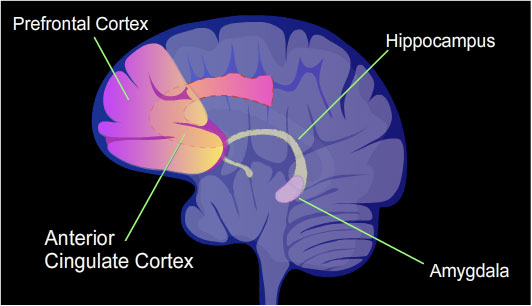
A 2025 Communications Biology paper gives this idea a neural shape. Researchers analyzed fMRI data from 577 adults aged 18 to 88 watching an eight-minute movie. They found that neural states became significantly longer with age, especially in visual and ventromedial prefrontal regions, implying fewer distinct state changes over the same period (Lugtmeijer et al., Communications Biology). The authors are careful: coarse event segmentation remains intact. But fewer distinct neural events could help explain why time feels compressed.
Attention decides what becomes a landmark
Attention is the gatekeeper between experience and memory. When something is new, uncertain, beautiful, threatening, funny, or confusing, attention rises. The brain spends more resources on it. When something is already mapped, attention can run on autopilot. That is efficient, but it makes time slippery. Efficiency is wonderful for getting through the day and terrible for remembering the day as a day.
This is where curiosity matters. A question makes the familiar slightly unfamiliar again. "Why is this street hotter than the park?" "Why do songs get stuck in my head?" "Why did that smell bring back a childhood room?" The moment you notice a gap, attention returns. Loewenstein's information-gap idea, summarized in the MillionWhys vault, is useful here: curiosity is strongest when you half-know enough to feel the missing piece. A good question turns routine into a boundary.
The hippocampus matters because it helps organize episodes, contexts, and memory. Event-boundary research links shifts in a story or environment to stronger memory organization. The practical version is simple: if you want a period to feel less vanished later, give your brain things worth separating. New routes, conversations, questions, and skills create edges.

Dopamine and timing make the stopwatch less mechanical
Neuroscience does not support one tiny "time gland." Timing involves networks. Reviews of cognitive aging and time perception point to attention, memory, processing speed, and timing circuits rather than a single clock that simply wears out (Turgeon, Lustig, and Meck, Frontiers in Aging Neuroscience). Dopamine is part of that story because it affects reward, movement, learning, and timing judgments.
A Simons Foundation report on a Science study describes how dopamine neurons in the substantia nigra pars compacta altered timing judgments in mice. Stimulating or inhibiting those cells made the animals behave as if time were moving faster or slower; higher dopamine activity made them more likely to judge an interval as short (Simons Foundation). That does not mean "dopamine explains aging time" in one sentence. It means felt time is chemically and neurologically adjustable, not a perfect recording of seconds.
The phrase "time flies when you are having fun" is therefore not only a greeting-card line. During an engaging event, attention and reward can change the live feeling of duration. Later, if the event created many memories, the same period may feel large in retrospect. This is the lovely contradiction: experience-time and remembered-time can point in different directions.

What actually slows it down
You cannot make the calendar longer. You can make a stretch of life more densely encoded. The strongest tools are not dramatic. Add novelty small enough to repeat: walk a different route, learn one odd mechanism, call someone you have not spoken to in months, cook a food you cannot pronounce, read outside your usual shelf, ask one real why and follow it to closure.
Presence helps too, but only if it means attention, not self-help fog. Noticing the color of the sky for three seconds is not magic. It is a micro-interruption in autopilot. Learning does the same thing. A new skill slows time because it produces errors, corrections, surprise, and landmarks. Your brain has to pay attention again.
This is why the "10-second nano-learning" idea in the MillionWhys vault fits the problem. A small question can make a day less blank. The point is not to turn life into homework. It is to let curiosity puncture routine, close one information gap, and leave a trace strong enough that the day does not slide away unmarked.

What people usually miss
The common mistake is treating the speeding-up feeling as either pure math or pure memory loss. It is neither. Proportion matters. Memory landmarks matter. Attention matters. Neural timing and event segmentation matter. Routine matters. The feeling comes from the stack.
The second missed point is that the cure is not constant stimulation. Endless feeds create many tiny shocks but not always real closure. Curiosity works differently. It starts with a gap you can feel, then gives you a satisfying answer, then leaves you able to notice the next gap. That is the difference between time being filled and time being compounded.
FAQ
Why does time speed up as you get older?
It feels that way because each year is a smaller fraction of your life, routines create fewer memory landmarks, and aging changes attention, memory, timing, and event segmentation. The clock is steady; the brain's record is not.
Is time really faster for adults than for children?
No. Physical time does not speed up. Subjective time changes because children encounter more firsts and adults often rely on familiar routines, which can compress memory after the fact.
Can novelty make life feel longer?
Yes, especially in retrospect. Novel experiences tend to create more distinctive memories and event boundaries. Novelty does not have to be huge; even a new route, question, skill, or conversation can add texture.
Does dopamine control time perception?
Dopamine is one important piece, especially in timing and reward-related circuits, but it is not the whole explanation. Felt time also depends on attention, emotion, memory, and context.
Why do boring moments feel slow but boring years feel fast?
In the moment, boredom can make you monitor time closely, so minutes drag. Later, that same uneventful period may leave few memories, so it compresses when you look back.
What does this have to do with AIgneous Million Whys?
Million Whys is built around tiny curiosity closures: one question, one answer, one little landmark. It is not about studying harder. It is about giving ordinary days more edges, so knowledge and time both feel less wasted.
Sources
Zauberman, Kim, Malkoc, and Bettman: Subjective Time Perception and Intertemporal Preferences
Frontiers in Aging Neuroscience: Cognitive Aging and Time Perception
Simons Foundation: Dopamine Cells Influence Our Perception of Time
University of Michigan Psychology: Time Flies By Faster As We Get Older
Curious? Try one 👇
Why is the sky blue?
Jump into the daily quiz →Keep Exploring
Related Posts
Why Does Deja Vu Happen? A Brain Familiarity Glitch
Why does deja vu happen? Memory science explains familiarity glitches, temporal-lobe signals, spatial resemblance, epilepsy warnings, and real closure.
Why Are Fun Facts Interesting? Memory Science
Why are fun facts interesting? Cognitive science says surprise creates a curiosity gap, primes memory, and turns answers into satisfying closure that sticks.
Neuroscience of Curiosity: Why Wonder Sticks
The neuroscience of curiosity explains why small daily wonders prime reward, memory, and better questions without turning learning into homework or hype.