

Why Can't You Tickle Yourself? Brain Prediction
On this page· 16
Why can't you tickle yourself? Try it before reading another line. Drag a finger over your ribs or the sole of your foot. You may feel pressure, maybe a faint itch, but not the helpless surprise of someone else doing the same thing. The odd part is not that your skin changed. The same nerves are still there. The trick is that your brain already knows the touch is coming, and it quiets the signal before it can turn into a real tickle.
TL;DR
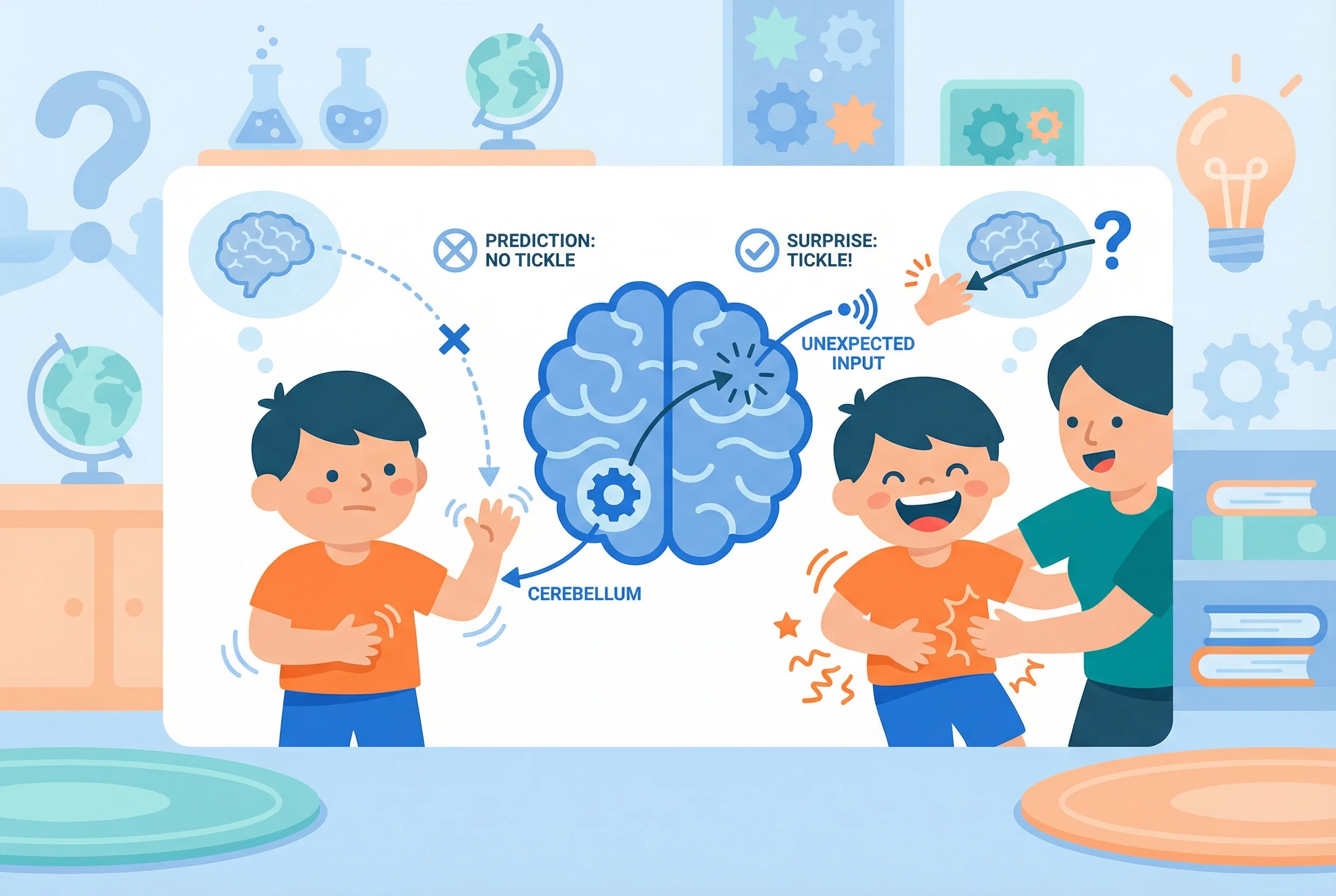
You usually cannot tickle yourself because your motor system sends a prediction of your own movement before the touch arrives. The cerebellum helps compare that prediction with the incoming sensation, and when the match is too good, touch areas respond less. Break the timing or spatial match, as robot experiments did, and self-made touch starts to feel more tickly again.
Short answer: self-tickling fails because the brain treats your own action as expected information. Blakemore, Wolpert, and Frith describe this as an internal forward model: a copy of the motor command predicts the sensory result, and that prediction attenuates the feeling (Neuroreport review). That small cancellation system is one reason you can ignore your own footsteps, sip from a moving cup, and notice the touch that came from the outside world.
Curious? Try one 👇
Why is the sky blue?
Jump into the daily quiz →Try It Right Now
The quick home experiment is useful because it shows what the answer cannot be. It is not simply that ticklish spots stop working when your own hand arrives. If someone else touches the same spot with the same pressure, the reaction comes back. It is also not only about knowing what will happen in a vague, conscious way. The timing and path of the touch matter down to fractions of a second.
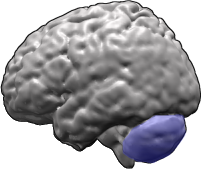
BrainFacts explains the beginner version well: the cerebellum predicts when and where your own pressure is about to land, then reduces activity in touch-processing areas such as the somatosensory cortex (BrainFacts). That is why the result feels oddly flat. Your skin reports contact, but your brain labels it as self-caused before it becomes urgent.
The Cerebellum's Prediction Trick
The key phrase is "forward model." When you decide to move, the motor command does not only travel to the muscles. A copy of that command also gives the brain a preview of what the movement should feel like. If the expected touch and the real touch match, the signal can be softened. If they do not match, the mismatch becomes interesting.
In a 1998 fMRI study, self-produced tactile stimulation was perceived as less ticklish than externally produced stimulation. The externally produced touch produced more activity in somatosensory cortex, while cerebellar activity patterns supported the idea that the cerebellum helps predict the sensory consequences of movement (Blakemore et al., Nature Neuroscience). The clean payoff: the brain is not just receiving touch. It is asking whether the touch was already predicted.
This is not a special "tickle switch." It is part of a broader self-monitoring system. The same prediction machinery helps you distinguish a sound you made from a sound in the room, a movement you intended from one that surprised you, and your own hand brushing your sleeve from a bug landing there.

Two Kinds of Tickle: Knismesis and Gargalesis
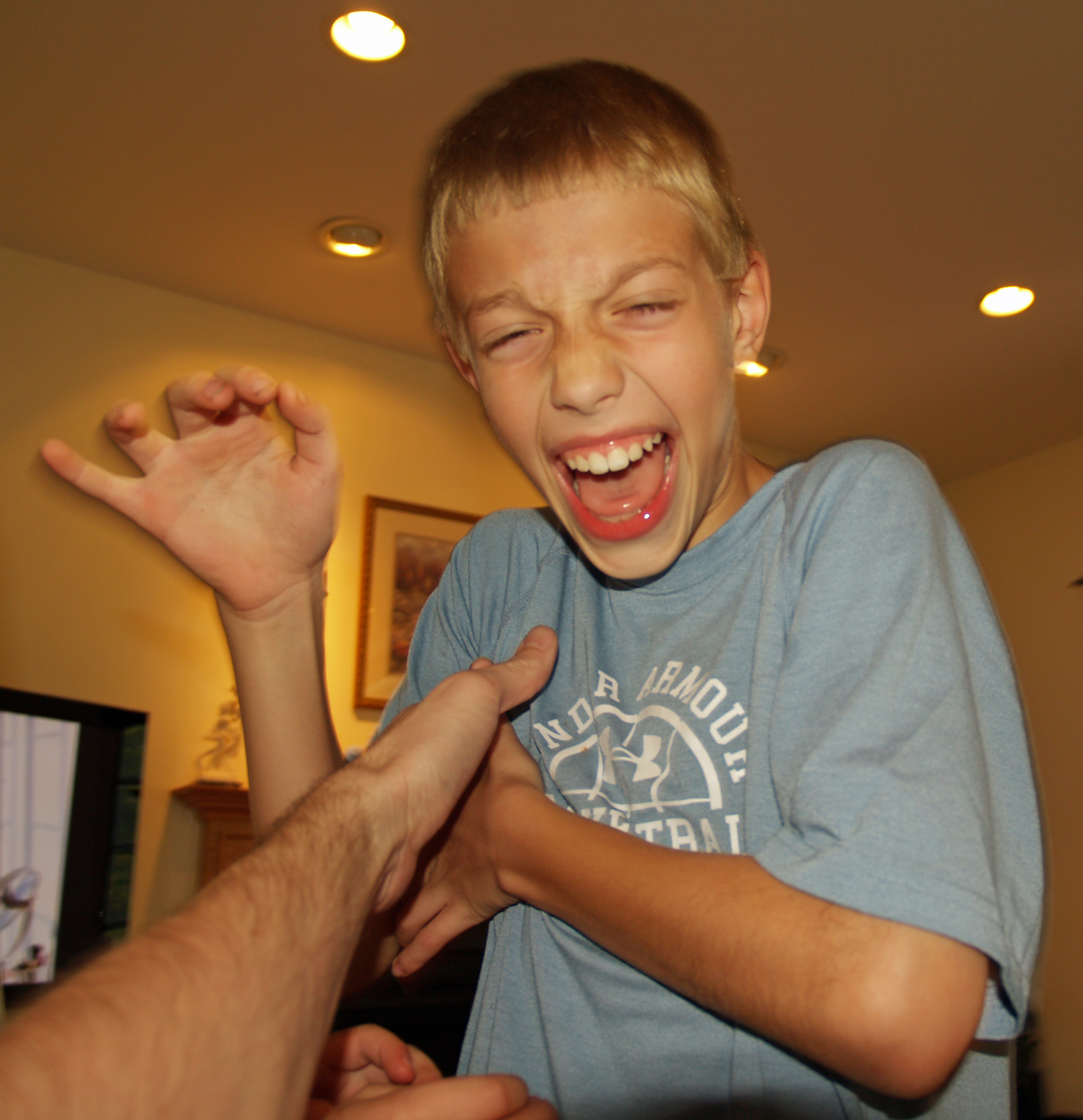
Tickle is really two related sensations wearing one everyday word. Knismesis is the light, crawling, feather-like kind that often feels more itchy than funny. Gargalesis is the harder, laughter-producing kind that shows up around ribs, armpits, neck, and feet. A 2022 review in Current Opinion in Behavioral Sciences describes knismesis as light moving touch and gargalesis as more intense tickle that can produce involuntary laughter (Varlamov and Skorokhodov, 2022).
The distinction matters because you can sometimes make a faint knismesis-like sensation on yourself, especially by brushing hair-bearing skin lightly. But the social, laughter-forcing version is much harder to self-produce. It seems to require a combination of touch, uncertainty, emotional context, and "not me" agency. That is why the question is so good: it looks like a skin question, then turns into a self-versus-other question.

The Robot Experiment That Fooled Brains
The best clue came from a wonderfully strange setup: people moved one robot with one hand, and a second robot delivered the touch to the other hand. When the movement and touch lined up perfectly, the stimulus felt less tickly. When researchers inserted a delay or rotated the relationship between movement and touch, the tickle rating rose. In the 1999 Journal of Cognitive Neuroscience paper, tickliness increased significantly as the delay rose from 0 to 200 milliseconds, and also increased with spatial perturbation (Blakemore, Frith, and Wolpert, 1999).
That result is the satisfying closure. It was not simply "you cannot surprise yourself." The brain cancels self-touch only when the predicted and actual touch line up in time and space. Make the signal late or displaced, and it starts to feel as if it came from someone else.

Why Some Symptoms Can Break the Rule
The same self-monitoring logic shows up in clinical research, but it has to be stated carefully. It is not that every person with schizophrenia can tickle themselves, and it is not a party trick diagnosis. The more precise finding is that some patients with auditory hallucinations or passivity experiences do not show the usual reduction for self-produced tactile stimuli.
A Psychological Medicine study reported that control participants and psychiatric patients without those symptoms rated self-produced touch as less intense, tickly, and pleasant than identical externally produced touch. Patients with auditory hallucinations and/or passivity experiences did not show the same difference, supporting a breakdown in self-monitoring rather than a simple diagnosis-wide claim (Blakemore et al., 2000). In plain English: when the "I caused this" tag is less reliable, self-made sensation can feel more external.
Why We Laugh at All
Ticklish laughter is still less settled than the self-tickle mechanism. Robert Provine framed tickle as an ancient laughter stimulus tied to social communication, especially between infants and caregivers and among people in playful relationships (Provine, 2004). A newer Science Advances review makes the uncertainty explicit: gargalesis remains a puzzle with motor, social, emotional, developmental, and evolutionary pieces (Kilteni, 2025).
That uncertainty is part of the charm. We know a lot about why self-touch is muted. We know less about why the right outside touch becomes laughter, squirming, pleasure, threat, bonding, and "please stop" all at once. The closure is real, but it opens a better next question.
What People Usually Miss
The missed point is that the anti-tickle system is not there to ruin the fun. It is there so the world can stay readable. If your brain reacted strongly to every self-made sensation, walking would feel like a constant attack from your own clothes, chewing would be distracting, and picking up a glass would flood the senses with information you already predicted.
So the boring self-tickle is actually a useful filter. Your brain discounts the touch it caused so it can notice the touch it did not cause. That is the same quiet prediction system that lets you guide a fork to your mouth, adjust a cup before it spills, and feel the difference between your own sleeve and something crawling on your arm.
Related videos
FAQ
Why can't you tickle yourself even when you try to surprise yourself?
Because the prediction is not just a conscious guess. A copy of your motor command lets the brain anticipate the timing, place, and rough force of your own touch before the sensation arrives.
Can anyone tickle themselves?
Most people cannot produce strong gargalesis on themselves, though light knismesis can happen. Research also suggests that some people with disrupted self-monitoring, including some patients with specific psychotic symptoms or people with high schizotypal traits, may experience self-produced touch as more tickly.
What part of the brain stops self-tickling?
The cerebellum is strongly implicated because it helps predict the sensory consequences of movement. Somatosensory cortex and anterior cingulate cortex also respond differently to self-produced versus externally produced touch.
Why does a delay make self-tickling feel stronger?
A delay makes the real touch mismatch the predicted touch. In robot studies, adding a short delay or spatial mismatch weakened the brain's cancellation and made the stimulus feel more tickly.
What does this have to do with AIgneous Million Whys?
This is a perfect Million Whys question: you can test it in 10 seconds, you half-know the answer, and the closure teaches a mechanism that reaches beyond tickling. One small itch becomes a clearer model of how the brain predicts the world.
Sources
Blakemore, Wolpert, and Frith: Why can't you tickle yourself?
Blakemore, Wolpert, and Frith: Central cancellation of self-produced tickle sensation
BrainFacts: Why Can't You Tickle Yourself?
Varlamov and Skorokhodov: Knismesis, the aversive facet of tickle
Provine: Laughing, Tickling, and the Evolution of Speech and Self
Kilteni: The extraordinary enigma of ordinary tickle behavior
Curious? Try one 👇
Why is the sky blue?
Jump into the daily quiz →Keep Exploring
Why can't you tickle yourself even though others can tickle you?
Human Biology
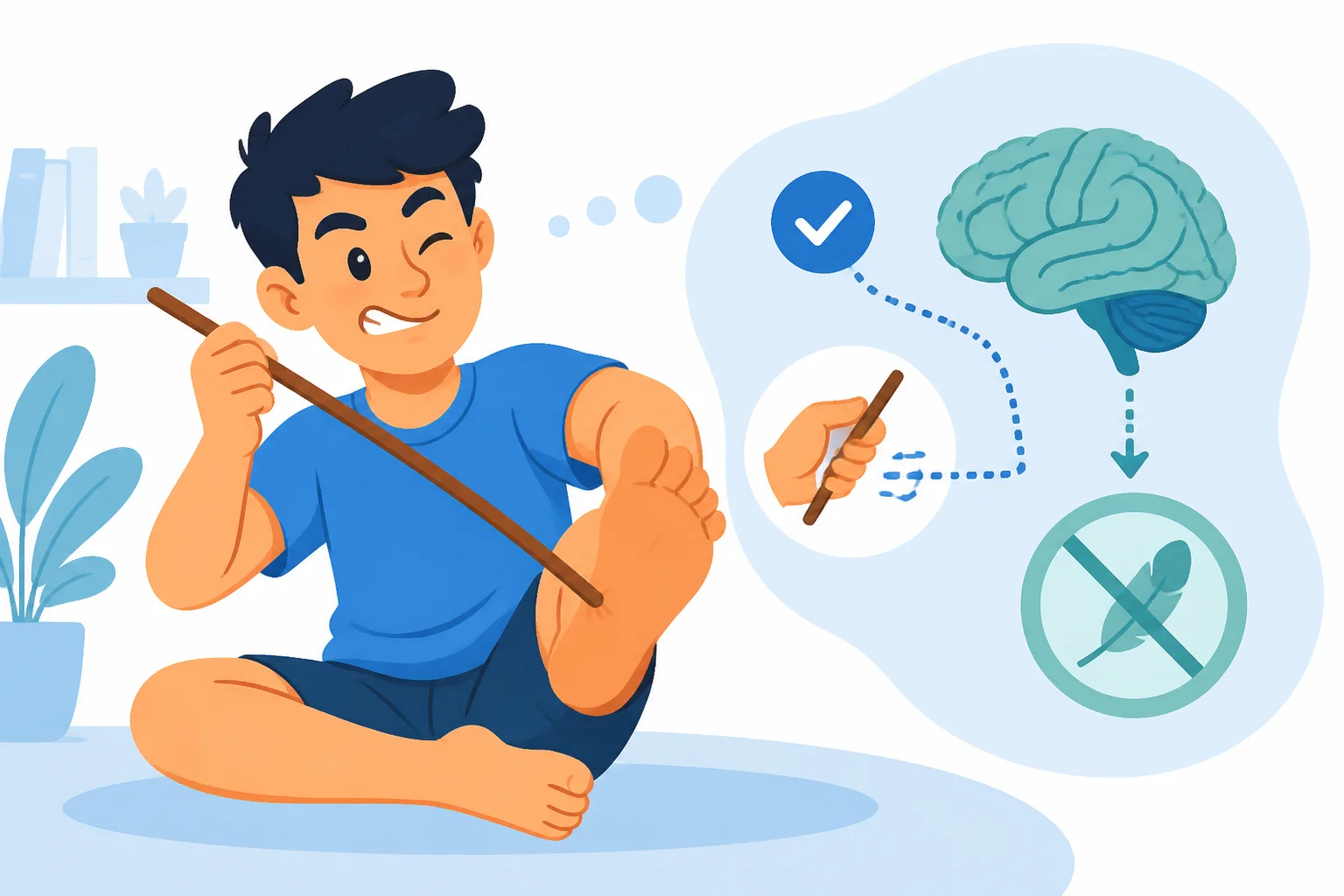
Why does trying to tickle yourself with a feather or a stick still fail to produce a ticklish sensation?
Human Biology
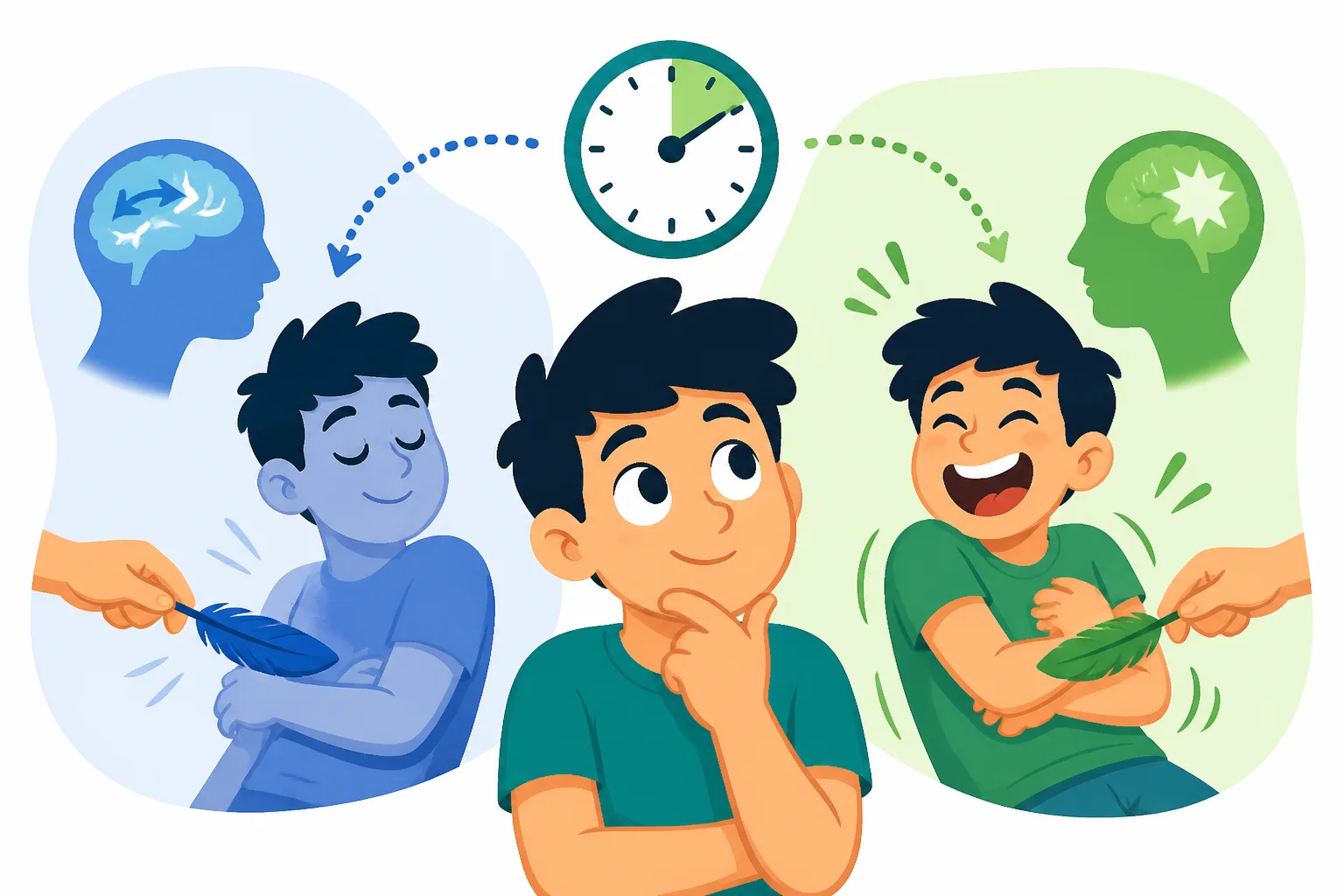
Why does delaying the touch by about 200 milliseconds make self-tickling feel ticklish again?
Psychology & Behavior
Related Posts
Why Does Deja Vu Happen? A Brain Familiarity Glitch
Why does deja vu happen? Memory science explains familiarity glitches, temporal-lobe signals, spatial resemblance, epilepsy warnings, and real closure.
Why Is Yawning Contagious?
Why is yawning contagious? Research points to automatic motor imitation, but empathy, brain cooling, and animal evidence make the full answer less tidy.
Why Does Music Give You Chills? Frisson Explained
Why does music give you chills? Frisson explained through dopamine, prediction, goose bumps, musical surprise, and why some songs create real closure.