

Why Do People Say Bless You When You Sneeze?
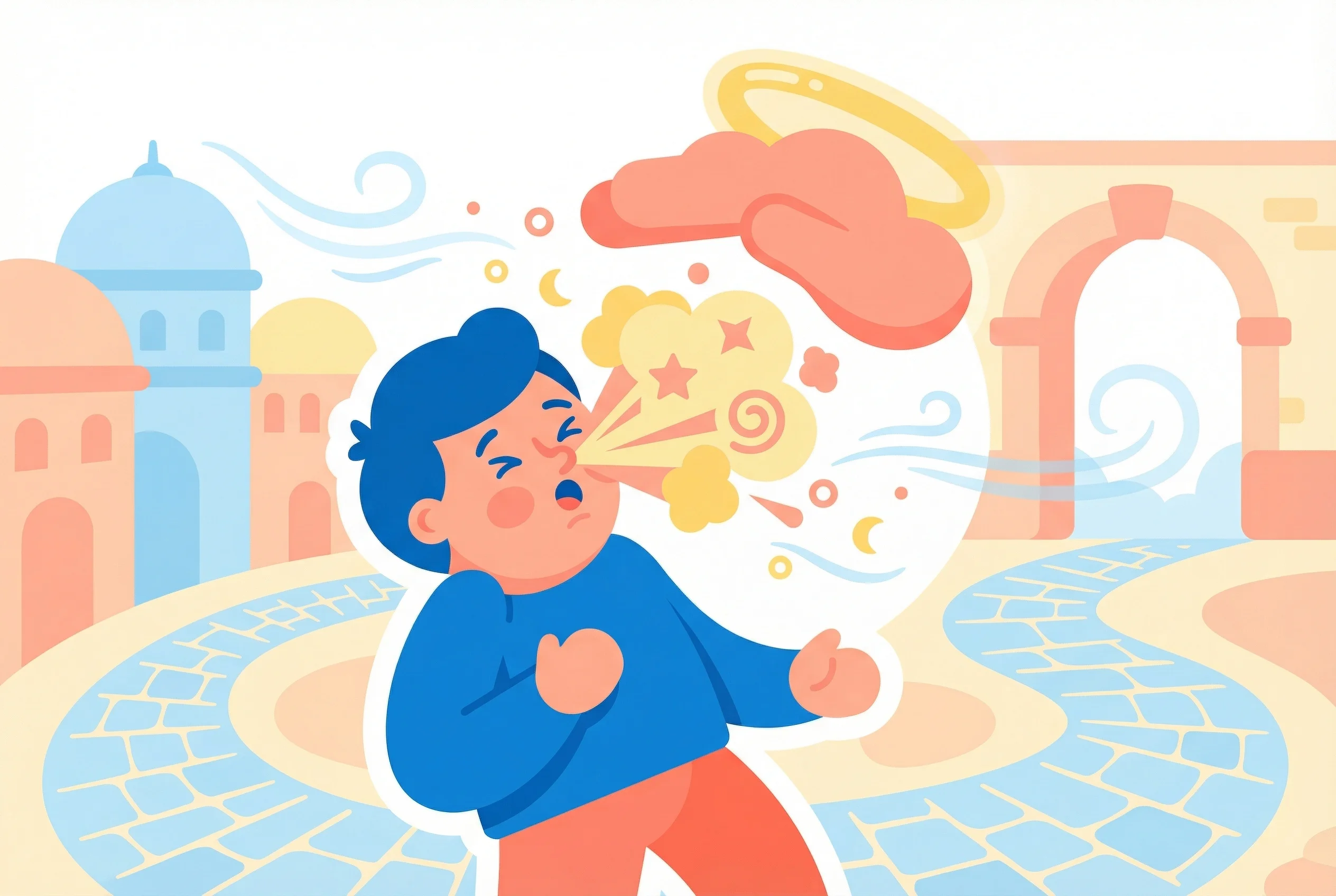
You can say "bless you" after a sneeze without believing any of the old reasons for it. That is the funny part. The phrase began as a tiny response to a dramatic body event: a sudden noise, a moment of vulnerability, and historically, a lot of superstition. The best answer is not that your heart stops, or that one pope invented the whole custom. It is that sneezing has long felt like a visible break in the body, and humans keep turning that break into a small social repair.
TL;DR
People say "bless you" after a sneeze because old ideas about health, danger, spirits, and plague got folded into everyday politeness. The heart-stopping explanation is false, and the Pope Gregory plague story is best treated as a later tradition rather than proven origin. The custom is older than that: Pliny the Elder was already talking about sneeze salutations in ancient Rome.
Short answer: "Bless you" is a surviving politeness formula. Its religious wording probably grew from older beliefs that a sneeze was medically or spiritually risky, while modern use mostly means "I noticed you; are you okay?" The satisfying bit is that the phrase no longer needs its old theories to keep working.

Curious? Try one 👇
Why is the sky blue?
Jump into the daily quiz →No, your heart does not stop when you sneeze
The most common playground explanation is also the easiest one to cut. Your heart does not stop when you sneeze. A sneeze changes pressure inside the chest, and that pressure can briefly affect blood flow and rhythm, but the heart's electrical activity continues. UAMS Health explains that the intrathoracic pressure of a sneeze can momentarily alter the heartbeat, yet the electrical activity of the heart does not stop (UAMS Health).
That matters because the heart-stop myth makes the custom sound like a little resurrection ceremony: sneeze, die for a split second, get welcomed back by "bless you." It is a neat story, but it is not physiology. The real sneeze is still dramatic enough. It is involuntary, loud, visible, and slightly embarrassing. Everyone nearby hears the body interrupt the room.

That interruption is probably part of why the phrase sticks. A cough can be ignored. A sneeze demands a response because it announces itself like a tiny alarm. The body creates a gap in the conversation, and the phrase closes it. That is very MillionWhys-shaped: the curiosity is not "what magic does the phrase do?" but "why did this one body reflex become a social ritual?"
The Pope Gregory story is famous, but not settled history
The medieval story says Pope Gregory I encouraged people to say a blessing after sneezes during a plague outbreak in Rome around 590. It is a good story because it turns the custom into emergency medicine: sneeze as symptom, blessing as prayer. But the careful version is: this is a widely repeated tradition, not a secure origin point. MIT's International Students Office lists the plague story among several possible origins and explicitly notes that no one is exactly sure which explanation is right (MIT ISO). History Facts gives the same caution: the Gregory story is often attributed to the phrase, but sneeze acknowledgment predates him (History Facts).

This is where the article earns its answer. If you say, "It came from Pope Gregory during the plague," you have a memorable story, but you have also flattened the evidence. Better: plague anxiety probably helped Christian Europe preserve or reinterpret a much older habit. A blessing made sense in a world where illness could arrive suddenly and medicine had little control over it. The sneeze became a sign that something unseen might be happening.
That does not mean people were foolish. They were doing what humans still do when a body signal is ambiguous: they made a small ritual around it. A ritual is useful even when the explanation changes. It turns uncertainty into a script.
Ancient Rome already had sneeze salutations
The custom is older than the plague story. Pliny the Elder's Natural History discusses saluting someone who sneezes in ancient Rome; a later English-language discussion of the passage notes that Pliny does not preserve the exact Roman wording, but he does show that the practice existed before the medieval Gregory tradition (Grammarphobia on Pliny's sneeze passage). In other words, the interesting fact is not that one culture invented a sneeze response. It is that many cultures noticed the sneeze as a moment worth marking.

Why would ancient people care? Sneezes sat at the crossroads of health and omen. A sneeze could mean irritation, illness, luck, divine attention, or simply a body doing something strange. Before germ theory, the line between medicine and meaning was blurrier. If something burst out of the body with no warning, people were going to explain it with the conceptual tools they had.
This is the part people usually miss: "bless you" is not one origin story. It is a fossil pile. Health wishes, spiritual protection, plague fear, Roman salutation, politeness, and habit all stacked on top of one another. The phrase survived because it could carry all of them lightly.
Other languages show the core meaning: health, mercy, or nothing
English kept "bless you," but many languages answer a sneeze with health rather than blessing. German Gesundheit means health. Spanish salud also means health. Babbel's guide to sneeze responses lists a range of health-wish formulas across languages, which shows that the human instinct is often less "religious spell" and more "small wish that your body is okay" (Babbel).
There are also cultures where a sneeze does not require a set response. The multilingual survey at Response to sneezing notes that in some languages, including Vietnamese, Japanese, or Korean, nothing is generally said unless someone is expressing concern. Use that source as a map, not as sacred law; customs vary by family, region, and setting. But the contrast is useful. It proves that the English-speaking reflex is not biologically inevitable. It is etiquette.

That etiquette does something tiny but real. A sneeze briefly exposes the person who sneezed: their body made noise, sprayed droplets, and interrupted whatever was happening. "Bless you" repairs the moment without making it a big deal. The sneezer says "thanks," and the room moves on. It is social closure in two words.
What people usually miss
The missed point is that the false explanations are not the same as the custom being silly. The heart does not stop. The Gregory story is not a clean, proven origin. Evil-spirit explanations tell us more about old worldviews than about sneezing. And still, the phrase remains useful because it answers a real social event.
It is also a small example of how knowledge compounds. At first you know the phrase. Then you learn the heart myth is false. Then you discover Pliny. Then the plague story turns from "the answer" into one layer in a longer history. That is the good kind of closure: not a dead end, but a better-shaped question.
The next time someone sneezes, the phrase can be less automatic for half a second. Not because you need to lecture them. Please do not. But because two ordinary words suddenly contain medicine, manners, medieval legend, ancient Rome, and the weird tenderness of humans making scripts for awkward little moments.
Related videos
FAQ
Why do people say bless you when you sneeze?
People say it because older beliefs about health, spirits, and plague became an everyday politeness formula. Today it usually means "I noticed; hope you're okay," not a literal medical claim.
Does your heart stop when you sneeze?
No. A sneeze can briefly change chest pressure and heartbeat timing, but the heart's electrical activity does not stop.
Did Pope Gregory invent saying bless you?
Probably not by himself. The Pope Gregory plague story is a famous tradition, but sneeze salutations appear to be older, including in ancient Roman material connected with Pliny the Elder.
What does gesundheit mean?
Gesundheit is German for health. In English-speaking countries it became a secular alternative to "bless you," with the same basic gesture of wishing someone well.
Do all cultures say something after a sneeze?
No. Some cultures have a health wish, some have a religious formula, and some do not normally require a set phrase. That is why the English reflex is better understood as etiquette than as a universal human rule.
What does this have to do with AIgneous Million Whys?
AIgneous Million Whys is built for exactly this kind of tiny question: something you do without thinking, followed by a real answer that gives closure and opens the next layer of curiosity.
Keep reading
Sources
UAMS Health: Does Your Heart Stop for an Instant When You Sneeze?
MIT International Students Office: Why Americans Say "Bless You"
History Facts: Why Do We Say "Bless You" When Someone Sneezes?
Grammarphobia: Pliny and Ancient Sneeze Salutations
Curious? Try one 👇
Why is the sky blue?
Jump into the daily quiz →Keep Exploring

Related Posts
Why Do We Get Goosebumps? The Fur Reflex Left Behind
Why do we get goosebumps? Tiny arrector pili muscles, old fur logic, emotional chills, and a useful closure loop explain the bumps on your skin.
Did You Know Facts That Sound Fake but Are True
Did you know facts that sound fake but are true — from why you forget at doorways to why cheese has holes. Guess each one, then see why it's real.
Fun Facts About Human Body: Everyday Biology
Fun facts about human body biology: why blinking, heart rate, gut rumbles, body clocks, and sneezing work as tiny automatic survival systems inside you.