

Why Does Music Give You Chills? Frisson Explained
On this page· 17
You know the moment: a voice enters after a long build, the harmony turns a corner, or the bass drops and your skin answers before you do. Why does music give you chills if nothing cold is happening? The short version is that your brain is predicting sound, waiting for closure, and rewarding the instant when a pattern lands better than expected. Frisson is not just "I like this song." It is a small bodily receipt for a solved emotional suspense.
TL;DR
Music chills, or frisson, happen when sound, expectation, emotion, and the body's arousal system line up. Studies from Robert Zatorre and Valorie Salimpoor's group found dopamine involvement during both anticipation and peak pleasure, while other work links chills to musical surprise, openness to experience, and stronger connections between auditory and reward circuits. The useful idea is simple: music gives you a tiny information gap, holds it open, then closes it.
Short answer: music gives you chills because your brain treats a powerful musical moment like a meaningful prediction being fulfilled. Dopamine-related reward circuits are active before and during the peak, the auditory system tracks the pattern, and the sympathetic nervous system can turn the emotional peak into goose bumps, tingling, or a shiver.
Curious? Try one 👇
Why is the sky blue?
Jump into the daily quiz →The Feeling Everyone Recognizes
Researchers usually call the sensation frisson, aesthetic chills, or music-induced chills. It can feel like a wave up the spine, goose bumps on the arms, a tight throat, or a sudden shiver. The body part matters because the feeling is not purely metaphorical. Grewe and colleagues defined musical chills as goose pimples and shivers down the spine, then measured both self-reports and physiological responses while people listened to music (Grewe et al., 2007).
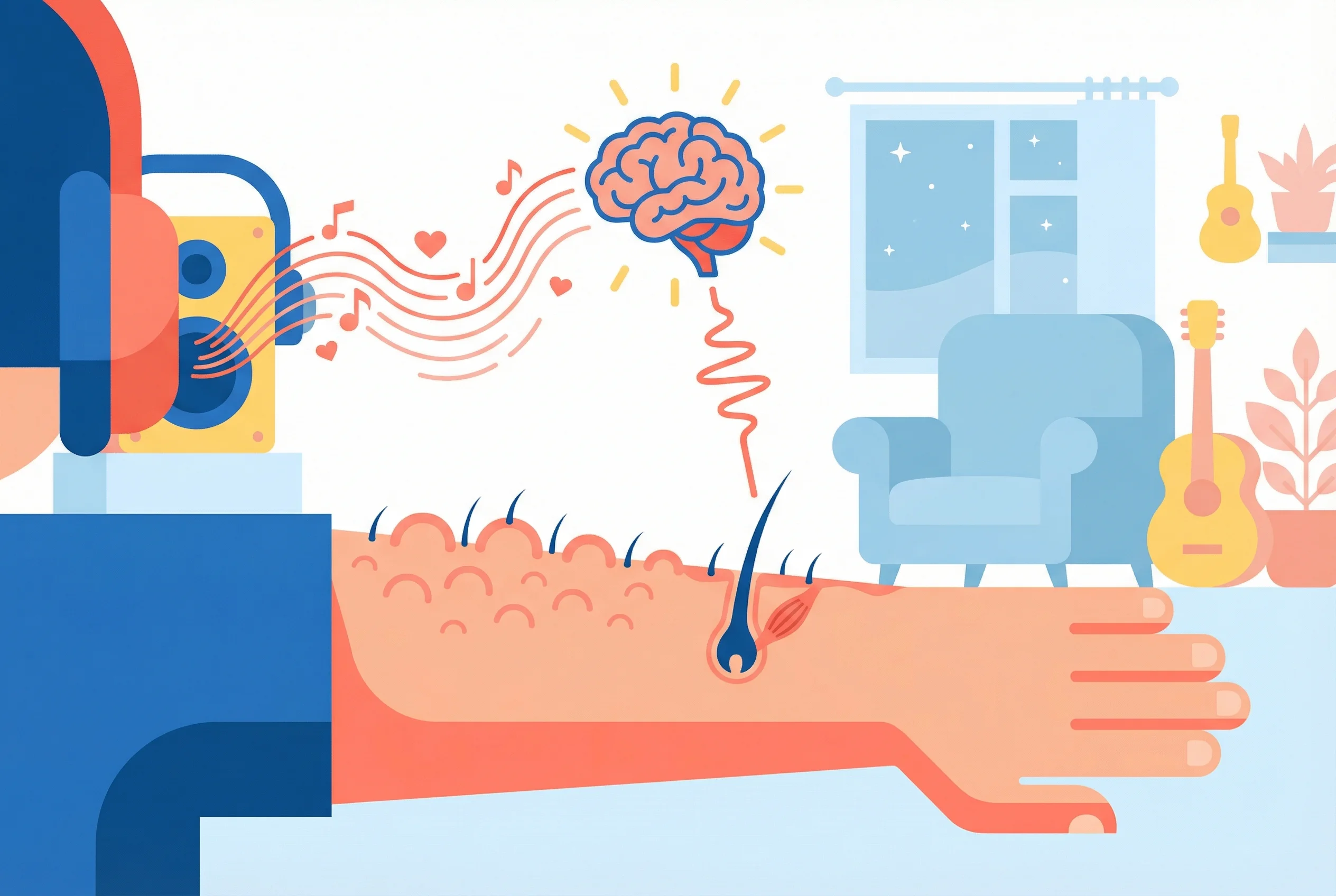
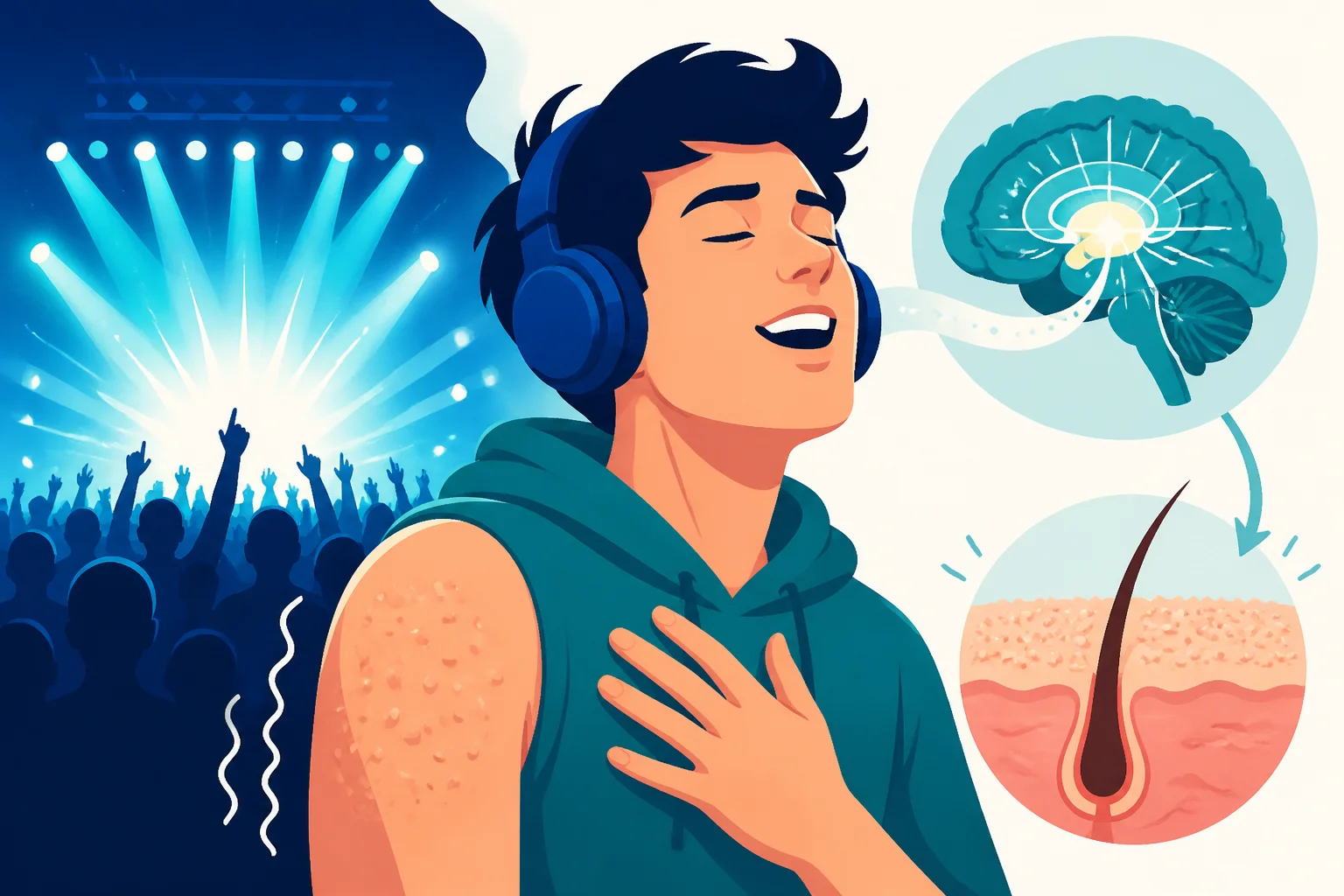
The important correction is that chills are not the same as cold shivering. They are closer to a burst of emotional arousal that borrows the body's skin-and-hair machinery. A song can create a tiny storm in the nervous system: heart rate changes, skin conductance shifts, and hair follicles respond. That is why a purely abstract thing - organized sound - can leave physical evidence on your arm.

The Dopamine Surge
The cleanest neuroscience hook comes from Salimpoor, Benovoy, Larcher, Dagher, and Zatorre. In a 2011 Nature Neuroscience study, participants brought music that reliably gave them chills. The researchers combined PET and fMRI methods and found evidence for dopamine release in the striatum during intense pleasure from music (Salimpoor et al., 2011). McGill's summary of the study emphasizes the surprising part: dopamine was involved not only at the peak emotional moment, but also during anticipation before the peak (McGill Newsroom).
That split matters. The pleasure is not only in the note that finally arrives. It is also in the seconds before it arrives, when your brain is leaning forward. The caudate is associated with anticipation; the nucleus accumbens is associated with the peak reward. If you have ever felt chills just before the chorus, you already know this from the inside.

The Surprise Structure of Music That Triggers It
Music is a prediction machine. A melody sets up what might come next; harmony makes some destinations feel more likely than others; rhythm teaches your body when to expect the next hit. Chills often appear when that prediction system is played with rather than ignored. A singer enters later than expected. A chord resolves after being withheld. A quiet passage suddenly opens into a larger sound.
Grewe's work found that chill reactions were often linked to musical structures such as a new voice entering, sudden dynamic changes, or other distinct moments, but not in a simple one-feature-equals-one-chill way (Music Perception, 2007). That is exactly what you would expect if frisson depends on a listener's model of the music. The same crescendo can be boring if it is too obvious, confusing if the listener has no grip on the pattern, and electric if it lands in the half-knowing zone.
This is where music and curiosity share a mechanism. Loewenstein's information-gap idea says curiosity peaks when you can feel a gap that seems closeable. Frisson has a similar shape: the music creates a gap in expectation, keeps it alive long enough to matter, then closes it with force. The closure is the payoff.

Why Some People Never Feel Frisson
Not everyone gets chills from music, and that does not mean they are less emotional or less musical. Individual differences are real. Colver and El-Alayli's 2016 study connected frisson with openness to experience, especially the more cognitive attentiveness side of openness, not just raw emotionality (Psychology of Music). A later behavioral-genetic paper on aesthetic chills also treats susceptibility as a measurable trait with both inherited and environmental contributions (Bignardi et al., 2022).
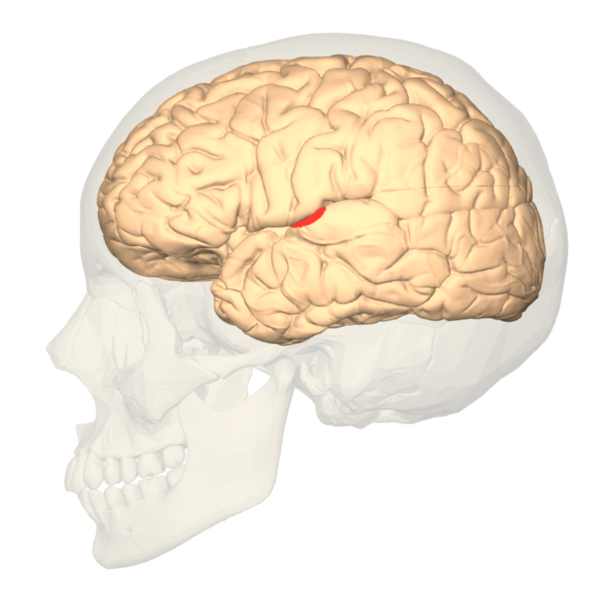
Brain wiring seems to matter too. Sachs, Ellis, Schlaug, and Loui reported that people who experience chills show stronger white-matter connectivity between auditory processing regions and emotional or reward-related regions (Social Cognitive and Affective Neuroscience). Separate research on specific musical anhedonia found that some people can perceive music normally but have reduced reward response to it, with weaker coupling between auditory cortex and ventral striatum (Martinez-Molina et al., 2016).
Aesthetic Chills Beyond Music
Music is the famous trigger, but it is not the only one. People report similar chills from poetry, speeches, film scenes, religious rituals, landscapes, mathematical beauty, and sudden moments of social meaning. That broader pattern is useful because it keeps the explanation from becoming too narrow. Frisson is not caused by "sound" alone. It is caused by a rewarding event that the mind can interpret as meaningful, surprising, and coherent.
Music is unusually good at producing that event because it controls time. It can delay, repeat, swell, pause, and resolve with millisecond precision. A painting can be beautiful all at once; a song can make you wait. That waiting is not wasted time. It is the nervous system building the gap that the peak will close.

The Evolutionary Puzzle
Why would a pattern of sound recruit reward circuits at all? There is no single settled answer. One line of thought is that music piggybacks on systems built for prediction, social bonding, vocal emotion, and movement. Another is that music creates a safe version of uncertainty: enough suspense to wake the body up, but enough structure to make the suspense closeable. Zatorre and Salimpoor's review in PNAS frames musical pleasure as an interaction between auditory pattern analysis, expectation, and reward systems (Zatorre and Salimpoor, 2013).
That may be the most honest answer: frisson is not one trick. It is a meeting point. The auditory cortex tracks pattern, memory supplies context, attention leans forward, dopamine systems mark anticipation and reward, and the skin shows the body was invited to the party.

What People Usually Miss
The easy explanation is "music releases dopamine." That is true enough to be useful, but too flat to be satisfying. The real mechanism is not a chemical squirt button. It is prediction, attention, emotion, memory, and closure. Dopamine is part of how the brain values the moment, but the song still has to build the moment.
The second missed point is that chills are not proof that a song is objectively great. They are proof that this listener, with this history and this brain, met this musical structure at the right distance. Too familiar can be dull. Too alien can be noise. The chills live in the middle, where you half-know what is coming and still get surprised.
That is why the experience feels so personal. A stranger may hear the same track and feel nothing. You may hear one note and get pulled back into a memory, a room, a face, or a version of yourself. The body answers because the brain did not process sound as decoration. It processed sound as meaning arriving on time.
Related videos
FAQ
What is frisson in music?
Frisson is the pleasurable chill, shiver, tingling, or goose-bump response some people feel during powerful music. It often appears during a peak moment, a surprise entrance, a crescendo, or a delayed resolution.
Does dopamine explain why music gives you chills?
Dopamine is part of the answer, especially in anticipation and peak pleasure, but it is not the whole answer. The music also has to create expectation, meaning, and emotional timing.
Why do only some songs give me chills?
Because frisson depends on your expectations, memories, attention, and sensitivity to a particular musical structure. A song that sits in your half-knowing zone can work better than a song that is simply loud or technically impressive.
Is it normal if music never gives me chills?
Yes. People vary a lot in musical reward sensitivity. Some enjoy music without chills, and some people with musical anhedonia perceive music normally but do not get the same reward response from it.
Can poetry, films, or ideas cause the same kind of chills?
They can. Aesthetic chills can happen when a meaningful pattern creates suspense and then closes. Music is just especially good at controlling that suspense over time.
What does this have to do with AIgneous Million Whys?
Million Whys is built around the same tiny loop: feel a gap, lean in, get real closure, then notice the next question. Music chills are the body version of curiosity compounding - a half-known pattern becoming satisfying knowledge.
Curious? Try one 👇
Why is the sky blue?
Jump into the daily quiz →Keep Exploring
Related Posts
Why Do We Get Goosebumps? The Fur Reflex Left Behind
Why do we get goosebumps? Tiny arrector pili muscles, old fur logic, emotional chills, and a useful closure loop explain the bumps on your skin.
Why Do Songs Get Stuck in Your Head?
Why do songs get stuck in your head? Earworm science explains catchy hooks, mental replay, stress, boredom, chewing gum, and practical ways to stop the loop.
Why Does Deja Vu Happen? A Brain Familiarity Glitch
Why does deja vu happen? Memory science explains familiarity glitches, temporal-lobe signals, spatial resemblance, epilepsy warnings, and real closure.