

Why Does Deja Vu Happen? A Brain Familiarity Glitch
On this page· 17
Why does deja vu happen? The honest answer is that no single theory has won, but the best evidence points to a memory system briefly disagreeing with itself. Something new feels familiar, while another part of you knows it should not. That mismatch is the uncanny spark: half-recognition without the memory that would normally explain it.
TL;DR
Deja vu is the feeling that a new moment has already happened before, paired with the awareness that this cannot be right. Research points to familiarity signals, temporal-lobe memory systems, spatial resemblance, and memory conflict. Most episodes are harmless and brief, but frequent, intense, or seizure-like deja vu can be a medical clue, especially in temporal lobe epilepsy.
Short answer: deja vu probably happens when the brain produces familiarity without a matching recollection. Reviews by Alan Brown, virtual-reality studies by Anne Cleary and colleagues, and memory research discussed by Chris Moulin all point toward the same shape: the experience is not proof of a past life or a prediction. It is a memory signal arriving without its usual context.
Curious? Try one 👇
Why is the sky blue?
Jump into the daily quiz →The Sensation Everyone Recognizes
Deja vu is strange because it contains two feelings at once. First: this is familiar. Second: I know I have not lived this exact moment before. If it were only familiarity, it would be ordinary recognition. If it were only uncertainty, it would be confusion. Deja vu is the collision.
Brown's review describes the classic pattern: the sensation that the present event has been encountered before, combined with the knowledge that it has not. The review also notes that roughly 60 percent of people report having experienced deja vu, and that reported frequency tends to decrease with age. That is why the phenomenon is perfect curiosity material: common enough that nearly everyone can enter, mysterious enough that the first explanation is usually too thin.
The experience is usually brief. It often arrives in a place that is ordinary - a hallway, a cafe, a conversation, a street corner - then disappears before you can inspect it. The shortness is part of the mystery. The brain gives you a loud familiarity tag and then refuses to hand over the file.
The Temporal Lobe Misfire Theory
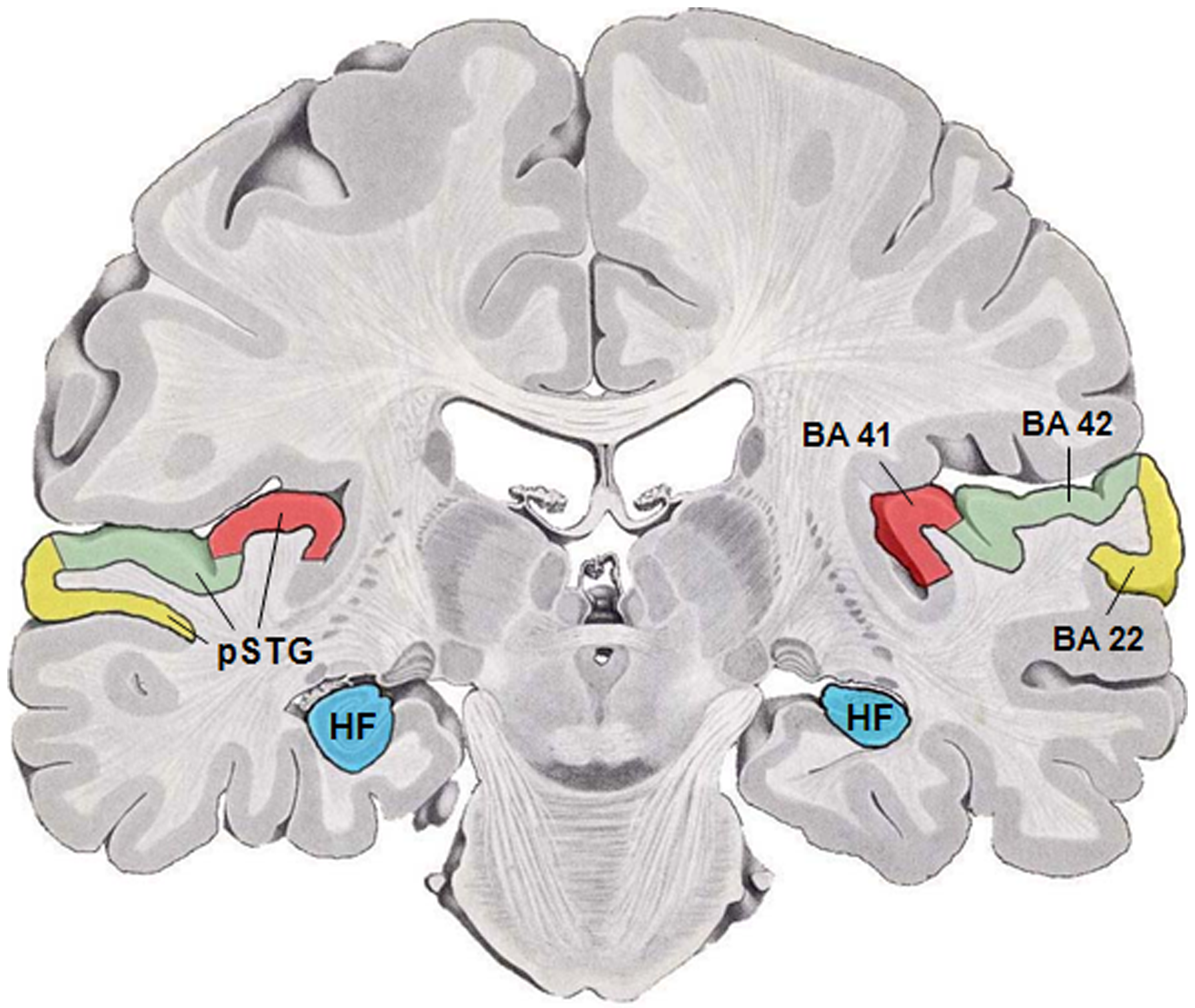
The temporal lobes help process memory, emotion, language, and recognition. That makes them a natural place to look for deja vu. In temporal lobe epilepsy, people can experience aura-like sensations before or during focal seizures, and clinical resources from the Epilepsy Foundation list deja vu among common aura experiences. A review of deja experiences in temporal lobe epilepsy notes the long historical link between seizure activity and deja vu-like states (Illman et al.).
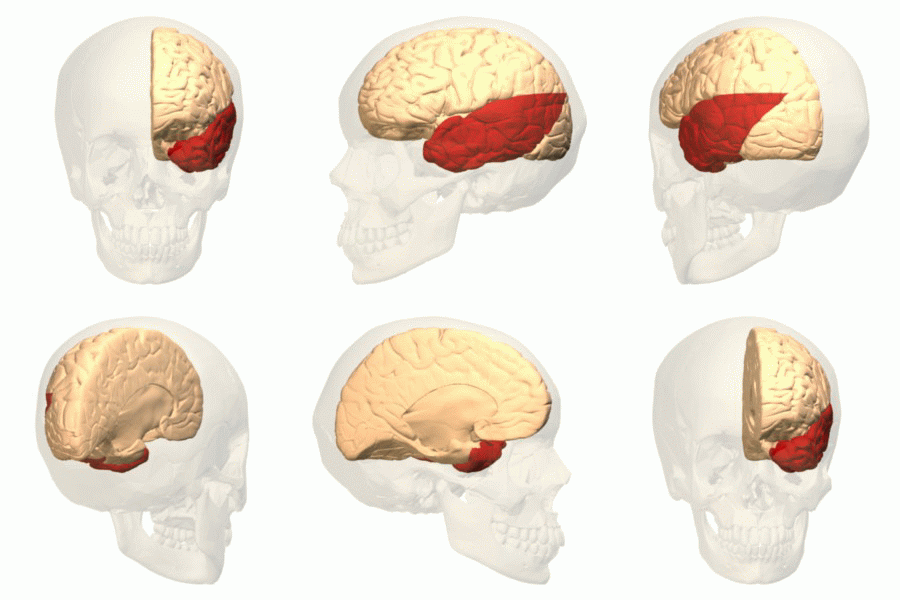
This does not mean ordinary deja vu is a seizure. That would be the wrong takeaway. The medical version matters because it shows that memory-familiarity circuitry can create the feeling when it is perturbed. Everyday deja vu may be a much lighter, non-pathological version of a similar kind of signal conflict.
A useful analogy is not "the brain lies" but "the brain timestamps badly for a second." Familiarity is normally a helpful shortcut. It lets you know that a face, room, tune, or route has been encountered before. In deja vu, that shortcut fires without the rest of the memory package that would make the feeling make sense.
The Familiarity Hypothesis
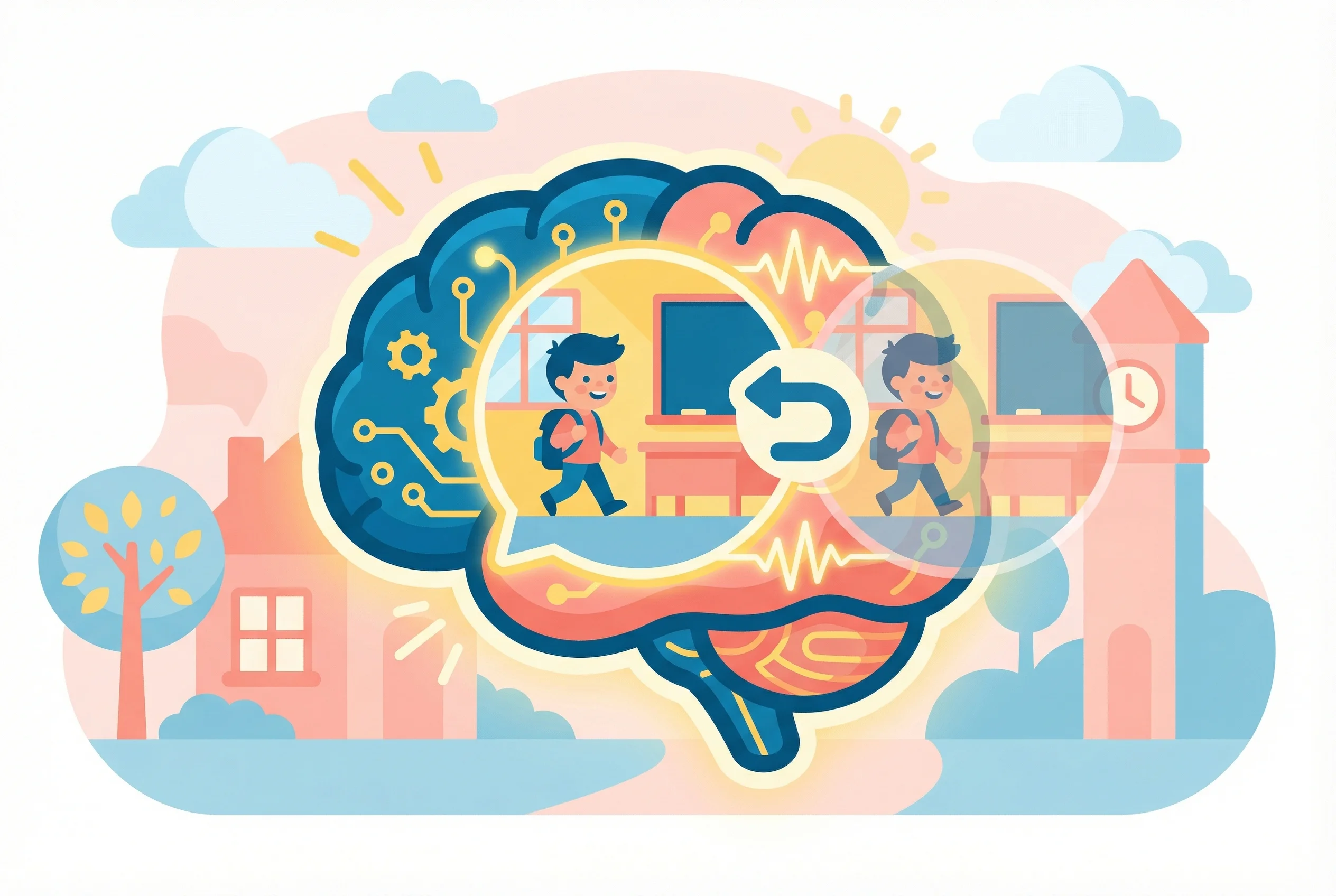
Anne Cleary's work gives the weird feeling a very practical shape. In a 2012 virtual-reality study, participants moved through 3D scenes. Some new scenes were arranged like earlier scenes, even though the objects were different. The study tested the Gestalt familiarity hypothesis: a current layout can resemble a previous layout enough to produce familiarity, while the earlier scene itself stays unrecalled.

This is a beautifully ordinary explanation for an extraordinary feeling. Maybe the cafe has the same spatial rhythm as a classroom: door on the left, window ahead, table angle just so. You do not remember the classroom, but the layout whispers "known." Your conscious mind then faces a contradiction: this is new, yet it feels old.
That theory also explains why deja vu can feel vivid without being accurate. The vividness comes from confidence in familiarity, not from a retrieved episode. The brain can be very sure about the wrong part of the experience.
Why Young Adults Get More Deja Vu
Surveys summarized by Brown find that deja vu is reported more often by younger people and less often with age. Researchers still debate why. One possibility is simple exposure: young adults encounter many new places, people, travel routes, schools, jobs, and social scenes, so there are more opportunities for partial resemblance. Another possibility is reporting: younger people may notice and remember the oddness more readily.
Chris Moulin has argued in public discussions that deja vu can be a sign of a healthy memory system checking itself. That is a useful reframing. The eerie part is not just "this feels familiar." It is the correction: "but I know it is not." A mind that can flag the mismatch is doing something sophisticated.

This fits the broader MillionWhys worldview: understanding often begins with an itch. Deja vu is not merely a spooky story. It is the mind catching itself in the act of knowing and not knowing at the same time.
When It Is a Warning Sign
Most deja vu does not need medical interpretation. A brief episode once in a while is part of ordinary human experience. The caution is about pattern, intensity, and companions. If deja vu is frequent, unusually intense, followed by confusion, paired with a rising stomach sensation, sudden fear, smell or taste changes, altered awareness, or repetitive movements, it may be worth medical attention.
The Epilepsy Foundation describes temporal lobe epilepsy auras as focal seizures with preserved consciousness and notes that feelings of deja vu can be among common auras. The Epilepsy Society similarly lists deja vu among possible focal aware seizure symptoms. The practical point is calm but important: deja vu alone is common; recurring episodes with seizure-like features deserve a clinician, not folklore.

Related Phenomena: Jamais Vu and Presque Vu
Deja vu has cousins. Jamais vu is the opposite feeling: something familiar suddenly feels unfamiliar. A word you know can look wrong. A familiar room can feel briefly foreign. Presque vu is the "almost seen" or tip-of-the-tongue state, when a name or word feels close but will not arrive.
These experiences matter because they reveal the same general architecture. Memory is not one button labeled "remember." It is a bundle of signals: familiarity, recollection, confidence, naming, context, and prediction. Usually they line up so smoothly that you never notice them. Deja vu, jamais vu, and presque vu are what it feels like when one signal arrives without the others.
What People Usually Miss
The mistake is to treat deja vu as either magic or nothing. It is neither. Calling it a past-life memory explains too much with too little evidence. Calling it "just a glitch" explains too little. The interesting middle answer is that deja vu shows how memory earns trust. You do not simply store the past and replay it. You infer whether the present belongs to something you have known before.
That inference is usually invisible. Deja vu makes it visible for a second. The payoff is not that the mystery disappears. The payoff is better: the mystery becomes specific. A new scene can feel old because familiarity is a signal, and signals can fire without the story that normally justifies them.
Related Videos
Deja vu - Dr. Anne Cleary (TEDxCSU)
What deja vu can teach us about memory - Chris Moulin (APA Speaking of Psychology)
FAQ
Why does deja vu happen in ordinary places?
Ordinary places can share layouts, moods, objects, or timing with earlier places. Your brain may detect the resemblance without retrieving the earlier scene.
Is deja vu a memory from a past life?
There is no good evidence for that. The better-supported explanation is a familiarity signal without a matching recollection.
Why does deja vu feel so real?
Because familiarity is normally a trusted memory signal. When it fires strongly, the feeling can be vivid even if no real previous episode is being retrieved.
Can deja vu be caused by epilepsy?
Sometimes. Deja vu can occur as an aura in temporal lobe epilepsy. Occasional brief deja vu is common, but frequent or intense episodes with other symptoms should be discussed with a clinician.
What is the difference between deja vu and jamais vu?
Deja vu makes something new feel familiar. Jamais vu makes something familiar feel strangely new or unreal.
What does this have to do with AIgneous Million Whys?
Deja vu is curiosity at the exact half-knowing point: you feel close to an answer but do not have closure. Million Whys is built for that moment - the itch, the explanation, and the next question that appears once the gap closes.
Curious? Try one 👇
Why is the sky blue?
Jump into the daily quiz →Keep Exploring
Related Posts
Why Are Fun Facts Interesting? Memory Science
Why are fun facts interesting? Cognitive science says surprise creates a curiosity gap, primes memory, and turns answers into satisfying closure that sticks.
Why Do Songs Get Stuck in Your Head?
Why do songs get stuck in your head? Earworm science explains catchy hooks, mental replay, stress, boredom, chewing gum, and practical ways to stop the loop.
Did You Know Facts That Sound Fake but Are True
Did you know facts that sound fake but are true — from why you forget at doorways to why cheese has holes. Guess each one, then see why it's real.