

Why Does Coffee Make You Tired? The Crash Explained
On this page· 16
Why does coffee make you tired when the whole point was to wake up? The short answer is that coffee does not add usable energy. Caffeine mostly borrows alertness by blocking the adenosine signal that says, "you have been awake for a while." The tiredness can still keep building in the background. When the caffeine level falls, the signal you muted can become noticeable all at once.
TL;DR
Coffee can make you tired because caffeine is a signal blocker, not a fuel source. It antagonizes adenosine receptors, so the brain feels less sleepy while adenosine-linked sleep pressure continues to matter underneath. The crash is stronger when you are already sleep-deprived, when the dose wears off during an afternoon low, when daily use has changed tolerance, or when a sweet coffee drink creates a separate glucose swing. The useful fix is not "more coffee forever"; it is timing, sleep, dose, and paying attention to what else is in the cup.
Short answer: coffee makes some people tired because caffeine temporarily hides sleep pressure rather than removing it. The most honest model is not a battery filling up. It is a notification being silenced. When the mute button stops working, the unread messages are still there.

Caffeine blocks the tiredness signal, not the tiredness
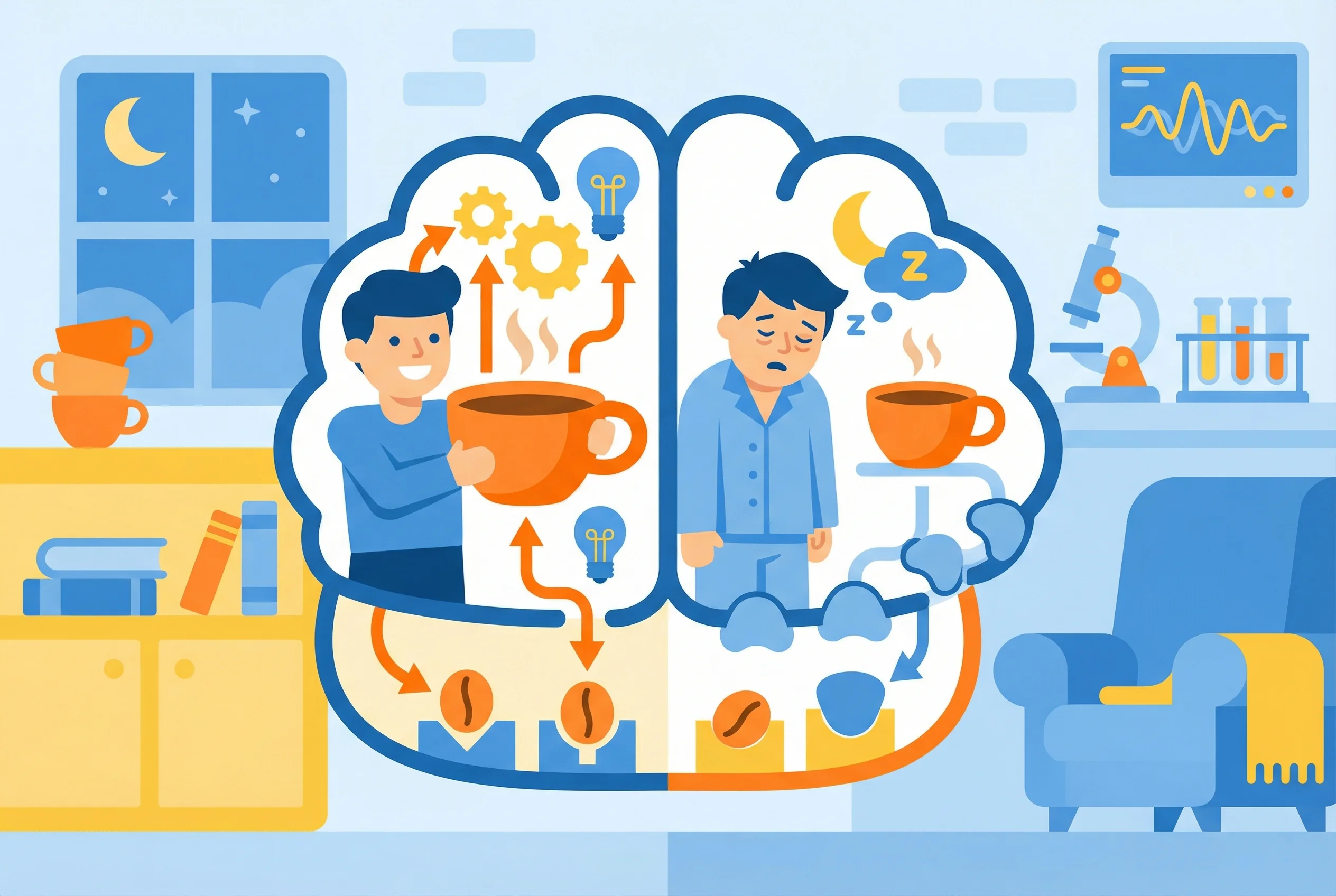
Adenosine is one of the molecules involved in sleep-wake regulation. A 2022 review in the Journal of Sleep Research describes the long research path connecting adenosine, caffeine, and sleep pressure, including caffeine's role as an antagonist at adenosine receptors (Lazarus et al., 2022). In plain English: adenosine helps make wakefulness feel costly, and caffeine can sit in the receptor seats where adenosine would normally deliver part of that message.
That is why coffee can feel almost magical at first. It does not have to create energy from nowhere. It only has to make one fatigue signal harder to hear. If you were already rested, that can feel like clean alertness. If you were running on too little sleep, it can feel like a temporary disguise. The body still has a sleep debt; caffeine just makes the debt collector less audible for a few hours.

Question 1 of 4
Why can caffeine make you feel alert without removing the brain's underlying need for sleep?
The crash is the bill coming back into view
The common "coffee crash" story is usually simplified too far, but the useful version is sound: caffeine's effect fades as the drug is metabolized and cleared, while sleep pressure and other fatigue signals have not necessarily gone away. Reviews of caffeine pharmacology describe caffeine as a non-selective antagonist at adenosine A1 and A2A receptors, which is the key reason it can reduce sleepiness for a while (Ferre, 2008/2015 review).
That does not mean adenosine "attacks" you in a cartoon swarm. It means the balance changes. While caffeine is active, a signal is being damped. Later, the same person is older by several waking hours, possibly underfed, possibly underhydrated, and often closer to the natural afternoon dip. The caffeine mask lifts at exactly the moment the body has more reasons to ask for rest.

Question 2 of 4
Why can a caffeine crash feel sudden several hours after coffee, even though caffeine made you feel alert at first?
Half-life explains why the timing feels strange
Caffeine does not vanish when the alert feeling softens. Sleep studies often model the problem by timing caffeine against bedtime. In a controlled study, 400 mg of caffeine taken at bedtime, 3 hours before bed, or 6 hours before bed all disrupted sleep compared with placebo, including reduced total sleep time and sleep efficiency (Drake et al., 2013). That matters for the "coffee made me tired" question because yesterday's caffeine can help create today's fatigue loop.
Here is the sneaky version: you drink coffee at 3 p.m., still fall asleep at night, and conclude the coffee did not matter. But "I fell asleep" is not the same as "my sleep was untouched." If caffeine trims sleep quality or total sleep, the next morning begins with more sleep pressure. Then the first coffee feels necessary, the afternoon coffee feels helpful, and the cycle quietly teaches you that coffee is the answer to a problem coffee helped preserve.
Tolerance can make the same cup feel weaker
If coffee used to work and now mostly keeps you from feeling normal, tolerance is one possible reason. Older biochemical work on caffeine tolerance reported receptor adaptation during severe continuous coffee ingestion, including upregulation of adenosine receptors as a compensatory response (PubMed abstract: Biochemical mechanism of caffeine tolerance). The details vary across tissues, species, dose, and study design, so this should not be turned into a one-size-fits-all claim. But the practical pattern is familiar: the nervous system adapts to a repeated blocker.
That is why adding more coffee can feel less like a lift and more like maintenance. The first cup removes withdrawal fog. The second cup briefly restores the old sparkle. By late afternoon, you are stacking caffeine on a system that has learned to expect caffeine. The interesting part is not moral failure. It is homeostasis: the body is very good at adjusting around repeated inputs.

Question 3 of 4
Why does the same cup of coffee stop giving you the same wake-up jolt after you drink it every day for a while?
The drink around the caffeine can be the real culprit
Not every coffee crash is purely adenosine. A plain espresso and a large sweet iced coffee are different biological events. Reviews of coffee and glucose metabolism note that acute caffeinated coffee can affect glucose and insulin responses, while longer-term coffee habits show a more complicated relationship in population studies (Santos and Lima, 2016/2019 review). Mayo Clinic likewise cautions that caffeine can affect blood sugar differently across people, especially people with diabetes (Mayo Clinic).
So if the "coffee" is really caffeine plus sugar plus not enough food, the tiredness may be a mixed signal. The caffeine can create alertness and jitteriness. The sugar can create a separate rise-and-fall pattern. Skipping breakfast can make both feel harsher. This is why two people can drink the same branded coffee and report opposite outcomes. They did not only drink caffeine; they drank a whole context.

Question 4 of 4
Why can a large sweet coffee on an empty stomach leave someone feeling different from the same caffeine in plain coffee?
What people usually miss
The most useful correction is that tiredness is not one thing. Sleep pressure, circadian timing, under-eating, stress, hydration, tolerance, and habit can all feel like "coffee made me tired." Coffee is often the most visible object in the story, so it gets blamed for every downstream feeling. Sometimes that is fair. Sometimes coffee only reveals the deeper issue: you were already tired, and the temporary cover-up made the return feel dramatic.
The curiosity payoff is small but practical. Once you see coffee as a signal tool rather than fuel, the question changes. You stop asking "how do I force this cup to work harder?" and start asking "what signal am I trying to mute?" That is the difference between chasing stimulation and getting real closure.
A clean self-test is boring but useful: compare the same dose earlier in the day, with food, after a normal night of sleep. If the "coffee makes me tired" pattern disappears, the culprit was probably timing or context. If it remains, the cup may be telling you less about coffee and more about your baseline fatigue.
Related videos
How does caffeine keep us awake? - TED-Ed. Verified live through YouTube oEmbed.
Your Brain On Coffee - AsapSCIENCE. Verified live through YouTube oEmbed.
FAQ
Why does coffee make you tired instead of awake?
Coffee can make you tired when caffeine stops masking sleep pressure, when you are already sleep-deprived, when tolerance has reduced the lift, or when the drink includes sugar and too little real food. The caffeine did not create tiredness from nothing; it often reveals tiredness that was already there.
Does caffeine give you real energy?
No. Caffeine can make you feel more alert by changing signaling in the brain, especially around adenosine receptors. It does not replace sleep, calories, oxygen, or recovery. That is why the "energy" can feel borrowed.
Can afternoon coffee make me tired the next day?
Yes, especially if it disrupts sleep quality or total sleep time. You may still fall asleep and still get less restorative sleep than you would have without caffeine. That can make the next morning's coffee feel more necessary.
Is a coffee crash the same as a sugar crash?
Not exactly. A caffeine crash is usually about alertness signaling and timing. A sugar crash is about a glucose rise and fall. Sweet coffee drinks can combine both, which is why they can feel sharper than plain coffee.
Should I quit coffee if it makes me sleepy?
Not automatically. Try moving caffeine earlier, reducing the dose, drinking it with food, or taking a short reset if daily tolerance seems obvious. If fatigue is persistent, severe, or paired with medical symptoms, treat it as a health question rather than a coffee puzzle.
What does this have to do with AIgneous Million Whys?
This is the kind of everyday mechanism Million Whys is built for: a familiar annoyance, a half-known explanation, and a satisfying answer that changes what you notice tomorrow. One small "why" closes, and the next one becomes easier to see.
Sources
Lazarus et al.: Adenosine, caffeine, and sleep-wake regulation
Ferre: The role of adenosine receptors in the central action of caffeine
Drake et al.: Caffeine effects on sleep taken 0, 3, or 6 hours before bed
PubMed: Biochemical mechanism of caffeine tolerance
Keep Exploring
Related Posts
Why Does Time Speed Up as You Get Older?
Why does time speed up as you get older? The answer sits in proportional time, memory density, dopamine, attention, and small doses of novelty in daily life.
Health Trivia Questions & Answers
Health trivia questions and answers about hiccups, balance, immunity, sleep, caffeine, hydration, and the everyday mechanisms working under your skin.