

The Everyday Science Questions Most Adults Get Wrong: What 55,918 Answers Show
On this page· 10
TL;DR: We looked at 55,918 answers that 3,981 people gave to short "why" questions on Million Whys between December 2025 and September 2026. People were right 72% of the time on three-option questions, but 122 of the 894 well-sampled questions were missed by most people, and 38 were missed by more than two in three, which is worse than guessing. The hardest questions were not obscure. They were about mirrors, fevers, zebras, stale bread and why astronauts float. Answers given in six to ten seconds were the most accurate; snap answers under three seconds were right only 50% of the time.
What we measured
Million Whys asks one everyday "why" question at a time, with three choices, and explains the answer whichever option you pick. Every answer is logged. For this study we took every answer given between 2025-12-02 and 2026-09-03, removed our own team's accounts, anyone under 18, automated or rapid-fire sessions, and a batch of imported records, and kept what was left: 55,918 answers from 3,981 people on 5,206 different questions. Most people answered around ten questions. The full method, including what we threw away and why, is at the end.
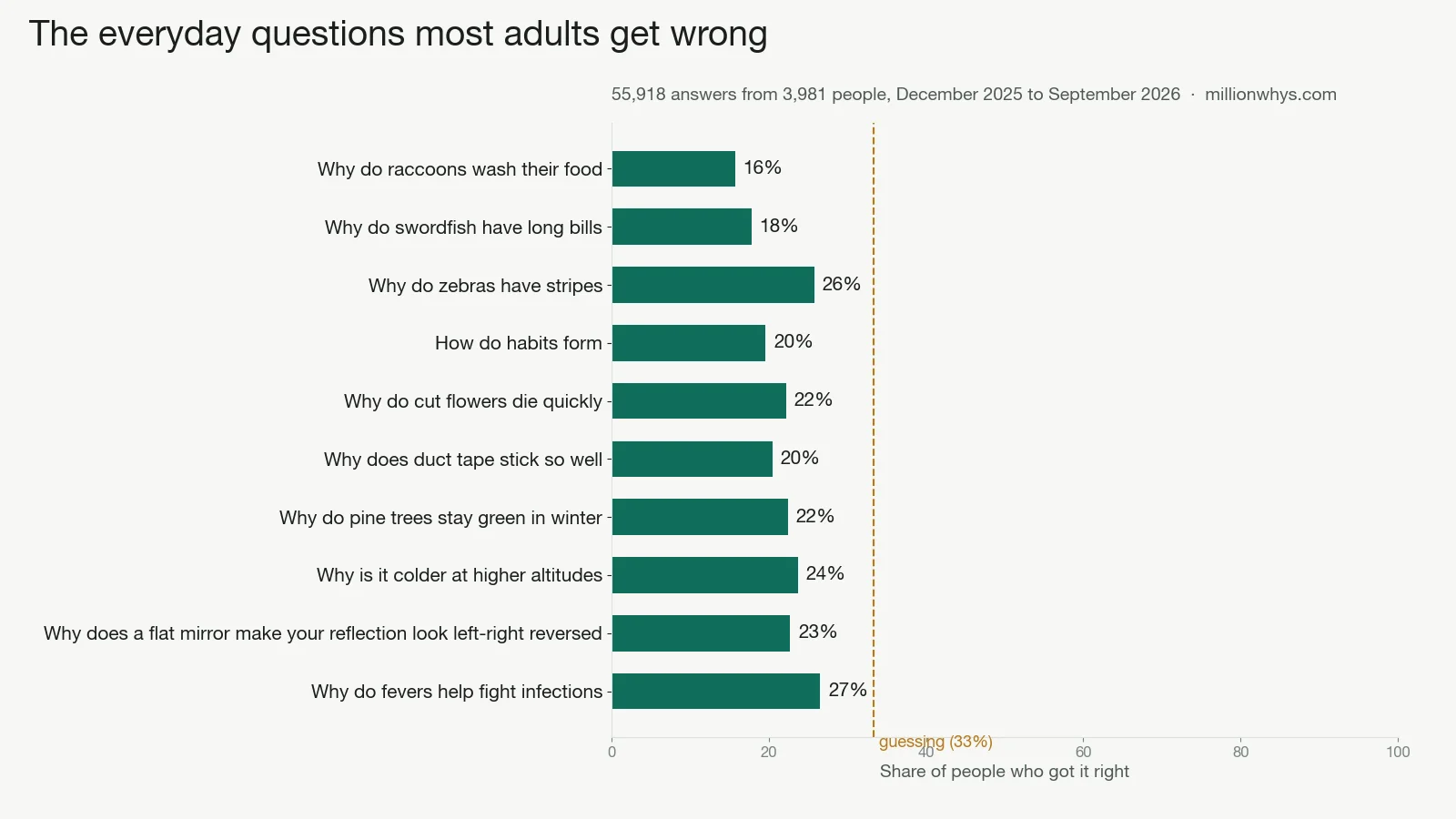
Because each question has three options, a coin-flip guesser scores 33%. The overall accuracy was 72%. That number is not the interesting part. The interesting part is the spread. Among the 894 questions that at least 30 people answered, the median question was answered correctly 79% of the time, the easiest tenth above 93%, and the hardest tenth below 45%.
1. The questions most people get wrong are about ordinary things
We expected the bottom of the table to be full of obscure facts. It is not. It is full of things everyone has seen: a mirror, a fever, a bunch of cut flowers, a ceiling fan on video, a loaf going stale. Here are twenty of the hardest questions, ranked by how confidently we can say they are hard (a statistical bound that penalises small samples), with the answer in plain words. Each was answered by at least 40 people.
| # | Question | Got it right | The answer |
|---|---|---|---|
| 1 | Why do astronauts float in space? | 30% | Free fall: the ship and the astronaut are falling around Earth together |
| 2 | Why do zebras have stripes? | 26% | The best-supported explanation is that stripes stop biting flies landing |
| 3 | Why do raccoons wash their food? | 16% | Wetting the paws sharpens their sense of touch; they are feeling, not washing |
| 4 | Why do swordfish have long bills? | 18% | They slash sideways through schools of fish to stun prey |
| 5 | How do habits form? | 20% | The basal ganglia take over a repeated action so the conscious brain can stop steering |
| 6 | Why do cut flowers die quickly? | 22% | Air bubbles enter the cut stem and block the water-carrying tubes |
| 7 | Why is it colder at higher altitudes? | 24% | Rising air expands and cools; it is not about distance from the Sun |
| 8 | Why does a flat mirror make your reflection look left-right reversed? | 23% | A mirror flips front-to-back, not left-to-right; our brain does the rest |
| 9 | Why do fevers help fight infections? | 27% | Higher body temperature makes immune cells work better; it does not cook the germs |
| 10 | Why do fan blades look backward? | 25% | A stroboscopic effect: flickering light samples the blades at the wrong moments |
| 11 | Why do some islands sink? | 25% | Volcanic islands sit on cooling crust that slowly subsides |
| 12 | Why are there asteroid belts? | 27% | Jupiter's gravity kept the rubble from ever forming a planet |
| 13 | Why does bread get hard when stale? | 27% | Starch molecules recrystallise and squeeze water out; staling is not drying |
| 14 | Why does sugar dissolve in water? | 29% | Water molecules surround each sugar molecule and pull it away from the crystal |
| 15 | Why do runners hit 'the wall'? | 30% | Muscle and liver glycogen run out |
| 16 | How do store-bought bananas grow without seeds? | 31% | They have three chromosome sets, so they are sterile, and are grown from cuttings |
| 17 | Why do parrotfish make sand? | 29% | They grind coral with beak-like teeth and excrete the sand |
| 18 | Why does helium make voices sound funny? | 36% | Sound travels faster in helium, which shifts the resonances of your throat; the pitch of your vocal folds does not change |
| 19 | Why does the Moon seem to change shape in the sky? | 36% | We see different amounts of the sunlit half; Earth's shadow is not involved |
| 20 | Why do pine trees stay green in winter? | 22% | Waxy, narrow needles lose little water, so the tree keeps them |
Notice how many of these have a popular explanation that is wrong in a specific, repeatable way. That is the pattern in the next section.
2. The wrong answers cluster: five misconceptions with numbers
For questions answered after April 2026 we also know which wrong option people picked. Where wrong answers pile onto one option, we are not looking at guessing. We are looking at a shared belief.
| Question | Got it right | Most popular wrong answer | Share of wrong answers |
|---|---|---|---|
| Why do astronauts float in space? | 30% | No gravity exists in space | 100% |
| Why do raccoons wash their food? | 16% | Softens food for easier eating | 67% |
| Why do fevers help fight infections? | 27% | High heat kills all germs | 50% |
| Why does helium make voices sound funny? | 36% | Gas pressure squeezes the throat | 57% |
| Why do 90% of people choose surgery with '90% survival rate' over one with '10% death rate'? | 49% | The percentage 90% sounds psychologically larger than 10% in any context | 84% |
The astronaut result is the cleanest. Every single wrong answer said there is no gravity in space. There is plenty: at the altitude of the International Space Station, gravity is about 90% as strong as on the ground. The station and everyone in it are falling around the Earth together, and falling together feels like floating. The fever result is the most useful to know: a fever does not cook germs, it speeds up your own immune cells. And the helium result shows how a true fact ("it makes my voice higher") hides a wrong mechanism (the pitch of your vocal folds does not change at all; the resonances of your throat do).
Question 1 of 1
Why do astronauts float in space?
3. "Easy" is a label, not a fact
Every question in the bank carries an editorial difficulty label. The labels do track reality: easy-labelled questions were answered right 79% of the time, hard-labelled ones 66%. But the spread inside each label is wide, and 13 questions we had marked easy were missed by most people. The Moon's phases are the standout. Most adults were taught this in primary school, and most still reach for Earth's shadow.
| "Easy" question | Got it right | The answer |
|---|---|---|
| Why do swordfish have long bills? | 18% | Slashing through fish schools |
| Why do astronauts float in space? | 30% | They're falling with the ship |
| Why do fingers wrinkle in water? | 34% | Nervous system creates grip |
| Why do remora fish stick to sharks? | 33% | Hitchhiking for free rides |
| Why does the Moon seem to change shape in the sky? | 36% | We see different lit portions |
| Why do bats hang upside down? | 34% | Easy takeoff by dropping |
| Why does wind make leaves rustle? | 36% | Turbulent air vibrates leaves |
| Why does the moon have phases? | 46% | Sun lights different moon sides |
4. People understand money better than plants
Grouping by topic, the gap between the best and worst categories is about 19 points. Economics questions were the easiest in the whole bank, and the questions about how living things work, plants, sea life, the sky, were the hardest. One reading: we get daily practice with money and almost none with photosynthesis.
| Category | Got it right | Answers |
|---|---|---|
| Economics & Money | 83% | 2,219 |
| Sports & Exercise | 78% | 3,853 |
| Chemistry Around Us | 76% | 1,816 |
| Music & Sound | 76% | 2,341 |
| Health & Medicine | 75% | 1,549 |
| Transportation | 75% | 1,948 |
| Human Biology | 74% | 2,436 |
| Technology | 74% | 7,927 |
| Earth Science | 73% | 2,080 |
| Insects | 72% | 1,814 |
| Animal Behavior | 72% | 3,890 |
| History & Culture | 72% | 1,096 |
| Materials & Engineering | 71% | 466 |
| Household Science | 71% | 1,903 |
| Physics in Daily Life | 71% | 3,861 |
| Food & Nutrition | 70% | 2,598 |
| Psychology & Behavior | 70% | 3,528 |
| Weather & Climate | 68% | 1,786 |
| Astronomy & Space | 67% | 3,161 |
| Light & Vision | 66% | 595 |
| Marine Life | 65% | 1,842 |
| Plant Science | 65% | 2,018 |
5. The six-to-ten-second sweet spot
For about 21,000 answers we know how long the person took. Accuracy follows a curve, not a line. Answers given in under three seconds were right 50% of the time. Six to ten seconds was the peak at 76%. After that, accuracy drifts down with every extra second, to 61% for answers that took longer than 45 seconds. Wrong answers took longer than right ones (median 13.5 seconds against 12.1). The likely reading is simple: the snap answer is a guess, the long deliberation is a sign the person never had the idea to begin with, and the sweet spot is recognition.
| Time to answer | Got it right | Answers |
|---|---|---|
| under 3 seconds | 50% | 1,112 |
| 3 to 6 seconds | 73% | 2,468 |
| 6 to 10 seconds | 76% | 4,647 |
| 10 to 15 seconds | 72% | 4,669 |
| 15 to 25 seconds | 69% | 4,504 |
| 25 to 45 seconds | 64% | 2,687 |
| 45 to 120 seconds | 61% | 1,470 |
6. Older adults did slightly better
Among signed-in adults who told us their age band, accuracy rose from the youngest group and then held. The groups are small, so treat this as a hint rather than a finding.
| Age | Got it right | People |
|---|---|---|
| 18 to 24 | 68% | 106 |
| 25 to 34 | 75% | 132 |
| 35 to 44 | 75% | 74 |
| 45 to 54 | 74% | 54 |
| 55+ | 71% | 43 |
Why "why" is hard
Most of what we call general knowledge is a stock of whats: the capital of Peru, the boiling point of water, the year of a battle. The questions people missed here are whys, and a why is a small model of how something works. You cannot look it up in the moment and you cannot bluff it with a keyword. The astronaut, the mirror and the fever each come with a folk explanation that sounds right, gets repeated, and never gets tested, because nothing in daily life ever asks you to use it.
That is the whole reason Million Whys exists: one question a day, three choices, and an explanation whether you were right or wrong. If you want to see where you land, today's question is free and takes ten seconds, and the daily set keeps a streak. If you would rather read first, start with why the sky is blue or whether trivia is actually good for your brain.
Method and limitations
- Sample. 55,918 answers, 3,981 people (433 signed-in, the rest guests identified by session), 5,206 questions, 2025-12-02 to 2026-09-03. About 41% of the answers arrived on a single launch day in December 2025, when roughly 2,000 people tried the site in one evening; their answers were paced like everyone else's, so we kept them.
- Exclusions. Our team's accounts, under-18 accounts, an imported batch of records from November 2025, answers from the WeChat mini program (a grading bug there made them unreliable for months), and 34 sessions that answered more than 150 questions in a day or scored at chance over 100+ answers.
- Ranking. The "hardest" list uses the upper bound of a 95% Wilson interval on accuracy, so a question needs both a low score and enough answers to make the list. Everything featured has at least 40 answers; the misconception shares need at least 8 recorded wrong picks.
- Which wrong option. Option choices were stored reliably only for December 2025 and from April 2026 onward, so misconception shares come from that subset. Right-or-wrong grading is reliable throughout.
- Who answers. People who open a curiosity app are not a random sample of adults. Accuracy here is probably higher than in the general population, which makes the misses more striking, not less.
- What we did not do. No country comparisons (samples outside the US and China are too small), no per-person scoring, and nothing that identifies an individual. The per-question table is available as a CSV: download the dataset (every question with 30 or more answers, with accuracy, confidence bounds, the correct answer and the most-picked wrong answer).
- Cite this. Million Whys, "The everyday science questions most adults get wrong", September 2026, based on 55,918 answers from 3,981 people. Data collected December 2025 to September 2026.
Sources
- Caro, T. et al. (2019). Benefits of zebra stripes: behaviour of tabanid flies around zebras and horses. PLOS ONE. Summary.
- Evans, S. S., Repasky, E. A. and Fisher, D. T. (2015). Fever and the thermal regulation of immunity: the immune system feels the heat. Nature Reviews Immunology 15, 335–349. Article.
- Graybiel, A. M. (2008). Habits, rituals, and the evaluative brain. Annual Review of Neuroscience 31, 359–387. PubMed.
- Gray, J. A. and BeMiller, J. N. (2003). Bread staling: molecular basis and control. Comprehensive Reviews in Food Science and Food Safety 2, 1–21. Article.
- NASA. What is microgravity? (90% of Earth's gravity reaches the space station; astronauts float because they are in free fall.)
- NOAA National Weather Service, JetStream: Layers of the atmosphere.
- Feynman, R. (1983). Fun to Imagine, BBC: the mirror segment.
- Zeveloff, S. I. (2002). Raccoons: A Natural History. Smithsonian Books.
Keep Exploring

Why does a wrong guess about something familiar, like why a mirror swaps left and right, make the real explanation land better than being told it straight away?
Psychology & Behavior
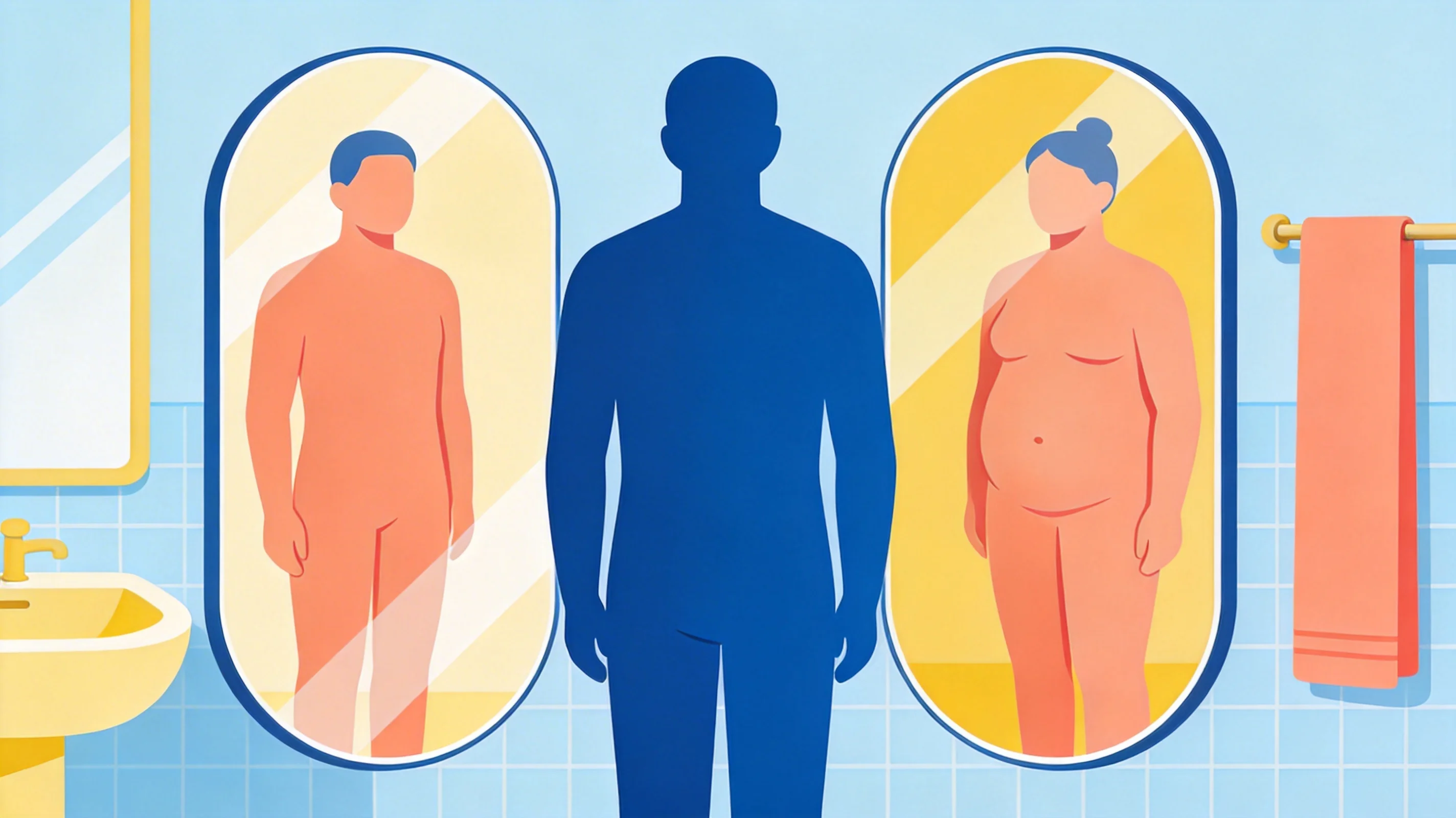
Why do some mirrors make you look thinner or fatter than you really are?
Light & Vision
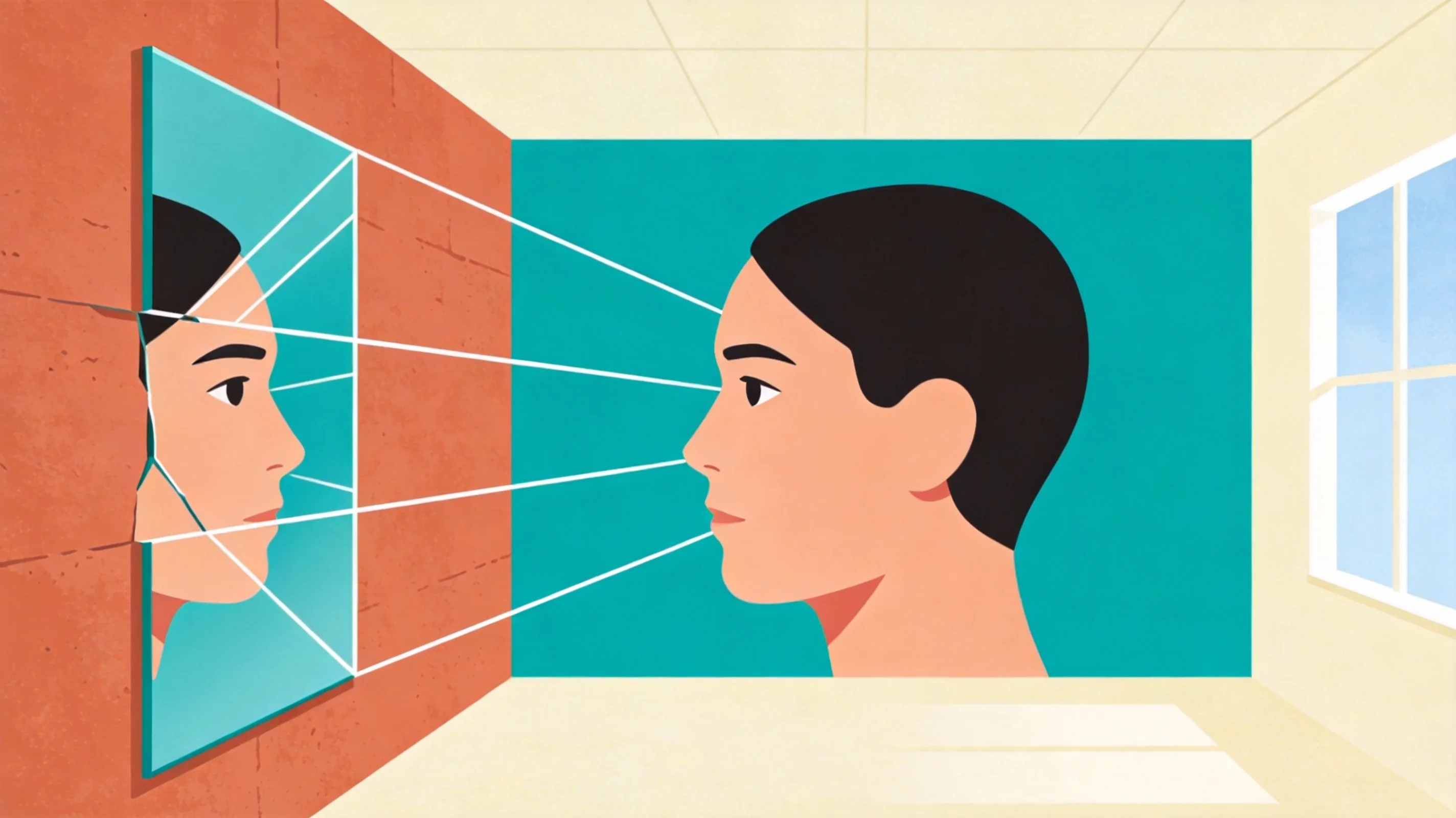
Why do mirrors reflect your face clearly but rough walls don't?
Light & Vision
Related Posts
Science Quiz for Adults: Questions With Answers
A science quiz for adults with 18 grown-up questions and answers about bodies, kitchens, weather, money, devices, materials, and curious debates with the why.
Daily Science Quiz: Questions With Answers
Daily science quiz questions with answers about the body, weather, space, materials, animals, hard everyday mechanisms, and tiny whys for curious adults.
10 Common Science Misconceptions Debunked for 2026
Explore 10 common science misconceptions with clear corrections and short explanations, from why seasons happen to why blood is never blue.