


Why Is the Sky Blue? The Science of Light Scattering
On this page· 17
Look straight up on a clear afternoon and the puzzle seems almost too ordinary to notice: sunlight is white, air is nearly transparent, yet the whole dome above you is blue. Why is the sky blue? The satisfying answer is not that the atmosphere contains blue pigment. It is that tiny air molecules redirect different wavelengths by very different amounts, while the Sun, the length of the light path, and even your eyes decide which of those scattered colors finally wins.
TL;DR
Sunlight contains the visible spectrum. When it enters Earth's atmosphere, molecules much smaller than visible wavelengths scatter short wavelengths far more strongly than long ones, sending blue light across the sky into your eyes. The same mechanism helps explain red sunsets, but vision, dust, water, and planetary atmospheres keep the color story from being a one-rule trick.
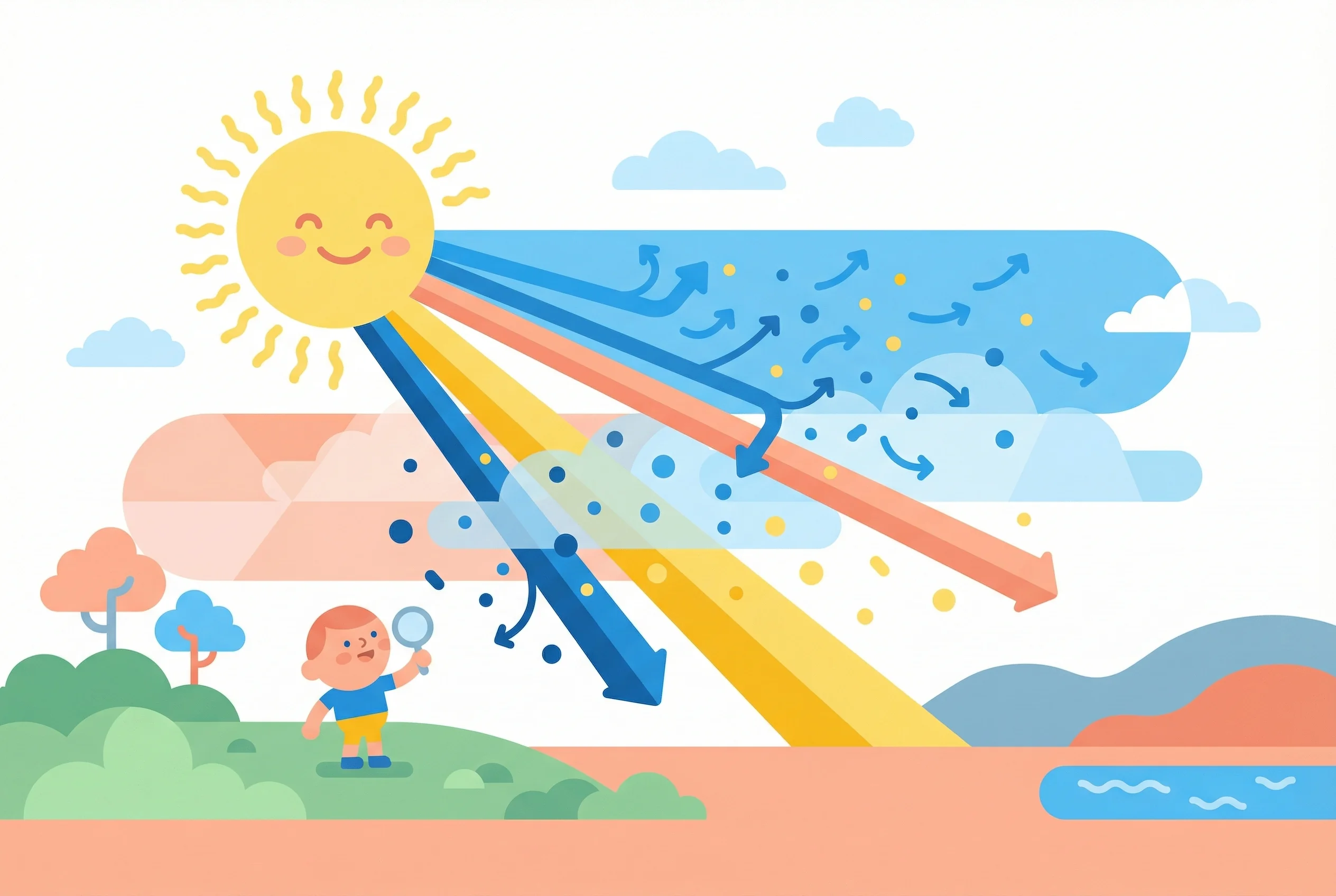
Short answer: the sky looks blue because nitrogen and oxygen molecules scatter the shorter visible wavelengths in sunlight much more efficiently than red light. That diffuse blue light reaches you from every direction, not just from the Sun. Both NASA Space Place and the UCAR Center for Science Education describe this molecular scattering as Rayleigh scattering.
Air molecules turn one beam into a blue dome
Sunlight arrives in a roughly straight beam. If Earth had no atmosphere, the Sun would still be bright, but the rest of the daytime sky would be black because there would be almost nothing between you and space to redirect sunlight into your line of sight. Air changes that geometry. Its nitrogen and oxygen molecules are far smaller than the wavelengths of visible light, which puts their interaction with light in the Rayleigh-scattering regime.
The useful rule is that the strength of Rayleigh scattering rises approximately as the inverse fourth power of wavelength. In compact form, scattering is proportional to 1/λ4. That fourth power makes the color difference steep. Using representative wavelengths of 450 nanometers for blue and 650 nanometers for red, the simple ratio (650/450)4 is about 4.4. Blue light is therefore scattered several times more strongly than red light under the same molecular conditions. This is a wavelength preference, not blue dye hiding in the air.

Each molecule redirects only a tiny fraction of the passing light. The atmosphere contains so many molecules, however, that their combined effect fills the sky. When you look away from the Sun, you are seeing light that left the original solar beam and was scattered toward you. The blue dome is therefore an enormous field of sideways sunlight.
Why the blue changes from overhead to the horizon
A clear sky is usually a deeper blue overhead and paler near the horizon. That gradient is another clue that the color is made by a path, not painted onto a surface. Looking upward, your line of sight crosses a relatively short column of atmosphere. Looking toward the horizon, it crosses a much longer column. Blue light can be scattered more than once along that longer route, and light reflected from the ground can join the mix. Multiple scattering blends wavelengths back toward white, so the horizon often looks washed out.
Aerosols add a second size scale. Dust, salt, smoke, and liquid droplets are generally larger than individual gas molecules and scatter colors more evenly. UCAR notes that skies with fewer aerosols tend to look deeper blue, while more aerosols make the sky paler or milky. This is why two cloudless days can carry visibly different blues even though the nitrogen and oxygen have not gone anywhere.

Clouds look white for the same broad reason that the hazy horizon does, only more strongly: their droplets are large enough to scatter the visible colors much more evenly. The atmosphere is running more than one optical regime at once. Molecules bias the sky toward blue; larger particles and droplets mix more of the spectrum together.
Question 1 of 5
Why does the clear sky usually look paler near the horizon than directly overhead?
Sunsets redden because sunlight takes the long way
At noon, the Sun is high and its direct light travels through a comparatively short atmospheric path. Near sunset, that path becomes much longer. Short wavelengths are repeatedly scattered out of the direct beam before it reaches you, leaving the transmitted light richer in yellow, orange, and red. NASA's sky explainer and UCAR's account both trace red sunsets to this longer path and the removal of more blue light.
That does not mean every red sunset is produced by clean-air Rayleigh scattering alone. Aerosols can intensify or muddy the colors depending on their size, abundance, and altitude. Smoke and volcanic particles sometimes create vivid displays because they add more scattering, while dense low-level haze can simply flatten the view. "Red sky" is an observation; it is not, by itself, a reliable air-quality measurement.

Question 2 of 5
Why does the Sun appear deep red at sunrise over the ocean?
Why the sky is not violet
The neat classroom answer creates its own problem. Violet has a shorter wavelength than blue, so Rayleigh scattering should favor violet even more. Why, then, do we not live under a violet sky?
There is no single on-off reason. First, sunlight does not deliver equal power at every visible wavelength. Second, human daytime vision is much less sensitive near the violet edge of the spectrum than around green and blue-green wavelengths. The International Commission on Illumination's photopic luminous-efficiency data formalize that changing visual sensitivity. Finally, the scattered spectrum is interpreted by three overlapping cone-response systems, not by a detector that labels one wavelength at a time. The combined signal is perceived as blue.

This is the first big "what people miss" moment: the atmosphere supplies a spectrum, but your visual system supplies the color experience. Change the incoming spectrum or the observer's sensitivity and the perceived sky can change even when the scattering physics stays the same.
Question 3 of 5
Why does the sky look blue instead of violet, even though violet has an even shorter wavelength?
Mars flips the palette with dust
Earth's blue day and red sunset are not universal. Mars commonly has a yellow-orange or butterscotch daytime sky, while the region close to the setting Sun can turn blue. NASA explains that fine Martian dust lets blue light remain concentrated closer to the Sun's direction while yellow and red light spread more broadly through the sky. Curiosity captured its first color sunset sequence at Gale Crater on April 15, 2015, over 6 minutes and 51 seconds (NASA Science).

Mars is a useful control experiment because it breaks the lazy rule that "short wavelengths always make a blue sky." Particle size, composition, and atmospheric density all matter. Rayleigh scattering by molecules dominates the simple Earth explanation; dust scattering dominates much of the Martian view. Same sunlight, different medium, different palette.
Question 4 of 5
Why can Mars have a yellow-orange daytime sky but a blue region right around the setting Sun?
The ocean is blue, but not simply because it mirrors the sky
The old stub on this page treated the ocean's blue as the same effect. That is too simple. Sky reflection can color the water's surface, especially at a shallow viewing angle, but deep clear water has its own spectral behavior. According to the National Ocean Service, water absorbs wavelengths in the red part of the spectrum more strongly, leaving more blue light to be returned to an observer. Suspended sediment, dissolved material, and phytoplankton can shift the ocean toward green, brown, or red.

The distinction is reusable: a blue object can look blue because it reflects blue, transmits blue, emits blue, scatters blue, or removes competing colors. The label is the same; the mechanism is not. Curiosity gets more useful when "what color is it?" turns into "which wavelengths reached me, and what happened to the others?"
Question 5 of 5
Why does deep, clear ocean water look blue, while sediment-rich or plankton-rich water can look green, brown, or red?
What people usually miss
The sky is not a blue ceiling. It is a volume in which sunlight is continually redirected. Every patch of blue marks a route from the Sun to a molecule and then to you. Move to a different atmosphere, look through a longer path, add larger particles, or replace the human observer, and the color changes.
That is why the best answer is bigger than "Rayleigh scattering." The named mechanism closes the first information gap, but the real payoff is a compact model: color depends on the source, the material in the path, the geometry, and the detector. That model explains a pale horizon, a red sunset, a blue Martian sunset, and an ocean that keeps looking blue even under a gray sky.
Related videos
FAQ
Why is the sky blue instead of purple?
Violet wavelengths scatter strongly, but the incoming solar spectrum, the atmosphere, and the lower violet sensitivity of human daytime vision combine into a color we perceive as blue. Scattering strength alone does not determine the final sensation.
Why is the sky paler near the horizon?
Your horizontal line of sight crosses more atmosphere. Repeated scattering, light reflected from the ground, and aerosols mix more wavelengths into the view, washing the deep overhead blue toward white.
Why are sunsets red and orange?
Low-angle sunlight travels through a longer atmospheric path. Much of its blue light is scattered away from the direct beam before it reaches you, so longer red and orange wavelengths become more prominent.
Would the sky be black without an atmosphere?
Yes. The Sun and illuminated objects would still be bright, but there would be no thick field of molecules to scatter sunlight across the rest of the sky. This is why space looks black even when an astronaut is in direct sunlight.
Is the ocean blue because it reflects the sky?
Reflection can contribute at the surface, but it is not the whole explanation. Water preferentially absorbs red wavelengths, while particles and organisms can alter which colors return to your eyes.
What does this have to do with AIgneous Million Whys?
This question is a perfect half-known gap: almost everyone has heard "scattering," but that word alone does not explain violet, sunsets, Mars, or the ocean. Million Whys is built around closing one small gap clearly enough that the next, better question becomes visible.
Keep Exploring

Related Posts
Fun Facts About Weather: Everyday Sky Physics
Fun facts about weather, explained through why raindrops flatten, clouds float, thunder rolls, snow survives warm layers, fog forms, and rainbows circle.
Facts About Light: Color, Shadows, Refraction
Facts about light get easier when you see the mechanism: visible wavelengths, refraction, scattering, shadows, and why color is a question your eyes answer.
Daily Science Quiz: Questions With Answers
Daily science quiz questions with answers about the body, weather, space, materials, animals, hard everyday mechanisms, and tiny whys for curious adults.