

Fun Facts About Weather: Everyday Sky Physics
Fun facts about weather are best when they do not stop at "wow, the sky is strange." The useful version answers why the strangeness happens: why raindrops are not drawn like raindrops, why a cloud can weigh as much as a small building and still float, why lightning makes thunder, and why a rainbow is secretly a circle with most of it hidden from your usual point of view.
TL;DR
Weather looks familiar because it happens above us every day, but the mechanisms are not obvious. Raindrops flatten as they fall, clouds stay up because their water is spread through a huge volume of buoyant air, lightning makes thunder by explosively heating air, snow can survive a slightly warm layer if it does not fully melt, and rainbows are full circles when the geometry lets you see them. The sky is not random decoration; it is physics with a very good public-relations department.
The short answer: weather is what you get when sunlight, water, air pressure, temperature, and gravity keep negotiating. Most "weather facts" become more satisfying when you can name the pressure change, phase change, light path, or tiny molecule behind them.
Curious? Try one 👇
Why is the sky blue?
Jump into the daily quiz →Raindrops are not teardrop-shaped
The icon on a weather app has lied to all of us politely. A falling raindrop is not a pointy tear with a tail. NASA's Global Precipitation Measurement education team describes small drops as rounded by surface tension, while larger falling drops get flattened on the bottom by air resistance, making them more like a hamburger bun than a cartoon tear (NASA GPM).
That detail matters because it turns rain from background mood into a forces problem. Surface tension tries to keep the water compact. Air pushing upward against the falling drop deforms it. If the drop gets too large, it can break apart into smaller drops. The question is not "what shape is rain?" but "which force is winning at this drop size?"

Clouds can be heavy and still stay overhead
A cloud looks weightless because its edges are soft. The water inside is not weightless. The Library of Congress explains the classic cumulus-cloud estimate this way: if a one-kilometer-by-one-kilometer cumulus cloud contains about 500,000 kilograms of water droplets, that is roughly 1.1 million pounds (Library of Congress).
The trick is distribution. That mass is smeared through an enormous volume as microscopic droplets and ice crystals. Each particle falls slowly, while rising air currents and the lower density of the cloudy air help keep the whole visible cloud in place. A cloud does not stay up because it is light. It stays up because the water is divided into tiny pieces inside moving air.

Lightning makes thunder by turning air into a shock wave
Thunder is not lightning "making a sound" in a vague way. It is air being heated so violently that it expands explosively. The National Weather Service notes that a lightning channel can heat the surrounding air to about 50,000 degrees Fahrenheit, far hotter than the surface of the Sun, for a very brief moment (NWS lightning temperature). That rapid expansion sends out a pressure wave: thunder (NWS thunder science).
This also explains why thunder rolls instead of arriving as one neat clap. Different parts of a long lightning channel are different distances from you, and sound reflects and spreads through a messy atmosphere. You are hearing one electrical event stretched out by geometry.

Snow can reach the ground when the air is not perfectly frozen
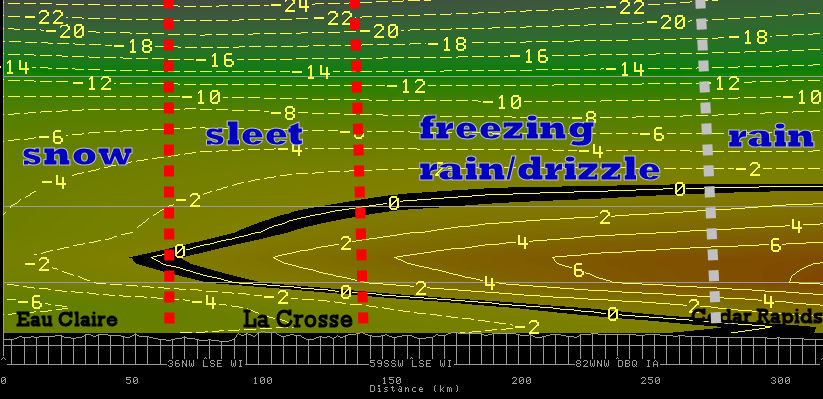
The phrase "above freezing" sounds like snow should lose the argument immediately. In real storms, a falling snowflake passes through layers. The National Weather Service explains that wintry precipitation depends on the vertical temperature profile: a warm layer can partially or completely melt falling snow, and the surface layer then determines whether the result is snow, sleet, freezing rain, or rain (NWS wintry mix).
So yes, snow can still be reported near or a little above 32 F at standard measuring height when the layer is shallow, the flakes are large enough, the air is dry enough for evaporative cooling, or the snow does not spend long enough in warm air to fully melt. The satisfying answer is not "the thermometer is wrong." It is that the thermometer is only one point in a vertical column.
Fog is a cloud that lost altitude
Fog feels like weather coming down to your face because that is almost literally what it is. The National Weather Service JetStream guide defines fog as a cloud in contact with the ground, formed when air near the surface becomes saturated and water vapor condenses into tiny droplets (NWS JetStream fog).
This is why fog appears in such specific moods: a clear night lets the ground radiate heat away; moist air cools near the surface; wind stays light enough that the droplets are not mixed away. The world does not become smoky. It becomes a low cloud you can walk through.

The smell after rain has chemistry behind it
That clean, earthy after-rain smell has a name people like because it sounds slightly fictional: petrichor. One of the key molecules involved is geosmin, produced by soil microbes including actinomycetes. The American Chemical Society describes geosmin as the compound behind the earthy smell of freshly turned soil and rain-wet ground (ACS Molecule of the Week).
The reason the smell arrives so suddenly is physical as much as chemical. When raindrops hit porous soil, tiny bubbles can form and burst, throwing microscopic aerosols into the air. Your nose is not detecting "rain" as a single thing. It is detecting a weather-triggered delivery system for molecules that were already waiting in the ground.
Wind is pressure trying to even itself out
Wind can feel like a personality: sharp, warm, restless, calm. Mechanically, it starts with pressure differences. UCAR's Center for Science Education explains that air moves from high pressure toward low pressure, with Earth's rotation, friction, and local terrain shaping the final path (UCAR wind).
The hidden payoff is that wind is not "air deciding to move." It is the atmosphere trying to smooth out an imbalance created by uneven heating. Sunlight warms surfaces unevenly; warm air expands and changes pressure; pressure gradients push air; the rotating Earth bends that flow. A breeze is a correction in progress.
Rainbows are full circles when you can see the geometry
From the ground, a rainbow usually appears as an arc because the horizon cuts off the lower part. The optical geometry is circular: sunlight enters raindrops behind the visible rainbow, bends, reflects internally, and exits toward your eyes at a characteristic angle. NASA's Astronomy Picture of the Day has featured full-circle rainbows photographed from above, where the missing lower half is no longer blocked by the ground (NASA APOD).
That is the closure hiding inside the cliche. A rainbow is not an object sitting in the sky. It is an angle-dependent light path that exists for your position. Move the observer, and the rainbow moves too.

What people usually miss
The common mistake is treating weather as a list of disconnected surprises. The better pattern is smaller: every weather fact is a closed loop between a visible thing and an invisible mechanism. A raindrop shape closes with air resistance. Thunder closes with explosive heating. Fog closes with saturation at the surface. The answer is satisfying because it does not just add trivia; it changes the next ordinary sky you look at.
Related videos
Weather 101: A Tutorial on Cloud Types - NWS Albuquerque
Thunderstorms 101 - National Geographic
FAQ
What is the strangest fun fact about weather?
The most useful strange fact is that a cloud can contain hundreds of thousands of kilograms of water and still float. The water is divided into tiny droplets spread through a huge volume of air, so the cloud behaves very differently from a lake in the sky.
Why are raindrops not shaped like teardrops?
Surface tension rounds small droplets, while air resistance flattens the bottom of larger falling drops. The familiar teardrop icon comes from water dripping off a surface, not from rain falling through the atmosphere.
Can it really snow when the temperature is above freezing?
Sometimes, yes. The key is the whole vertical temperature profile, not just the reading at one height. If the warm layer is shallow or the snow does not fully melt before reaching the ground, snow can survive longer than the simple 32 F rule suggests.
Why does thunder arrive after lightning?
Light reaches you almost instantly at storm distances, while sound travels much more slowly. The delay tells you the lightning was farther away; the rumble happens because sound from different parts of the lightning channel reaches you at different times.
What does this have to do with AIgneous Million Whys?
Weather is exactly the kind of everyday half-knowing Million Whys is built around. You already know rain, clouds, thunder, and fog. The spark is the next question: what mechanism makes the familiar thing work?
Keep reading
Sources
NASA GPM: The Shape of a Raindrop
Library of Congress: How much does a cloud weigh?
National Weather Service: Lightning temperature and thunder science
National Weather Service: What causes a wintry mix? and JetStream fog guide
Curious? Try one 👇
Why is the sky blue?
Jump into the daily quiz →Keep Exploring
Related Posts
Weather Trivia Questions With Answers
Weather trivia questions with answers about clouds, wind chill, snow, lake ice, hurricanes, humidity, forecasting, and the hidden physics above us every day.
Facts About Rainbow: Why Rainbows Form
Facts about rainbow formation: how sunlight, raindrops, refraction, double rainbows, fogbows, and moonbows create the colors you see in the sky.
Facts About Ice: Why Frozen Water Gets Weird
Facts about ice: why frozen water floats, expands, makes six-sided snowflakes, turns slippery, rejects sea salt, reflects sunlight, and shapes life on Earth.