

Interesting Facts About Chameleons: Color and Tongue
Interesting facts about chameleons often get flattened into one myth: they change color to match anything behind them. Put a chameleon on a chessboard, the story goes, and it should become a chessboard. Real chameleons are stranger and more limited than that. Their color is communication, temperature, stress, light, pigment, and in some species microscopic crystal spacing. Then the animal adds separately moving eyes, a spring-loaded tongue, gripping feet, and a tail built for branches.
TL;DR
Chameleons do not simply copy the background. Many change color for signaling, temperature, stress, and light, and panther chameleons can tune guanine nanocrystals in skin cells to shift reflected wavelengths. Their eyes scan separately but converge for a strike, their tongue uses elastic recoil for ballistic projection, and their feet and tails are branch-gripping tools. The important caveat: chameleons vary by species, so no single trait should be treated as universal in the same strength.
Short answer: the most interesting chameleon facts are not gimmicks. Color change is constrained biology, not magic camouflage; the tongue is a power-amplified projectile; the eyes solve a scanning-and-depth problem; and the body is shaped around slow, careful movement through branches. The closure is better than the myth because it explains what the animal is actually doing.

Curious? Try one 👇
Why is the sky blue?
Jump into the daily quiz →Color change is not a background-copy machine
The first correction is simple: chameleons do not look at any surface and decide to paint themselves into it. San Diego Zoo is blunt about this: chameleons do not deliberately match every background, and each species has a limited set of colors and patterns it can display. Color change can reflect mood, fear, anger, light, temperature, humidity, dominance, courtship, or pregnancy, depending on the species and context.
That makes the animal more interesting, not less. A camouflage myth turns the chameleon into a novelty filter. The real mechanism turns it into a signaling surface. A male becoming brighter is not doing a party trick; he may be advertising dominance or courtship condition. A darker or duller display can signal stress, submission, or thermoregulation. The skin is a conversation between body state and environment.
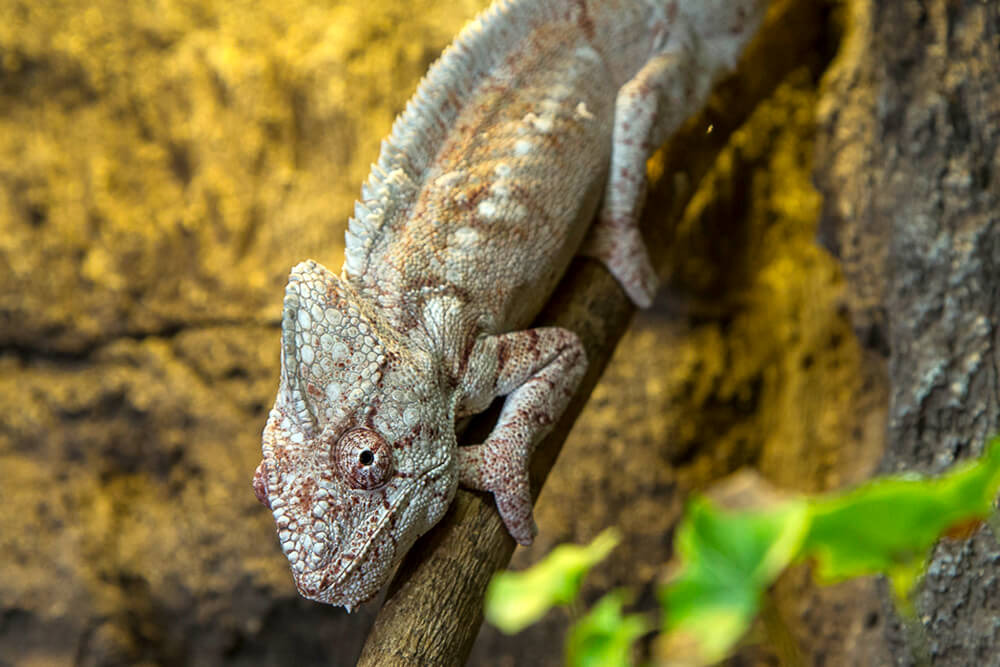
Some chameleons tune crystals under the skin
The famous modern color paper is a 2015 Nature Communications study on panther chameleons. The researchers found that rapid color change in adult males involved active tuning of a lattice of guanine nanocrystals in a superficial layer of iridophore cells. When the spacing changes, the reflected wavelengths shift. That is structural color: physics doing part of what pigment alone cannot.
The same paper also described a deeper layer of iridophores with larger crystals that reflects a substantial amount of sunlight, especially in the near-infrared. That matters because it ties color to heat as well as display. Still, the caveat in the brief is important: do not apply the panther-chameleon mechanism as if every chameleon has the same color range or the same performance. Species differ. Some shift dramatically; others mostly move through subtler browns, greens, or brightness changes.

The eyes scan separately, then lock together
Chameleon eyes look comic until you ask what problem they solve. The animal moves slowly and is often exposed on branches, so wide surveillance is useful. San Diego Zoo describes each eye as able to rotate and focus separately, letting a chameleon look at two different things at once; when prey appears, both eyes can focus in the same direction for a clearer view. That shift from separate scanning to paired targeting is the key.
Depth matters because the tongue strike is a commitment. A chameleon cannot afford a sloppy launch toward empty air. The slow body, independent eye turrets, and sudden tongue all belong to one hunting strategy: spend time gathering information, then release energy quickly. It is a nice reminder that speed in an animal is often local. The whole animal is slow; one part is violently fast.

The tongue is a spring, not just a sticky rope
A chameleon tongue can be longer than the body in some types, according to San Diego Zoo, and it is not powered like a simple muscular reach. A 2016 Scientific Reports study by Christopher Anderson describes ballistic tongue projection as power amplification: elastic tissues store energy and release it faster than muscle contraction alone could manage. The paper reports tongue projection up to two body lengths and very high performance in small species.
Brown University's report on the same work gives the intuitive version: the smallest chameleons in the study produced especially extreme acceleration relative to body size. That does not mean every internet number about tongue speed is safe to repeat. It does mean the weirdness is real. A chameleon does not sprint after lunch; it turns the tongue itself into the sprint.

Feet and tails make the slow body make sense
Chameleons are not built like generic lizards with a color upgrade. Many live in trees or shrubs, and the limbs show it. San Diego Zoo explains that the five toes are grouped into opposing bundles, with a different arrangement on front and hind feet, so the foot can grasp branches in a pincer-like way. Sharp claws add grip on bark and rough surfaces.
The tail often adds a second anchor. Most chameleons have a prehensile tail that can wrap around branches, and San Diego Zoo notes that this tail cannot be broken off and regrown like the tails of many other lizards. That detail is easy to skip, but it is a useful trade-off. A detachable tail is a predator escape feature. A gripping tail is climbing equipment. You do not always get both.

Species variation is the antidote to viral facts
Many chameleon "facts" are technically true somewhere and misleading everywhere. Some species are large, such as Meller's chameleon, which the Smithsonian National Zoo describes as a mainland African species reaching about 2 to 2.5 feet in length. Some are tiny leaf chameleons. Some have dramatic horns or casques; some do not. Some give live birth, while many lay eggs. Some are mostly arboreal, while others live closer to the ground.
That is why the best chameleon writing keeps saying "some" and "many." The caution is not pedantry. It protects the wonder. If every chameleon is described as a rainbow-shifting, two-body-length-tongue, branch-tailed, live-bearing creature, then the real diversity disappears under one cartoon animal. Species variation is where the next questions live.
Habitat adds another layer of caution. San Diego Zoo describes chameleons across Africa, Madagascar, parts of Asia and Europe, with habitats ranging from rainforests and lowlands to deserts, scrub savannas, and mountains. A desert-adapted chameleon and a humid-forest chameleon are not solving the same daily problem. Once you notice that, the animal stops being a meme and becomes a map of small evolutionary compromises.
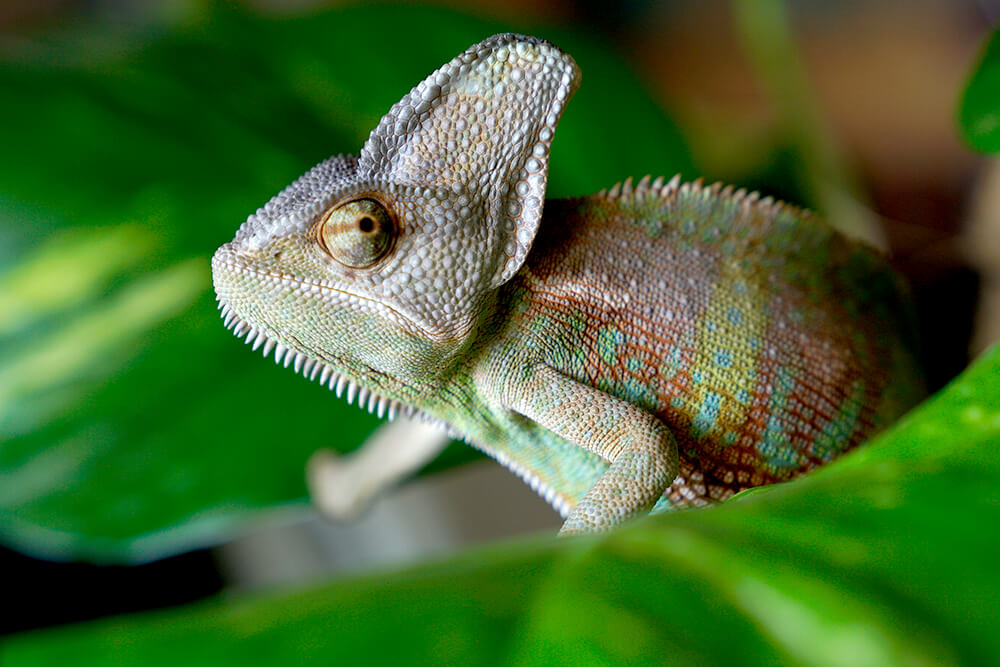
What people usually miss
The usual myth makes the chameleon passive: it blends in with whatever happens to be behind it. The real animal is active. It signals, heats and cools, scans, judges distance, stores elastic energy, grips branches, and chooses slow movement until one small part of the body has to be fast. The background is only one piece of the scene.
The other missed point is that chameleons are not a single trick with legs. They are a family of specialized reptiles with different bodies, habitats, and limits. The satisfying closure is not "they can become any color." It is "their bodies solve several hard problems at once, and every solution has a caveat." That is the kind of answer that leaves you knowing more and wanting to ask better questions.
Related videos
FAQ
What are the most interesting facts about chameleons?
The best facts explain mechanisms: color change can signal body state, some species tune nanocrystals in the skin, the eyes can scan separately, and the tongue uses elastic power amplification.
Do chameleons change color to match any background?
No. They have species-specific color ranges and change color for reasons such as signaling, temperature, stress, light, and reproductive state. Background matching is only a small and often overstated part of the story.
How do chameleons change color?
It depends on the species and color range. In panther chameleons, research has shown that changing the spacing of guanine nanocrystals in iridophore cells can shift the wavelengths reflected by the skin.
How fast is a chameleon's tongue?
Fast enough that the key mechanism is not ordinary muscle speed. Scientific Reports research describes the tongue as an elastic, power-amplified projectile, with especially high performance in small chameleons.
What does this have to do with AIgneous Million Whys?
Million Whys is built around this exact kind of closure. You start with a half-known myth, ask one honest "why," and the answer turns into skin optics, eye geometry, elastic motion, and species variation.
Keep reading
Sources
Teyssier et al. 2015: Photonic crystals cause active colour change in chameleons
Anderson 2016: Off like a shot
Brown University: Tiniest chameleons deliver most powerful tongue-lashings
Curious? Try one 👇
Why is the sky blue?
Jump into the daily quiz →Keep Exploring
Related Posts
Random Animal Facts: Weird Adaptations Explained
Random animal facts explained through real adaptations: polar bear fur, anteater tongues, salmon homing, skunk spray, bee dances, and elephant trunks.
Fun Facts About Snails: Teeth, Torsion, Slime
Fun facts about snails: how radula teeth, torsion, slime, shell growth, senses, dormancy, and reproduction make slow animals surprisingly strange.
Fun Facts About Zebras: What Stripes Really Do
Fun facts about zebras: stripes deter biting flies, but the real story also includes herd life, digestion, species differences, and stripe myths explained.