

Fun Facts About Snails: Teeth, Torsion, Slime
Fun facts about snails sound fake because the animal is so easy to underestimate. A snail moves slowly, carries a shell, leaves a shining trail, and seems like background garden weather. Then you look closer and the soft body turns into a set of mechanisms: a toothed radula instead of jaws, a twisted body plan called torsion, mucus that can lubricate and stick, tentacles that taste the world, shells that grow by chemistry, and reproductive lives that vary far more than the viral version admits.
TL;DR
Snails are gastropod molluscs, not simple blobs with houses. Many feed with a radula, a ribbon-like structure carrying rows of tiny teeth; their bodies show torsion, a developmental twist that moves the mantle cavity forward; their mucus helps them crawl, cling, and avoid drying out; and their shells, senses, dormancy, and reproduction differ widely across species. The big correction: do not turn one snail species into "all snails."
Short answer: the most useful fun facts about snails are mechanism facts. UC Berkeley's Museum of Paleontology describes gastropods as a highly diverse mollusc group, most of which use a radula in feeding and have a body plan shaped by torsion (UCMP: The Gastropoda). The Natural History Museum adds the everyday field guide version: snails and slugs need moisture, use chemical senses heavily, and may aestivate when dry or hibernate when cold (Natural History Museum).
Curious? Try one 👇
Why is the sky blue?
Jump into the daily quiz →The radula is a tongue-like tool with teeth
The first surprise is feeding. Many snails do not chew like mammals. They use a radula: a ribbon-like structure with rows of tiny teeth that can scrape, rasp, or process food depending on the species. UCMP is careful here: most gastropods use a radula in some part of feeding, but some have lost it, and feeding habits range from grazing and browsing to scavenging, suspension feeding, and carnivory (UCMP: The Gastropoda).
That caveat matters because the internet loves to flatten this into "snails have thousands of teeth." Some do have many radular teeth, and some radulae look astonishing under magnification. But the exact number and shape depend on the group. A grazing snail, a predatory cone snail, a limpet, and a species that has lost the radula are not all doing the same mouth job.
The closure is better than the viral line. A radula is not a tiny shark mouth. It is a replaceable, specialized feeding surface. If a snail is scraping algae, the radula works like a file. If a carnivorous gastropod is drilling or hunting, the feeding equipment can be transformed for a much stranger job.

Torsion twists the body plan
Gastropods are famous for shells, but the deeper body-plan word is torsion. UCMP describes gastropods as having a body that has undergone torsion so that the pallial cavity faces forward, and later calls torsion the best documented source of gastropod asymmetry (UCMP: The Gastropoda). In plain English, the developing animal twists part of its body plan relative to the head-foot region.
This is one of those facts that sounds too academic until you ask why it matters. Torsion helps explain why gastropods are not just miniature clams with spiral hats. Their internal layout, shell coiling, mantle cavity position, and asymmetry are part of a developmental history. The animal's shape is a solved problem with trade-offs, not a doodle.
It also protects against another bad simplification: shell spiral is not the whole story. The spiral is visible; torsion is developmental. You can look at the shell and miss the twist that helped make the animal a gastropod.
Slime is not just mess
Snail mucus has a public-relations problem. We notice the trail and stop there. Functionally, mucus is part lubricant, part adhesive, part moisture management, and part chemical world. The Natural History Museum explains that snails and slugs need to stay wet, are easier to see when it rains, and can become dormant in dry or cold conditions (Natural History Museum). The mucus trail is one visible sign of an animal solving the problem of moving a soft foot over a rough world.
The physics is pleasingly odd: to move, the foot sends waves of muscular contraction while the mucus layer lets the body grip and slide. A snail can cross surfaces that would shred or dry a softer animal because the trail changes the contact. That does not mean mucus is magic glue in every context, but it does mean the shining line is a functional material, not a mistake.
Mucus also helps explain why snails and slugs appear after rain. The weather is not summoning them for drama. Dampness changes their risk budget. When the world is wet, movement costs less water, chemical trails are easier to follow, and the animal can explore with less chance of drying out.

The shell grows; it is not a borrowed house
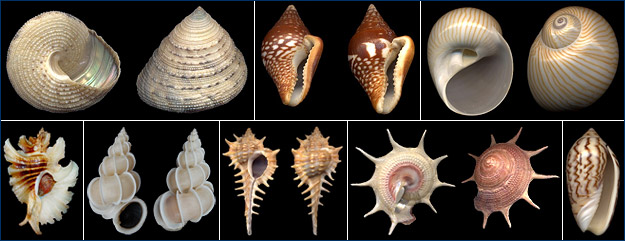
A snail shell is part of the animal, not a portable empty house it found. UCMP describes the gastropod shell as typically coiled around a central columella, with a larval shell region called the protoconch, and notes that shells are partly or entirely lost in some groups, including many slugs and nudibranchs (UCMP: The Gastropoda). The Natural History Museum adds a nice corrective for slugs: many have an internal reduced shell, and shell loss has happened multiple times in evolution (Natural History Museum).
The shell's job is also not one thing. It can reduce drying, protect against some predators, anchor muscles, and shape how the animal retreats. But it costs material and energy, especially calcium. That cost is why losing or reducing a shell can make sense for animals living in tight spaces, underground, or in other niches where a bulky coil gets in the way.
Chirality, the right-left direction of shell coiling, is another place to stay precise. Most familiar snail shells coil one way, but left-coiling forms exist. The rare direction can affect mating compatibility in some lineages, but it is not a universal romance rule. As with teeth and sleep, species matters.

Tentacles turn the world into touch and chemistry
Snail faces look simple until you notice how much work the tentacles do. The Natural History Museum notes that snails and slugs cannot hear like humans do, may sense vibrations, rely heavily on touch, and use chemosensors that combine smell-like and taste-like information (Natural History Museum). That is why a snail explores slowly: it is reading the surface.
For many land snails, the upper tentacles carry eyes and the lower pair helps with chemical and tactile sensing. Vision is limited compared with ours, so the animal does not need a cinematic world to survive. It needs enough light, texture, moisture, and chemical information to find food, avoid danger, and follow trails.
This is a useful empathy shift. Slow movement is not evidence of a dull life. It is a different sensory economy. The snail's world is close, wet, chemical, and tactile. It is less about seeing a landscape and more about tasting the map as you cross it.

Dormancy and reproduction are species-specific
Two popular snail facts need careful handling. First, dormancy. Snails can aestivate when conditions are too dry and hibernate when it gets too cold, according to the Natural History Museum (Natural History Museum). That does not mean every snail can "sleep for years" in the same way. Dormancy depends on species and conditions.
Second, reproduction. UCMP says most gastropods have separate sexes, while some groups, mainly heterobranchs, are hermaphroditic, and most hermaphroditic forms do not normally self-fertilize (UCMP: The Gastropoda). That is the sentence the internet usually skips. Many familiar land snails are hermaphrodites, but "all snails are both sexes" is too broad.
The pattern is not less interesting when it gets more precise. It becomes more interesting because gastropods are a huge, diverse group. A freshwater snail, a garden snail, a limpet, a sea hare, and a predatory marine snail may share a broad ancestry while solving life very differently.
What people usually miss
The common mistake is making snails cute or gross and stopping there. The better frame is engineering at a tiny pace. The radula solves feeding. Torsion solves and complicates body layout. Mucus solves contact, moisture, and adhesion problems. The shell solves protection but creates cost. Tentacles solve a sensory problem in a world where vision is limited.
The second missed point is variation. Snails are not one animal with one checklist. Gastropods include land, freshwater, and marine forms; shell-bearing and shell-reduced forms; grazers and predators; separate-sex and hermaphroditic lineages. The satisfying answer is not "snails are weird." It is "snail weirdness has mechanisms, and those mechanisms differ by species."
Related videos
- Professor Dave Explains: Phylum Mollusca, Class Gastropoda
- Fishy Science: What's Inside a Snail's Shell?
FAQ
What is the most surprising fact about snails?
The radula is usually the best doorway: many snails feed with a ribbon-like structure carrying rows of tiny teeth. It is not a mammal-style mouth, and the details vary by species.
Do all snails have thousands of teeth?
No. Many gastropods have radular teeth, and some have very many, but tooth number and form vary widely. Some gastropods have even lost the radula, so the viral version is too broad.
Can snails really sleep for years?
Some snails can enter dormancy during dry or cold conditions, but "sleep for years" should not be treated as a universal snail fact. It depends on species and environment.
Are all snails hermaphrodites?
No. Many familiar land snails are hermaphroditic, but UCMP notes that most gastropods have separate sexes and that hermaphroditism is concentrated in some groups.
What does this have to do with AIgneous Million Whys?
Million Whys is built for tiny closures like this: a slow garden animal turns into questions about teeth, twists, slime, shells, and senses. One small answer makes the next small mystery easier to notice.
Keep reading
Sources
UC Berkeley Museum of Paleontology: The Gastropoda
Natural History Museum: For the Love of Snails and Slugs
Curious? Try one 👇
Why is the sky blue?
Jump into the daily quiz →Keep Exploring
Related Posts
Fun Facts About Hedgehogs: Spines, Sleep, Survival
Fun facts about hedgehogs: how spines, curling, night foraging, hibernation, and connected gardens turn a cute animal into survival engineering today.
Interesting Facts About Chameleons: Color and Tongue
Interesting facts about chameleons: color change is not magic camouflage; it is signaling, skin physics, eye geometry, and a ballistic tongue explained.
Interesting Facts About Platypus: Nature's Puzzle
Interesting facts about platypus biology: eggs, venom, electric bills, milk without nipples, glowing fur, and why this mammal feels assembled from questions.