

Fun Facts About Zebras: What Stripes Really Do
Fun facts about zebras usually start with the stripes, which is fair: the stripes are the doorway. But the better question is not "are zebras black with white stripes or white with black stripes?" It is why a grazing animal would wear a pattern so loud that humans can spot it from a safari truck. The satisfying answer is not one neat trick. The strongest evidence points to biting flies, while the older stories about camouflage, cooling, herd confusion, and recognition each need careful limits.
TL;DR
Zebra stripes are most strongly supported as a defense against biting flies, especially at close range when flies try to land. The camouflage and predator-confusion ideas are not useless, but they are weaker or more context-dependent than the fly evidence. The rest of the animal is just as interesting: zebras are social equids, high-volume grazers, hard-hoofed travelers, and three species with different stripe patterns and social lives.
Short answer: the best-supported explanation for zebra stripes is that they reduce biting-fly landings, not that they make zebras invisible. Comparative work in Nature Communications, close-range experiments in PLOS ONE, and later work in Scientific Reports all point toward flies as the strongest current mechanism. The fun is that a child's drawing of a zebra turns out to be a live argument about vision, disease, heat, and social life.

Curious? Try one 👇
Why is the sky blue?
Jump into the daily quiz →The stripe question has one leading answer
For a long time, zebra stripes attracted almost every plausible explanation: hiding in grass, confusing predators, recognizing individuals, cooling the body, and deterring flies. The useful modern shift is that scientists stopped treating those ideas as folklore and started testing them against geography and behavior. A 2014 Nature Communications study compared striping across wild equids and environmental variables, including overlap with biting flies, predator ranges, woodland habitat, and temperature. Its strongest signal supported the biting-fly hypothesis.
That does not mean the case is magically closed forever. Biology rarely moves like a courtroom verdict. But it does mean the stripe story has a front-runner. Biting flies matter because they do more than annoy an animal. They take blood meals, interrupt feeding, and can transmit disease. If a visual pattern makes landing harder, the benefit can be real even if the pattern looks absurd to human eyes.

The stripes seem to work at the landing moment
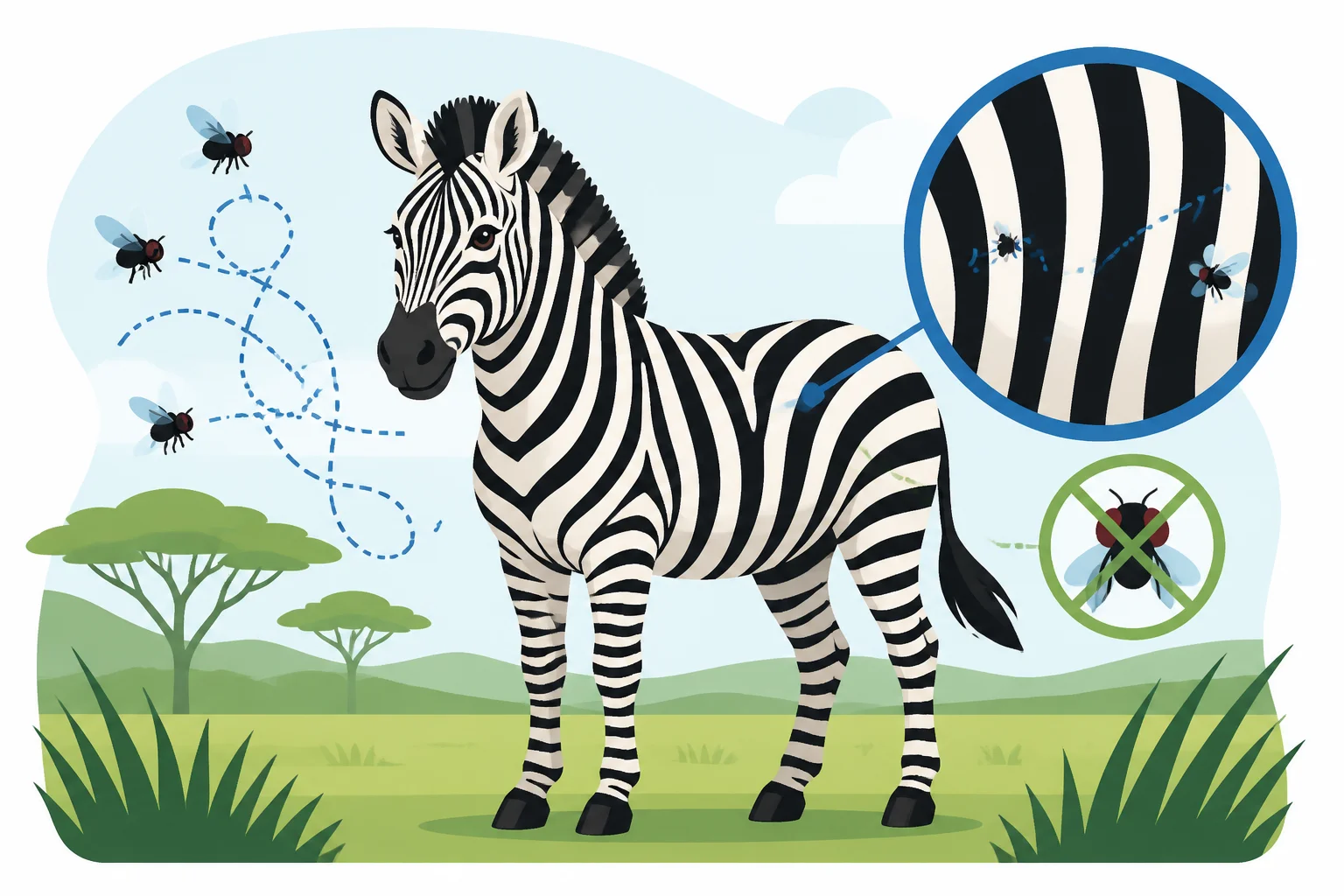
The close-up fly work is the part people usually miss. The stripes do not necessarily stop every fly from approaching. In a 2019 PLOS ONE experiment, researchers observed tabanid flies around zebras and horses and also used striped coats on horses. Flies still came near zebras, but they landed much less successfully. The visual pattern appears to disrupt the final landing phase.
That is a cleaner payoff than "flies are confused" in a vague way. Think of it as a navigation problem. A fly trying to land has to control speed, distance, and angle in the last fraction of the approach. A striped surface can make that final read unreliable. Later Scientific Reports work framed the biting-fly hypothesis as the best-supported one while still asking what exact visual features of real zebra coats matter most.

Camouflage is the tempting answer, but not the strongest one
Camouflage feels intuitive because humans look at a zebra and see a pattern. Predators, however, do not see like humans, and zebras do not behave like quiet camouflage artists. A UC Davis visual-modeling study reported that zebra stripes are unlikely to work as effective camouflage against major predators at useful viewing distances. By the time a lion or hyena is close enough for the pattern to become clear, scent, movement, and sound may already matter more.
That is a nice example of why a half-known answer can be dangerous. "Stripes hide zebras" sounds plausible until you ask: hide from whom, at what distance, in what habitat, under what light, and compared with what sensory cue? Curiosity gets sharper when the question becomes more specific.

Cooling, confusion, and recognition are not all equal
Thermoregulation is another famous idea: black and white stripes absorb and reflect sunlight differently, so maybe they create tiny air currents or help regulate heat. The problem is not that this is impossible. The problem is that it has not displaced the fly evidence as the best-supported explanation. The same goes for predator confusion. A mass of moving stripes may make it harder to isolate one body in a herd, and San Diego Zoo describes overlapping stripes as one form of protection. But that does not prove the stripes originally evolved mainly for that reason.
Individual recognition is real in a practical sense: stripe patterns differ, and researchers use them to identify animals. It is also true that foals must learn their mothers, and San Diego Zoo notes that mothers may separate briefly so foals can imprint. Still, "humans can identify zebras by stripes" is not the same as "stripes evolved for ID cards." A good zebra fact keeps those levels separate.

Zebras are built for a grass problem
The stripes get the fame, but the digestive system explains the daily life. Zebras are equids, not ruminants, so they do not process grass like cattle. They are high-volume grazers, clipping tough grasses with strong incisors and relying on hindgut fermentation to extract enough energy from fibrous plants. The Smithsonian National Zoo notes that Grevy's zebras feed mainly on grasses but also eat bark, fruit, and leaves, and that poor nutrient quality can make eating occupy a large share of the day.
That turns a plain grazing scene into a mechanism. A zebra is not casually nibbling because the landscape is abundant. It is running a constant intake strategy on food that many animals cannot use efficiently. This is also why zebras can shape grasslands for other grazers: by taking coarse top growth, they help open the way for fresh shoots and for species that prefer more tender forage.

Herd life is protection, communication, and memory
Zebra society depends on the species. Plains and mountain zebras live in family groups with a stallion, mares, and young; those family groups may gather into larger herds. Grevy's zebras are different: males hold territories, while females and young move through them more loosely. San Diego Zoo makes this distinction clearly, which is why "zebras live in herds" is only partly true unless you say which zebra.
The visible social cues are also more detailed than the postcard version. Zebras use calls, ear positions, facial expressions, grooming, and movement to coordinate. When they rest at night, San Diego Zoo describes zebras lying down while one stands watch. A foal has to get up quickly, follow its mother, and learn her pattern. The stripes are therefore part of a larger social world, not a standalone costume.
Three zebra species, three different answers
There are three living zebra species: plains zebra, mountain zebra, and Grevy's zebra. San Diego Zoo describes Grevy's as the largest, with narrow stripes and large rounded ears; mountain zebras have a distinctive dewlap and different striping on the haunches; plains zebras are the most abundant and include subspecies with "shadow" stripes between darker bands. These differences matter because the popular question "why do zebras have stripes?" hides a second question: why do different zebras have different stripe patterns?
That is where the topic becomes more than a fact list. If stripes help with flies, why do stripe widths and patterns vary? If species live in different habitats and social systems, how much of the pattern is shaped by fly pressure, heat, predator pressure, ancestry, or constraints inherited from earlier equids? A good answer gives closure without pretending the next question disappeared.
What people usually miss
The common mistake is treating "why zebras have stripes" as if one sentence can carry all the biology. The better version has layers. The strongest current evidence says biting flies are central. Some other ideas may still matter in limited ways. And the animal wearing the stripes is not just a stripe machine: it is a social grazer, a traveler, a defensive kicker, a mother-following foal, and a set of species adapted to different African landscapes.
The payoff is not that the old classroom answer was stupid. It is that the real answer is more satisfying. A zebra's coat is not just decoration; it is a visual interface between mammal, insect, predator, herd, heat, and habitat. That is exactly where curiosity does its best work: you thought you knew the animal, then one small gap opened and the whole body became interesting again.
Related videos
FAQ
What are the best fun facts about zebras?
The strongest ones explain a mechanism: stripes reduce biting-fly landings, zebra patterns are individually distinctive, foals learn their mothers quickly, and different zebra species have different stripe layouts and social systems.
Why do zebras have stripes?
The best-supported explanation is that stripes help deter biting flies, especially during the final landing phase. Camouflage, cooling, predator confusion, and recognition have been discussed, but they are not equally supported.
Are zebras black with white stripes or white with black stripes?
Zebras have dark skin under the hair, while the coat pattern grows as black or brown stripes on lighter hair. The more useful answer is that the visual contrast matters more than the color-label puzzle.
Do all zebras have the same stripe pattern?
No. Individuals differ, and species differ too. Plains, mountain, and Grevy's zebras all have recognizable stripe styles, which is one reason a single zebra fact often needs a species caveat.
What does this have to do with AIgneous Million Whys?
This is the Million Whys shape: a familiar animal, a half-known answer, and then real closure that opens the next gap. "Stripes are camouflage" is easy; "stripes make fly landings fail" is the spark that compounds.
Keep reading
Sources
Caro et al. 2014: The function of zebra stripes
Caro et al. 2019: Benefits of zebra stripes
Caro et al. 2022: Zebras of all stripes repel biting flies at close range
UC Davis: Zebra stripes not for camouflage, new study finds
Curious? Try one 👇
Why is the sky blue?
Jump into the daily quiz →Keep Exploring
Related Posts
Interesting Facts About Chameleons: Color and Tongue
Interesting facts about chameleons: color change is not magic camouflage; it is signaling, skin physics, eye geometry, and a ballistic tongue explained.
Random Animal Facts: Weird Adaptations Explained
Random animal facts explained through real adaptations: polar bear fur, anteater tongues, salmon homing, skunk spray, bee dances, and elephant trunks.
Fun Facts About Beavers: Nature's Water Engineers
Fun facts about beavers explain orange teeth, dams, lodges, wetlands, and why these rodents quietly redesign streams for other species.