

Facts About Giraffes: The Neck Is the Trap
On this page· 15
Facts about giraffes get strange fast because the famous neck is not just a ladder for leaves. It is a whole engineering problem. A giraffe has to pump blood roughly two meters upward to its brain, then lower that same brain toward the ground to drink without turning the skull into a pressure accident. The familiar textbook answer, "long necks evolved to reach tall trees," is only the first doorway. The more interesting question is how the animal survives the body plan at all.
TL;DR
Giraffes are not just tall browsers; they are pressure-managed mammals. Their blood pressure can reach about 280/180 mmHg, their heart weighs around 11 kg, their legs use tight skin and fascia like a natural anti-gravity suit, and their neck evolution is still debated. The real payoff is this: the neck is both an evolutionary question and a cardiovascular solution.
The short answer: giraffes live with blood pressure about twice human pressure because gravity makes the head a hard place to perfuse. Their bodies manage that pressure with a strong heart, specialized vessels, tight lower-leg tissues, and head-position responses during drinking. The neck itself may have been shaped by feeding height, male combat, vigilance, or several pressures together, so the honest answer is not a single cartoon of an animal stretching toward leaves.
Curious? Try one 👇
Why is the sky blue?
Jump into the daily quiz →The neck creates a blood-pressure problem first
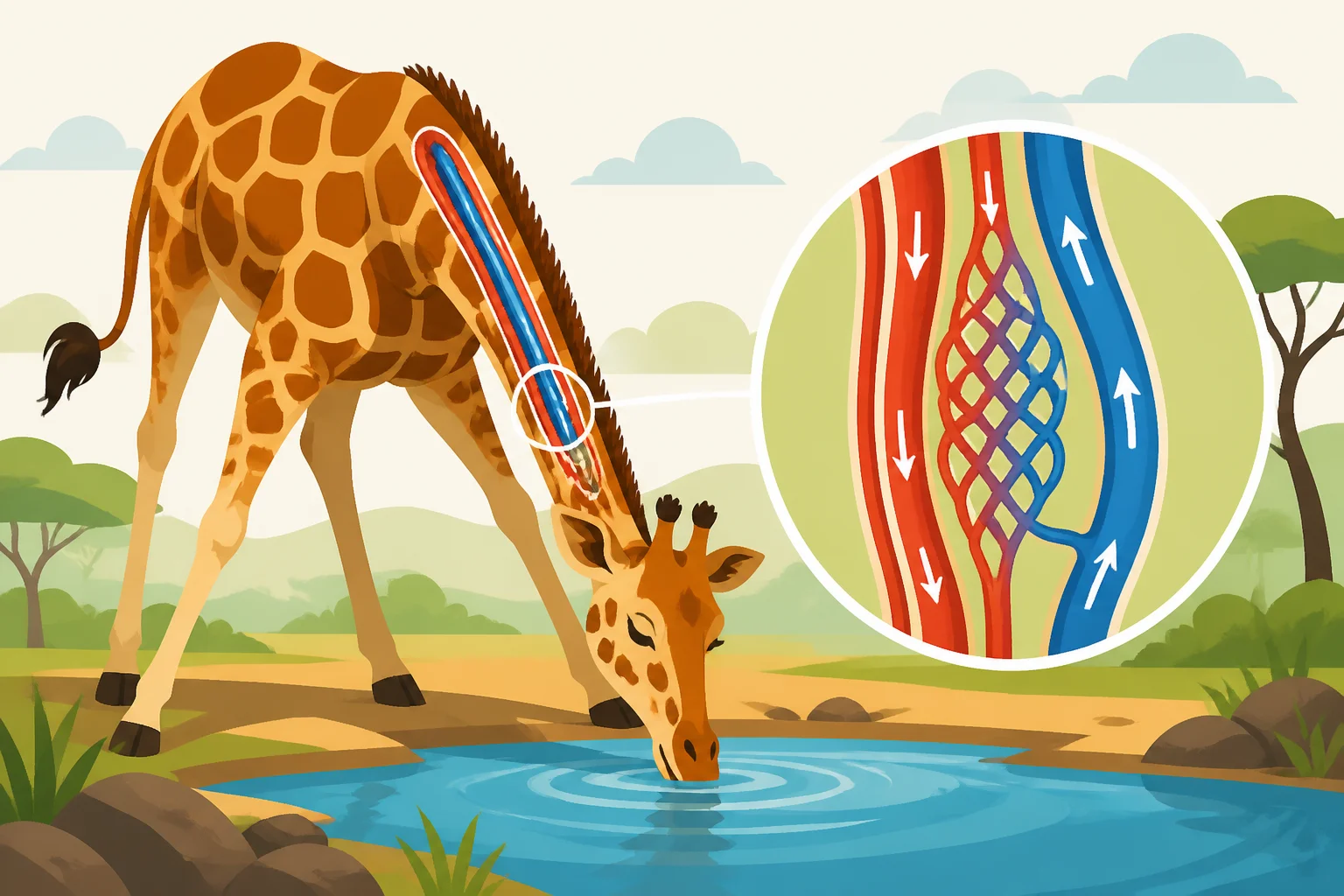
A giraffe's head is often around two meters above its heart, which means ordinary mammal pressure would not reliably push blood up the neck. The Giraffe Conservation Foundation summarizes the adult figure at up to about 280/180 mmHg, compared with a common human reference of 120/80 mmHg, and gives the heart mass at around 11 kg (Giraffe Conservation Foundation). That number is not decoration. It is the price of being tall and still keeping the brain awake.
Recent physiology work frames the same problem in energy terms: long necks impose a hydrostatic gradient, so each meter of height demands extra pressure at heart level. A 2025 paper on giraffe limb and heart geometry reports adult mean arterial pressure at the heart around 200-250 mmHg and notes that every meter of height requires about 77 mmHg of additional pressure (Seymour and Snelling, Journal of Experimental Biology). That is why "the giraffe has a long neck" is not a cute fact; it is a circulatory budget.
There is a small trap here: a giraffe's high pressure is not simply "more power is better." If pressure is too low, the brain is under-supplied; if pressure is unmanaged, the lower body and lowered head are at risk. The animal has to solve opposite constraints at the same time. It must be forceful enough to send blood uphill, yet controlled enough that the same force does not flood tissues downhill. That tension is what makes the giraffe such a useful model for gravitational physiology.

Drinking is the part that feels impossible
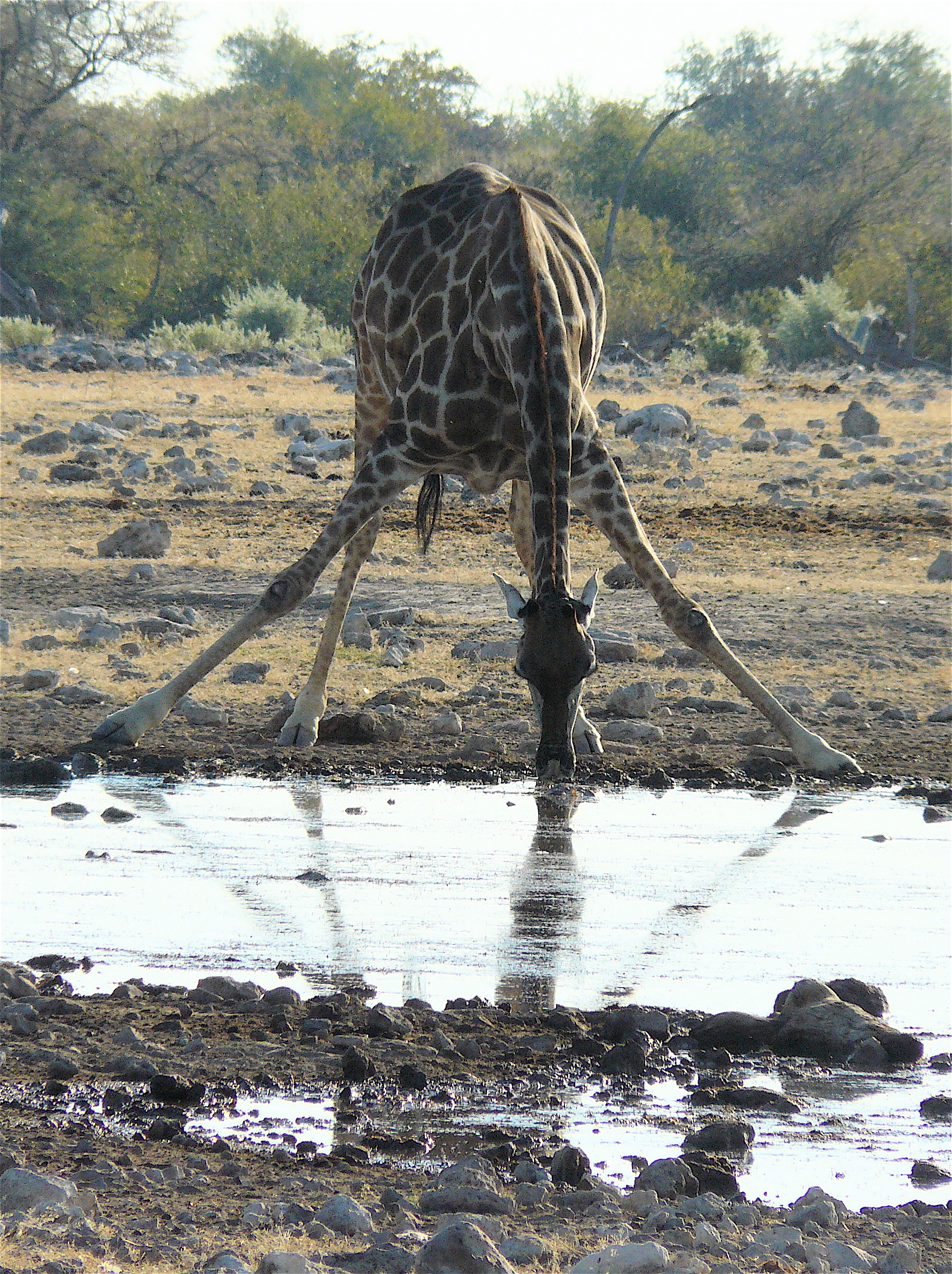
Now flip the geometry. To drink, a giraffe spreads its front legs and lowers its head by a large vertical distance. If you imagine only a pump and a pipe, that should send blood pressure toward the head in exactly the wrong direction. This is where many popular explanations say "a valve fixes it" and move on. The real picture is subtler.
A 2025 study, Hemodynamics and Drinking in the Giraffe, found that lowering the head was associated with decreases in proximal carotid blood pressure and heart rate, and that drinking itself produced oscillating increases in jugular pressure, likely from swallowing movements (Brondum et al., 2025). The authors also note that regulation during drinking remains debated. In other words, the giraffe is not saved by one cartoon valve. It uses a dynamic system: heart rate shifts, vessel pressures change, venous flow is managed, and the whole neck behaves more like active plumbing than a hose.

The legs are wearing a natural g-suit
High pressure is not only a head problem. The lower legs are below the heart, so fluid should tend to pool there. Giraffes avoid walking around with swollen legs partly because their skin and fascia are unusually tight. A classic Nature paper on gravitational hemodynamics described tight skin as helping move fluid upward against gravity, with other edema-prevention mechanisms including precapillary vasoconstriction and low capillary permeability (Hargens et al., Nature, 1987).
Later cardiovascular anatomy work uses the same memorable phrase: thick skin and tight underlying fascia function like a "g-suit" alongside vessel-wall changes and sympathetic innervation (Nilsson et al., 1988). That comparison matters because it moves the giraffe from "long animal" to "pressure suit animal." The shape is not just held up by bones; it is hydraulically managed by tissue.
The neck-for-leaves story is not wrong, but it is too neat
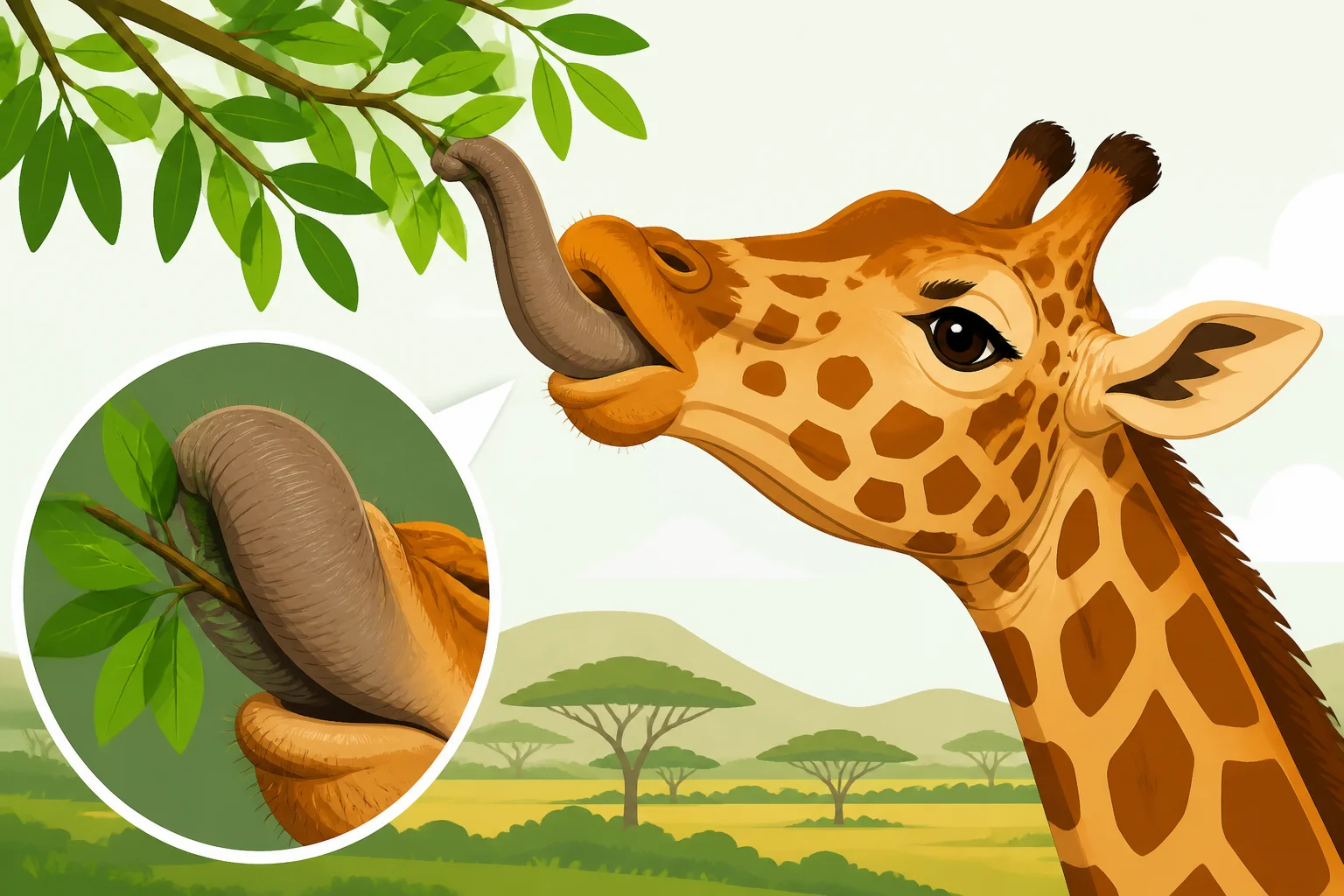
The classic browser story says a long neck lets giraffes eat foliage other herbivores cannot reach. That is plausible and still important, but it is not the whole debate. In 1996, Robert Simmons and Lue Scheepers proposed the "necks-for-sex" hypothesis: male giraffes fight by swinging their necks and heads, so sexual selection might have favored longer, heavier necks (Simmons and Scheepers, 1996).
The right way to read that idea is as a competing hypothesis, not a solved replacement. Reviews since then have found the evidence mixed. A Biology review on giraffe stature and neck elongation argues that neither the feeding nor sexual-selection story fully closes the case, and proposes vigilance as another possible pressure (Williams, 2016). That is a better curiosity payoff than "because leaves": evolution often works like a messy committee, not a single-purpose invention.
The skull and skeleton turn the neck into a weapon and sensor
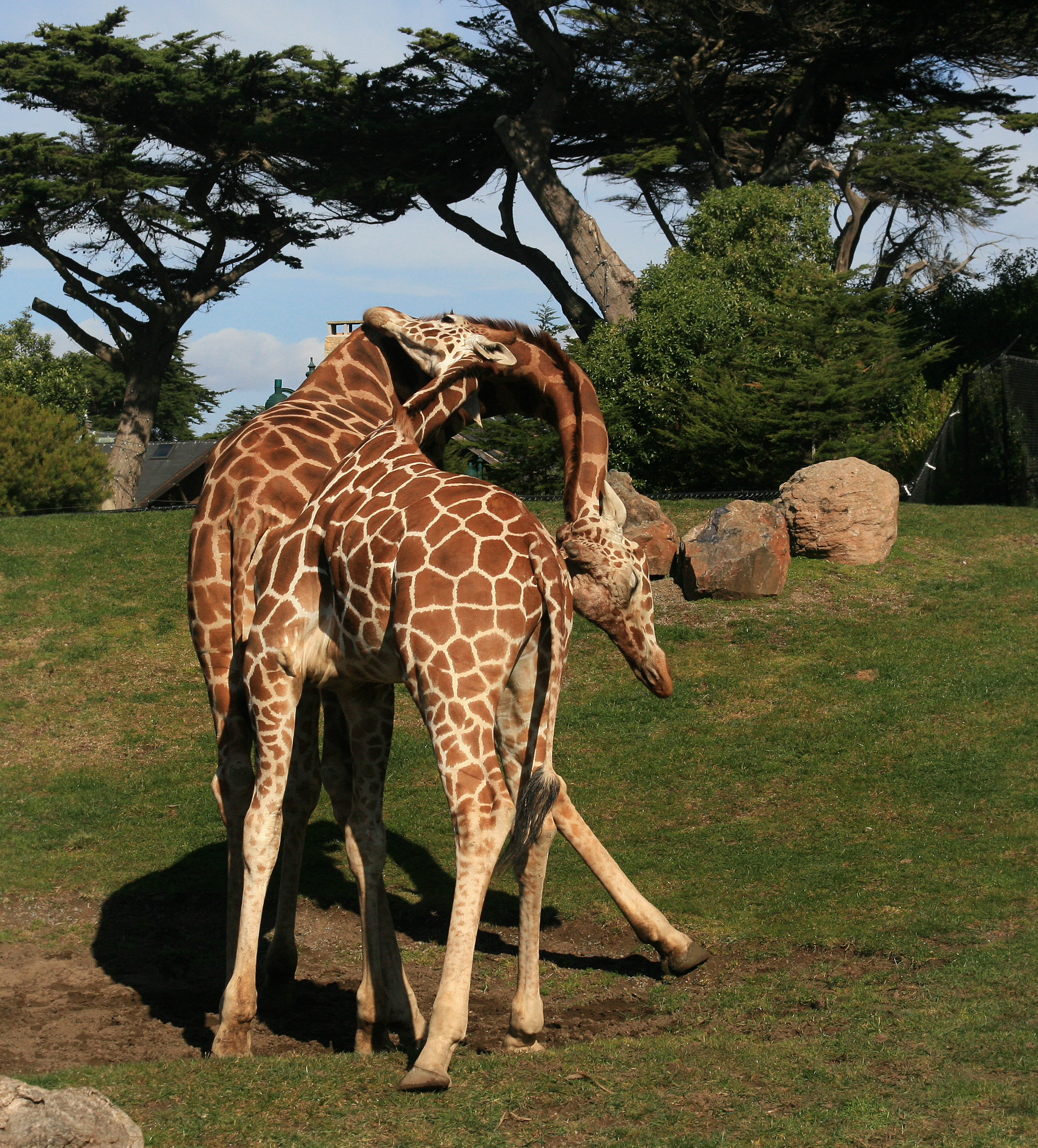
Male giraffe fights are not gentle pushing contests. The head carries ossicones, the skin-covered hornlike structures on top of the skull, and males swing the head and neck like a weighted club. That does not prove sexual selection created the neck, but it does explain why the neck cannot be understood only as a feeding tube. It is also a lever, a display surface, a lookout tower, and a social weapon.
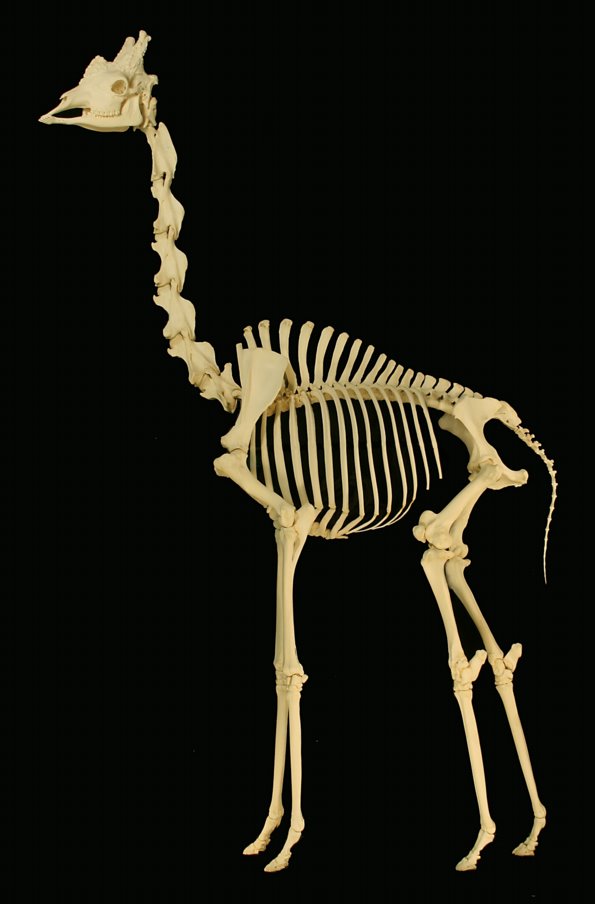
Look at the skeleton and the weirdness becomes clearer: giraffes have the same basic count of seven cervical vertebrae as humans, but each neck vertebra is dramatically stretched. The animal did not solve height by adding many little neck bones. It elongated the standard mammalian pattern and then had to solve the consequences in blood, muscle, ligament, and behavior.
That is also why the neck is not free. Long vertebrae need support from muscles and connective tissue; a high head changes balance while walking and galloping; and a long lever becomes useful in male combat only if the skull, ossicones, and neck can tolerate impact. The anatomy is therefore a bundle of trade-offs. The same structure that reaches leaves creates a hydraulic challenge, becomes a weapon, raises the visual field, and forces the body to invest in support systems that shorter mammals do not need.

What people usually miss
The common mistake is treating "why do giraffes have long necks?" as if it asks for one cause. It actually asks two questions. First: what selection pressures made a long-necked body worth the cost? Second: what physiological machinery lets that body work every day? The first question is still contested. The second is where the marvel is: high pressure without constant damage, drinking without blackout, legs without edema, and a body plan that turns an awkward silhouette into a living pressure-management system.
Related videos
FAQ
What is the most surprising fact about giraffes?
Their blood pressure is the surprise hiding behind the neck. A giraffe needs very high pressure to send blood up to the brain, but it also needs safeguards when the head comes down to drink.
Is a giraffe's heart really around 11 kg?
Yes, that figure is commonly given by giraffe-focused conservation sources, including the Giraffe Conservation Foundation. The heart is large because the left ventricle has to pump blood through a very tall body.
Did giraffes evolve long necks only to reach leaves?
No one should state it that neatly. Feeding height is a major hypothesis, but sexual selection, vigilance, and mixed-pressure explanations are also discussed in the scientific literature.
Why do giraffes not faint when they drink?
They use posture, changing heart and vessel dynamics, venous pressure management, and other circulatory adaptations. Recent research suggests the drinking response is dynamic, not a single simple valve trick.
What does this have to do with AIgneous Million Whys?
This is exactly the kind of question Million Whys is built for: a familiar animal, a half-known answer, and then a satisfying closure that opens the next gap. "Long neck for leaves" is the start; the real spark is the pressure system that makes the neck possible.
Sources
Giraffe Conservation Foundation: How does a giraffe's heart work?
Brondum et al. 2025: Hemodynamics and Drinking in the Giraffe
Hargens et al. 1987: Gravitational haemodynamics and oedema prevention in the giraffe
Nilsson et al. 1988: Sympathetic innervation of the cardiovascular system in the giraffe
Curious? Try one 👇
Why is the sky blue?
Jump into the daily quiz →Keep Exploring
Related Posts
Fun Facts About Zebras: What Stripes Really Do
Fun facts about zebras: stripes deter biting flies, but the real story also includes herd life, digestion, species differences, and stripe myths explained.
Random Animal Facts: Weird Adaptations Explained
Random animal facts explained through real adaptations: polar bear fur, anteater tongues, salmon homing, skunk spray, bee dances, and elephant trunks.
Interesting Facts About Platypus: Nature's Puzzle
Interesting facts about platypus biology: eggs, venom, electric bills, milk without nipples, glowing fur, and why this mammal feels assembled from questions.