

Fun Facts About Penguins: Adaptations Explained
On this page· 16
Fun facts about penguins are best when they stop being cute trivia and turn into mechanisms. The tuxedo is camouflage. The awkward walk is attached to a body tuned for water. The bare feet on ice are not a mistake; they are part of a heat-control system. Penguins look like birds that gave up on flying, but the better answer is stranger: they traded air for water, then rebuilt almost every visible feature around that bargain.
TL;DR
Penguins are flightless birds whose "impossible" traits make sense once you read them as aquatic engineering. Dense feathers trap air, counter-current blood flow limits heat loss through feet and flippers, black-and-white countershading hides them in water, salt glands handle excess sea salt, and emperor penguins use huddles plus deep-diving physiology to survive one of Earth's hardest breeding environments.
Short answer: Penguins are adapted for cold water more than for cute waddling. Their bodies solve three linked problems: keeping heat, moving efficiently underwater, and feeding in saltwater without becoming dehydrated. The satisfying closure is that most "fun facts about penguins" are not random. They are trade-offs created by one evolutionary decision: use wings as flippers and make the ocean the main room.

Curious? Try one 👇
Why is the sky blue?
Jump into the daily quiz →The tuxedo is not for the ice
The black-and-white pattern is usually described as a penguin tuxedo, which is charming and slightly misleading. The color pattern matters most underwater. The University of Texas Marine Science Institute describes penguin countershading as a two-toned camouflage system: a dark back is harder to pick out from above against dark water, while a pale underside is harder to see from below against the brighter surface.

That detail changes the whole animal. On land, the white belly can look conspicuous against snow. In the sea, the same pattern becomes a visibility trick. A predator looking down sees a dark back against dark water; a fish looking up sees a pale belly against light. The tuxedo is less "formalwear" than a moving optical compromise.
The feathers are a dry suit made of tiny parts
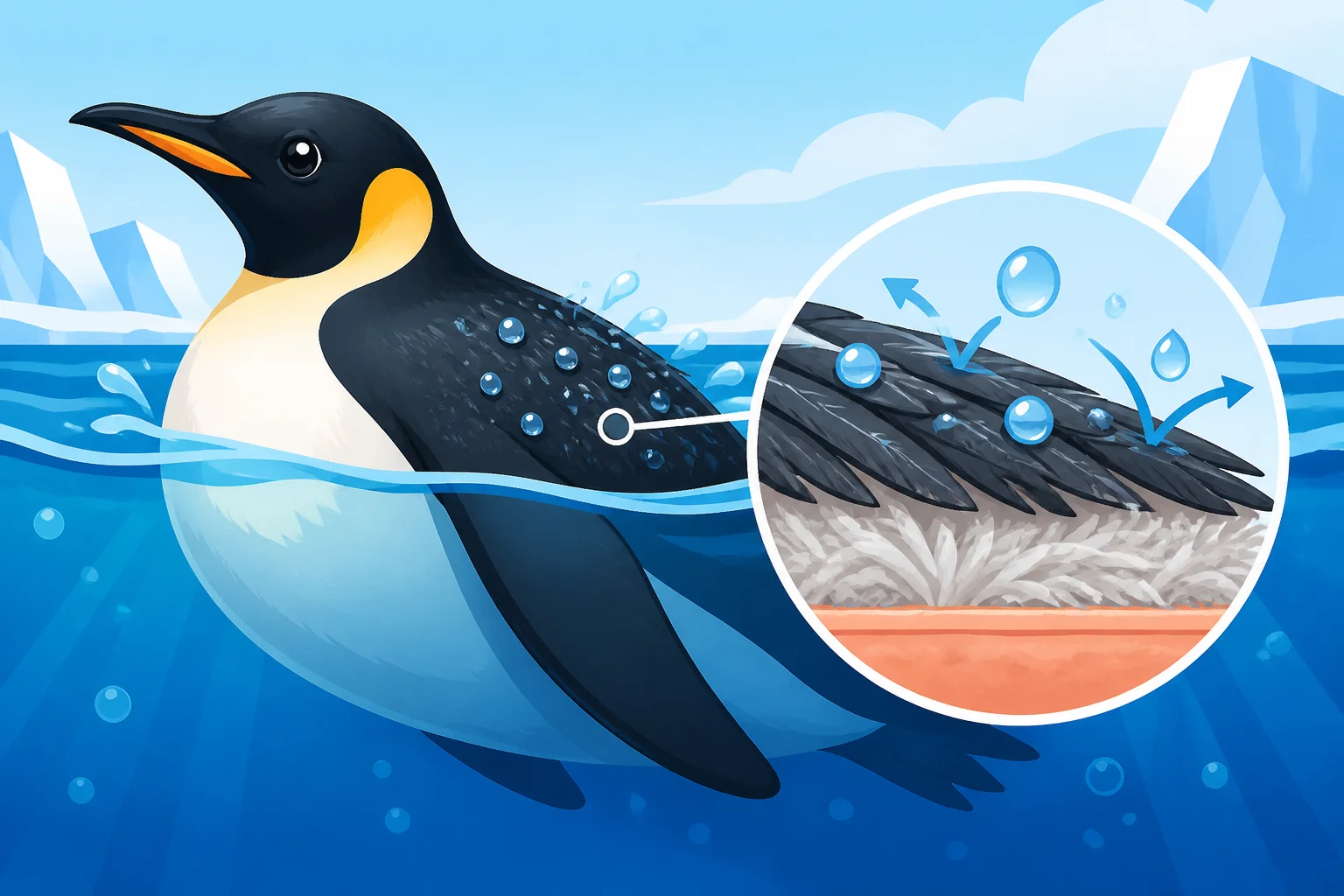
A penguin does not stay warm because one big fluffy coat magically works in seawater. Penguin Science explains that Adelie penguins have short, cup-shaped, closely overlapping feathers that help make a waterproof cover, with downy tufts near the base trapping warm air close to the skin. A separate Penguin Science preening note describes the oil gland near the tail that helps keep feathers smooth, clean, and waterproof; a peer-reviewed emperor penguin feather study also describes contour feathers forming a rigid waterproof cover over an insulating layer of down.

This is why molting is such a serious event. If the feather coat is the waterproofing, insulation, and streamlining system, replacing it is not like changing a jacket. During molt, penguins are temporarily less ready for the sea, so the timing has to fit their feeding and breeding cycle. The simple "penguins have feathers" fact becomes more interesting once you notice that the whole animal depends on keeping those feathers clean, overlapped, oiled, and renewed.
Their feet are cold on purpose
Penguins stand on ice with bare-looking feet, which seems like bad design until you follow the blood. Penguin Science describes counter-current heat exchange in the legs: warm blood going toward the feet runs close to colder blood returning from the feet, so heat is transferred back toward the body. That means the cold-looking foot is part of the heat budget, not a design oversight.
That means the foot can be kept much cooler than the body core. A warm foot would dump precious heat into the ice or cold water. A cooler foot loses less heat, while returning blood is warmed before it reaches the body. It is not that penguins are immune to cold. It is that they budget heat carefully, sending it where it matters and not wasting it through the part touching the ice.
The wing became a flipper, and the bird accepted the cost
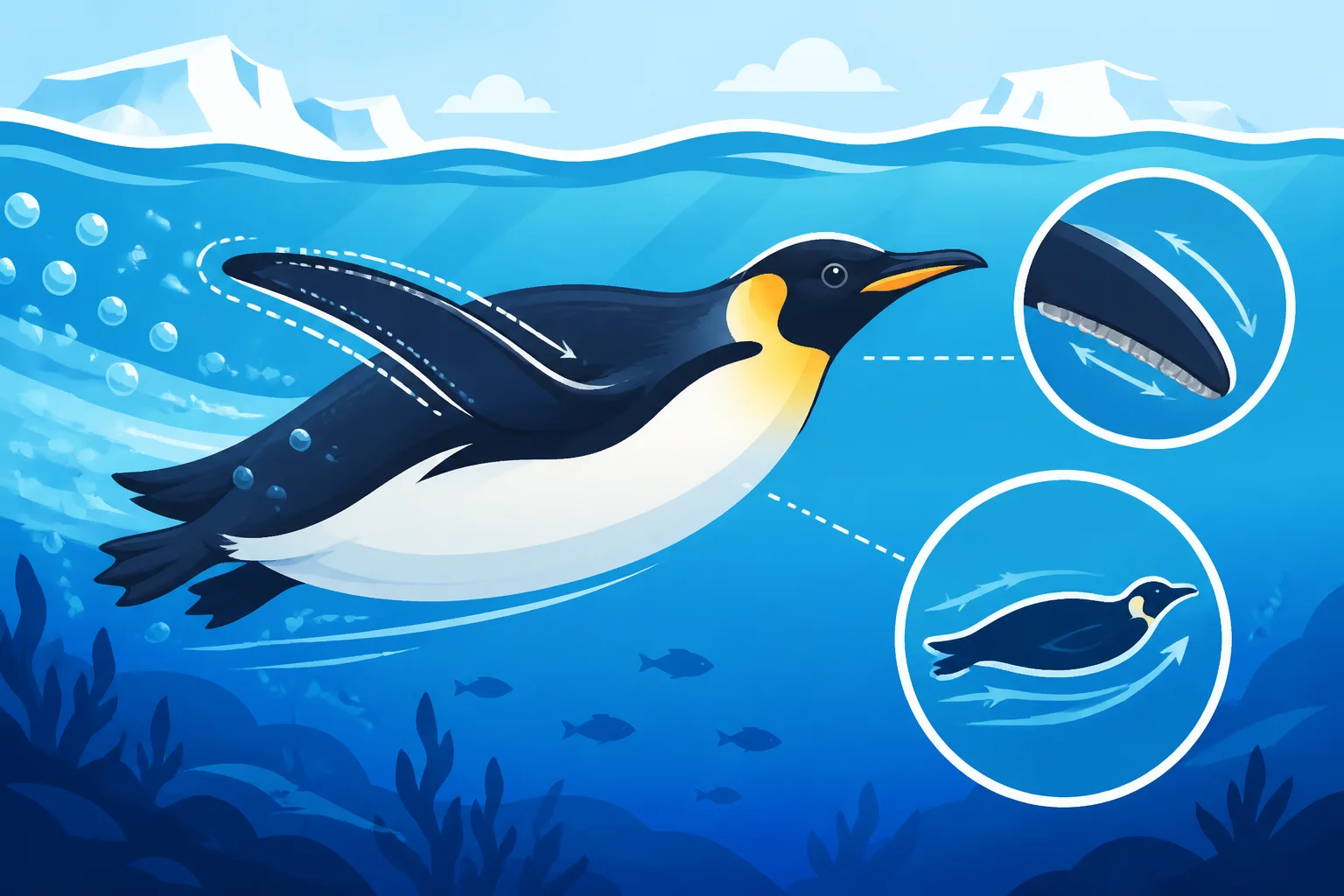
Penguins are not failed flyers. They are birds whose wings became underwater tools. Aerial flight and underwater "flight" ask for opposite designs. Air rewards long, light wings; water rewards short, stiff, powerful flippers. Once penguins committed to chasing prey underwater, the old bird bargain changed. The body became denser and more streamlined, the wings stopped folding like ordinary bird wings, and swimming became the main performance.
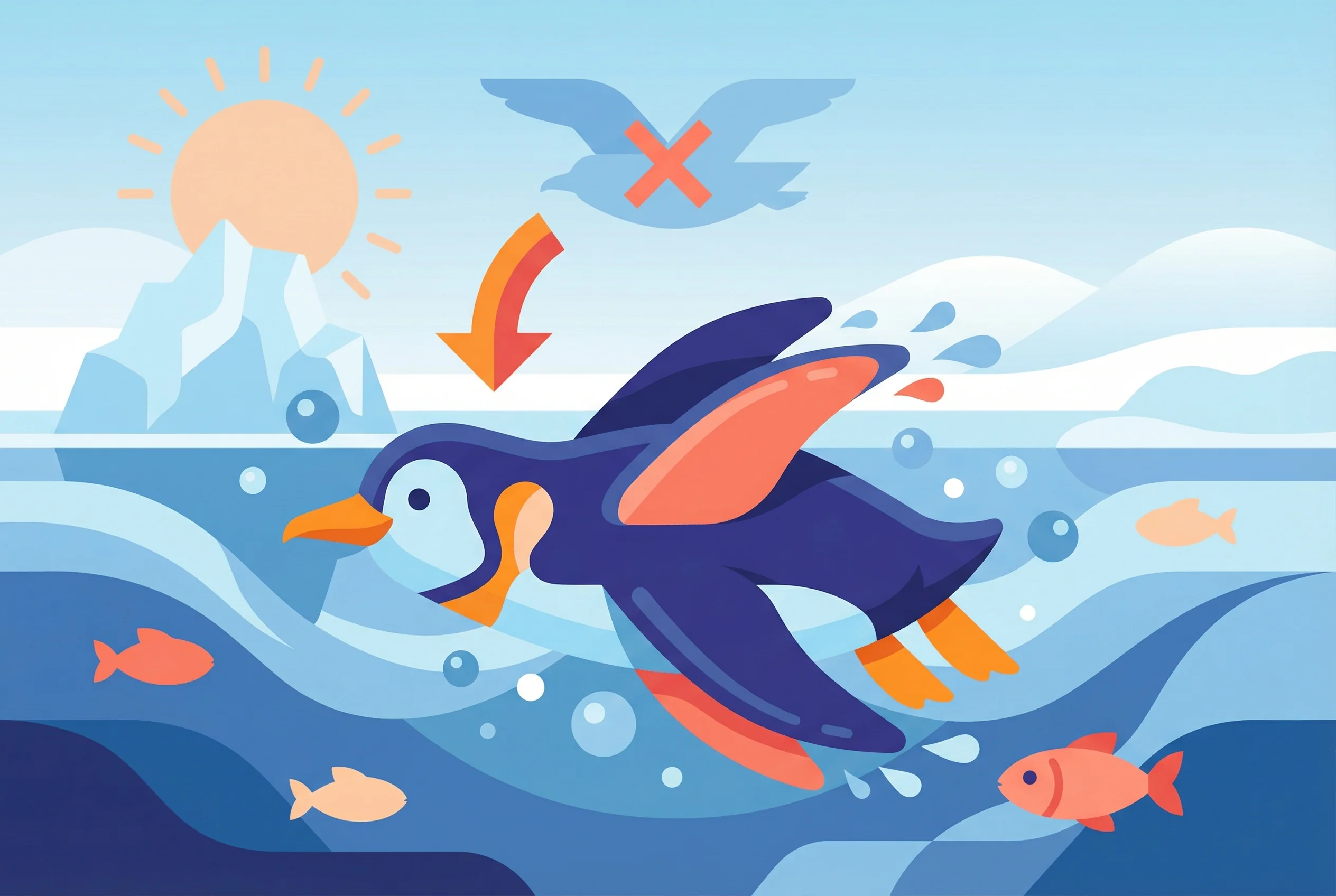
The payoff can be extreme. NOAA Ocean Today notes that emperor penguins can dive to 1,850 feet, deeper than any other bird, and stay underwater for more than 20 minutes. Scripps Institution of Oceanography describes emperor penguins using deep Ross Sea banks as reliable foraging habitat, with dives beyond 400 meters recorded in the research. Those numbers are not party facts; they reveal what the flipper trade bought. Penguins lost sky travel, but they gained access to a cold, dense, prey-filled world most birds cannot use.
They do not drink the ocean the way a cartoon would
Another popular penguin fact says they can drink saltwater. The safe version is more precise: penguins and other marine birds can handle excess salt because they have salt-removing glands. The Saint Louis Zoo notes that king penguins have a special gland that removes salt after they swallow saltwater. That fits the broader seabird pattern: the salt problem is not ignored, it is routed through specialized anatomy.
That does not mean a penguin magically turns seawater into a glass of fresh water. It means salt balance is actively managed after salt enters the body through prey and seawater. The mechanism is wonderfully unglamorous: remove the extra salt, send it toward the bill, and get rid of it as concentrated brine. The animal's elegance is not in looking graceful on land. It is in making marine living chemically possible.
Emperor penguin huddles are social physics
Emperor penguins add a final layer: group behavior. They breed during Antarctic winter, when the physics is brutal. A paper in New Journal of Physics describes emperor penguins surviving temperatures below -50°C and wind speeds above 150 km/h, then analyzes huddling as a phase transition from a fluid to a solid-like state. PLOS ONE modeling treats the huddle as a heat-preservation problem where boundary birds move as conditions change.

That is the part people usually miss. Huddling is not just "standing close because cold." It is a moving system. Birds at the cold edge do not stay sacrificed forever; the group shifts. The colony behaves like a living heat-sharing pattern, where individual motion and collective shape keep more birds alive than solitary toughness could.
What people usually miss
The biggest missed point is that penguins are not optimized for land. The waddle is the visible cost of being built for the sea. If you judge a penguin on ice, it looks comic. If you judge it underwater, the same body becomes fast, controlled, and efficient.
The second missed point is that each adaptation solves more than one problem. Feathers insulate, waterproof, streamline, and need annual replacement. Color works as camouflage in water, not as decoration on ice. Salt glands turn a salty diet into a survivable chemistry problem. Huddling is social behavior, but it is also heat transfer.
The third missed point is the curiosity lesson. A good penguin fact should not end at "wow." It should close one gap and open another: if feathers trap air, what happens during molt? If feet are cold on purpose, how cold is safe? If wings became flippers, what did the bird give up? That is where a cute fact becomes a compounding question.
Related videos
FAQ
What is the most surprising fun fact about penguins?
Their feet are managed for heat loss. Counter-current blood flow helps keep body heat in the core while allowing the feet to stay cooler on ice and in cold water.
Why are penguins black and white?
The pattern is countershading. In water, a dark back blends better with darker depths from above, while a light belly blends better with the brighter surface from below.
Can penguins really drink saltwater?
They can handle salt from seawater and salty prey because glands above the eyes remove excess salt from the blood and excrete concentrated brine. It is salt management, not magical instant freshwater.
Why can emperor penguins dive so deep?
They are built as underwater hunters: streamlined bodies, flipper-like wings, oxygen-management physiology, and a life spent feeding in cold ocean systems. NOAA notes emperor penguins can dive to 1,850 feet and stay under for more than 20 minutes.
What does this have to do with AIgneous Million Whys?
AIgneous Million Whys is built for this exact pattern: a half-known fact, a quick guess, and then a real mechanism that gives closure. Penguins are not just cute; they are a stack of tiny "why" questions that compound.
Curious? Try one 👇
Why is the sky blue?
Jump into the daily quiz →Keep Exploring
Related Posts
Random Animal Facts: Weird Adaptations Explained
Random animal facts explained through real adaptations: polar bear fur, anteater tongues, salmon homing, skunk spray, bee dances, and elephant trunks.
Fun Facts About Hedgehogs: Spines, Sleep, Survival
Fun facts about hedgehogs: how spines, curling, night foraging, hibernation, and connected gardens turn a cute animal into survival engineering today.
Fun Facts About the Ocean: Pressure, Light, Life
Fun facts about the ocean, from crushing pressure and fading sunlight to phytoplankton oxygen, deep-sea animals, vent life, and why the blue surface fools us.