

Fun Facts About the Ocean: Pressure, Light, Life
On this page· 15
Fun facts about the ocean get much better when they stop being postcard facts. The ocean is blue at the top, but most of it is dark, cold, pressurized, and alive in ways that make land feel like the special case. The useful question is not just "what is down there?" It is why pressure rises so brutally, why sunlight disappears so fast, and how life keeps finding closure in places where sunlight never arrives.
TL;DR
The ocean is not one habitat. It is a stack of physical worlds: a thin sunlit skin, a fading twilight layer, a dark deep ocean, and chemically powered oases on the seafloor. Pressure rises by about one atmosphere every 10 meters, significant sunlight is rare beyond 200 meters, and tiny phytoplankton near the surface produce roughly half of Earth's oxygen. The blue surface is only the cover; the mechanism is underneath.
Short answer: The strangest fun facts about the ocean are all mechanism facts. Water pressure increases because every deeper layer carries the weight of the water above it; light disappears because water and particles absorb and scatter photons; surface plankton power oxygen and food webs through photosynthesis; and some deep-sea communities use chemosynthesis around hydrothermal vents when sunlight is gone. NOAA's ocean facts on pressure, light, oxygen, and chemosynthesis are the backbone for the facts below.
Curious? Try one 👇
Why is the sky blue?
Jump into the daily quiz →Pressure turns depth into a physics problem
The first ocean fact to keep in your head is wonderfully simple: for every 33 feet, or 10.06 meters, you go down, pressure increases by one atmosphere, according to the NOAA National Ocean Service. That means the first few meters of a dive are not just scenery; your ears notice the added force almost immediately. The deeper you go, the more water sits above you, and the weight of that water presses from all directions.
That is why the deep ocean is so hard for humans and machines. NOAA Ocean Exploration notes that at 2,000 meters below the surface, pressure is around 200 atmospheres; most organisms with gas-filled spaces like lungs or swim bladders would be crushed by pressures that many deep-sea animals tolerate because their bodies are largely water and lack vulnerable air pockets (NOAA Ocean Exploration). The point is not that deep animals are "stronger" in a superhero sense. They are built around a different pressure baseline.
The deepest ocean pushes that idea to the edge. NOAA's deep-sea marine life explainer describes the bottom of the Mariana Trench, over 11,000 meters deep, as reaching about eight tons per square inch, roughly a thousand times standard atmospheric pressure (NOAA Ocean Exploration). That is the part people usually miss: the deep ocean is not merely far away. It is physically another world stacked under the one we swim in.
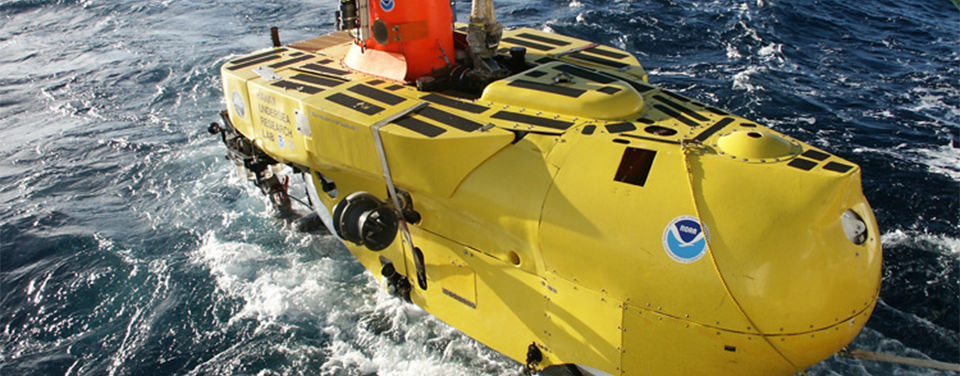
Sunlight only owns the ocean's thin top layer
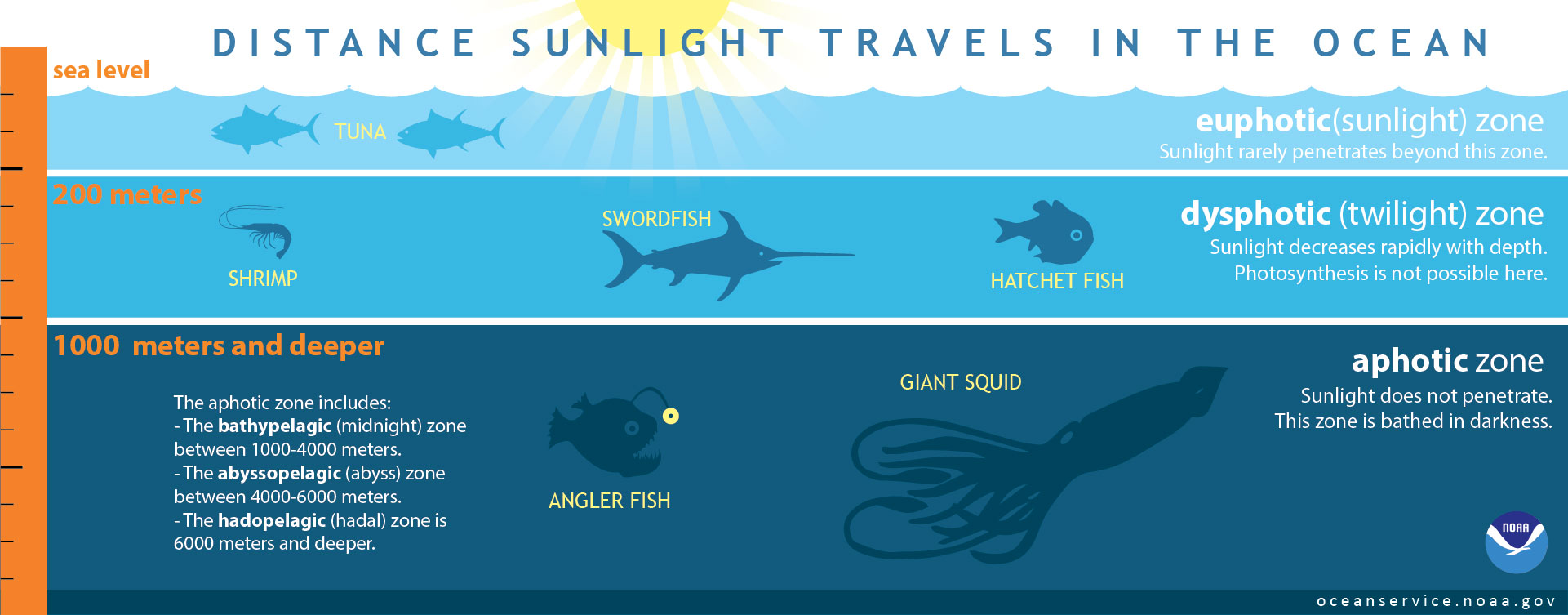
The second mechanism is light. NOAA explains that sunlight may be detected as far down as 1,000 meters under the right conditions, but there is rarely significant light beyond 200 meters (NOAA National Ocean Service). The upper 200 meters are the euphotic, or sunlight, zone. From 200 to 1,000 meters is the dysphotic, or twilight, zone, where light fades too quickly for photosynthesis. Below 1,000 meters, the aphotic zone is effectively dark.
That reframes the ocean. Most beach thinking treats the ocean as a blue surface with a bottom somewhere. Biology treats it more like a vertical city where the lighting system changes floor by floor. The bright top layer is where photosynthesis can happen. Below it, animals cannot count on plants making food in place, so they depend on sinking organic material, migration, predation, or chemical energy from special seafloor systems.
The color itself is a clue. Water absorbs longer red wavelengths relatively quickly and scatters shorter blue wavelengths more effectively, while suspended particles and plankton change what satellites see from above. NASA's ocean color work tracks chlorophyll partly because phytoplankton alter reflected light; the ocean's color can reveal the seasonal pulses of life near the surface (NASA Earth Observatory).
The air you breathe is partly an ocean story
Here is the ocean fact that still sounds fake even after you verify it: NOAA says scientists estimate roughly half of Earth's oxygen production comes from the ocean, mostly from photosynthetic plankton, algae, and bacteria near the surface (NOAA National Ocean Service). One small cyanobacterium, Prochlorococcus, is credited by NOAA with producing up to 20 percent of the oxygen in the biosphere.
That does not mean every second breath literally just floated out of today's waves. Oxygen cycles are messy. NOAA is careful that the ocean also consumes a large amount of oxygen through marine life and decomposition. The better closure is this: the ocean's sunlit skin is one of Earth's great engines for primary production. A large share of the planet's breathable oxygen story begins with tiny organisms doing chemistry in water.
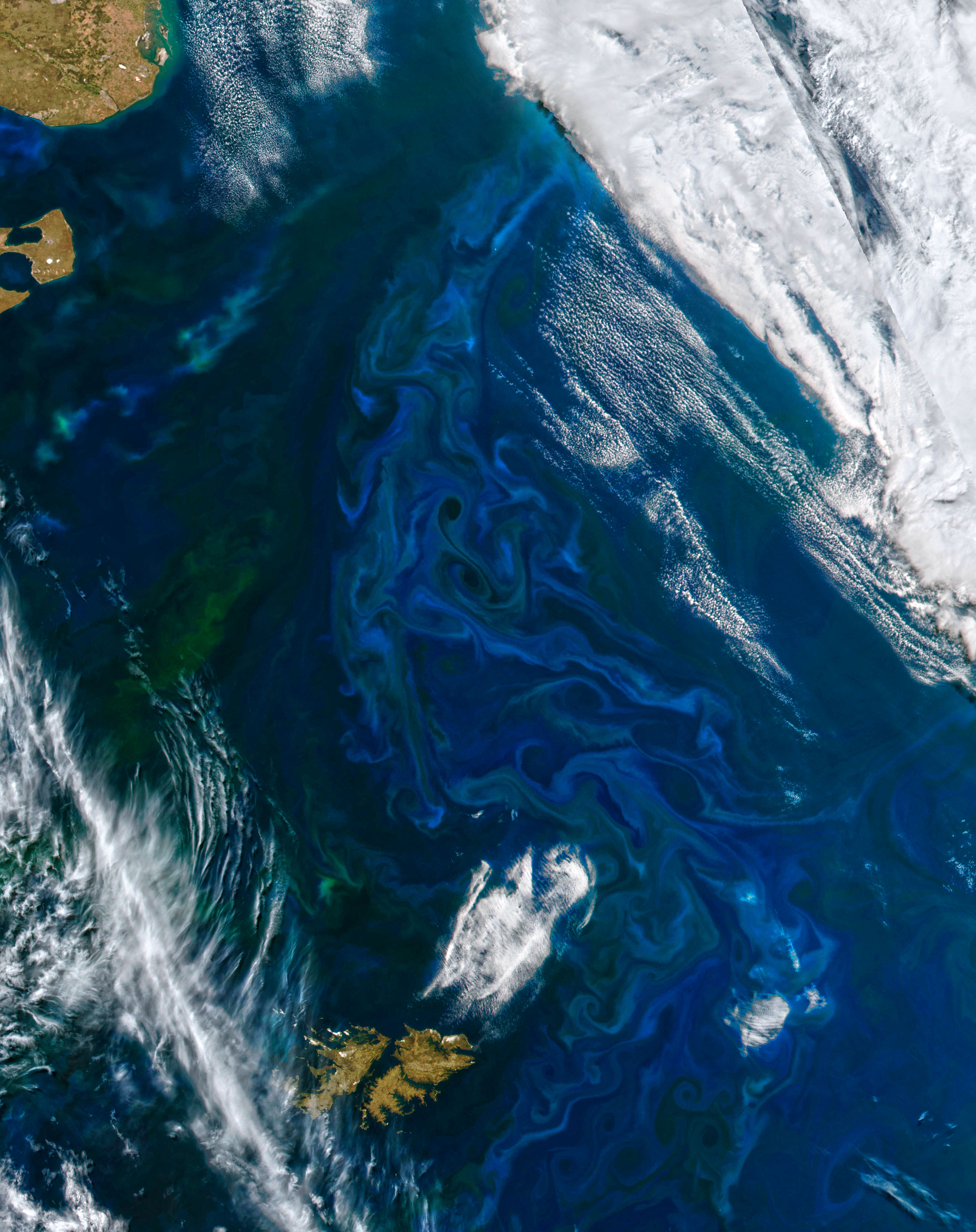
NASA's satellite imagery makes that invisible engine visible. In the South Atlantic and South Pacific, seasonal blooms can paint the water blue-green because phytoplankton contain chlorophyll and other pigments. NASA describes phytoplankton as plant-like organisms that soak up sunlight and nutrients, create their own food, and form the base of marine food webs (NASA Earth Observatory). Tiny things, planet-scale residue.
Deep life often runs on falling snow
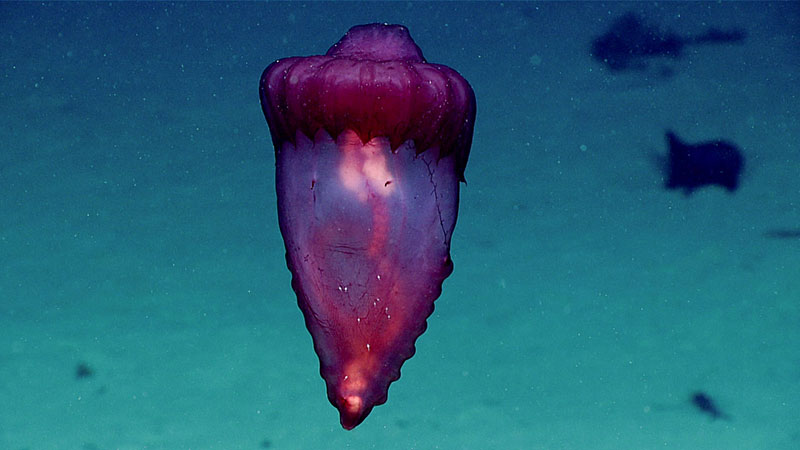
Once light fades, food becomes the central problem. NOAA's deep-habitat explainer notes that below about 200 meters, ocean waters average about 4 degrees Celsius, photosynthesis is not possible, and deep-sea organisms face pressure, limited light, cold, and scarce food (NOAA Ocean Exploration). Much of the deep ocean is fed by "marine snow": dead plankton, fecal pellets, molts, and other organic fragments that drift down from the sunlit layers.
That falling snow makes the deep ocean feel less like a wasteland and more like a slow postal system. The surface writes the letters. The deep reads what arrives. A crab on the seafloor, a sea cucumber crossing sediment, or a fish cruising in darkness may ultimately depend on sunlight that never touched its body. The energy was captured above, repackaged by life, and delivered downward one particle at a time.
This is also why the deep ocean is both huge and sparse. NOAA describes it as the largest living space on Earth by volume, yet the lack of local photosynthesis means food is often thinly distributed. The weird bodies of deep-sea animals are not decorations. They are answers to an environment where pressure is high, light is low, temperature is cold, and calories arrive unpredictably.

Hydrothermal vents broke the sunlight rule
Then the ocean adds the exception that makes the whole system feel alive again. At hydrothermal vents, communities can be built around chemosynthesis instead of photosynthesis. NOAA explains that vent bacteria can use chemical energy from compounds such as hydrogen sulfide to make sugars, supporting food webs where sunlight does not reach (NOAA Ocean Exploration). Humans first observed a thriving vent community on the deep-ocean floor in 1977.
This is the kind of fact that changes the shape of a question. Before vents, it was easy to imagine that ecosystems ultimately had to begin with sunlight. Vents showed that life could gather around geologic chemistry: hot, mineral-rich fluids rising from the seafloor, microbes converting chemical gradients into food, and animals clustering around that microbial economy.
The satisfying part is not just "life finds a way." It is more specific: life finds an energy gap. Near the surface, that gap is between sunlight and carbon dioxide. At vents, it is between reduced chemicals from Earth's crust and oxidants in seawater. Curiosity works the same way at a human scale. Once you see the missing mechanism, the scene stops being magic and becomes more interesting.

What people usually miss
People usually treat ocean facts as isolated trivia: deepest point, biggest animal, saltiest water, weirdest fish. Those are fine openings, but they do not compound until you connect them. Pressure explains why submarines are hard and why air spaces are fragile. Light explains why most ocean life cannot be organized like a coral reef. Phytoplankton explain why invisible surface life matters to the atmosphere. Chemosynthesis explains why sunlight is not the only way to start a food web.
The ocean becomes easier to remember when each fact closes a gap and opens the next one. Why does pressure crush? Because depth is weight. Why does the deep go dark? Because water absorbs and scatters light. Why is there life anyway? Because energy can arrive as falling organic matter or seafloor chemistry. The answer is not one fact. It is a chain of whys.
Related videos
NASA Goddard: The Ocean's Green Machines
NASA Goddard: Our Living Planet From Space
Want the quiz-card version? Try Ocean Trivia Questions With Answers.
FAQ
What is the most surprising fun fact about the ocean?
The most useful surprise is that the sunlit ocean is only a thin top layer. Significant sunlight is rare below 200 meters, so much of the ocean runs on darkness, pressure, falling food, and in some places chemical energy from the seafloor.
How fast does pressure increase in the ocean?
NOAA gives the simple rule: pressure increases by about one atmosphere every 33 feet, or 10.06 meters, of depth. That is why even shallow diving changes how your ears feel.
Does the ocean really make oxygen?
Yes. NOAA estimates that roughly half of Earth's oxygen production comes from oceanic plankton, algae, and photosynthetic bacteria. The exact share changes, and the ocean also consumes oxygen, but the surface ocean is a major oxygen-production engine.
Can life exist in the ocean without sunlight?
Yes. Most deep-sea life still depends indirectly on food made in sunlit waters, but hydrothermal vents and cold seeps can support chemosynthetic communities that use chemical energy instead of sunlight.
What does this have to do with AIgneous Million Whys?
AIgneous Million Whys is built for this kind of chain: one small question closes, then a better one appears. Ocean facts are not just facts to memorize; they are tiny doors into pressure, light, chemistry, and life, each one answerable in a curious 10-second moment.
Sources
NOAA National Ocean Service: How does pressure change with ocean depth?
NOAA National Ocean Service: How far does light travel in the ocean?
NOAA National Ocean Service: How much oxygen comes from the ocean?
NASA Earth Observatory: Breathing Life into the Ocean
NOAA Ocean Exploration: What conditions exist for life in the deep ocean?
Curious? Try one 👇
Why is the sky blue?
Jump into the daily quiz →Keep Exploring
Related Posts
Ocean Trivia Questions With Answers
Ocean trivia questions with answers about coastlines, tides, deep-sea pressure, glowing fish, whales, sharks, and the whys hiding under blue water.
Fun Facts About Penguins: Adaptations Explained
Fun facts about penguins: how feathers, feet, flippers, salt glands, countershading, huddles, and deep dives make impossible adaptations work.
Fun Facts About Weather: Everyday Sky Physics
Fun facts about weather, explained through why raindrops flatten, clouds float, thunder rolls, snow survives warm layers, fog forms, and rainbows circle.