

Fun Facts About Beavers: Nature's Water Engineers
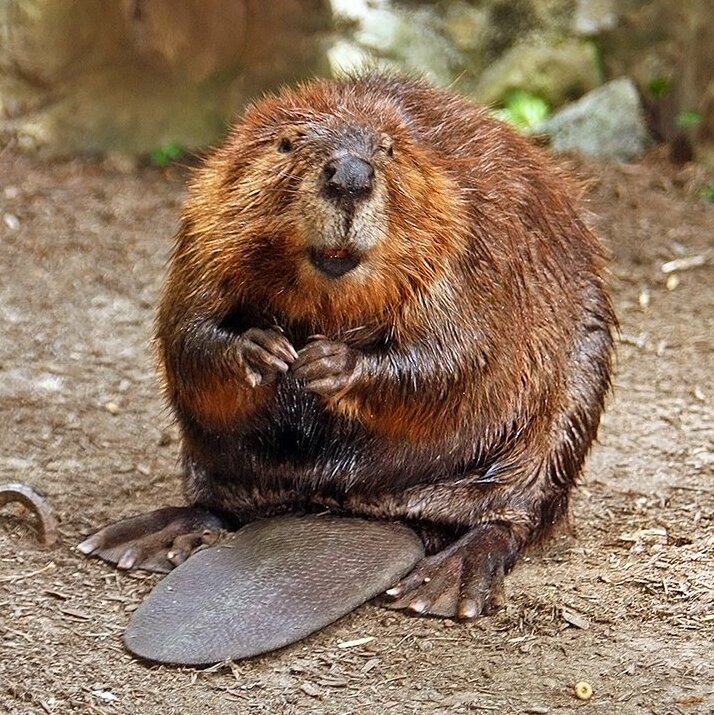
Beavers look like a nature mascot until you notice what they actually do: they redesign water. A beaver can turn a narrow stream into a pond, a pond into a wetland, and a wetland into a neighborhood for fish, frogs, birds, insects, plants, and mammals. The fun facts about beavers are not random cute details. Their orange teeth, flat tails, waterproof fur, lodges, and dams are all parts of one strange machine: a rodent that survives by changing the shape of a landscape.
TL;DR
Beavers are ecosystem engineers because their dams slow water, raise local water levels, and create wetlands that many other species use. Their orange front teeth are strengthened by iron-rich enamel, their incisors keep growing, and their lodges give them underwater access to a safer home. The satisfying twist is that the animal famous for chewing trees is really building water security.
The short answer: beavers are built to make ponds. They cut wood with self-wearing incisors, pack branches with mud and stones, and maintain dams that change stream flow. Those ponds protect beavers from predators, store food near the lodge, and create the wetland conditions that make beavers such a powerful keystone species.
Curious? Try one 👇
Why is the sky blue?
Jump into the daily quiz →The dam is a survival tool, not a hobby
The basic beaver problem is simple: a beaver is a large rodent with valuable fur, short legs, and many predators on land. Water changes the odds. The National Park Service describes North American beavers as ecosystem engineers that build dams and lodges, turning small streams into ponds that other animals also use in its Acadia beaver guide. For the beaver, the pond is first a moat.
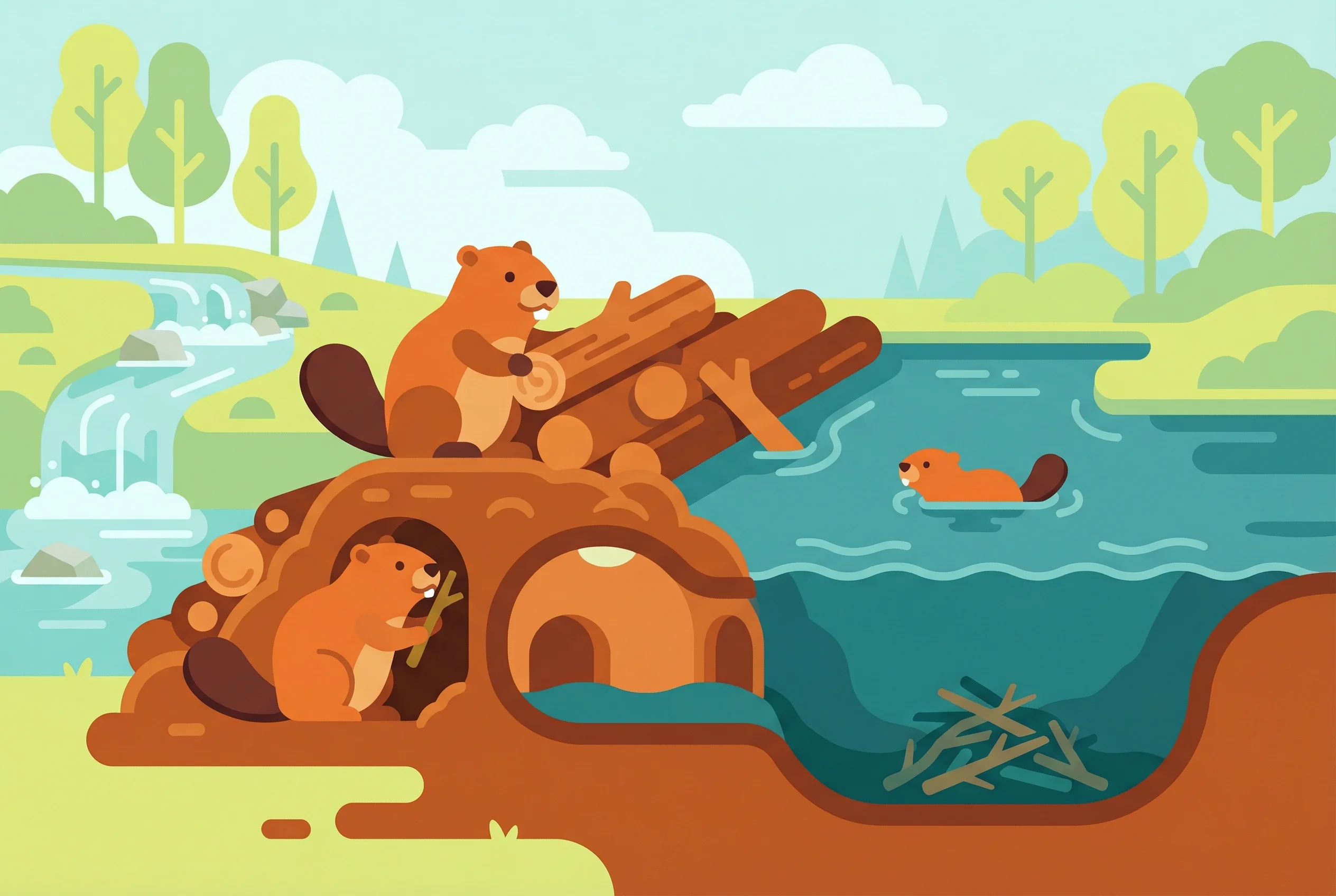
A dam slows moving water until it pools. That deeper water lets a beaver swim to safety, store branches underwater for winter food, and keep the entrance to its lodge submerged. A predator can stand on the bank, but it cannot easily enter a lodge through an underwater doorway. That is the little engineering move people miss: the dam is not the house. The dam makes the water deep enough for the house to work.
Beavers also maintain dams rather than treating them as one-time construction. Running water is noisy; leaks announce themselves. When a gap opens, a beaver can patch it with branches, stones, mud, and plant material. That maintenance instinct is why a beaver pond can persist long enough for the whole surrounding edge to change. The animal is responding to immediate survival cues, but the landscape experiences the result as long-term hydrological editing.

Those orange teeth are reinforced tools
Beaver teeth look orange because the outer enamel of the incisors contains iron. The Smithsonian's National Zoo notes that this iron-rich enamel strengthens the teeth and helps prevent breaking while a beaver gnaws through wood. The color is not dirt, age, or a carrot habit. It is a material clue.
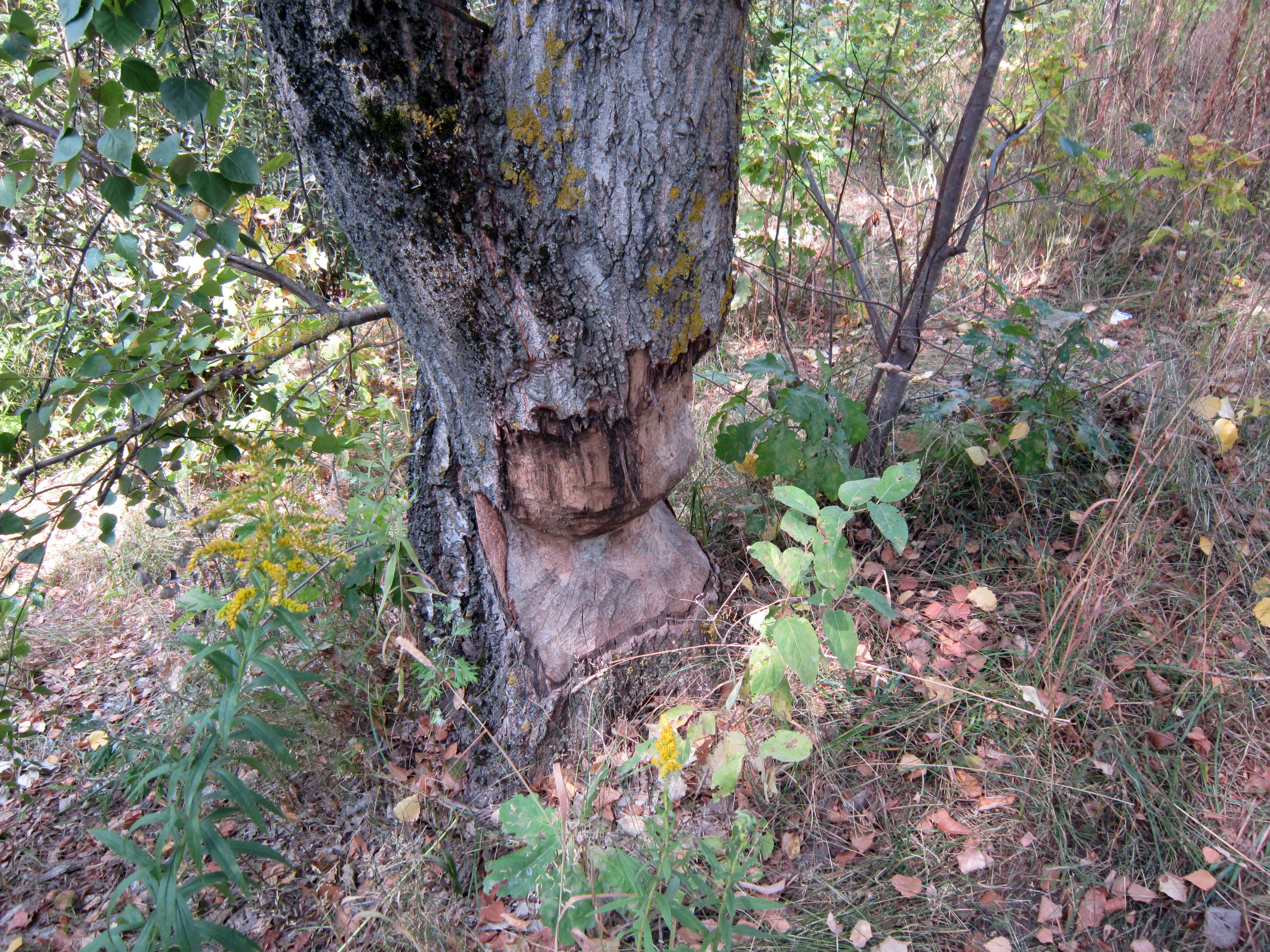
The second trick is growth. Like other rodents, beavers have incisors that keep growing. Constant chewing wears them down; growth replaces what is lost. The front surface is harder than the back, so gnawing wears the tooth into a chisel-like edge. A beaver is not carrying a tool. Its mouth is the tool, and the tool repairs itself while being used.
That self-renewing tool matters because beavers do not only cut tiny twigs. They fell woody plants for food, lodge material, and dam repair. The point is not that a beaver casually slices through every tree it sees. The point is that the animal has a reliable way to turn local vegetation into architecture. A streamside willow or aspen becomes winter food, dam structure, and habitat material in the same system.
The lodge is a house with a hidden door
A beaver lodge can look like a messy pile of sticks, but the important design is inside: a dry chamber above the waterline and entrances below it. That layout lets the animal breathe and rest inside while reaching the pond without walking across open ground. In winter, when ice covers the surface, the underwater entrance matters even more.
The lodge also changes how to read the dam. A dam that raises the water a little may be enough to flood the lodge entrance. A dam that is maintained all season helps keep that entrance usable as water rises and falls. The beaver is not building a monument. It is keeping a water level in the range where the whole shelter system still works.
The lodge is also a family structure. Beavers usually live in colonies centered on a breeding pair and their young, so the shelter has to support more than one animal moving in and out of water. The whole arrangement rewards cooperation: cutting, dragging, mud-packing, food caching, and alarm signaling all become more useful when several related animals share the same pond system. The engineering is physical, but the payoff is social survival.

The wetland is the side effect everyone else gets
Once water slows down, the rest of the ecosystem changes. Sediment settles. Banks stay wetter. Plants colonize shallow edges. Insects, amphibians, fish, birds, and mammals find new habitat. A 2021 open-access review in BioScience summarizes beaver effects on hydrology: beaver ponds can increase surface water storage, elevate the water table, and contribute to groundwater recharge across river systems.
This is why beavers get the unusually grand label "ecosystem engineer." They are not just living in an ecosystem. Their ordinary behavior creates physical conditions that other species then use. A single dam is small; a chain of dams can make a stream behave less like a pipe and more like a sponge.
That sponge metaphor is not just poetic. Fast channels tend to move water away; ponded, messy, vegetated channels hold it longer. That can mean cooler patches, wetter soils near the channel, more edge habitat, and slower release after storms. None of those effects are guaranteed everywhere, and managers have to measure local conditions, but the mechanism is concrete: slow water down, spread it sideways, and give plants and sediment time to reshape the banks.

Beaver restoration is powerful, but not magic
Because beaver ponds can slow water and expand wetlands, land managers now sometimes work with beavers or build beaver-dam analogues to start similar processes. The U.S. Fish and Wildlife Service's Beaver Restoration Guidebook frames beaver-related restoration as a practical tool, not a fairy tale: it depends on stream shape, vegetation, water availability, landowner conflict, and whether the site can support dam-building in the first place.
That caveat matters. Beavers can flood roads, fields, culverts, and yards. The same dam that makes habitat in one place can make trouble in another. The curious answer is not "beavers good" or "beavers bad." It is more precise: beavers are strong enough landscape engineers that humans have to decide where to make room for the process and where to manage it carefully.
That is also why coexistence tools exist: pond-leveling devices, culvert guards, setbacks, and restoration planning can sometimes keep the wetland benefits while reducing damage. The important shift is from seeing every dam as a nuisance to seeing it as a process with costs and services. When a beaver raises water, it is doing something humans often pay machines to imitate.

What people usually miss
Most beaver facts get told as isolated trivia: orange teeth, flat tail, big dam, funny walk. The better pattern is that each trait closes a specific problem. The teeth solve the wood problem. The tail helps with swimming, fat storage, balance, and alarm slaps. The waterproof fur solves the cold-water problem. The dam solves the safety-and-depth problem. The lodge turns that new pond into a home.
That is why the best fun facts about beavers feel satisfying rather than random. You start with a weird detail, then it clicks into a system. The animal is not merely adapted to wetlands. It makes the wetland that makes its life possible.
Related videos
- Beavers Created a Thriving Wetland - the results are magic
- Why beavers matter as the planet heats up
FAQ
Why do beavers build dams?
Beavers build dams to slow water and create ponds. The deeper pond helps protect them from predators, keeps lodge entrances underwater, and lets them store food close to home.
Why are beaver teeth orange?
The orange color comes from iron-rich enamel on the incisors. That enamel strengthens the teeth while the softer back side wears faster, helping maintain a sharp cutting edge.
Do all beavers build dams?
No. Beavers build dams where they need to raise or stabilize water. If a lake, deep river, or wetland already provides enough water depth and safety, a beaver may rely more on a lodge or bank den than on a large dam.
Are beavers good for ecosystems?
Often, yes. Beaver dams can create wetlands, store water, raise local water tables, and add habitat complexity. The same flooding can also conflict with human infrastructure, so coexistence usually requires site-specific management.
What does this have to do with AIgneous Million Whys?
Beavers are exactly the kind of topic Million Whys loves: a familiar animal with a hidden mechanism. One small question about orange teeth or dams opens into hydrology, evolution, habitat, and the satisfying closure of understanding why the detail exists.
Keep reading
Sources
National Park Service: Acadia's North American Beaver
Smithsonian National Zoo: Beaver
BioScience / PMC: Beaver as nature's ecosystem engineers
U.S. Fish and Wildlife Service: Beaver Restoration Guidebook
Curious? Try one 👇
Why is the sky blue?
Jump into the daily quiz →Keep Exploring
Related Posts
Random Animal Facts: Weird Adaptations Explained
Random animal facts explained through real adaptations: polar bear fur, anteater tongues, salmon homing, skunk spray, bee dances, and elephant trunks.
Fun Facts About Bears: Smell, Sleep, and Cubs
Fun facts about bears: how their smell, winter denning, polar bear fur, seasonal diets, and cub timing reveal clever survival mechanisms in plain English.
Interesting Facts About Platypus: Nature's Puzzle
Interesting facts about platypus biology: eggs, venom, electric bills, milk without nipples, glowing fur, and why this mammal feels assembled from questions.