

Why Don't Birds Get Electrocuted on Power Lines?
On this page· 16
Why don't birds get electrocuted on power lines? The answer is not that birds are immune to electricity, and it is not that high voltage is harmless. A bird on one wire is usually safe because both feet are nearly at the same electrical potential. Current needs a useful path from higher potential to lower potential. A small bird sitting on a single conductor usually does not provide that path, so the wire stays the easier route.
TL;DR
Birds usually avoid electrocution on a single power line because current needs a voltage difference across the body. Two feet on the same wire are almost the same potential, so very little current is driven through the bird. The danger appears when a bird bridges two wires, touches energized equipment and grounded hardware, or nests near poorly spaced distribution-pole parts.
Short answer: a bird on one wire is like a person standing on one rung of an electrical "height." There is high voltage relative to the ground, but not much voltage difference between the bird's two feet. MIT's School of Engineering explains the core idea: when both feet are at the same electrical potential, electrons have little motivation to travel through the bird's body; touch a second wire or grounded part, and the body can become the path (MIT School of Engineering).

Curious? Try one 👇
Why is the sky blue?
Jump into the daily quiz →The Question Every Kid Asks
The everyday picture is almost suspicious: a row of birds perched on a wire that would be deadly for a person to grab from the ground. The missing piece is that "being at high voltage" is not the same thing as "having dangerous current pass through you." A voltage is a difference, like height in a gravity analogy. Current is what happens when charges get a path down that difference.
If you stand on the ground and touch a live conductor, your body can help connect the wire to the ground. That is a large potential difference across you. If a bird lands with both feet on one clean conductor, its body is not spanning much potential difference. The conductor is still energized, but the bird is not connecting it to a lower-potential destination.

Voltage Difference: Current Needs Somewhere to Go
Electric current is driven by potential difference through a conductive path. In a power system, the line can be thousands of volts relative to ground, but along a short stretch of the same metal wire the difference between two nearby points is tiny. That is why the bird's two feet do not create the kind of push that sends damaging current through the body.
There can be a very small voltage drop along a real wire, so "zero current" is a simplified classroom phrase. The practical point still holds: the wire is an extremely low-resistance path compared with the bird, and the potential difference between the feet is far too small to drive dangerous current through a small body. The bird is not defeating electricity. It is simply not closing the dangerous circuit.
Why One Wire Is Safe
On one wire, the bird rises to the wire's potential, much as a helicopter line worker can be brought to the same potential as a live line before work begins. That sounds dramatic, but equal potential is the reason there is no large current through the body. The bird's two feet are electrically boring: same conductor, same neighborhood of voltage, no strong push across the body.
This is also why birds can all face the wind and shuffle around without instantly dying. The physical arrangement matters more than the number printed on the line. One wire under two feet is a different situation from one hand on a wire and one foot on the ground.

Why Two Wires Are Deadly
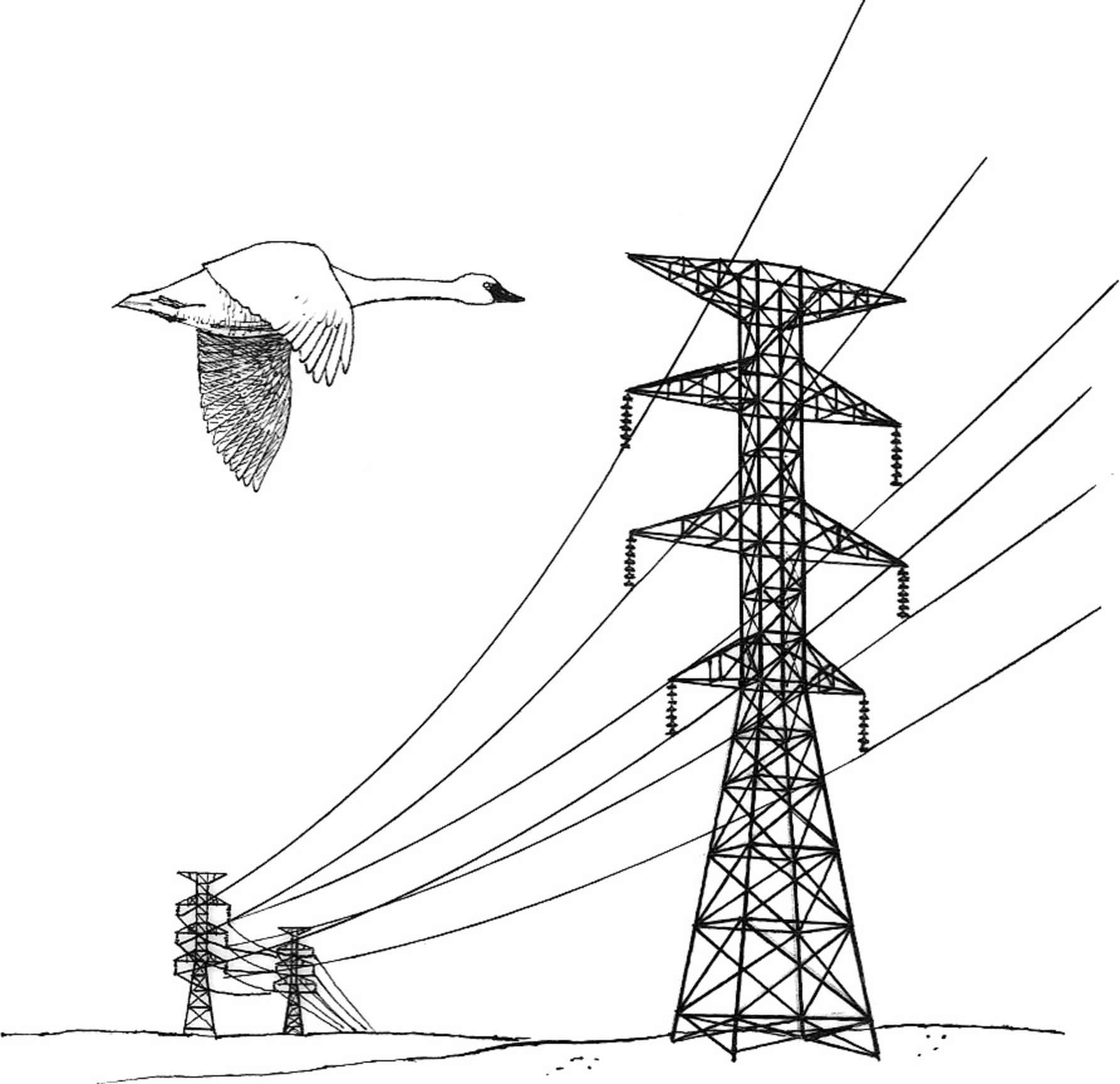
The danger begins when a body bridges unlike potentials. If a large bird's wing touches a second energized conductor, or if one part of the bird touches a live wire while another touches grounded hardware, the body can become the connecting path. The U.S. Fish & Wildlife Service describes electrocutions at distribution poles this way: birds complete a circuit by touching two energized parts or an energized part and a grounded part at the same time (U.S. Fish & Wildlife Service).
That is why size matters. Small songbirds usually cannot span dangerous clearances. Eagles, hawks, vultures, storks, pelicans, and other large birds have wingspans and body sizes that can bridge conductors or pole hardware. The problem is often not the long transmission span where birds perch on one wire, but the distribution pole where wires, crossarms, transformers, and grounded pieces sit close together.
When Birds Do Get Electrocuted
Bird electrocution is real and serious. A 2014 PLOS ONE review estimated that U.S. power lines kill between 12 and 64 million birds per year when collisions and electrocutions are combined, including an estimated 0.9 to 11.6 million from electrocution (Loss, Will, and Marra, 2014). Those ranges are wide because field data are hard to collect, but the scale is not trivial.
The main electrocution risk is not a peaceful row of small birds on a single wire. It is poles and equipment with unsafe clearances, especially for large birds that perch, hunt, nest, or take off from the structure. Nesting material can add another hazard by making a connection between energized and grounded parts. The same accident that kills a bird can also damage equipment, cause fire, or trigger an outage.

How Utilities Protect Wildlife
Bird-safe design is mostly geometry. The safest overhead structures keep enough distance between energized components, and between energized and grounded components, that a bird cannot bridge the gap. The U.S. Fish & Wildlife Service points to proven distribution-pole solutions and APLIC guidance documents, and newer international guidance from IFC says safe distancing is a permanent solution because it does not rely on long-term maintenance in the same way add-on insulation can (IFC, 2026).
Other tools include covering exposed energized parts, changing insulator position, moving nests to safer platforms, adding perch deterrents in specific places, and marking wires so flying birds can see them. Collision and electrocution are different problems: diverters help birds notice wires in flight; covers and spacing help prevent a perched bird from becoming a circuit.

What People Miss: Grounded Is Not Magic
The common shortcut is "birds are safe because they are not grounded." That is close, but it can hide the better idea. Ground is not a magic electricity sponge. It is one possible reference point and return path. What matters is the voltage difference across the body and whether the body completes a circuit. A bird can be in danger without touching literal dirt if it touches two parts at different potentials. A person can be in danger because standing on the ground while touching a live wire creates a large potential difference across the body.
Once you see it that way, the mystery becomes clean. Electricity is not hunting for birds. It follows available paths. A bird on one wire usually fails to offer a useful path; a bird bridging two different electrical points accidentally becomes one.
Most everyday mysteries open the same way — not by memorising the fact, but by finding the mechanism underneath it. If you want more of them, you can generate a random trivia question and get the same treatment: the answer, then the reason it works.
Related videos
FAQ
Why don't birds get electrocuted on power lines if the voltage is so high?
Because both feet are usually on the same conductor, so there is very little voltage difference across the bird's body. High voltage relative to ground is dangerous when the body connects that high potential to a lower one.
Would a bird die if it touched two power lines?
Yes, it could. Touching two conductors at different potentials can drive current through the bird. The same risk appears when a bird touches an energized part and a grounded crossarm, transformer case, or other hardware.
Why are large birds more at risk than small birds?
Large birds have wider wingspans and longer bodies, so they are more likely to bridge dangerous gaps on distribution poles. Raptors and other large perching birds are therefore a major focus of avian-safe utility design.
Do bird diverters stop electrocution?
Not usually. Diverters make lines more visible and help reduce collisions. Electrocution prevention depends more on spacing, insulation, covering exposed parts, and pole designs that keep birds from bridging two electrical points.
What does this have to do with AIgneous Million Whys?
This is the kind of everyday question Million Whys is built around: a familiar scene, a half-known answer, and a satisfying closure. The real lesson is not "birds are special"; it is that current needs a path, and once you see that, the whole wire scene makes sense.
Curious? Try one 👇
Why is the sky blue?
Jump into the daily quiz →Keep Exploring

Related Posts
Why Does Heat Kill? The Body's Cooling Limit
Why does heat kill? Your body survives heat by moving and evaporating water; death begins when humidity, time, and physiology stop that cooling loop inside.
Why Do Heatwaves Cause Power Outages?
Why do heatwaves cause power outages? AC demand, overheated transformers, sagging lines, plant cooling constraints, solar ramps, and thin grid margins.
Animal Quiz Questions and Answers, Explained
Animal quiz questions and answers in six curiosity-first rounds: neighborhood animals, ocean life, birds, insects, big mammals, and clever animal behavior.