

Why Do Heatwaves Cause Power Outages?
On this page· 18
A heatwave power outage can feel backwards. The sun is bright, the sky is clear, and yet the grid is suddenly under more stress than it was during a storm. Why do heatwaves cause power outages? Because heat attacks the grid from both ends at once: people demand more electricity for cooling, while wires, transformers, power plants, and operators have less margin to deliver it. The uncomfortable part is that the failure is often not one dramatic break. It is a stack of small physical limits arriving together.
TL;DR
Heatwaves cause power outages when cooling demand rises at the same time that grid equipment and power plants lose capacity. Air conditioners push peak load higher, transformers age and overheat faster, transmission lines carry less current and sag more, thermal plants can be constrained by cooling water, and solar-heavy systems face a steep evening ramp. The grid fails when the margin between demand and available supply gets too thin.
Short answer: heatwaves cause outages by raising electricity demand and lowering the grid's ability to meet it. The main mechanisms are air-conditioning peaks, overheated distribution transformers, reduced transmission capacity, power-plant cooling constraints, and the evening mismatch between cooling demand and falling solar output.
Curious? Try one 👇
Why is the sky blue?
Jump into the daily quiz →The Perfect Storm: Demand Spike Meets Capacity Drop
The grid is designed around peaks, not averages. On a mild day, many pieces of the system have room to spare. During a heatwave, that spare room shrinks. The International Energy Agency summarizes the double squeeze clearly: heatwaves increase electricity demand as people use air conditioning, while higher temperatures can reduce the efficiency and capacity of thermal power plants such as coal, gas, and nuclear (IEA).
This is why heat is different from ordinary high demand. The same weather that makes everyone turn on cooling also makes the hardware worse at shedding heat. A transformer, conductor, or turbine does not care that the cause is human comfort. It only sees more current, hotter ambient air, less cooling, and fewer safe operating margins.

AC Demand Physics: Why the Load Jumps So Fast
Air conditioning is not a polite load. When outdoor temperatures rise, more people use cooling, cooling systems run longer, and inefficient buildings leak heat faster. The IEA's 2024 efficiency analysis notes that peak demand is mainly driven by air-conditioner ownership and maximum daily temperatures, which increases the need for new infrastructure (IEA Energy Efficiency 2024). In plain English: more hot homes become more compressors running at the same time.
The nonlinearity is the trap. Going from warm to very hot does not merely add a few fans. It can shift whole neighborhoods into sustained compressor use, especially in the late afternoon and evening when people return home, buildings have stored heat all day, and the grid is already carrying commercial and residential load. The grid operator's problem is not "some people are uncomfortable." It is "millions of machines are now synchronized by the weather."

Transformer Overheating
Distribution transformers are the quiet metal boxes that step voltage down before electricity reaches homes and businesses. During a heatwave they face a bad combination: more current flowing through them and hotter surrounding air. A U.S. Department of Energy vulnerability review notes that high temperatures can accelerate transformer aging, and cites the rule of thumb that a 7 degrees C increase in hotspot temperature can double the aging acceleration factor (DOE / Oak Ridge review).
That does not mean every hot day breaks transformers. It means heat spends transformer life faster, especially when the load stays high for hours or days. A short peak can be managed. A long heatwave is more like holding a heavy weight with tired arms. The equipment may survive the first hour, then the next, until insulation, oil temperature, or protective devices say no.

Transmission Line Sag Is Literal
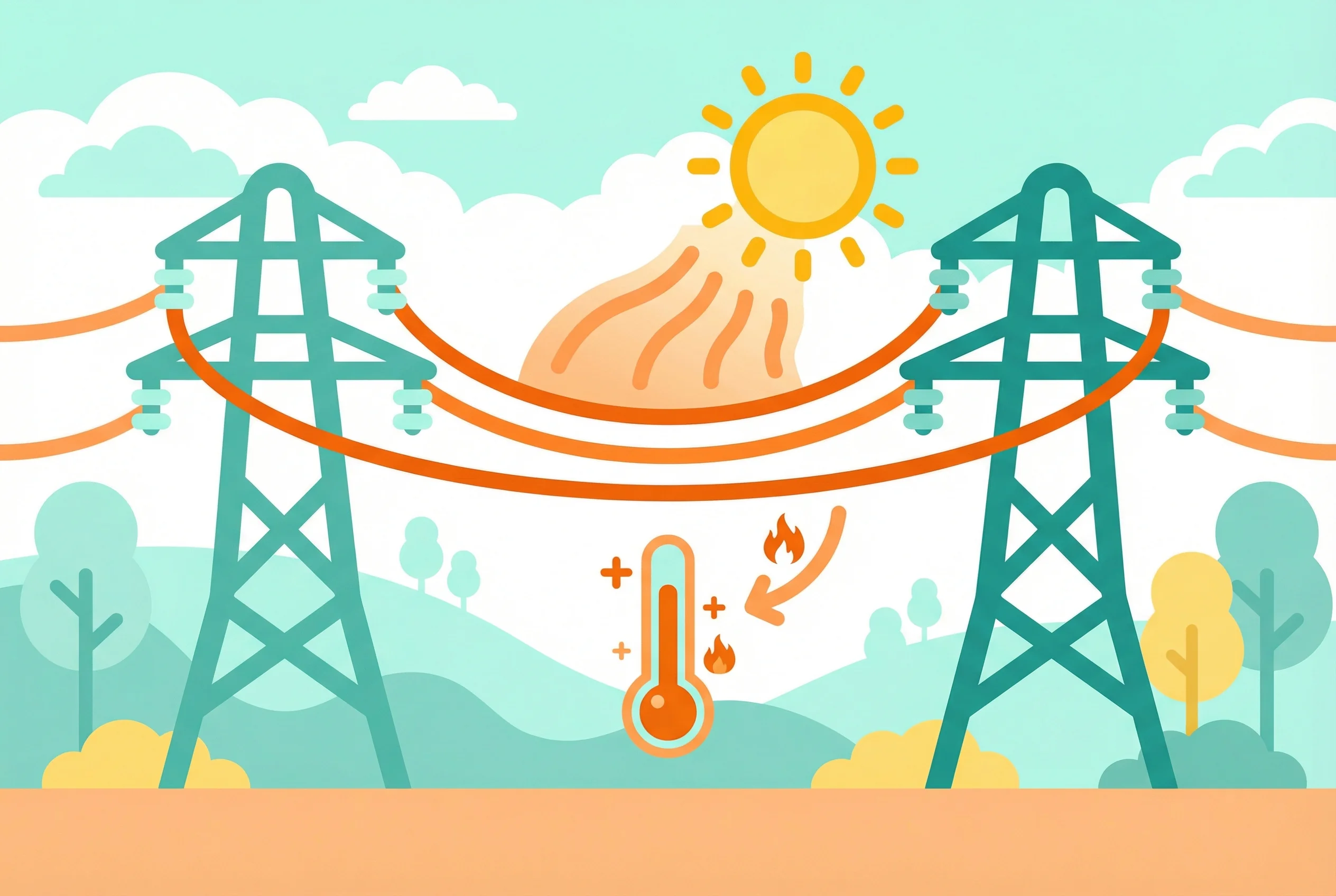
Power lines are physical objects. When conductors heat up, they expand and sag. The same heatwave that increases demand also raises conductor temperature directly and indirectly, because more current is flowing through the wire. The U.S. Department of Energy's advanced transmission report explains that transmission capacity is limited by thermal, voltage, and stability constraints, and that thermal limits are set partly to prevent excessive sag (DOE Advanced Transmission Technologies Report).
Sag matters because clearance matters. A line that droops too low can violate safety clearances, contact vegetation, or force operators to reduce how much power the line can carry. That is one reason heatwaves can create a delivery problem even when generation exists somewhere else. The electricity may be available in theory but constrained by the hot metal path between supply and demand.

Power Plants Also Need Cooling
Heatwaves can reduce supply, not just increase demand. Thermal plants need to reject waste heat. Nuclear, coal, and gas plants use cooling systems that can be constrained by high air or water temperatures. In France's June 2026 heatwave, Le Monde reported that EDF shut down one reactor and reduced output at two others because river temperatures required environmental limits, while RTE said the overall national grid remained secure (Le Monde, June 24 2026).
That same heatwave also showed the distribution-side version of the problem. Al Jazeera reported that up to 106,000 clients in France were without power late on June 23 as scorching temperatures strained infrastructure (Al Jazeera, June 24 2026). Those facts should not be mashed into one false claim. Nuclear output limits and local outages are different mechanisms. Together, they show why heat is a system stressor rather than a single-point villain.

Solar Helps at Noon, Then the Evening Ramp Arrives
Renewables do not "cause" heatwave outages, but a solar-heavy grid has a timing problem operators must plan around. Solar can be extremely useful during sunny afternoons, yet household cooling demand often stays high after solar production begins falling. The U.S. Department of Energy's solar integration guide explains the pattern: peak power usage often occurs on summer afternoons and evenings, when solar generation is falling and people come home to cool homes, cook, and run appliances (DOE Solar Energy and Storage Basics).
This is the famous duck-curve problem in practical clothes. The grid does not only need enough energy over the day. It needs the right amount of deliverable power at the right hour. Storage, flexible demand, transmission, and fast-ramping resources help turn a sunny noon into a survivable evening.

France 2026 and Texas 2021: Two Different Warnings
France 2026 is the direct heatwave case: record heat raised demand, strained local infrastructure, and forced environmentally driven reductions at some river-cooled nuclear units while the national grid operator still judged supply secure. The lesson is precision. A heatwave can create local outages and plant constraints without meaning a whole national grid is collapsing.
Texas 2021 was not a heatwave; it was an extreme cold event. It belongs here only as a comparison in grid margin. ERCOT's February 2021 materials document controlled outages and generation outages during extreme weather, showing how a weather shock can push available supply below demand and force operators to shed load to protect the system (ERCOT February 2021 event materials). The shared lesson is not "cold equals heat." It is that extreme weather turns hidden assumptions about fuel, equipment, weatherization, demand, and reserves into live constraints.
What People Usually Miss
The common mistake is looking for one guilty part. Was it renewables? Old wires? Bad policy? Too much AC? A transformer? Usually the honest answer is a stack. Heatwaves cause outages when several margins shrink at once. Demand rises. Equipment runs hotter. Transmission capacity tightens. Plants may derate. Operators hold reserves. A small fault that would be routine on a mild day can become serious when everything else is already near its limit.
The second missed point is timing. Peak danger is not always when the sun feels hottest on your skin. In many systems, the hard hour is late afternoon or early evening: buildings are heat-soaked, people come home, cooling demand remains high, and solar output is sliding down. That is why batteries, demand response, building efficiency, and better forecasting can be as important as building another power plant.
The third missed point is that a grid outage is also a public-health event. Losing electricity during dangerous heat means losing cooling, refrigeration, medical-device charging, elevators, communications, and sometimes water pressure. The grid is not just an engineering diagram. It is the invisible life-support layer for modern heat adaptation.
Related videos
FAQ
Can hot weather really cause a power outage?
Yes. Hot weather can raise demand through air conditioning while also reducing the safe capacity of equipment and power plants. The outage may come from a local transformer, a constrained line, insufficient reserves, or a protective operator action.
Why do air conditioners stress the power grid?
They turn heat into synchronized electricity demand. When many buildings need cooling at the same time, compressors run longer and peak load can climb sharply.
Do power lines sag in a heatwave?
They can. Conductors expand as they heat up, and high current adds more heating. Operators set thermal limits partly to avoid unsafe sag and clearance problems.
Do solar panels prevent heatwave outages?
Solar helps a lot during sunny hours, but it does not erase the evening ramp. If cooling demand stays high as solar output falls, the system needs storage, flexible demand, transmission, or other generation to cover the gap.
Was Texas 2021 a heatwave blackout?
No. Texas 2021 was an extreme cold event. It is useful here as a grid-margin case study: extreme weather can raise demand, reduce supply, and force controlled outages when reserves are not enough.
What does this have to do with AIgneous Million Whys?
This is a perfect Million Whys question because the first answer is too simple. "Everyone turned on AC" is only the doorway. The satisfying closure comes when you see the whole system: heat, metal, water, timing, human behavior, and hidden margins all interacting.
Sources
IEA: Electricity systems and the growing climate threat
IEA Energy Efficiency 2024: Heatwave-driven electricity demand
DOE / Oak Ridge: Extreme weather and grid vulnerabilities
DOE: Advanced Transmission Technologies Report
DOE: Solar energy and storage basics
Le Monde: France heatwave and EDF nuclear output, June 24 2026
Al Jazeera: France power outage during European heatwave, June 24 2026
Curious? Try one 👇
Why is the sky blue?
Jump into the daily quiz →Keep Exploring
Related Posts
Urban Heat Island Effect: Why Cities Stay Hotter
Urban heat island effect, explained: why asphalt, buildings, lost trees, waste heat, and warm nights make city blocks hotter than parks, and how cities cool.
Why No AC in Europe? Heat, Homes, and Habits
Why no AC in Europe? Mild summers, old buildings, energy prices, culture, and policy made cooling rare, but hotter heatwaves are changing the math for homes.
Why Don't Birds Get Electrocuted on Power Lines?
Why don't birds get electrocuted on power lines? The trick is voltage difference: one wire is usually safe, but two electrical points can be deadly fast.