

Facts About Light: Color, Shadows, Refraction
On this page· 16
Facts about light look simple until you ask why ordinary scenes behave the way they do. A straw bends in a glass. The sky turns blue. A shadow has a fuzzy edge. A prism pulls a rainbow out of white light. None of those moments requires exotic equipment; they are everyday clues that light is not just "brightness." It is electromagnetic radiation, waves and photons, color and energy, and a constant negotiation between the world and your eyes.
TL;DR
Light is the visible slice of the electromagnetic spectrum, roughly 380 to 700 nanometers for human eyes. Color comes from wavelength and perception; refraction happens when light changes speed in a new medium; the blue sky comes from short-wavelength scattering; and shadows are geometry made visible. The satisfying part is that many "weird" light facts are one mechanism wearing different costumes.
Short answer: Light behaves strangely because it travels as electromagnetic radiation and interacts with matter by reflecting, refracting, scattering, absorbing, and sometimes dispersing. Your eyes then turn that physical signal into color, depth, brightness, and edge. The world does not merely contain light; much of what you think of as "the world" is your brain's reconstruction of light after it has bounced, bent, or scattered.

Curious? Try one 👇
Why is the sky blue?
Jump into the daily quiz →Visible light is a tiny window, not the whole thing
NASA describes visible light as the segment of the electromagnetic spectrum the human eye can view, typically about 380 to 700 nanometers (NASA Science: Visible Light). That means "light" in daily speech is only a narrow biological window. Radio waves, microwaves, infrared, ultraviolet, X-rays, and gamma rays are also electromagnetic radiation; your eyes just are not built to register them directly.
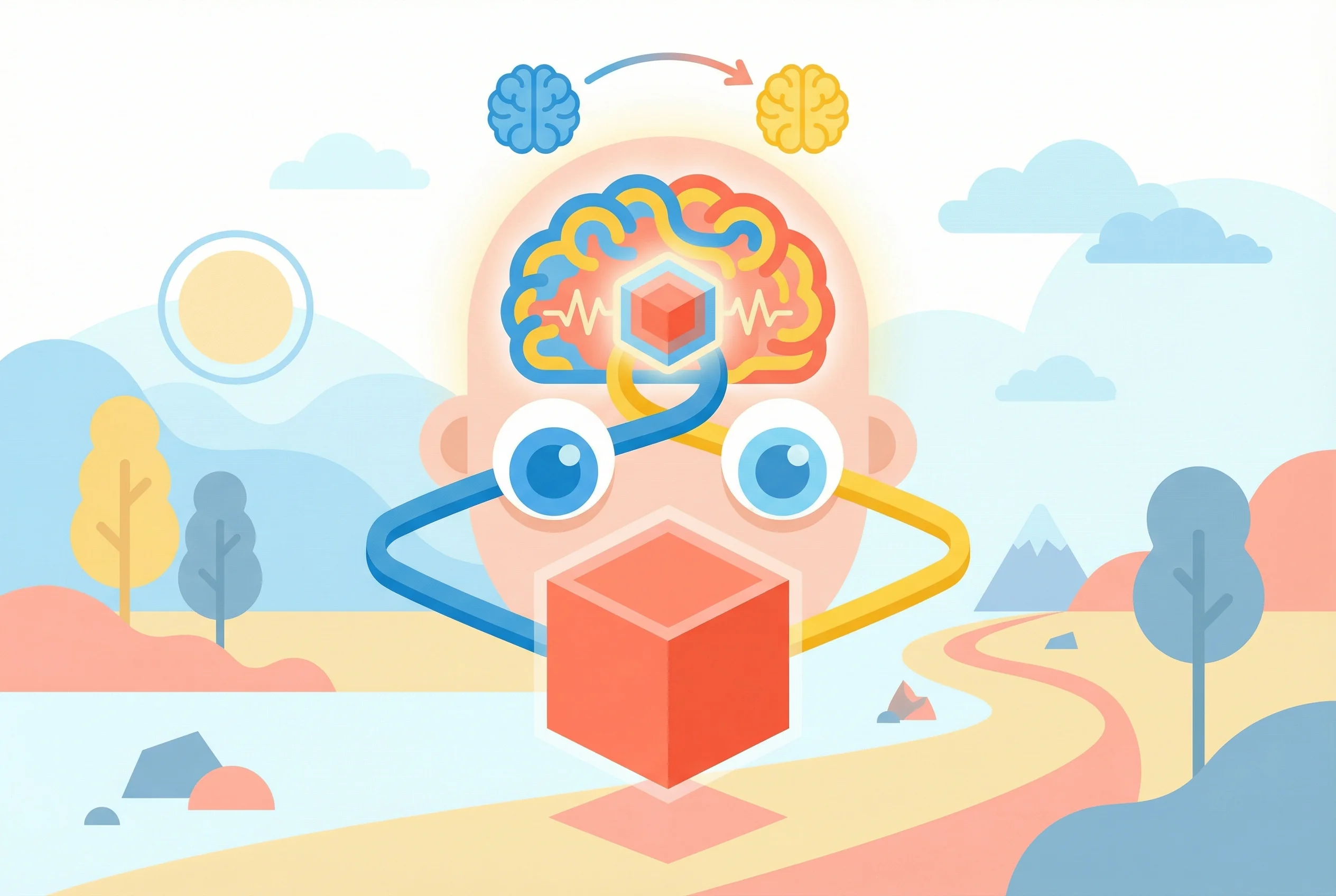
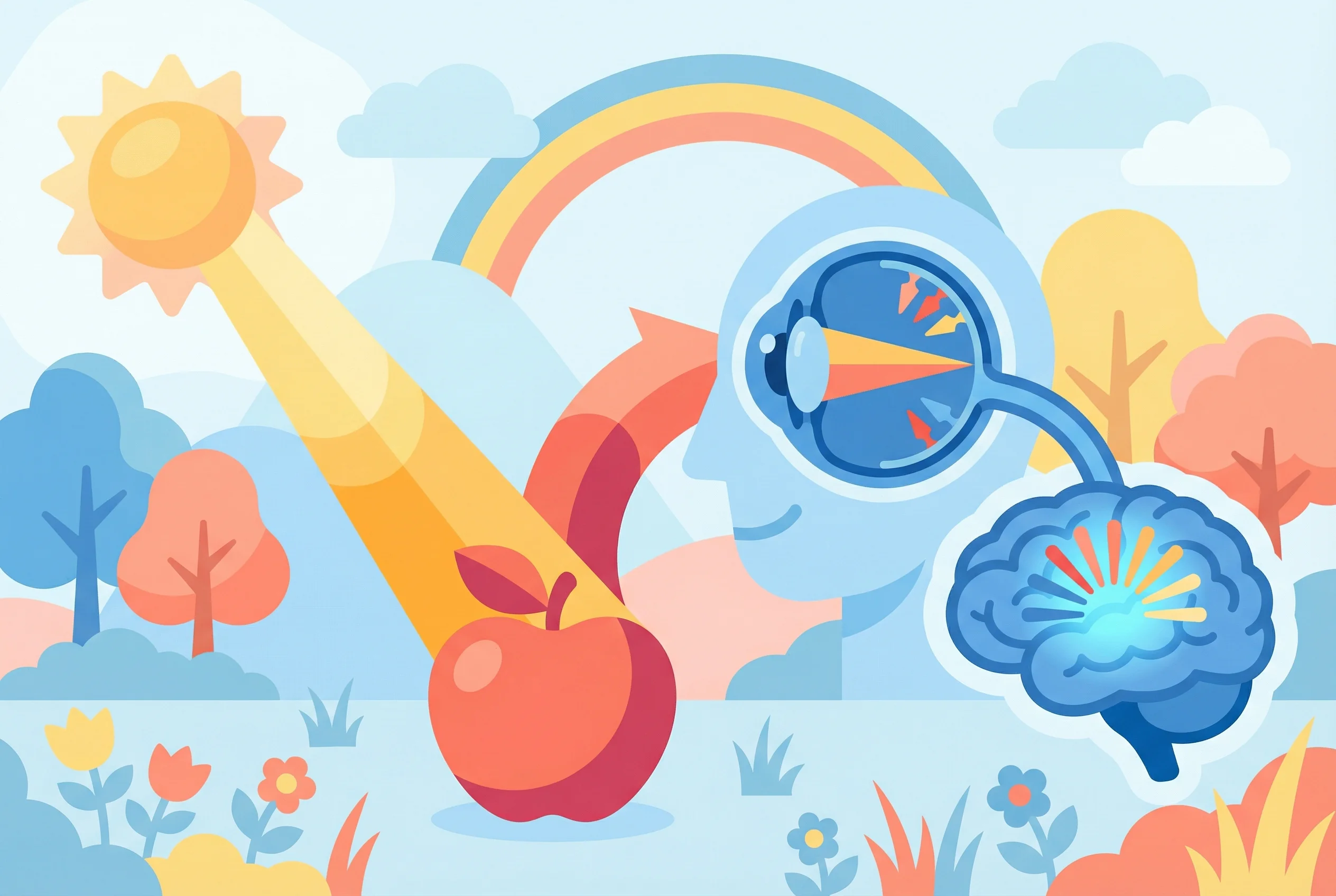
This is the first useful fact about light: color is not painted onto objects. It is a relationship among illumination, material, wavelength, and your visual system. A red apple under ordinary sunlight reflects more long-wavelength light toward your eyes. Put the same apple under a weird light source and the "same" object can look different because the incoming wavelengths have changed.
The curiosity payoff is that vision is selective. Humans do not see reality raw. We see the portion of radiation our eyes can sample, then the brain makes a usable model from it. Many animals sample a different window. Birds and insects, for example, can often detect ultraviolet patterns humans miss, which is why a flower may contain signals that are invisible to us but obvious to a pollinator.
A prism works because colors bend by different amounts
When white light passes through a prism, different wavelengths separate. NASA's visible-light explainer notes that a prism spreads the visible spectrum because each color has a different wavelength; violet is around the short-wavelength end and red around the long-wavelength end (NASA Science). The prism is not adding color. It is separating wavelengths that were already mixed together.
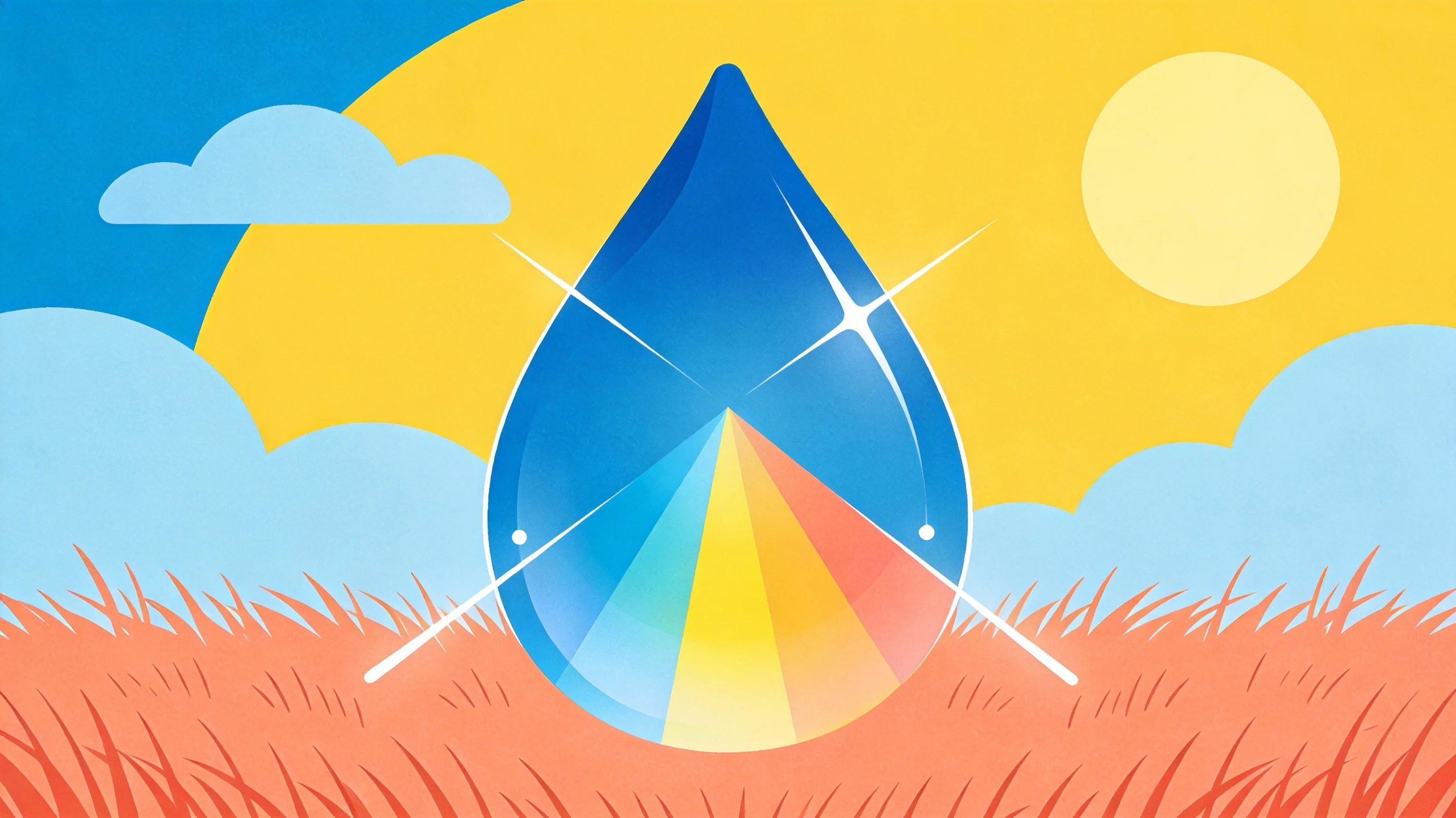
That same idea explains why a rainbow is not a painted arch in the sky. Sunlight enters raindrops, bends, reflects, bends again, and leaves sorted by angle. You see the color that reaches your eye from each droplet at the right geometry. Move your position and the rainbow belongs to a different set of droplets. That is why the "end" of a rainbow is not a place you can walk to; it is an angle-dependent optical event.

The sky is blue because air scatters short wavelengths
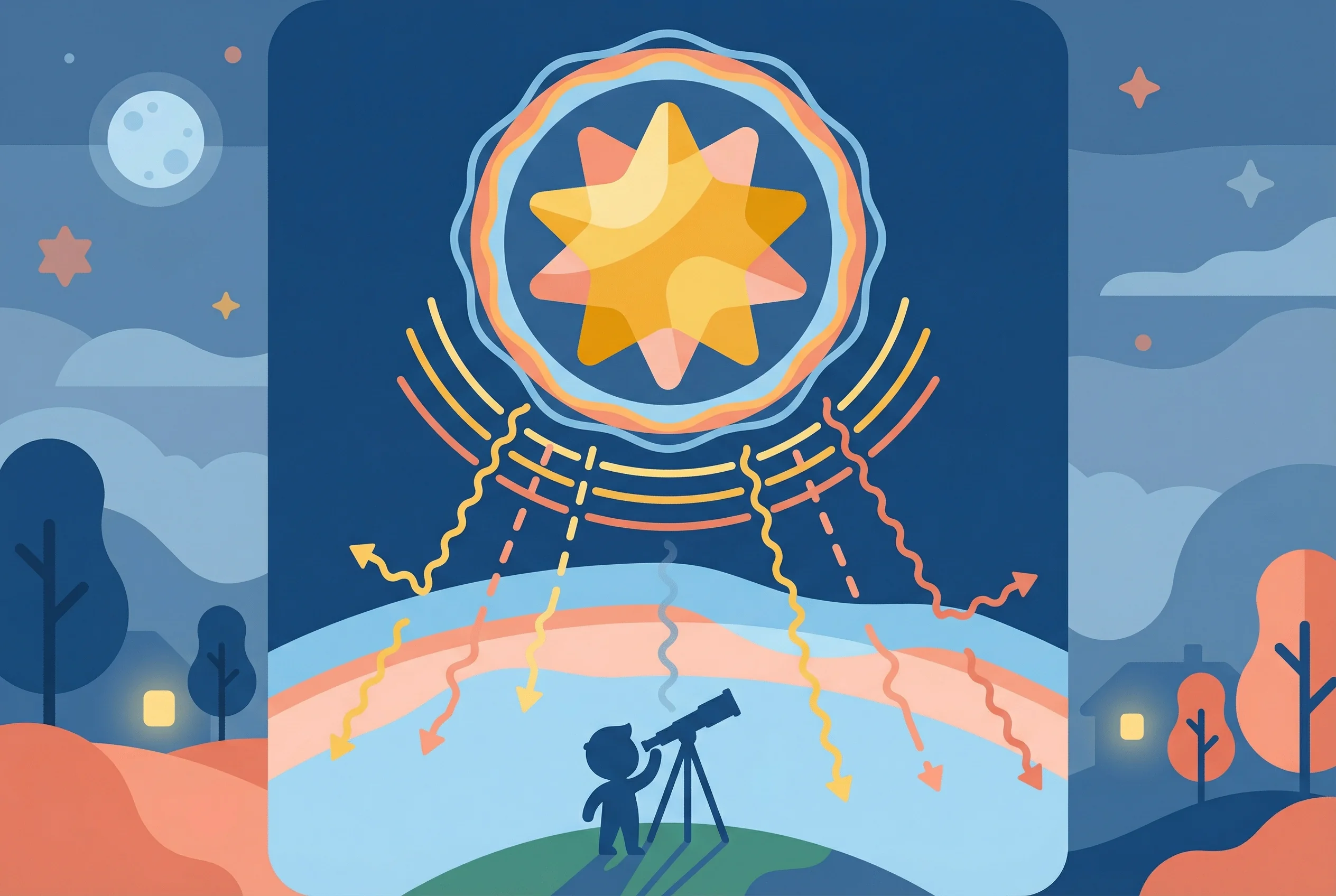
NOAA explains the blue sky through scattering: sunlight reaches the atmosphere and gases and particles scatter it in different directions, with shorter blue wavelengths scattered more efficiently than longer red wavelengths (NOAA NESDIS). At sunrise and sunset, sunlight travels through more atmosphere, so much of the blue has scattered out of the direct path and warmer colors dominate.
The common follow-up question is better: if violet has an even shorter wavelength than blue, why is the sky not violet? The answer is partly biology. The Sun's spectrum and the eye's sensitivity matter; humans are not equally sensitive to every visible wavelength. The physical scattering and the human receiver jointly produce the color we report.
This is a good example of curiosity closure. "Because Rayleigh scattering" is a label. The real closure comes when the pieces click: sunlight contains many wavelengths; small air molecules scatter shorter ones more; your eyes have their own sensitivities; therefore a blue sky is not one fact but a chain of mechanisms.
Refraction is why a straw looks bent in water
OpenStax defines refraction as the change in direction of a light ray when it passes through substances with different refractive indices, and relates it to changes in light speed in a medium (OpenStax University Physics). That is the straw-in-water trick. The straw is not bent. Light from the underwater part changes direction as it leaves water for air, so the underwater part appears shifted.
This is one reason lenses work. A lens is a shaped material that makes light rays bend in controlled ways. Your eye has a lens; a camera has a lens; glasses, telescopes, microscopes, fiber optics, and projectors all exploit refraction. A child's glass-of-water illusion is the same family of physics as a telescope that lets us see a moon of Jupiter.

Shadows are not just darkness; they are blocked geometry
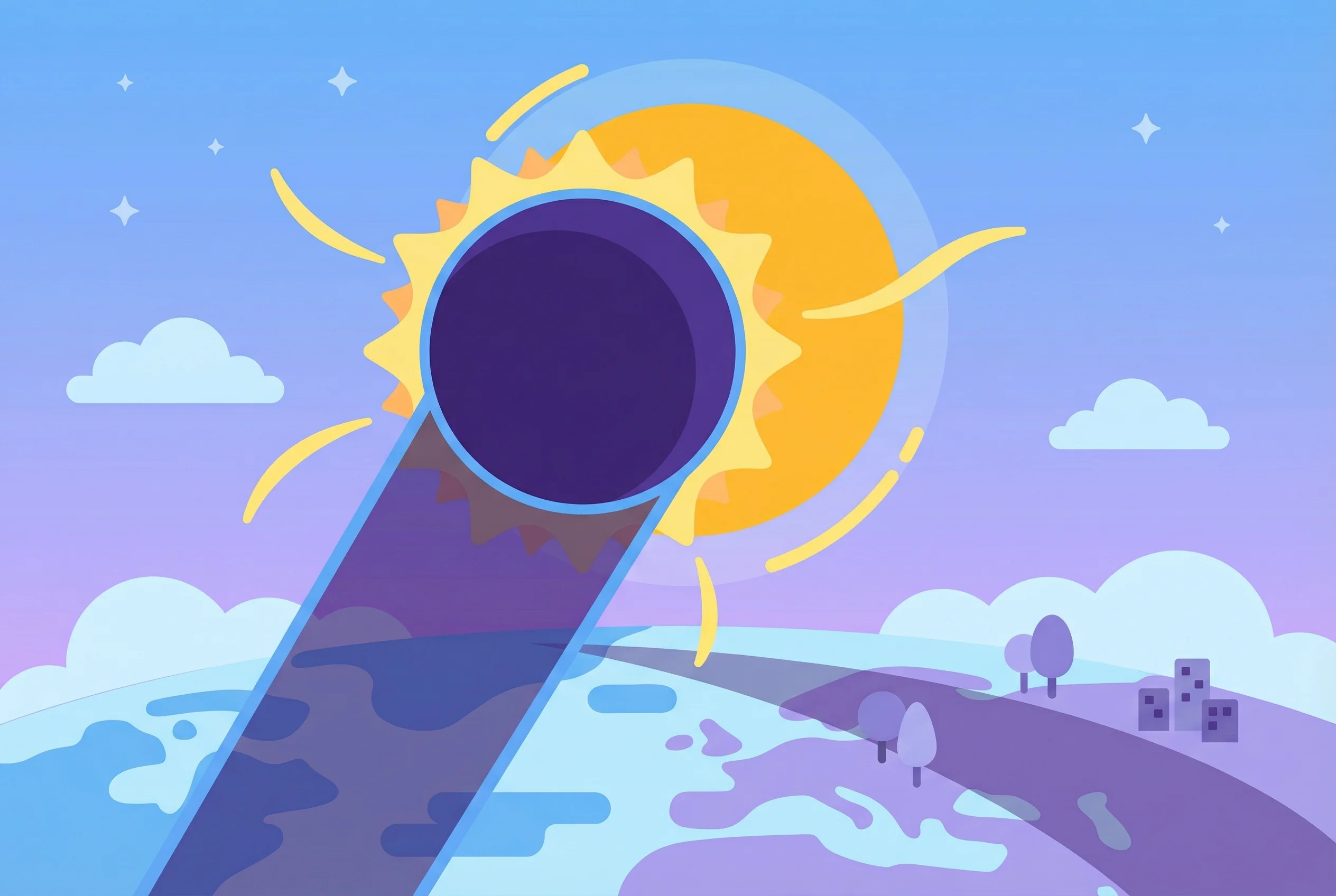
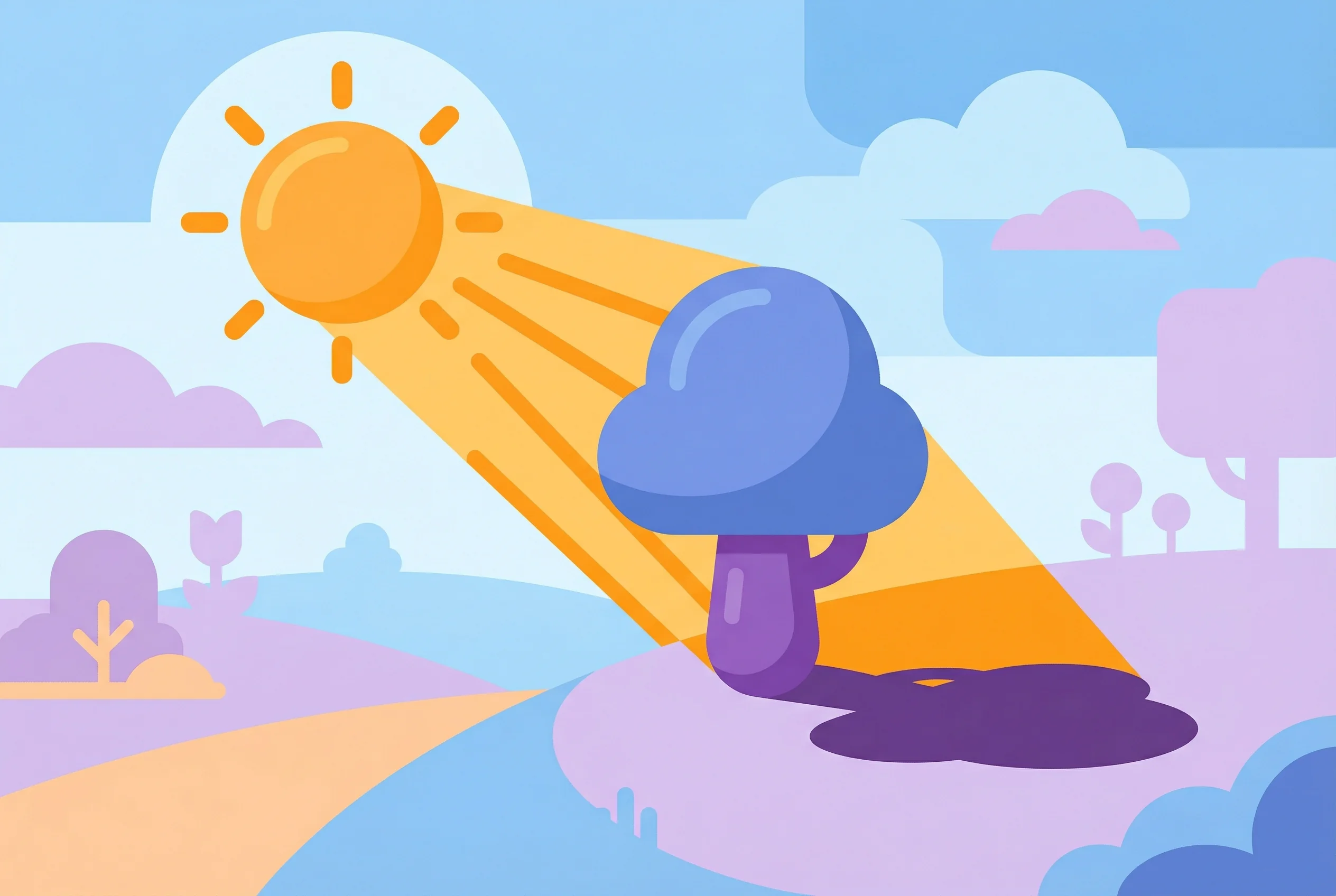
A shadow forms when an opaque object blocks light. That sounds obvious, but the edge tells the deeper story. If the light source were a perfect point, shadows would have sharper edges. Real sources have size, so some parts of the source may be blocked while others still reach the surface. That creates a darker umbra and a softer penumbra, the same vocabulary used for eclipses.
That is why a hand shadow near a wall looks sharper than the same hand farther away. Close to the wall, the blocked region has less room to spread into a fuzzy transition. Farther away, the partial-shadow region grows. A softbox in photography uses this on purpose: make the light source larger, and shadows become gentler.
Light carries energy, so color can become heat
Light is not merely visual information. It carries energy. When a surface absorbs light instead of reflecting it, some of that energy becomes molecular motion, which we experience as heat. That is why dark clothes often feel hotter in sunlight than white clothes: dark fabric absorbs more of the incoming visible and near-visible energy, while white fabric reflects more of it.
The mechanism also explains why sunlight powers life and technology. Plants use parts of the visible spectrum in photosynthesis. Solar cells convert incoming photons into electrical energy. Asphalt warms under the Sun. A black car dashboard can become uncomfortably hot even when the air outside feels tolerable. Same Sun, different absorption and reflection.
What people usually miss
The mistake is memorizing light facts as disconnected trivia. Prism equals rainbow. Atmosphere equals blue sky. Water equals bent straw. Object equals shadow. The better mental model is interaction. Light meets matter, and the outcome depends on wavelength, material, angle, distance, and the observer.
That model compounds. Once you know refraction, you can understand straws, lenses, rainbows, mirages, and why stars twinkle through a turbulent atmosphere. Once you know scattering, you can connect blue skies, red sunsets, hazy streetlight halos, and the way far mountains fade. The facts stop being isolated. They become a small map.
It also changes how you look around. A glass of water becomes a lens experiment. A sunset becomes an atmospheric path-length experiment. A shadow on the sidewalk becomes evidence that the Sun is not a point source. The win is not collecting more trivia; it is getting a reusable mechanism that keeps paying rent every time the world does something strange in front of you.
FAQ
What are the most important facts about light?
Light is electromagnetic radiation; visible light is only a narrow band humans can see; color depends on wavelength and perception; light can reflect, refract, scatter, absorb, and disperse; and those interactions explain many everyday optical effects.
Why does white light turn into a rainbow in a prism?
White light contains many visible wavelengths. A prism bends different wavelengths by different amounts, so the mixed light separates into colors.
Why is the sky blue?
Air molecules scatter shorter wavelengths of sunlight more strongly than longer wavelengths. Human eyes then perceive that scattered short-wavelength light as a blue sky.
Why does a straw look bent in water?
Light from the submerged straw changes direction as it moves from water into air. Your brain traces the bent ray backward and places the underwater part of the straw where it only appears to be.
What does this have to do with AIgneous Million Whys?
AIgneous Million Whys is built for exactly this kind of curiosity loop: one ordinary question, one real mechanism, one satisfying closure, then the next nearby gap. Light is a perfect example because a tiny daily question can unfold into a durable map of physics.
Curious? Try one 👇
Why is the sky blue?
Jump into the daily quiz →Keep Exploring
Related Posts
Facts About Rainbow: Why Rainbows Form
Facts about rainbow formation: how sunlight, raindrops, refraction, double rainbows, fogbows, and moonbows create the colors you see in the sky.
Why Is the Sky Blue? The Science of Light Scattering
Why is the sky blue? Follow sunlight through air molecules to see why noon turns blue, sunsets redden, Mars flips the palette, and blue oceans differ.
Fun Facts About Weather: Everyday Sky Physics
Fun facts about weather, explained through why raindrops flatten, clouds float, thunder rolls, snow survives warm layers, fog forms, and rainbows circle.