

Are Trivia Games Good for Your Brain? Honest Science
Trivia gets dismissed as a drawer full of useless facts: capital cities, old sports records, the animal with the strangest digestion. But the better question is not whether a fact sounds useful at first glance. The better question is what your brain is doing in the few seconds between seeing a question, committing to an answer, and getting closure. So, are trivia games good for your brain? They can be, when they make you retrieve, guess, check, and connect. They are not magic brain training, and they do not prove you are getting generally smarter. The useful part is the active question-then-reveal loop.
TL;DR
Trivia games are good for your brain when they make you actively retrieve an answer before the reveal. That retrieval practice is backed by memory research, and curiosity can make the answer feel rewarding enough to stick. The limit is just as important: trivia is not proven to raise IQ, prevent dementia, or transfer broadly to every kind of thinking.
Short answer: trivia is best understood as a small retrieval machine. A good trivia prompt opens a knowledge gap, asks you to search memory, forces a commitment, and then closes the gap with feedback. That sequence can strengthen memory for the material you engaged with, and it can add new nodes to your broad knowledge web. Passive trivia scrolling, where you read a list of answers without guessing, is much weaker. The brain benefit lives in the effortful moment before the answer appears.

Curious? Try one 👇
Why is the sky blue?
Jump into the daily quiz →Are trivia games good for your brain or just fun?
They are both, but the fun is part of the mechanism. A trivia question is not the same as a sentence. A sentence can slide past you. A question interrupts you. It says: you know something about this, but maybe not enough. That little interruption is the beginning of an information gap.
Curiosity researchers have studied that gap directly. George Loewenstein's 1994 review argued that curiosity often begins when attention focuses on a missing piece of knowledge that feels reachable, not when a person is handed a complete explanation from nowhere (Loewenstein, 1994). MillionWhys is built around that same small gap: a question first, then the answer's closure.
That matters because trivia is only "useless" if you treat knowledge as a static pile. In real cognition, a fact can become a handle. "Octopuses have blue blood" is not just an odd sentence; it opens the mechanism of copper-based hemocyanin, oxygen transport in cold water, and why evolution solves the same problem with different chemistry. A fact becomes useful when it lets you ask the next better question.
The first honest answer, then, is modest: trivia games are good for your brain when they make curiosity active. They are not good merely because they contain information. Information without a gap is wallpaper. A question with a reveal is closer to a tiny experiment on your own memory.
How trivia questions train retrieval practice
The strongest case for trivia comes from the testing effect, also called retrieval practice. In the classic formulation, trying to pull information from memory can improve later retention more than simply re-reading the same material. Roediger and Karpicke's 2006 paper, "Test-Enhanced Learning: Taking Memory Tests Improves Long-Term Retention," tested this directly with educational prose passages and found that later recall improved when learners practiced retrieval rather than only restudying (Roediger & Karpicke, 2006).

A trivia card is not identical to a lab recall test. Many trivia games are multiple choice, and multiple choice involves recognition as well as recall. Still, a good multiple-choice question can make you search memory before you choose. If the distractors are plausible, you have to compare, eliminate, and commit. That is a cognitive act, not just a click.
This is why the reveal should not come too early. If the answer appears instantly, the brain gets familiarity without retrieval. Familiarity feels like learning, but it is often just the pleasant sense that you have seen something before. The useful sequence is slower: read the question, feel the gap, pick an answer, then read the explanation. The explanation closes the gap and gives the memory something to attach to.
That also explains why trivia with explanations is stronger than trivia with answer keys. "Correct: B" gives closure, but not much structure. "Correct: B, because..." turns the fact into a mechanism. If the question is "Why do flamingos stand on one leg?", the answer matters less than the explanation that links posture, heat loss, muscle mechanics, and habitat. The explanation is where the fact stops being a dead label.
Does trivia help memory through curiosity?
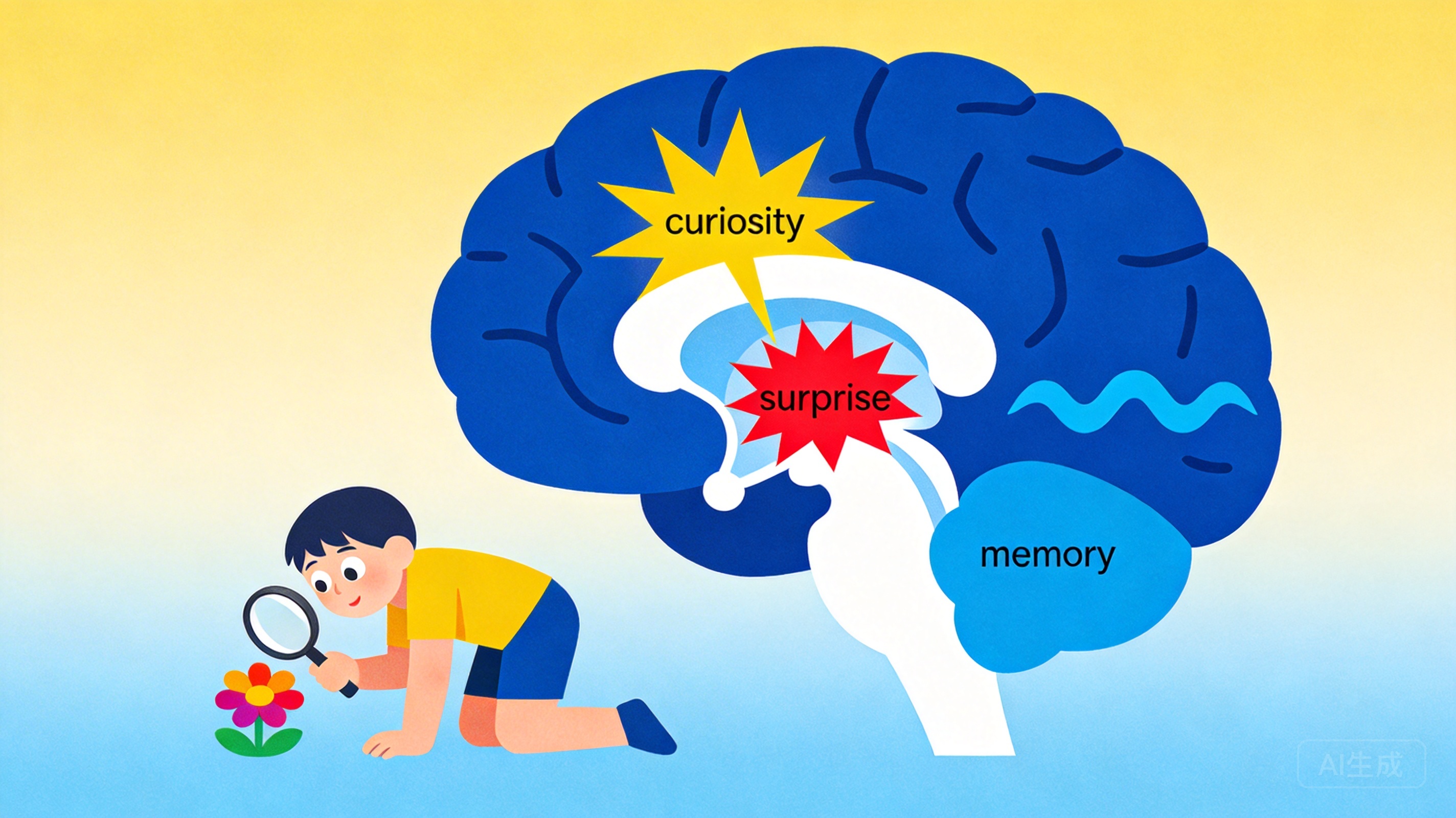
Curiosity appears to change the state in which memory is formed. In a 2014 Neuron paper, Matthias Gruber, Bernard Gelman, and Charan Ranganath used trivia questions to induce high- and low-curiosity states. Their study reported that states of curiosity modulated hippocampus-dependent learning through dopaminergic circuitry, and that curiosity could improve memory for the target answers and some incidental information encountered during the curious state (Gruber, Gelman & Ranganath, 2014).

That finding fits the everyday feeling of a good question. Before the answer, there is tension. After the answer, there is a little click of closure. The point is not that every trivia question triggers a dramatic neural event. The point is that curiosity creates a different learning posture than being told a fact cold. A fact delivered after a question arrives into an open slot.
Kang and colleagues also studied epistemic curiosity with trivia questions in a 2009 Psychological Science paper titled "The Wick in the Candle of Learning." They linked higher curiosity to reward circuitry and later memory for answers (Kang et al., 2009). Again, the careful claim is not "trivia makes you brilliant." The careful claim is that curiosity can prepare the brain to value and retain an answer.
That is why the best trivia games feel less like a knowledge dump and more like a rhythm: itch, guess, closure, next itch. The trick is making sure the closure is real. Endless stimulation without explanation is just attention capture. A good answer should leave you more satisfied and more capable of asking the next question.
Is trivia good for adults and crystallized knowledge?
Adults often learn differently from children because new information has more places to connect. A twelve-year-old may hear "plate tectonics" as a new label. An adult may connect it to earthquakes, coastlines, volcanoes, maps, insurance, and that one documentary they half remember. Trivia can be good for adults because it keeps adding small hooks into a growing web of crystallized knowledge.
Crystallized intelligence is the knowledge, vocabulary, and learned patterns accumulated through experience. It is often contrasted with fluid intelligence, the ability to solve novel problems without relying heavily on stored knowledge. The lifespan picture is not a simple "everything peaks young" story. Hartshorne and Germine's large 2015 study found that different cognitive abilities peak at different ages, with some abilities peaking later than early adulthood (Hartshorne & Germine, 2015).
This is where trivia gets unfairly underestimated. A broad fact is not automatically shallow. A broad fact can be the first bridge between fields. Knowing that bees can navigate using polarized light is not a party trick if it later helps you understand animal navigation, optics, or why the sky contains information invisible to us. Trivia is often the doorway into mechanism.
But the doorway only matters if you walk through it. A trivia game that gives you a correct answer and no explanation mostly trains name recognition. A trivia game that gives a short explanation can enlarge the knowledge web. A trivia game that lets you follow the next "why" turns the fact into a path.
Brain training myths trivia cannot honestly support
Here is the boundary: trivia should not be sold as a magic bullet for intelligence, workplace performance, or dementia prevention. The brain-training industry has repeatedly made claims that outrun the evidence. In 2014, the Stanford Center on Longevity and the Max Planck Institute for Human Development published a statement from cognitive scientists and neuroscientists warning that the scientific literature did not support broad claims that software-based brain games improve general cognitive performance in everyday life or prevent cognitive decline and brain disease (Stanford Center on Longevity, 2014).

That caution applies to trivia too. If a trivia app says it will make you smarter in every domain, be skeptical. If it says daily trivia prevents dementia, be more than skeptical. The responsible claim is narrower and still valuable: active recall can improve retention of material you engage with, curiosity can support memory formation, and broad knowledge can give you more concepts to connect later.
In other words, trivia is not a general intelligence upgrade. It is a format. Formats matter because they shape attention. A bad format gives you answers before you care. A good format makes you want the answer, asks you to commit, and gives you enough explanation to turn the answer into a usable piece of understanding.
How to make trivia good for your brain
If you want the brain benefit, use trivia in a way that preserves the retrieval loop. First, do not peek. The moment of commitment matters. Even if you are guessing, the guess forces a search. Second, read the explanation even when you get it right. Correct guesses can be lucky; explanations tell you whether the underlying model is real. Third, return to topics over time. Spacing matters for memory, and repeated retrieval is usually better than one intense burst followed by nothing.
Fourth, prefer questions that explain mechanisms. "What is the fastest animal?" is fine. "Why can a peregrine falcon dive so fast without losing control?" is better. Mechanism gives the fact teeth. Fifth, follow the question that appears after the answer. If a moonbow is a rainbow made by moonlight, the next useful question might be why it often looks white to human eyes. That is how curiosity compounds: one closed gap reveals the outline of another.
This is also why ten seconds can be enough. Not enough to master a domain, obviously. Enough to complete one honest learning cycle: see a gap, make a prediction, get closure. If you repeat that cycle with real explanations, the knowledge web thickens. The outcome is not "I studied." The outcome is "I left with one more connected piece of the world."
Cognitive benefits of trivia come from connections
The phrase "cognitive benefits of trivia" can sound suspicious, because it is often used to make a small thing sound medically grand. A better way to say it is this: trivia can create more retrieval routes. When a fact connects to a mechanism, an image, an analogy, a prior mistake, and a later question, it has more ways back into awareness.

That is why the same trivia question can be shallow or deep. "What metal is liquid at room temperature?" can stop at "mercury." Or it can connect to metallic bonding, atomic structure, thermometers, toxicity, and why gallium melts in your hand while iron obviously does not. The first version is a label. The second version is a small network.
This network view also keeps the claim honest. Trivia does not need to promise far-transfer miracles to be worthwhile. A person with a richer web of examples can often notice analogies faster. They have more mental hooks for new information. But that is not the same as saying a trivia session improves general reasoning across unrelated domains. The benefit is local first: you remember and connect the material you actually touched.
For adults, that local-first benefit is enough. Most adult curiosity is not syllabus-shaped. It begins with "I saw this thing and now I need to know why." A good trivia loop catches that moment, gives it a handle, and makes the next handle easier to grab. The compounding comes from many small closures, not from one heroic lesson.
What people usually miss
People ask whether trivia is useful as if the content alone decides the answer. It does not. The same fact can be dead or alive depending on the format. "The hippocampus helps memory" is a loose sentence. "Which brain structure is deeply involved in forming new episodic memories?" makes you search. The reveal closes a gap. The explanation gives the fact a job.

So the honest answer is: trivia can be good for your brain, but not because trivia facts are sacred. It is good when it creates active retrieval, real curiosity, and satisfying closure. It is weak when it becomes passive list scrolling. It is dishonest when it borrows the language of neuroscience to promise far-transfer benefits the evidence does not support.
Related videos
Henry Roediger - Retrieval Practice to Enhance Learning and Retention
How Curiosity Changes the Brain and Enhances Learning
FAQ
Are trivia games good for your brain if you only play casually?
Yes, if "casually" still means you answer before the reveal and read the explanation. A casual ten-second retrieval attempt is more active than passively reading a fact list.
Do trivia games improve memory?
They can improve memory for the material you retrieve and review. That is different from saying trivia improves all memory in every setting. The strongest evidence supports retrieval practice for learned material, not a blanket memory upgrade.
Is trivia good for adults?
Trivia can be especially useful for adults because new facts connect to a larger existing knowledge web. The best adult trivia is not just harder; it gives mechanisms and lets curiosity branch.
Can trivia games make you smarter?
Not in the broad, brain-training-ad sense. A trivia game can build knowledge, retrieval fluency, and curiosity habits. It should not promise IQ gains, dementia prevention, or general cognitive transfer without evidence.
How should I use trivia for learning without turning it into school?
Keep it question-first. Choose an answer before peeking, read the why, and follow one next question if it catches you. The goal is not exam prep; it is a small loop of curiosity and closure.
What does this have to do with AIgneous Million Whys?
AIgneous Million Whys is built around the useful version of trivia: a ten-second question, a committed answer, a sourced explanation, and a next "why" when curiosity opens another gap. It treats curiosity as the engine, not as decoration around a study tool.
Keep reading
Sources
Loewenstein, G. (1994). The Psychology of Curiosity: A Review and Reinterpretation.
Hartshorne, J. K., & Germine, L. T. (2015). When Does Cognitive Functioning Peak?
Curious? Try one 👇
Why is the sky blue?
Jump into the daily quiz →Keep Exploring
Related Posts
Testing Effect: Why Trivia Beats Re-Reading
The testing effect explains why answering a question first can make memory stronger than re-reading. Here is the research, the limits, and the trivia link.
Trivia vs Flashcards: Which Helps Memory?
Trivia vs flashcards compares two retrieval tools: spaced decks for chosen material and curiosity-led questions for broad memory without cram pressure.
Trivia for Adults: A Curiosity-First Guide
Trivia for adults works best when it fits real adult learning: quick questions, clear mechanisms, no classroom pressure, and curiosity that compounds daily.