

Testing Effect: Why Trivia Beats Re-Reading
In study after study, people who re-read a passage often feel fluent sooner than people who quiz themselves on it. Then the delayed test arrives, and the quizzed group remembers more. That reversal is the testing effect: pulling an answer out of memory is not just a way to measure learning. It is one of the ways learning happens. The useful part for a curiosity product is simple: a question creates a small information gap, a guess commits your mind, and the answer gives closure instead of another loose fact sliding past.
TL;DR
The testing effect means that retrieving information from memory can improve later retention more than simply re-reading the same material. The canonical Roediger and Karpicke work found that repeated testing hurt immediate performance but improved one-week recall, and later retrieval-practice work showed the same basic pattern with foreign-language word pairs. Trivia works when it borrows that mechanism: ask first, make the learner choose, then close the gap with a real explanation.
Short answer: the testing effect is the memory advantage produced by retrieval practice. A quiz is useful not because it feels school-like, but because it forces a small act of recall before the answer arrives. That act strengthens access to the memory, reveals what is missing, and makes the explanation land with more force than a sentence that was simply handed to you. The limit matters too: the effect is about remembering and connecting learned material, not about making people generally smarter.

Curious? Try one 👇
Why is the sky blue?
Jump into the daily quiz →Testing Effect Research: Why Re-Reading Feels Better at First
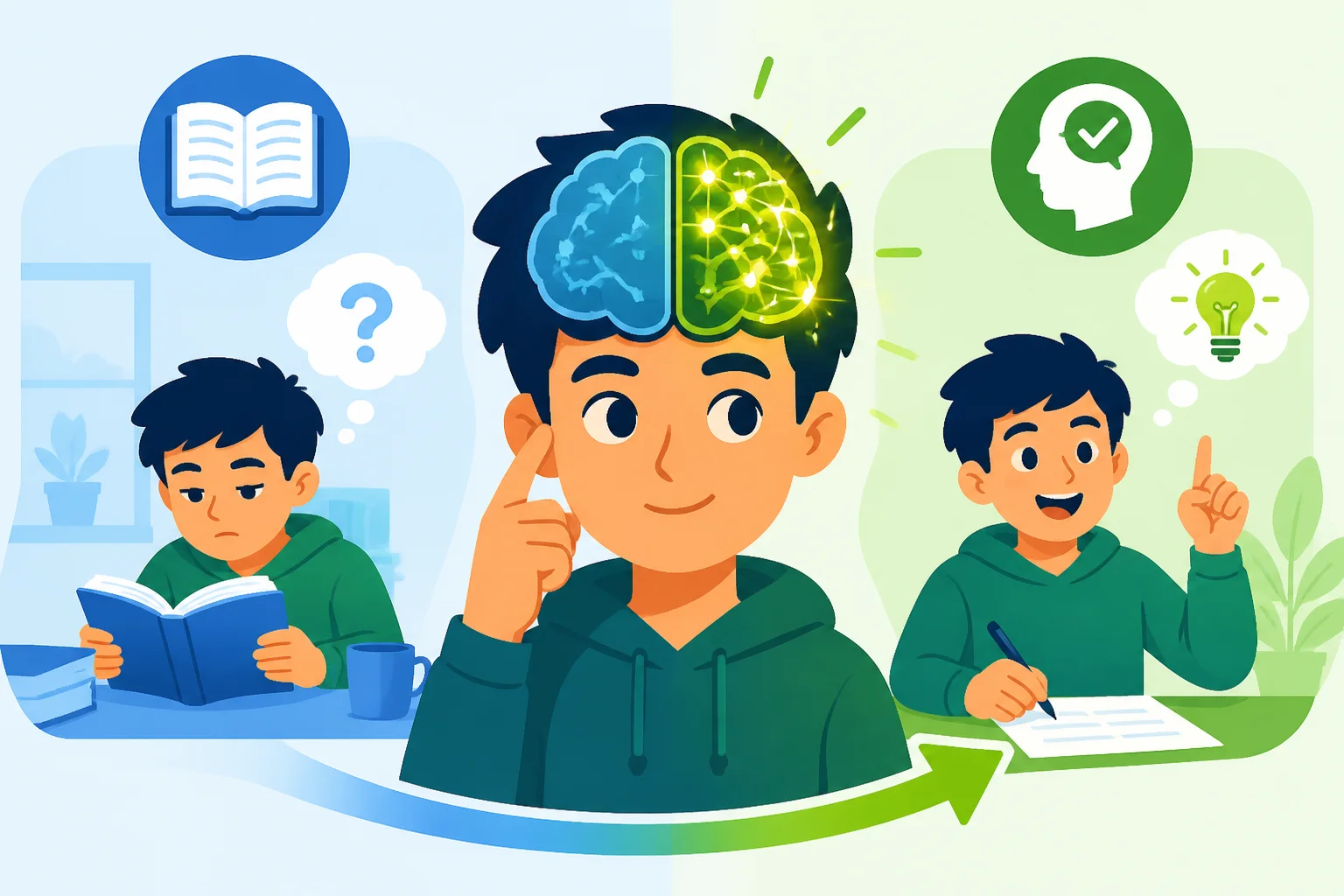
The best trap in learning is fluency. When you read a paragraph for the third time, your eyes move faster, the words feel familiar, and your brain reads that ease as evidence that the knowledge is yours. The testing effect pushes against that illusion. In Roediger and Karpicke's 2006 Psychological Science study, students read prose passages and then either kept studying or took recall tests. On an immediate test, repeated studying looked good. After a week, the pattern flipped: the repeated-test condition recalled about 61% of idea units, while the repeated-study condition recalled about 40%, according to the PubMed-indexed article on test-enhanced learning.
That number is worth handling carefully. It does not mean every quiz beats every reading session by 21 points. It means that, in that experimental setup, the harder route produced better delayed access. The act of trying to retrieve a passage made the memory more usable later, even though it felt less comfortable while doing it. That is exactly why casual learning needs a question before the explanation. The tiny discomfort is not a bug. It is the mind noticing an answer-shaped gap.
The same result explains why "tell me a fun fact" pages often blur together. If the fact arrives before the question, there is no moment where the reader has to locate an answer. A good trivia card reverses the order. It asks, "Which of these is true?" and waits just long enough for the learner to take a side. Then the explanation has somewhere to attach.
Retrieval Practice Strengthens the Memory You Touch
Karpicke and Roediger's 2008 Science article sharpened the point with vocabulary-style materials. Learners studied foreign-language word pairs under different schedules. Repeated studying after an item had already been learned did not help delayed recall as much as repeated retrieval; the PubMed summary says the results demonstrated the "critical role of retrieval practice in consolidating learning" (Karpicke and Roediger, 2008). The lesson is not "never study." The lesson is that after the first exposure, simply putting the answer in front of yourself again is not the same as making your memory do work.
For a curious adult, this is liberating. You do not need to turn every idle minute into a formal lesson. You need a format that makes the smallest possible retrieval act happen before closure. A 10-second cycle can be enough: read a question, choose an answer, then read why the correct answer is correct. The cycle is tiny, but it contains the same cognitive shape as larger retrieval practice: effort, feedback, correction, and a new link in memory.

This is also where AIgneous Million Whys' education values matter. Learning input is naturally fragmented: one question, then another, then another. Structure is the output that emerges as those fragments connect. A testing-effect-shaped card respects that rhythm. It does not demand a full course before the first spark. It lets a small question become a real unit of knowledge, then lets the next question grow from the closure of the first.
There is a subtle emotional benefit here too. Re-reading asks you to trust the page. Retrieval asks you to trust your own attempt, then repair it. That repair step is where confidence becomes better calibrated. If you missed the question, you know exactly what was missing. If you got it right for the wrong reason, the explanation can still correct the model. If you got it right and the explanation adds a mechanism, the card upgrades a lucky answer into usable knowledge.
That is why a good retrieval loop needs feedback, not just a score. The 2006 study tested recall under controlled conditions, but a consumer trivia experience should not mimic the coldness of a lab test. It should preserve the cognitive act and change the feeling around it. The question is the gap. The choice is the retrieval attempt. The explanation is the closure. The score, if it exists at all, is secondary.
Active Recall and the Fluency Illusion
Robert and Elizabeth Bjork's work on "desirable difficulties" gives a useful language for this feeling. The UCLA Bjork Learning and Forgetting Lab describes research on conditions that make learning more durable even when they make performance look worse during practice (Bjork Lab research overview). Retrieval practice is one of those difficulty patterns. It is desirable because it introduces friction in service of later access.
The friction matters because the brain is a poor judge of its own future memory. Re-reading produces a warm sense of familiarity; active recall produces exposed uncertainty. That uncertainty feels worse, so people often avoid it. But the uncertainty is the point. It tells you which part of the knowledge is missing. It turns "I saw this before" into "Can I actually bring this back?"
Curiosity makes that friction friendlier. A school test often carries judgment: score, rank, consequence. A curiosity question carries an itch: wait, which one is it? When the answer arrives, the learner gets closure rather than a grade. That is why the same cognitive engine can feel completely different in a trivia feed than it did in a classroom. The mechanism is retrieval; the emotional wrapper is wonder.

Multiple-Choice Trivia Can Still Trigger Retrieval
A fair objection is that trivia cards are usually multiple choice, not free recall. Free recall is harder: you produce the answer without options. Multiple choice gives cues, and bad multiple-choice questions can collapse into guessing. But that does not make the format empty. Little, Bjork, Bjork, and Angello studied multiple-choice tests as learning events and found that competitive alternatives can improve later performance, including on related information (Optimizing multiple-choice tests as tools for learning).
The word "competitive" is doing important work. A distractor that is obviously wrong does not create much retrieval. A plausible alternative does. It forces the learner to compare: why is this one tempting, and why is the other one better? That comparison is where memory gets a handle. In a good trivia card, the wrong answers are not throwaway jokes. They are nearby possibilities that make the correct explanation sharper.
That is also why the reveal should not arrive too soon. If you peek before choosing, you turn retrieval practice back into reading. The commitment is small, but it changes the mental event. You are no longer watching information pass by. You are asking your own memory to make a bet, then letting the explanation update it.
Multiple choice also gives trivia one advantage over many self-testing routines: it lowers the blank-page barrier. Free recall is powerful, but casual learners often abandon it because staring at an empty prompt feels like work. Plausible options make the first step lighter. They give the learner enough context to enter the "half-knowing" zone where curiosity is strongest. The format should not make the answer obvious; it should make the question approachable.
The wrong answers are therefore part of the lesson design. A weak distractor says, "This is a quiz." A strong distractor says, "Here is the neighboring idea you might confuse with the truth." When the feedback explains why that neighbor is wrong, the learner gets a sharper boundary around the concept. In science trivia, that might mean separating evaporation from condensation. In history trivia, it might mean distinguishing a cause from a coincidence. In everyday-phenomenon trivia, it might mean learning why an intuitive explanation is tempting but incomplete.
Why Testing Helps Learning More When It Is Spaced
The testing effect works best when it is not crammed into one heroic session. Memory benefits from time gaps, because a delayed retrieval attempt requires the learner to reconstruct the answer rather than ride the fading trace of immediate exposure. Cepeda and colleagues' 2008 Psychological Science paper on spacing effects found that the best interstudy gap depends on the desired retention interval; the PubMed abstract reports that the optimal gap was roughly 20-40% of a one-week test delay and about 5-10% of a one-year delay (spacing effects in learning).
That does not mean casual learners should calculate a spacing schedule before answering a question about penguins, rainbows, or Roman concrete. It means daily small encounters are cognitively sensible. A question today, another tomorrow, and a related one next week can do more than one long list swallowed in a single sitting. The spacing gives your memory a chance to lose just enough fluency that retrieval becomes useful again.

This is where the 10-second nano-learning loop becomes more than convenience. It fits the way curiosity actually appears: in small gaps during the day, not only in scheduled study blocks. A question at breakfast, a question in a line, a question before bed. Each one is too small to feel like a duty, but each one has enough structure to leave residue.
Spacing also protects the experience from becoming a fact binge. Reading 100 facts in a row can feel rich while it is happening, but the facts compete with one another and the gap-closing moment gets weaker. A spaced question has room around it. You can notice the uncertainty, commit, get the explanation, and later meet a related idea with a slightly changed mind. That is closer to how adult curiosity naturally compounds: not as one giant download, but as many small recognitions that start connecting.
Learn With Quiz Questions Without Turning Curiosity Into Homework
The testing effect can be misused if every question becomes a productivity chore. The research supports retrieval as a memory mechanism, not a moral personality test. For curiosity-led learning, the goal is not to squeeze maximum efficiency out of every second. The goal is to make the smallest learning unit honest: do not just show a fact; create a gap, ask for a choice, then close it with a clear explanation.
That gives a practical rule: use quiz questions when you want a fact to be remembered and connected later. Do not use them to pretend every topic needs a score. A good adult trivia experience should feel like a friend asking, "Wait, what do you think happens here?" not like a worksheet following you around. The answer's job is closure. The next question's job is compounding.
The best sequence is almost embarrassingly simple. First, read the question without rushing. Second, choose before you reveal. Third, read the explanation even when you got it right, because the "why" is where the portable knowledge lives. Fourth, let related questions appear later instead of bingeing the whole topic into blur. That is not exam prep. It is curiosity with a memory engine inside it.
Here is a practical way to use the testing effect without importing school anxiety:
- Choose first. Do not treat the answer reveal as the content. Treat your prediction as the opening move.
- Read the explanation after both right and wrong answers. Correct guesses can still be shallow guesses.
- Notice the tempting wrong answer. If it almost fooled you, it marks a real boundary in your understanding.
- Stop while the curiosity is still alive. A few complete loops are better than a long feed that turns into blur.
- Return later. Retrieval becomes more valuable after the answer has had time to fade.
The surprising part is how humane this can feel when it is designed around curiosity rather than compliance. Nobody needs a red pen hovering over a coffee-break question. The learner only needs a small honest challenge and an answer that respects the fact that they bothered to wonder.

What People Usually Miss About the Testing Effect
People usually frame the testing effect as a study tip: quiz yourself instead of re-reading. That is true, but too narrow. The deeper point is that format changes the meaning of a fact. A fact handed to you is an object. A fact you tried to predict is an answer. The answer has a place in your mind because a gap opened just before it arrived.
This is why a trivia card can be more than entertainment and still not become a study product. The card does not need to promise that trivia boosts IQ, prevents dementia, or turns idle scrolling into a degree. Those would be overclaims. It only needs to do one honest thing: make a learner retrieve, commit, receive feedback, and understand the mechanism. Repeat that thousands of times across topics, and knowledge starts to compound.
The other missed point is that the testing effect is not anti-reading. It is anti-passivity. Reading gives the first exposure, language, and context. Retrieval makes that context answerable. Explanation makes the answer meaningful. Spacing gives the memory time to become a real recovery act. The useful format is not "quiz instead of learn." It is "question, then learn in a way your memory can use."
That matters for AI-era learning because answers are now cheap. A chatbot can produce a paragraph instantly; a search engine can surface a snippet; a feed can deliver endless facts. The scarce event is the learner's own moment of wanting to know. A question-first interface protects that moment. It lets AI or editorial knowledge serve the gap instead of smothering it with premature answers.
Related Videos
Retrieval Practice to Enhance Learning and Retention
The Testing Effect and Retrieval Practice
FAQ
What is the testing effect in simple terms?
The testing effect is the finding that trying to retrieve information can improve later memory for that information. In plain English: answering before you review often sticks better than only reading again.
Does the testing effect mean quizzes are always better than studying?
No. You need initial exposure before retrieval can work, and different goals need different methods. The testing effect is strongest as a retention tool: once you have seen the material, retrieval helps make it available later.
Are multiple-choice trivia questions good for memory?
They can be, especially when the wrong options are plausible enough to make you think. Multiple choice is easier than free recall, but a committed choice plus feedback still creates a retrieval-and-correction loop.
How do I use active recall without making learning feel like homework?
Keep it small and curiosity-led. Read one question, make a real guess, then read the explanation. Stop before it feels like a chore. The point is a satisfying closure loop, not a forced study block.
Is trivia a substitute for deep study?
No. Trivia is best for broad exposure, memory hooks, and curiosity sparks. Deep skill still needs deliberate practice, feedback, and time. The honest claim is that trivia can make knowledge more retrievable and connected, not that it replaces expertise.
What does the testing effect have to do with AIgneous Million Whys?
Million Whys uses the question-first rhythm because curiosity and retrieval fit together. A 10-second card creates a gap, asks for a choice, then gives closure with the "why" behind the answer. That is the product idea in miniature: learning that starts from curiosity, not guilt.
Keep reading
Sources
Roediger and Karpicke, 2006: Test-enhanced learning
Karpicke and Roediger, 2008: The critical importance of retrieval for learning
UCLA Bjork Learning and Forgetting Lab research overview
Little, Bjork, Bjork, and Angello, 2014: Multiple-choice tests as learning tools
Curious? Try one 👇
Why is the sky blue?
Jump into the daily quiz →Keep Exploring

Related Posts
Trivia vs Flashcards: Which Helps Memory?
Trivia vs flashcards compares two retrieval tools: spaced decks for chosen material and curiosity-led questions for broad memory without cram pressure.
Are Trivia Games Good for Your Brain? Honest Science
Are trivia games good for your brain? This evidence-based guide explains retrieval practice, curiosity, memory benefits, and the honest limits of brain games.
Why Are Fun Facts Interesting? Memory Science
Why are fun facts interesting? Cognitive science says surprise creates a curiosity gap, primes memory, and turns answers into satisfying closure that sticks.