

Facts About Swans: Biology Behind the Grace
Facts about swans get interesting at the moment the postcard image stops working. A swan on still water looks effortless, almost decorative. Then it has to run across the surface to take off, defend a nesting territory, keep a long pair bond from becoming a fairy tale, and feed underwater with a neck that turns grace into reach.
TL;DR
Swans are graceful, but not delicate. Large species need long takeoff runs, strong wings, and large wetland spaces; their long necks let them reach submerged plants; many form durable pair bonds, but divorce and extra-pair paternity exist in the broader swan story; cygnets and adults vary by species; and "mute" swans are only less vocal than some relatives, not silent. The real biology is better than the myth because it has trade-offs.
The short answer: swans are large waterfowl built around reach, buoyancy, flight power, and social bonding. They look smooth because the visible motion hides a lot of work: feet pushing water, wings moving heavy bodies, necks harvesting plants below the surface, and breeding behavior shaped by territory and offspring survival.
Curious? Try one 👇
Why is the sky blue?
Jump into the daily quiz →Taking off is the least effortless part
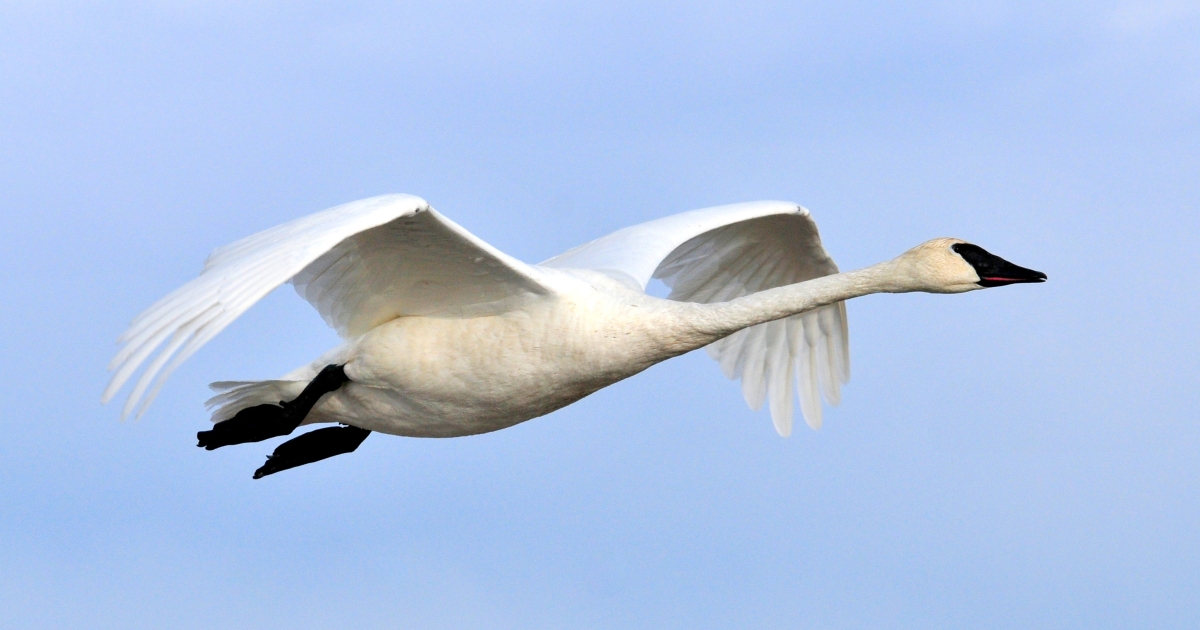
A swan floating across a pond makes size look irrelevant. Flight gives the size away. The U.S. Fish and Wildlife Service lists trumpeter swans at 54.3 to 62.2 inches long with an 80-inch wingspan, and notes that larger males can reach a wingspan of up to 10 feet (U.S. Fish and Wildlife Service). Audubon's field guide gives trumpeter swans a weight range of about 15 to 30 pounds (Audubon Trumpeter Swan).
That mass changes the drama of takeoff. A small bird can seem to pop into the air. A large swan often has to patter across the water, gaining speed while its wings push enough air to lift the body. The graceful flight is real, but it is earned by a runway.
The neck is not only for looking elegant
The long neck is feeding equipment. Audubon's mute swan guide describes mute swans feeding mostly on aquatic vegetation, reaching underwater with the neck and also grazing on land (Audubon Mute Swan). That reach changes what part of a pond is available. A duck can dabble. A swan can reach deeper stems, leaves, and roots without diving completely.
This is why the swan shape makes more sense in water than on a lawn. The body floats, the feet steer and push, and the neck searches below the surface. What looks like a decorative curve is a movable harvesting tool.

"Mate for life" is real, but too neat
Swans have earned their romantic reputation for a reason. Cornell's public species overview says mute swans form long-lasting pair bonds, and Audubon summarizes the familiar pattern: many mute swan pairs reportedly stay together for life. But Audubon also gives the caveat that the folklore tends to skip: divorce is reported in less than 3 percent of mates that breed successfully and about 9 percent of mates that do not (Audubon on birds that mate for life).
Even "monogamous" needs careful language. A PubMed-indexed study of black swans found that extra-pair paternity occurs in a species with strong social bonds (Kraaijeveld et al., 2004). That does not mean every swan pair is unstable. It means the charming human shorthand is not the same as biology. Pair bonds can be durable, adaptive, and still imperfect.

Cygnets are not just tiny white adults
Young swans are called cygnets, and the cute part hides a practical problem: they have to grow into a very large flighted body before migration, winter, or local conditions make life harder. Audubon's mute swan field guide notes that pairs usually form at about two years and first nest at three to four years; courtship includes facing each other and turning their heads side to side in unison (Audubon Mute Swan).
Cygnets also remind you that swan coloration is not one simple template. Young birds can be grayish, brownish, or white depending on species and morph. The adult "perfect white swan" image is only one stage and one slice of the family.

Mute swans are not actually mute
The name "mute swan" is a comparison, not a vow of silence. Audubon's field guide describes their calls as including hisses, barks, and snorts, and the New York Invasive Species information page notes that mute swans can be aggressive and territorial, especially around nesting and brood-rearing (NYIS Mute Swan).
That matters because the graceful image often edits out the bird's social life. A nesting swan is not performing elegance for humans. It is protecting space, mate, eggs, and young. The arched-wing threat posture is not ornamental; it is a warning written in body shape.
Black swans break the default mental picture
If the word swan automatically gives you a white bird on a European pond, black swans are the correction. They are native to Australia and show why "swan facts" should not quietly mean "mute swan facts." Species differ in color, range, voice, breeding timing, migration, and social behavior.
The black swan also became a metaphor in philosophy and statistics because Europeans once treated white swans as the obvious rule until black swans forced the rule to change. That is a useful miniature lesson: nature keeps punishing definitions built from whatever one culture happened to see first.
That does not mean a page about swans should pretend every species behaves the same way. It means the first useful move is to name which swan you mean. A mute swan in a park, a trumpeter swan on a North American wetland, a tundra swan on migration, and a black swan in Australia are not interchangeable props.
It also keeps the romance honest. A swan can be a symbol and an animal at the same time. The symbol likes clean rules: white bird, lifelong pair, mirrored necks. The animal lives in details: which species, which habitat, whether the pair bred successfully, whether a territory is crowded, whether young are present, whether migration changes the social setting. The curiosity payoff is not that the myth is "wrong." It is that the real bird has more moving parts than the myth can hold.
Flight turns the body into sound
Swans are often heard before their details are seen. Trumpeter swans get their name from their deep call, while mute swans are famous for the sound of wings in flight as much as for vocal calls. The biology is straightforward and lovely: big wings moving a lot of air do not pass through the sky silently.
That sound is also a contact signal. In open wetlands, where birds can be separated by distance, fog, reeds, or glare, sound keeps bodies connected. The same anatomy that makes the flight powerful also makes it audible, which is a nice reminder that a bird's beauty is often a side effect of solving a practical problem.

What people usually miss
The mistake is choosing between myth and mechanism, as if one must kill the other. The better answer is that swans are romantic because their biology is costly. Pair bonds matter because raising young is hard. Elegance matters because moving a heavy body through water and air takes engineering. The long neck, the territorial display, the takeoff run, the cygnet stage, the sound of wings: each one is a piece of the hidden work behind a familiar silhouette.
Related videos
America's Arctic - Tundra Swan - Cornell Lab of Ornithology
The Mute Swan - Princeton EEB 321
FAQ
What are the most surprising facts about swans?
The best surprise is how much work sits under the graceful image. Large swans may need a running start on water, their long necks are feeding tools, and their pair bonds are real but not as simple as the phrase "mate for life" suggests.
Do swans mate for life?
Many swans form durable pair bonds, and some pairs do remain together for life. But biology is more precise than folklore: divorce, re-pairing after a mate dies, breeding failure effects, and extra-pair paternity have all been documented in swan or bird studies.
Are mute swans silent?
No. "Mute" means less vocal compared with some other swans, not silent. Mute swans can hiss, snort, bark, and make wing sounds in flight.
Are swans dangerous?
They are not villains, but they are large territorial birds. Around nests or cygnets, a swan may display, hiss, chase, or strike. The sensible rule is simple: admire from distance, especially during breeding season.
What does this have to do with AIgneous Million Whys?
Swans are a perfect Million Whys question because the familiar answer is half-right. "They are graceful birds" is the doorway. The satisfying closure is learning what the grace is doing: lifting weight, defending young, reaching underwater, and turning a myth into biology.
Keep reading
Sources
U.S. Fish and Wildlife Service: Trumpeter Swan
Audubon Field Guide: Trumpeter Swan
Audubon Field Guide: Mute Swan
Audubon: Birds that mate for life
Kraaijeveld et al. 2004: Extra-pair paternity in black swans
Curious? Try one 👇
Why is the sky blue?
Jump into the daily quiz →Keep Exploring



Related Posts
Fun Facts About Beavers: Nature's Water Engineers
Fun facts about beavers explain orange teeth, dams, lodges, wetlands, and why these rodents quietly redesign streams for other species.
Fun Facts About Penguins: Adaptations Explained
Fun facts about penguins: how feathers, feet, flippers, salt glands, countershading, huddles, and deep dives make impossible adaptations work.
Interesting Facts About Owls: Silent Hunters
Interesting facts about owls: silent flight, dish-shaped faces, uneven ears, fixed tube eyes, pellets, and the mechanics behind night hunting.