

Why Does Compound Interest Work? The Quiet Curve
On this page· 16
Why does compound interest work? Because the percentage keeps applying to a base that has already changed. That sounds almost too small to matter, which is why compounding is so easy to underestimate. In the first few rounds, the new growth looks like pocket change. Later, the same rule is working on a much larger number, and the curve starts to feel as if it woke up. This is a mechanics explainer, not investment advice: the interesting part is the arithmetic, including the less cheerful fact that inflation and fees compound too.
TL;DR
Compound interest works because each period's gain becomes part of the next period's starting amount. The rate is not magic; the denominator changes. That is why growth feels disappointingly slow early, then surprisingly fast later, and why costs or inflation can quietly compound in the opposite direction.
The short answer: simple interest pays on the original principal only, while compound interest pays on principal plus prior interest. Investor.gov illustrates the basic idea with $100 earning 5%: after one year you have $105, and after the second year you have $110.25 because the second year's 5% is applied to $105, not $100 (Investor.gov). The extra 25 cents is tiny. The point is that it has joined the base.

The mechanism is the base, not the rate
Imagine putting one question into a jar every day. On day one, the jar barely changes. On day one hundred, the same daily habit has become a visible collection. Compounding has a similar feel, except the new pieces are generated from what is already in the jar. If the base is $100 and the rate is 5%, the first year's interest is $5. If that $5 stays in the account, the next 5% applies to $105.
The common formula writes that as A = P(1 + r/n)nt: amount equals principal times one plus the periodic rate, raised to the number of compounding periods. The formula looks more dramatic than the idea. P is the starting base, r is the annual rate, n is how many times per year the interest is applied, and t is time. Investor.gov's compound-interest calculator asks for those same ingredients: initial investment, contributions, time, rate, and compounding frequency (Investor.gov calculator).
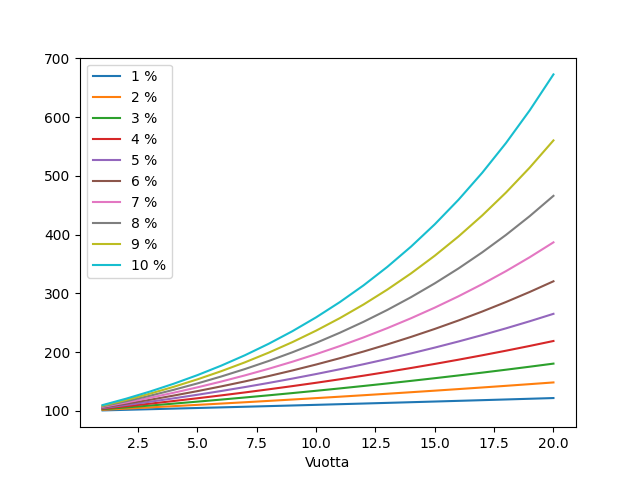
That distinction matters. A high rate for one period can look exciting, but compounding is mostly about repetition. A modest rate repeated for many periods can outrun a louder number that happens only once. That is the part our intuition tends to miss, because human attention is good at noticing jumps and bad at feeling repeated multipliers.
Question 1 of 5
You leave $100 in an account at 5% a year and keep the interest in. Why is the second year's interest bigger than the first year's?
Why most of the growth arrives late
The strangest thing about compounding is that the early years can be mathematically important and emotionally boring. Suppose $1,000 grows at 7% per year with no extra contributions. After one year, the gain is $70. After ten years, the account is about $1,967. After twenty years, it is about $3,870. After thirty years, about $7,612. The first decade did not look explosive, but it built the base that made the later decades possible.
This is why the "magic" language around compound interest can be misleading. Nothing supernatural happens between year 20 and year 30. The same 7% rule is simply being applied to a base that has already doubled more than once. Investor.gov's Rule of 72 explanation gives a useful rough check: divide 72 by the annual rate to estimate the number of years needed for a value to double; at 9%, that rough doubling time is about 8 years (Investor.gov).

A curiosity habit works in a similar shape. One tiny answer rarely feels life-changing. But it changes what you can notice next. Once you understand why ice floats, you are closer to asking why lakes freeze from the top down. Once you know how caffeine blocks adenosine receptors, the afternoon crash becomes less mysterious. Knowledge compounds because each closure reveals a new gap.
Question 2 of 5
At a steady 9% annual return, roughly how long does the Rule of 72 say it takes for an investment to double?
Compounding frequency changes the curve, but not the story
Compounding frequency is how often the earned interest gets folded back into the base. Annual compounding does that once a year. Monthly compounding does it twelve times. Daily compounding does it 365 times. More frequent compounding can produce a higher ending amount at the same stated annual rate, because the base is updated more often.
But frequency is not a loophole that turns arithmetic into free money. The rate, time, deposits, taxes, account rules, and risk all still matter. The cleaner lesson is that compounding is a feedback loop: output becomes input. When the output is interest, the base grows. When the output is an explanation you actually understand, the next question starts from a better place.

Question 3 of 5
Two savings accounts both advertise 5% a year, but one compounds annually and the other compounds monthly. Why does the monthly one end the year with more money?
Fees compound in the wrong direction
The same arithmetic that makes gains grow can make costs grow. A fee is not just a one-year subtraction; it can reduce the future base that would have generated later gains. The SEC's investor bulletin on fund fees says fees and expenses reduce investment returns and that a higher-cost fund must perform better than a lower-cost fund to generate the same return for the investor (SEC Investor Bulletin).
That is the part most cheerful compounding examples skip. If two hypothetical portfolios earn the same gross return but one has higher ongoing costs, the difference is not only this year's fee. It is every future dollar that the removed fee can no longer earn. The subtraction gets its own quiet curve.
This does not mean "fees are always bad" or "lowest cost always wins." Products, advice, convenience, and risk can have real value. It means that any recurring percentage deserves respect. A recurring percentage is not a sticker price. It is a small machine that runs every period.
Question 4 of 5
Why does a fund charging 1% a year need to earn more than a fund charging 0.1% just to leave investors with the same money?
Inflation compounds too
Inflation is another compounding story, but it works on purchasing power. If prices rise 3% one year and 3% the next, the second year's increase applies to the already-higher price level. That is why "only a few percent" can still change what a dollar buys over time. The U.S. Bureau of Labor Statistics explains that its CPI inflation calculator uses the Consumer Price Index for All Urban Consumers, a broad measure of price changes for goods and services purchased by urban households (BLS CPI calculator).
This is why the real question is not just "What grew?" but "What grew after costs and purchasing power changed?" A nominal number can rise while the practical value rises less, stays flat, or falls. Again, the point is not advice. The point is closure: compounding is a rule about repeated percentages, and the rule does not care whether the percentage helps you or hurts you.
Question 5 of 5
Why does two years of 3% inflation raise prices by slightly more than 6%?
What people usually miss
People usually miss the dead years. We notice the exciting right side of the curve and forget that it was built by the quiet left side. The early period is not wasted because it looks small; it is where the base is being trained. That is true in money, and it is true in curiosity. One small explanation makes the next explanation easier to reach. A month of tiny closures changes what you are capable of wondering about.
The other missed point is symmetry. Compounding is not a moral force. It does not mean "good things grow." It means repeated percentage effects build on themselves. Interest, fees, inflation, habits, attention, and knowledge can all become feedback loops. The question worth asking is: which loops are you feeding?
Related videos
FAQ
Why does compound interest work better over long periods?
Because time gives each gain more chances to become part of the next base. The first gains can look small, but later gains are calculated on a base that already includes many earlier gains.
Is compound interest the same as simple interest?
No. Simple interest is calculated only on the original principal. Compound interest is calculated on the principal plus interest that has already been added.
Does more frequent compounding always matter a lot?
Not always. More frequent compounding can increase the ending amount, but the effect depends on the rate, time, and account terms. Frequency is one input, not the whole story.
Can compound interest work against you?
Yes. Recurring fees, debt interest, and inflation can compound in ways that reduce your future position. The arithmetic is neutral; the direction depends on what is being compounded.
Is this investment advice?
No. This page explains a mechanism. Decisions about saving, investing, borrowing, taxes, and risk depend on personal circumstances and should be checked against reliable financial guidance.
What does this have to do with AIgneous Million Whys?
Million Whys is built around the same shape, but for curiosity: one small answer closes a gap, changes the base of what you understand, and makes the next question easier to notice. Knowledge compounds when the loop stays small enough to repeat.
Keep Exploring
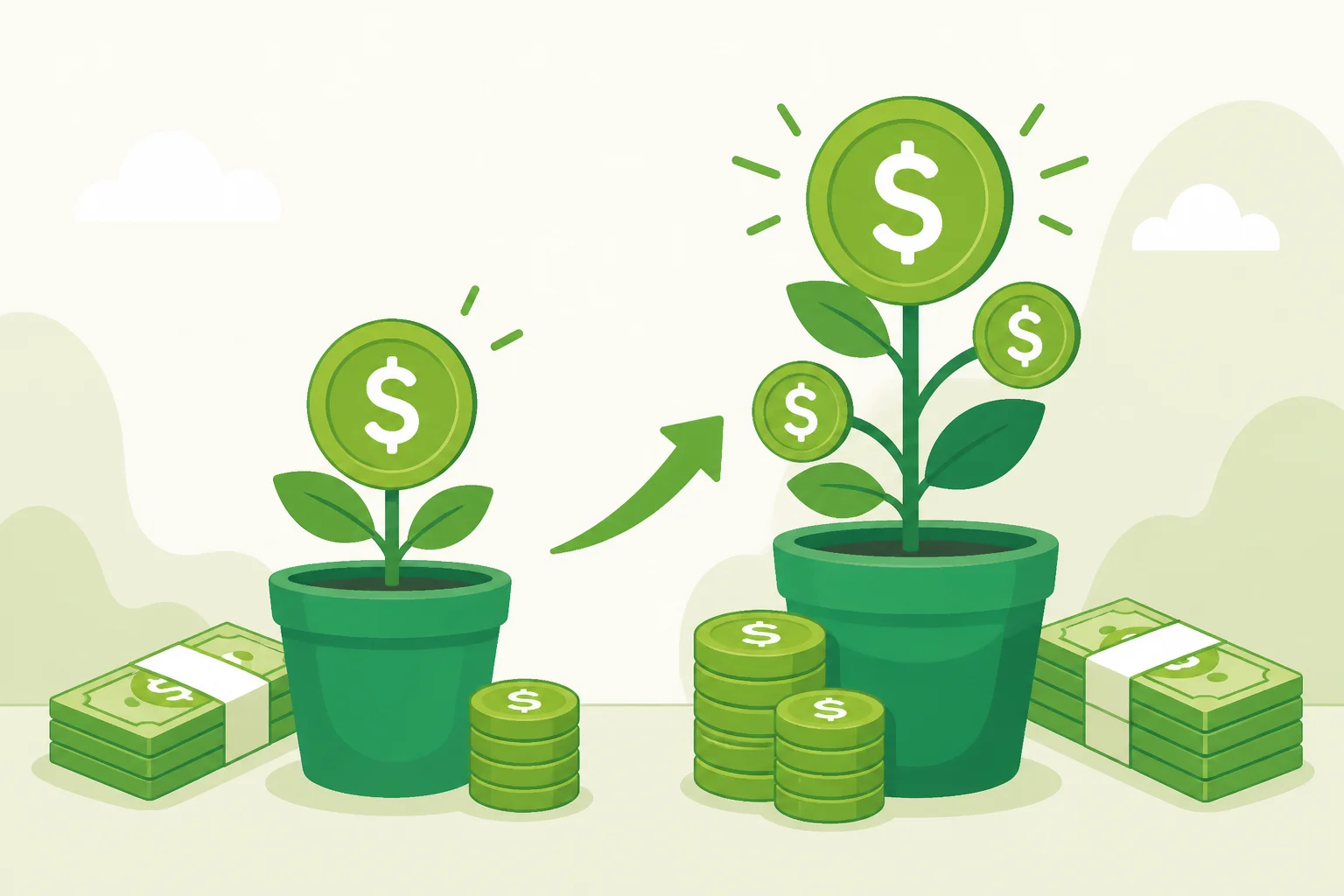
You leave $100 in an account at 5% a year and keep the interest in. Why is the second year's interest bigger than the first year's?
Economics & Money
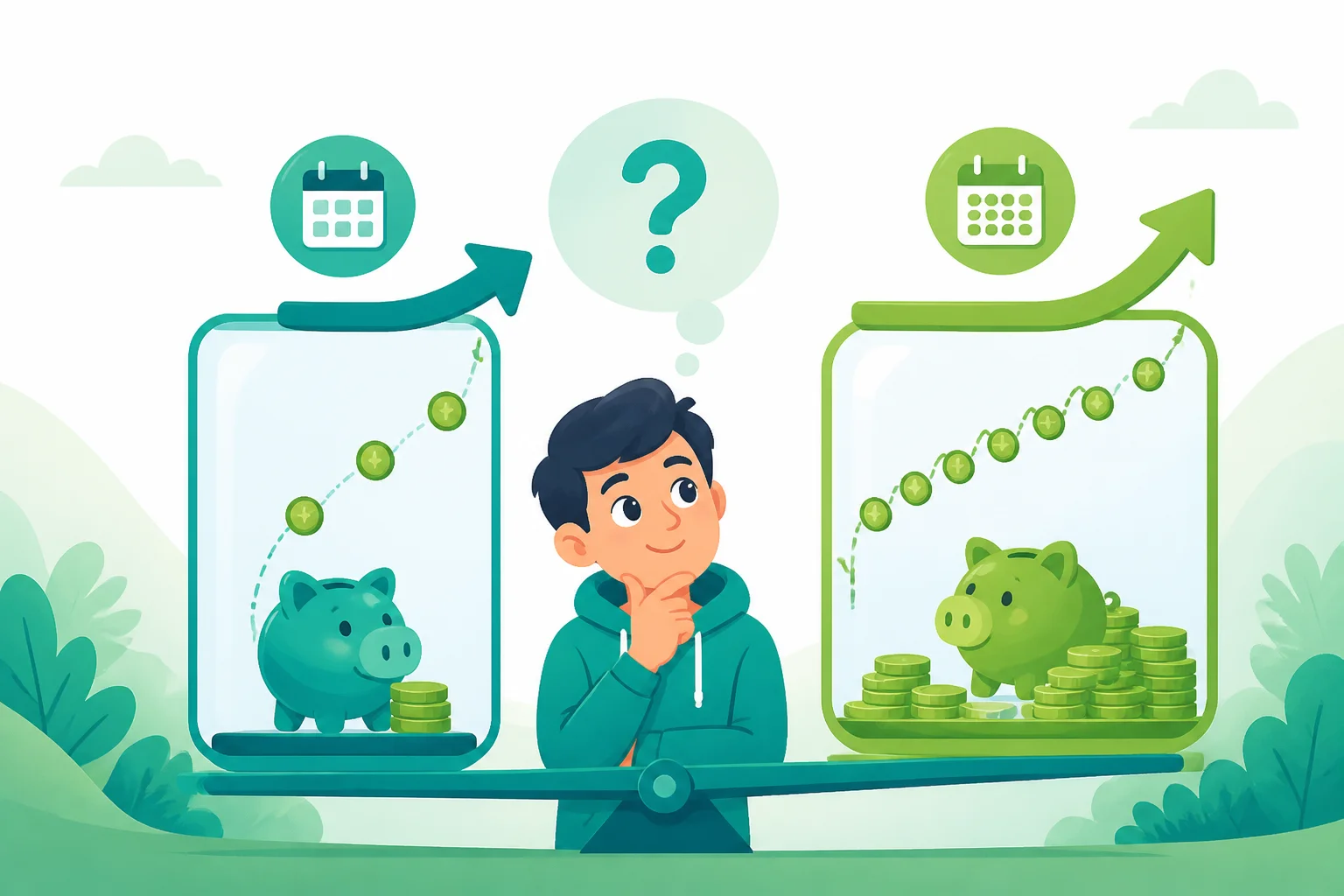
Two savings accounts both advertise 5% a year, but one compounds annually and the other compounds monthly. Why does the monthly one end the year with more money?
Economics & Money
Why do banks charge interest on loans?
Economics & Money
Related Posts
Why Does Time Speed Up as You Get Older?
Why does time speed up as you get older? The answer sits in proportional time, memory density, dopamine, attention, and small doses of novelty in daily life.
Learning Anything Starts With Tiny Questions
Learning anything works better when the unit is a tiny question: curiosity opens the gap, real answers close it, and knowledge compounds over time.
Why Are Fun Facts Interesting? Memory Science
Why are fun facts interesting? Cognitive science says surprise creates a curiosity gap, primes memory, and turns answers into satisfying closure that sticks.