

Wet Bulb Temperature: Why Humid Heat Turns Deadly
On this page· 17
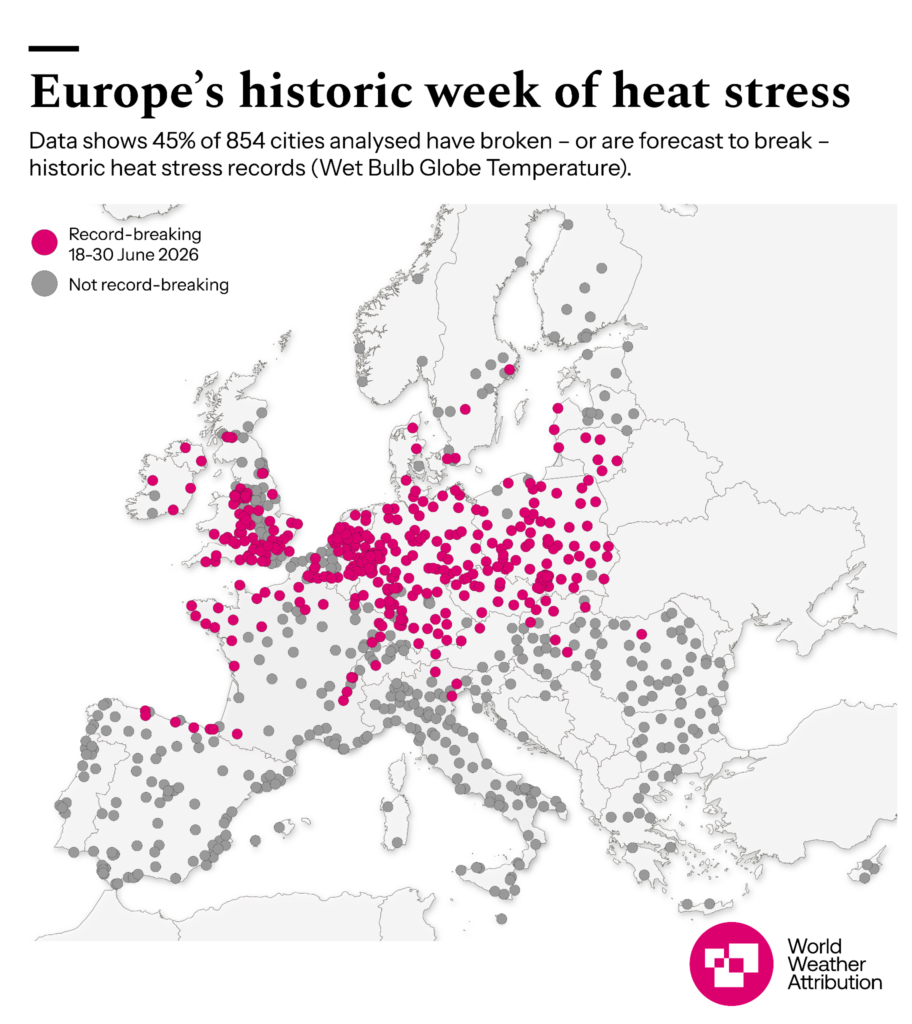
Wet bulb temperature is the heat number that explains why some summer days feel merely uncomfortable and others feel like the air has stopped accepting sweat. During the June 2026 European heatwave, World Weather Attribution reported record-breaking heat stress across roughly 45% of the European cities it analyzed, using Wet Bulb Globe Temperature as the health-relevant lens. That is the useful doorway: not "how hot is the air?" but "can your body still dump heat into it?"
TL;DR
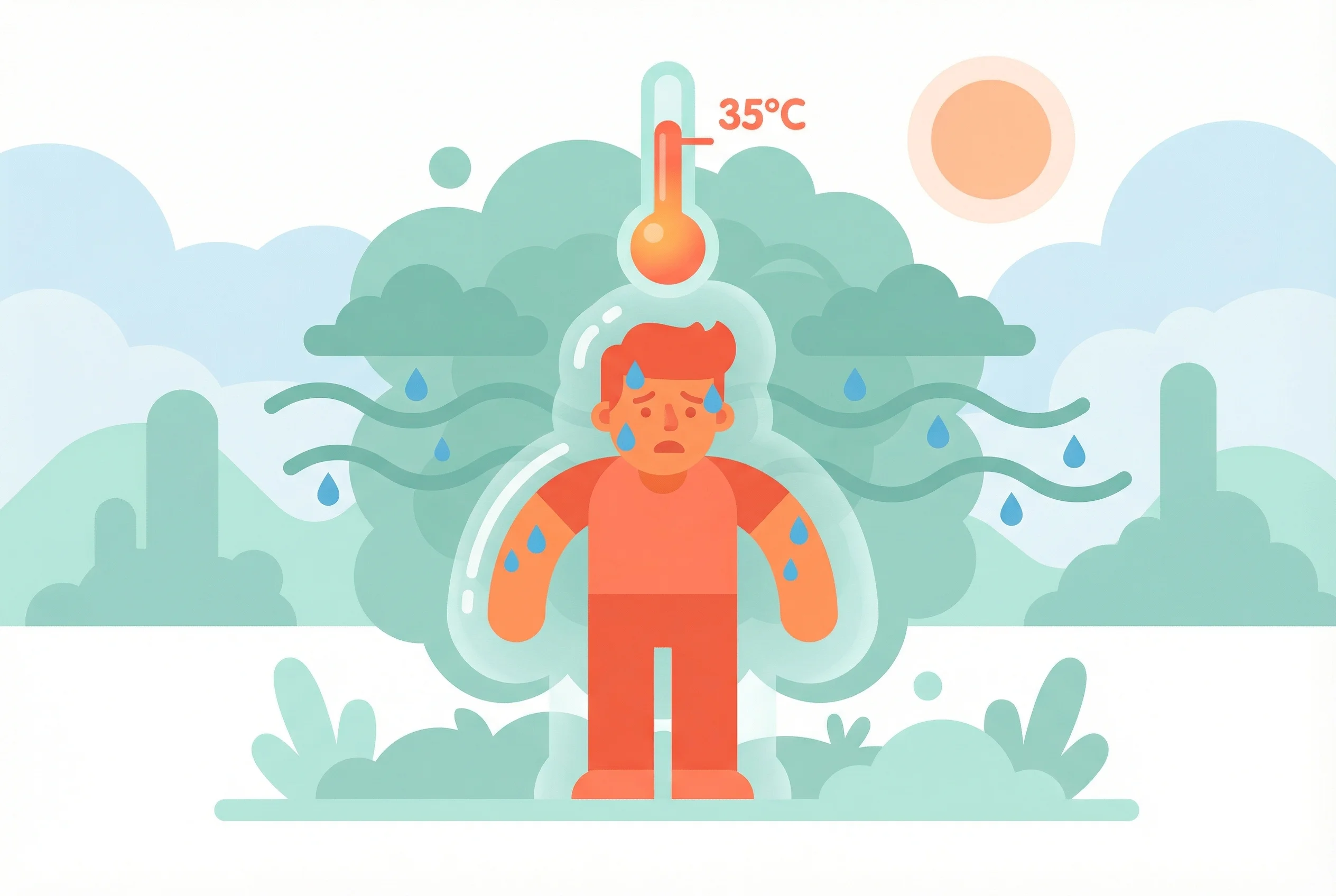
Wet bulb temperature is the lowest temperature air can reach through evaporation. For people, it matters because sweat only cools you when it evaporates. Around 35°C wet bulb is a theoretical upper survival boundary for a healthy person in shade with unlimited water; real people can be in danger well below that, especially in sun, work, illness, old age, or poorly cooled buildings.
Short answer: wet bulb temperature combines heat and humidity into one cooling-limit number. A dry 40°C day can be brutal but still allow sweat to evaporate; a humid day with a lower air temperature can be more dangerous because evaporation stalls. NASA summarizes the classic limit at about 95°F, or 35°C, for at least six hours of exposure, while the National Weather Service explains that WBGT adds solar radiation and wind to estimate practical heat stress.
Curious? Try one 👇
Why is the sky blue?
Jump into the daily quiz →What Is Wet Bulb Temperature?
Wet bulb temperature starts with a simple experiment. Wrap a thermometer bulb in wet cloth and move air across it. If the air is dry, water evaporates quickly and pulls heat away, so the thermometer reads lower than the ordinary air temperature. If the air is humid, evaporation slows, and the wet-bulb reading stays closer to the dry-bulb reading. The National Weather Service describes this directly: a wet bulb measures the temperature read by a thermometer covered in wet cloth, and evaporation cools the thermometer in the same basic way sweat cools skin.

The curiosity payoff is that wet bulb is not just another weather metric. It is a measure of the room left for evaporation. When the gap between air temperature and wet bulb is wide, sweat has room to do its job. When the gap narrows, the body loses its main cooling trick. That is why this number can feel more honest than the headline temperature when people are asking, "why does this heat feel different?"
Wet Bulb vs Dry Bulb Temperature
Dry bulb temperature is the ordinary air temperature measured in shade. Wet bulb temperature is lower unless the air is already saturated with water vapor. At 100% relative humidity, the two numbers meet because evaporation cannot cool the wet cloth any further. At lower humidity, wet bulb drops below dry bulb because evaporating water removes heat.

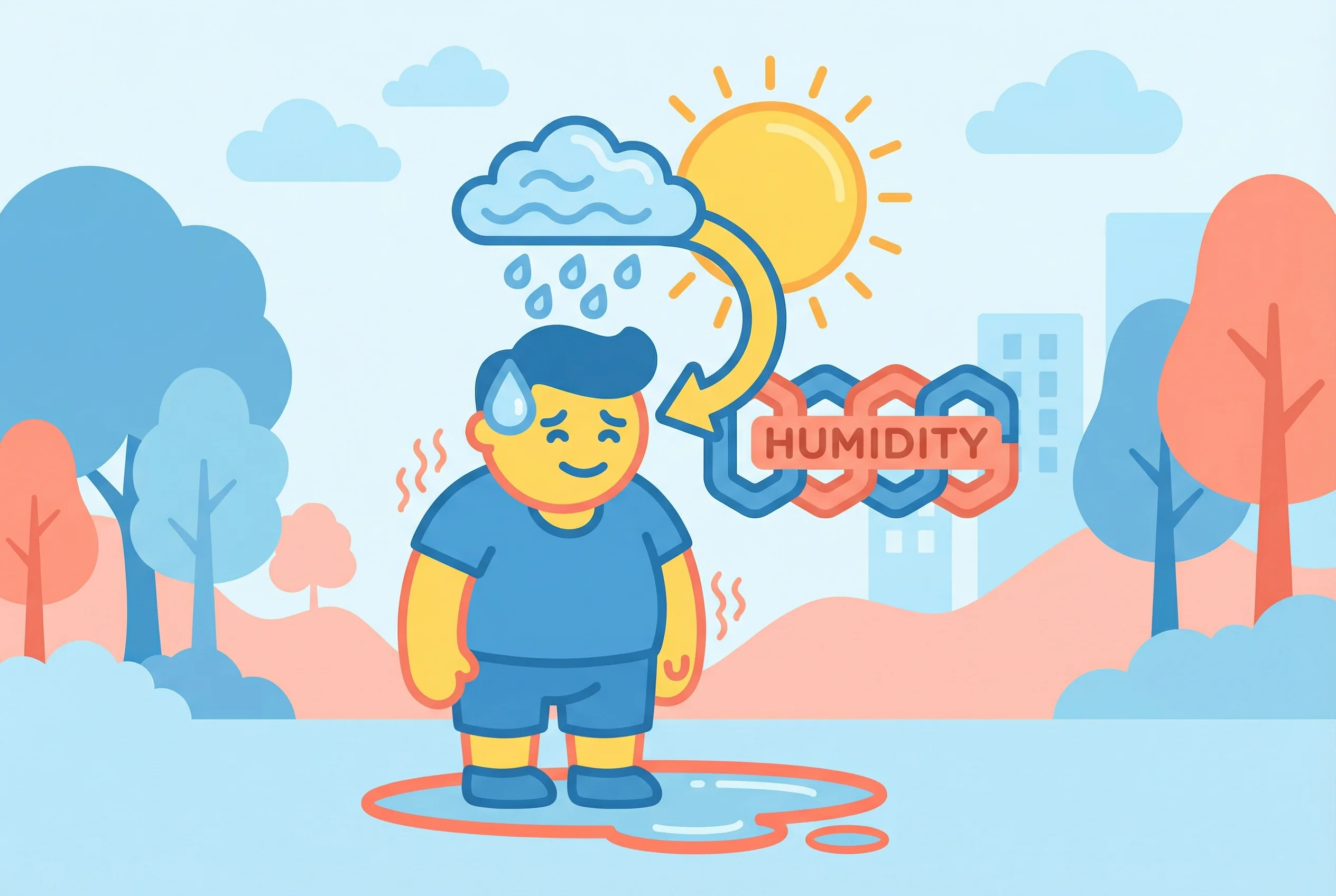
This is why "40°C" is not enough information. A desert 40°C day and a tropical 34°C day can place very different demands on a human body. In dry air, sweat disappears from skin and takes heat with it. In humid air, sweat can sit there, making you wet without making you cooler. The dry-bulb number tells you how hot the air is. The wet-bulb number tells you how much cooling the air will still allow.
How to Calculate Wet Bulb Temperature
The most accurate method uses psychrometric equations or instruments, because the true value depends on temperature, humidity, pressure, and ventilation. For a fast estimate near standard sea-level pressure, many calculators use Roland Stull's 2011 approximation, published in the Journal of Applied Meteorology and Climatology. Stull presented an empirical equation for wet-bulb temperature from air temperature and relative humidity, valid for most everyday combinations from -20°C to 50°C and 5% to 99% relative humidity.
You do not need to run the formula by hand to understand the direction. Raise relative humidity while holding air temperature constant and wet bulb rises. Raise air temperature while humidity stays high and wet bulb rises too. The dangerous zone is not just "hot"; it is hot plus moisture plus limited air movement, especially when buildings trap heat overnight.

Why 35°C Wet Bulb Is the Human Survival Limit
The famous 35°C threshold comes from the physiology of heat balance. Sherwood and Huber's 2010 PNAS paper argued that sustained wet-bulb temperatures above 35°C would make it impossible for humans and other mammals to dissipate metabolic heat. NASA's explainer uses the same number as the approximate highest wet-bulb temperature a person can survive for at least six hours when exposed to the elements.
But the number is often misunderstood. It is not a magic line where 34.9°C is safe and 35.1°C is instantly fatal. It is a theoretical upper boundary under idealized assumptions. Older adults, children, pregnant people, outdoor workers, people on certain medications, and people in badly ventilated homes can be harmed at much lower wet-bulb or WBGT values. The answer's closure is not "panic at 35." It is "humidity steals the body's cooling margin long before the air temperature looks impossible."
WBGT: Wet Bulb Globe Temperature
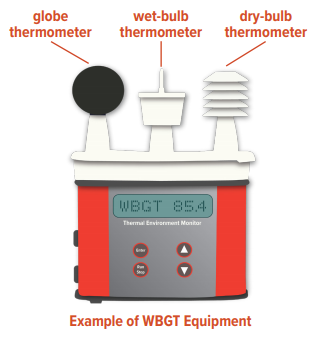
Wet Bulb Globe Temperature, or WBGT, is a practical heat-stress index. The National Weather Service explains that WBGT combines three thermometer ideas: wet bulb for evaporative cooling, black globe for solar radiation, and dry bulb for shaded air temperature. That is why athletes, outdoor workers, military planners, and marathon organizers use it. A shaded thermometer misses the extra load from direct sun; a heat index misses wind and radiation; WBGT tries to estimate the body-facing environment.
World Weather Attribution used WBGT in its June 2026 European heatwave analysis and reported that, from June 18 to 29, about 45% of 854 cities analyzed had broken or were forecast to break historical heat-stress records. That is the metric shift people miss: a city can break a human-stress record even when the dry-bulb thermometer is not the most dramatic number in history.
Today's Wet Bulb Temperature and the 2026 Spike
The June 2026 heatwave was not just a hot week floating in isolation. World Weather Attribution found that the event occurred under a southerly-flow pattern that had historical analogues, but that the same circulation now produces much hotter conditions because the baseline climate has warmed. The group also reported that similar June heat would have been about 3.5°C cooler during the day in 1976 and that night temperatures would have been about 2.4°C cooler.
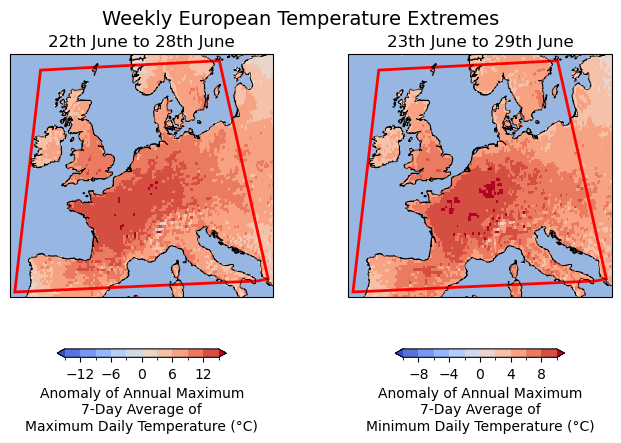
That is why "current wet bulb temperature" has become a more useful search than it used to be. The danger is not only the afternoon peak. Warm nights keep bodies and buildings from resetting. Humidity means sweat buys less relief. Dense cities hold heat. The question is no longer academic; it is a daily check on whether outdoor work, sport, commuting, or a non-air-conditioned room is crossing from uncomfortable into risky.
Indoor Wet Bulb Temperature and Your Home
Indoors, the same physics applies with a lag. A home can remain dangerous after the street begins cooling, especially on upper floors, in dense neighborhoods, or in buildings without cross-ventilation. Fans help when they move air across wet skin, but they do not lower the wet-bulb limit. Evaporative coolers work best in dry climates because they rely on the air being able to accept more water. In humid heat, mechanical cooling or access to a cooler space can become a health intervention rather than a luxury.

What people usually miss is that heat risk is not one number on a weather app. It is a relationship among air temperature, humidity, sun, wind, activity, clothing, age, health, and the building around you. Wet bulb temperature gives the cleanest "can sweat still work?" clue. WBGT gives the broader "what does this environment do to a body?" clue.
Related videos
FAQ
What does wet bulb temperature mean?
It means the lowest temperature air can reach through evaporation under current conditions. For people, it is a clue to whether sweat can still cool the body.
What wet bulb temperature is dangerous?
The theoretical upper survival boundary is often cited around 35°C wet bulb, but many people can be harmed well below that depending on age, health, sun exposure, activity, and indoor conditions.
Is wet bulb temperature the same as heat index?
No. Heat index estimates how hot shaded air feels from temperature and humidity. Wet bulb focuses on evaporative cooling potential. WBGT goes further by adding sun and wind effects.
How can I lower wet bulb temperature indoors?
Mechanical cooling lowers both heat and moisture. Ventilation helps if outside air is cooler or drier. In humid heat, fans can help sweat evaporate but cannot solve a dangerous wet-bulb environment by themselves.
Where do I find current wet bulb temperature today?
Use a local meteorological service, a WBGT forecast where available, or a calculator that takes air temperature and relative humidity. Treat the result as a risk clue, not a full medical safety guarantee.
What does this have to do with AIgneous Million Whys?
Million Whys is built for moments like this: a half-known phrase in the news, a real mechanism underneath it, and the satisfying closure of finally seeing why humidity changes everything.
Sources
World Weather Attribution: Fossil fuel emissions have rapidly worsened European heatwaves
National Weather Service: Wet Bulb Globe Temperature, how and when to use it
NASA: Too hot to handle, wet-bulb temperature and human limits
Sherwood and Huber 2010: An adaptability limit to climate change due to heat stress
Stull 2011: Wet-Bulb Temperature from Relative Humidity and Air Temperature
Curious? Try one 👇
Why is the sky blue?
Jump into the daily quiz →Keep Exploring

Related Posts
Why No AC in Europe? Heat, Homes, and Habits
Why no AC in Europe? Mild summers, old buildings, energy prices, culture, and policy made cooling rare, but hotter heatwaves are changing the math for homes.
Why Does Heat Kill? The Body's Cooling Limit
Why does heat kill? Your body survives heat by moving and evaporating water; death begins when humidity, time, and physiology stop that cooling loop inside.
Heat Stroke vs Heat Exhaustion: Key Differences
Heat stroke vs heat exhaustion: spot the difference, know when confusion means emergency, and use calm first aid before a hot day turns dangerous fast.