

Why Do Onions Make You Cry? Chemistry & Fixes
On this page· 17
Cutting an onion feels like a tiny kitchen betrayal: nothing dramatic happens, and then your eyes start watering as if the vegetable won. The useful answer to why do onions make you cry is not "because onions smell strong." It is a fast defense chemistry chain that begins when a knife breaks onion cells and ends when a volatile sulfur compound reaches the wet surface of your eye. Once you see the chain, the good remedies stop sounding like folklore and start sorting themselves into "slows the chemistry," "moves the gas," or "does almost nothing."
TL;DR
Onions make you cry because cutting them mixes separated sulfur compounds and enzymes. That reaction produces syn-propanethial-S-oxide, a volatile lachrymatory factor that reaches your eyes, irritates sensory nerves at the cornea, and triggers reflex tears. Cold onions, sharp knives, ventilation, and water help only insofar as they slow production of the gas, reduce cell damage, or keep the gas away from your eyes.
Short Answer
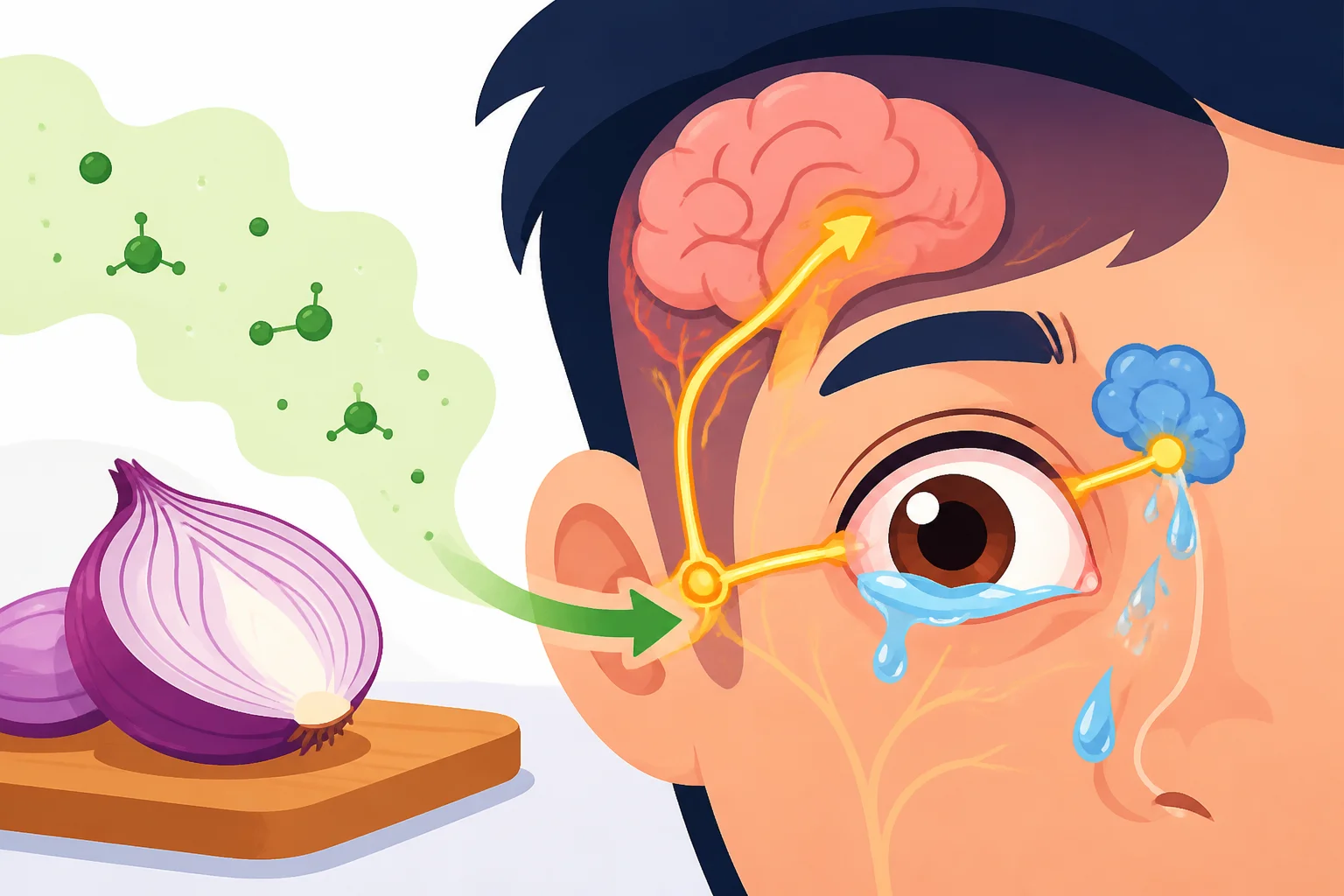
When onion tissue is damaged, alliinase and lachrymatory-factor synthase help convert onion sulfur precursors into syn-propanethial-S-oxide. The Library of Congress describes this compound as the irritant that stimulates the eye's lacrimal glands, and the American Chemical Society identifies it as the culprit behind onion tears. The gas is small and volatile enough to drift upward; when it contacts the watery film on the eye, it irritates the cornea's sensory nerves, and your tear glands flush the surface.

The Onion Keeps The Ingredients Apart
The first thing people usually miss is that an intact onion is not already full of tear gas. It is full of separated ingredients. Onion cells hold sulfur-containing flavor precursors in one place and enzymes in another. That separation matters: the chemistry is mostly quiet until the tissue is crushed, sliced, or bitten.
In a peer-reviewed structural study of onion lachrymatory-factor synthase, researchers describe the pathway as part of the chemical defense system of Allium plants. Damage to tissue lets alliinase act on cysteine sulfoxide precursors, producing reactive sulfenic acids. In onions, a second enzyme, lachrymatory-factor synthase, channels one of those intermediates toward the volatile lachrymatory factor, (Z)-propanethial S-oxide.
That is why crushing onion cells tends to be worse than slicing them cleanly. A dull knife ruptures more tissue, mixes more compartments, and gives the chemistry more surface area. A sharp knife does not make the onion harmless, but it makes the damage narrower. The same logic explains why grating an onion can feel like opening the floodgates: it destroys many cells at once.

Question 1 of 5
Why does cutting an onion start tear-inducing chemistry when an intact onion already contains both sulfur-containing ingredients and enzymes?
The Chemistry Chain Is Fast, But Not Magic
The Library of Congress gives the clean version of the sequence: cutting releases lachrymatory-factor synthase; that enzyme helps convert amino acid sulfoxides through sulfenic acid chemistry; the unstable intermediate rearranges into syn-propanethial-S-oxide; the airborne compound reaches the eyes and triggers tears. The American Chemical Society's molecule profile says the same essential thing: exposing onion enzymes to air generates 1-propenesulfenic acid, and another enzyme rearranges it into the volatile tear-causing molecule.
The Royal Society of Chemistry's education article adds the eye-side detail: propanethial-S-oxide is a lachrymator, meaning a compound that makes the eyes water. It is not just "onion smell." Onion odor is partly from related sulfur compounds, but the tear reflex is specifically about a volatile irritant reaching sensitive tissue.
This chain also explains why timing feels strange. You often do not cry at the first cut. The molecule has to form, leave the onion surface, move through the air, dissolve or react at the tear film, and be detected by nerve endings. That tiny delay is the gap where practical tricks can help.

Question 2 of 5
Why does cutting an onion not make your eyes tear until its chemical irritant reaches the tear film?
Your Eye Treats The Gas Like A Tiny Alarm
The surface of the eye is wet, exposed, and heavily wired for protection. That is why a small irritant can produce a big response. Scientific American's classic Ask the Experts explanation traces the sensation through the cornea and trigeminal nerve: free nerve endings detect the irritant, the brain interprets the signal as burning, and autonomic fibers activate the tear glands.
That response is useful. Reflex tears are not a sign that the onion has emotionally moved you; they are the eye's rinse cycle. The goal is to dilute and remove the irritant before it can keep stimulating the cornea. This is also why wearing sealed goggles works so well. They do not change the onion chemistry at all. They simply keep the molecule from reaching the eye.
Contact lenses can reduce irritation for some people for the same physical reason: they cover part of the corneal surface. That does not make them a recommended onion strategy, and it will not protect every sensitive area, but it fits the mechanism better than a charm-like kitchen hack.

Question 3 of 5
Why do onion fumes make your eyes tear up through a nerve reflex instead of simply making the tear glands react on their own?
Which Onion Tricks Actually Match The Mechanism?
The best onion tricks are boring because physics and chemistry are boring in exactly the useful way.
Chilling the onion can help because lower temperature slows enzyme activity and reduces volatility. It does not delete the chemistry; it turns the volume down. Use short chilling before cutting, not long refrigerator storage as a blanket rule, because whole onions generally keep better in cool, dry, ventilated pantry conditions.
A sharp knife helps because it crushes fewer cells. Fewer ruptured cells means less mixing of precursors and enzymes. If your cutting board smells brutally oniony and your eyes sting quickly, the knife may be doing more smashing than slicing.
Ventilation helps because the lachrymatory factor has to travel through air. A range hood, open window, or small fan can move the gas away from your face before enough of it reaches your eyes.
Cutting near running water can help in two ways: water can intercept some volatile compound, and the airflow near a sink may pull vapor away. It is not a universal fix, and cutting under water is awkward, but the idea at least points at the correct bottleneck: keep the molecule out of your eyes.
Bread in the mouth is the weak one. People defend it with stories, but the chemistry does not need your mouth to reach your eyes. Unless the bread changes your breathing or blocks airflow in some accidental way, it is mostly ritual. The onion gas is not waiting for permission from a sandwich.

Question 4 of 5
Why can chilling an onion and chopping it in a well-ventilated place both reduce tears, even though they work differently?
Why Different Onions Hit Differently
Not every onion feels equally aggressive. Variety, growing conditions, storage, age, and sulfur chemistry all affect pungency. Sweeter onions often feel milder because their balance of sugars and sulfur compounds differs from sharper storage onions, though "sweet" does not mean chemically silent.
Tearless onions make the mechanism especially clear. The LOC article points to Japanese work identifying lachrymatory-factor synthase as the key enzyme, and the structural study notes that silencing LFS expression produced onions that did not irritate the eyes when tissue was disrupted. In other words, remove the right enzymatic step and the kitchen drama mostly disappears.
That does not make ordinary onions defective. The same sulfur chemistry that bothers your eyes belongs to the Allium family's flavor and defense system. The payoff of the question is a little funny: the onion is not attacking you personally. You are walking into a plant's broken-cell alarm system and then asking why the alarm is loud.

Question 5 of 5
How can silencing one onion gene make the onion stop irritating your eyes when you cut it?
What People Usually Miss
The misconception is that onion tears are a smell problem. They are really a routing problem. The onion routes sulfur precursors through enzymes after damage; the product routes through air; your eye routes the irritation through protective nerves; tears route the irritant away. Every working trick interrupts one leg of that route.
That is a useful curiosity pattern beyond onions. When a fact feels like folklore, ask where the chain begins, what carries the signal, and what closes the loop. The answer is often hiding in a tiny mechanism you have experienced a hundred times without naming it.
Related Videos
FAQ
Why do onions make you cry more when the knife is dull?
A dull knife crushes more onion cells. More crushed cells means more enzyme and sulfur precursor mixing, which can produce more lachrymatory factor near your face.
Does chilling an onion really stop tears?
It can reduce them, not guarantee zero tears. Cold slows enzyme activity and volatility, so less irritant may reach your eyes during the cut.
Is onion smell what makes your eyes water?
Not exactly. The smell comes from several sulfur compounds, but the tear reflex is mainly tied to syn-propanethial-S-oxide reaching the eye surface.
Why does cutting onions under water help some people?
Water can intercept some of the volatile irritant before it reaches your eyes. The trade-off is practical: underwater cutting is slippery and awkward, so ventilation is usually easier.
Are onion tears harmful?
For ordinary cooking exposure, they are usually temporary irritation. If you have unusual pain, injury, or a medical eye condition, treat that as a health issue rather than a kitchen trick problem.
What does this have to do with AIgneous Million Whys?
This is exactly the kind of 10-second question that compounds: you start with "why am I crying over dinner prep?" and leave with enzymes, volatility, eye nerves, and a practical test for folk remedies. AIgneous Million Whys is built for that tiny closure loop.
Sources
American Chemical Society: syn-Propanethial S-oxide
Library of Congress: Why does chopping an onion make you cry?
Structural study: Enzyme that makes you cry, lachrymatory-factor synthase
Royal Society of Chemistry Education: Propanethial-S-oxide
Scientific American: the chemical process behind onion tears
Keep Exploring


Related Posts
27 Chemistry Trivia Questions With Answers (Easy to Hard)
27 chemistry trivia questions with answers, sorted easy to hard: kitchen reactions, soap and bubbles, metals and rust, fireworks colors, dry ice, and more everyday chemistry explained simply.
Why Do We Get Goosebumps? The Fur Reflex Left Behind
Why do we get goosebumps? Tiny arrector pili muscles, old fur logic, emotional chills, and a useful closure loop explain the bumps on your skin.
Why Can't You Tickle Yourself? Brain Prediction
Why can't you tickle yourself? Your cerebellum predicts your own touch, cancels the surprise, and shows how the brain labels self-made sensation clearly.