

Why Do Bees Buzz? the Mechanics Behind the Sound
On this page· 7
On a warm afternoon, a bee drifts past a flower with a soft, steady buzz. It lands, pauses, and buzzes again without taking off. The sound seems familiar, but the second buzz raises a question: if the wings aren't carrying the bee through the air, what's making the noise?
To understand why bees buzz, follow the sound back to its source. The same muscles that power flight can vibrate the bee's body, warm it before takeoff, shake pollen from certain flowers, and produce other purposeful sounds. A buzz isn't just a by-product of flying. It's a flexible motor behavior.
The Familiar Sound That Starts the Question
A bee's buzz can seem like a tiny engine passing through the garden. One moment it hangs beside a blossom, and the next it settles on a flower, its sound fading as it lands. That everyday scene gives the impression that the wings alone must be making all the noise.
But watch closely, and the puzzle grows. Sometimes a bee makes a strong vibration while gripping a flower, with no obvious takeoff. In those moments, the buzz is doing a job beyond moving the bee from place to place.
The key is to think of buzzing as something the bee's body can do for different purposes. It helps power flight, but it can also help warm the body or release pollen that would otherwise stay tucked inside a flower. Different bees and different situations can produce different sounds, too.
So the simple question, “Why do bees buzz?” has several answers. The first step is to look inside the bee's thorax, where the flight muscles set the sound in motion.
How Flight Muscles Turn a Bee Into a Living Tuning Fork
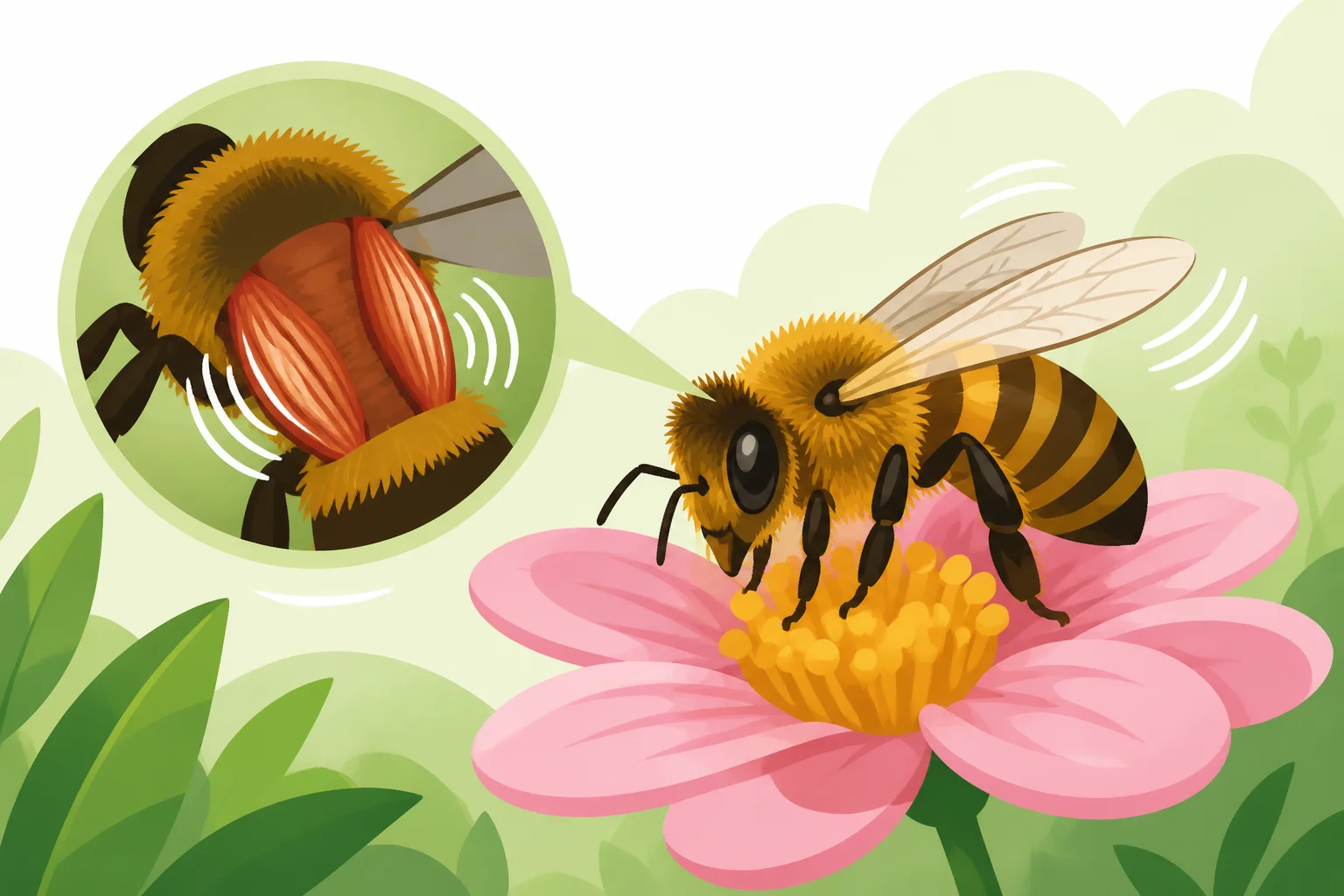
A bee doesn't buzz like a fan, with sound caused only by air rushing over moving blades. The main driver is inside its thorax: indirect flight muscles contract rapidly and deform the thoracic body wall. That rhythmic movement drives the wings during flight, while the vibrating body contributes to the sound.
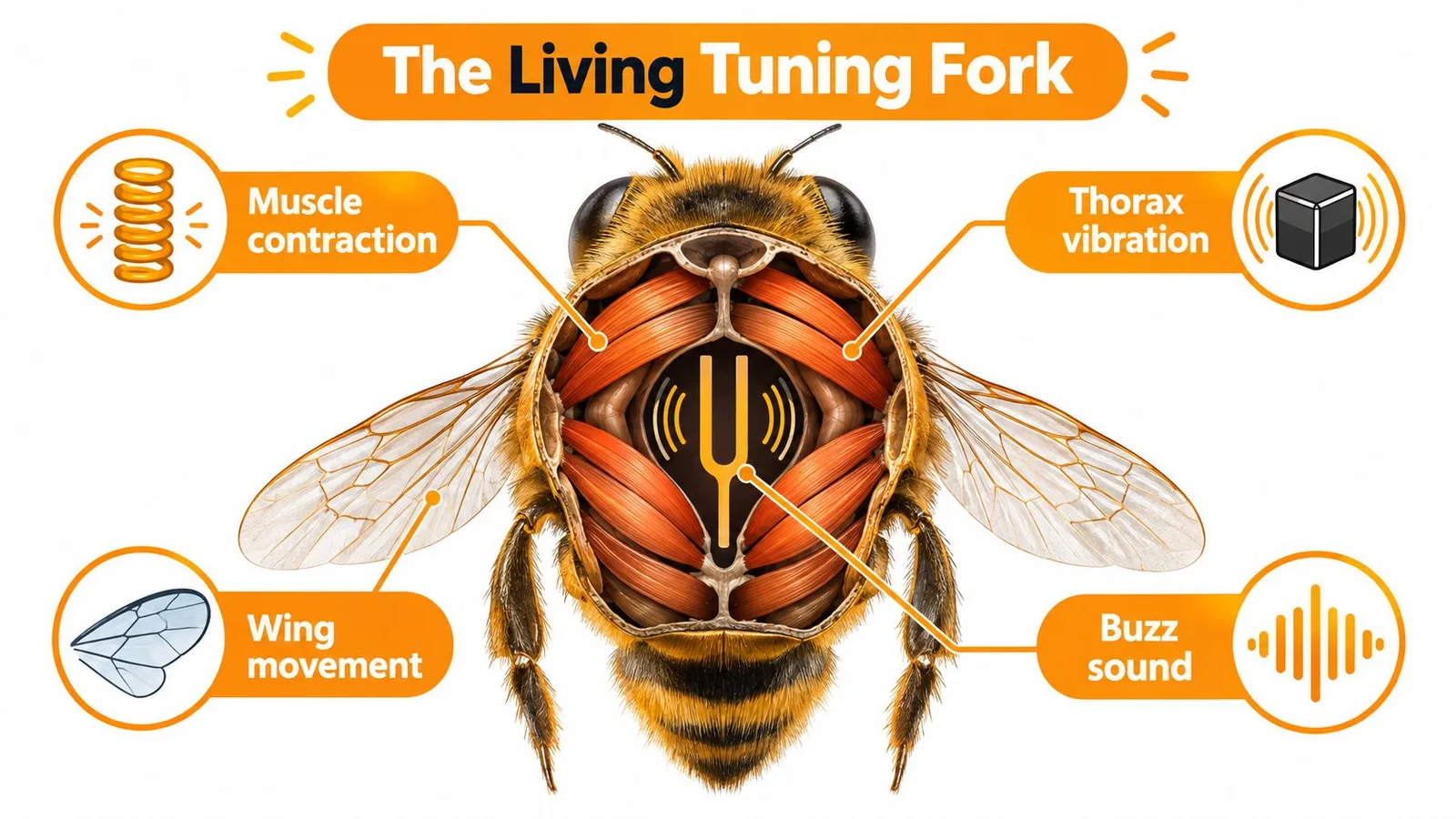
Think of a tuning fork. Strike it, and its metal prongs vibrate, producing a tone. A bee's thorax isn't made of metal, of course, but it also behaves as a resonant system: its muscles set the body wall oscillating, and the wings respond to that movement during flight.
The bee's flight apparatus operates near its natural vibration frequency. This helps the bee get mechanical power from its muscles efficiently. The result is more than a random flutter: the body and flight system work together, making the buzz a consequence of coordinated muscle activity.
The distinction matters because the wings aren't always moving in the usual flight pattern. Bees can contract those same muscles while their wings remain nearly motionless, producing vibration without taking off. That's one reason a bee buzzing on a flower can sound active even when it isn't flying.
For a different example of how a familiar insect sound can prompt questions about behavior, explore why flies swarm in groups. A sound alone doesn't tell the whole story. To understand it, ask what the animal's body is doing and what the behavior might accomplish.
Question 1 of 5
What is the main source of a bee's buzz when it is sitting on a flower with its wings barely moving?
Why the Same Bee Can Sound Higher or Lower
Record a bee at first light and again after lunch, and the second buzz may sit clearly higher. The reason is usually thermal. A bee's flight muscles cycle faster as the thorax warms, and faster cycling produces a higher vibration frequency, which our ears hear as a higher pitch.
Bee buzzes occupy a wide band overall, spanning a few hundred hertz from the lowest hums to the highest whines, and the frequency tends to climb steadily with each degree of thoracic warming. As one documented example, measurements of Arctic bumblebees showed vibration frequency rising from approximately 140 hertz at 16 °C to about 300 hertz at 44 °C as the insects' bodies heated. That helps explain why a bee basking in the sun can sound noticeably sharper than it did on a cold morning.
| Factor | Effect on buzz | Why it matters |
|---|---|---|
| Thoracic temperature | Warmer muscles can vibrate faster, producing a higher frequency. | A bee's pitch can change with its body state. |
| Body size | Larger bees generally produce lower-frequency vibrations. | Different body dimensions change the mechanics of oscillation. |
| Behavior | Flight and non-flight buzzes can differ in frequency and force. | The sound may reflect what the bee is doing, not just which species it is. |
Temperature is not the only variable. A larger bee drives a heavier thorax that oscillates more slowly, and a bee contracting its muscles to warm up or to shake pollen loose can buzz at a different frequency than the same insect in free flight.
A quick caution on vocabulary, since this trips people up: frequency counts vibrations per second and sets pitch, while loudness is a separate property. A mosquito whines at a high frequency yet stays faint. Engineers apply the same variable, the rate of a vibration, when designing noise-cancelling headphones that counter sound waves with matching frequencies.
Question 2 of 5
Why does the same bumblebee buzz at a higher pitch after basking in the sun than it did on a cold morning?
Buzz Pollination and the Tomato Flower Mystery
A bumblebee lands on a tomato flower and does something worth watching: it stops flying but keeps buzzing. The bee grips the flower's anthers, the pollen-producing parts, and fires its flight muscles while staying perfectly still. That vibration travels through its body into the flower and shakes pollen loose through tiny openings.

The behavior is called buzz pollination, or floral sonication. It works on poricidal flowers, which release pollen through small pores the way a salt shaker releases salt through its holes. A bee brushing past such a flower collects very little. A bee vibrating it collects a cloud. Tomatoes are a familiar example.
The sequence runs like a small machine:
- The bee clamps onto the anther with its body and mandibles.
- Its thoracic muscles contract, generating vibration.
- The vibration passes through the contact points into the anther wall.
- Pollen grains bounce free and exit through the pores.
Each step shapes the outcome. Firm contact determines how much energy transfers into the flower, and the character of the vibration affects how readily pollen breaks loose. The flight-muscle system is doing the work, yet the job at hand is harvesting, not takeoff.
Not every bee does this. Evolutionary research estimates that floral sonication developed independently about 45 times within bees, a sign the behavior emerged repeatedly wherever it paid off rather than once as a shared inheritance (research on the evolution of floral sonication). It clusters around flowers whose pollen resists ordinary contact.
That pairing is the heart of the tomato flower mystery. The bee supplies mechanical energy, and the flower's architecture decides what that energy accomplishes. A buzz that signals flight in one context becomes a pollen pump in another, which is why the sound belongs in the category of multi-purpose motor behavior rather than a single fixed noise. For more questions that begin with an everyday observation, browse these facts about nature.
Question 3 of 5
Why does a bumblebee grip a tomato flower's anthers and vibrate without flying?
Heating Up, Warning Off, and Other Non-Flight Buzzes
A bee's thoracic muscles work like an engine that gives off two products at once: motion and heat. Every contraction that could drive the wings also releases warmth into the thorax, and a bee can tap that warmth on purpose. Flight muscles perform poorly when cold, so on a chilly morning the bee runs bouts of contractions to bring the thorax up to working temperature, much as shivering raises heat in a person's muscles. As the earlier look at pitch described, this warm-up can be dramatic, and it explains how some bees get airborne while the surrounding air is still cool.
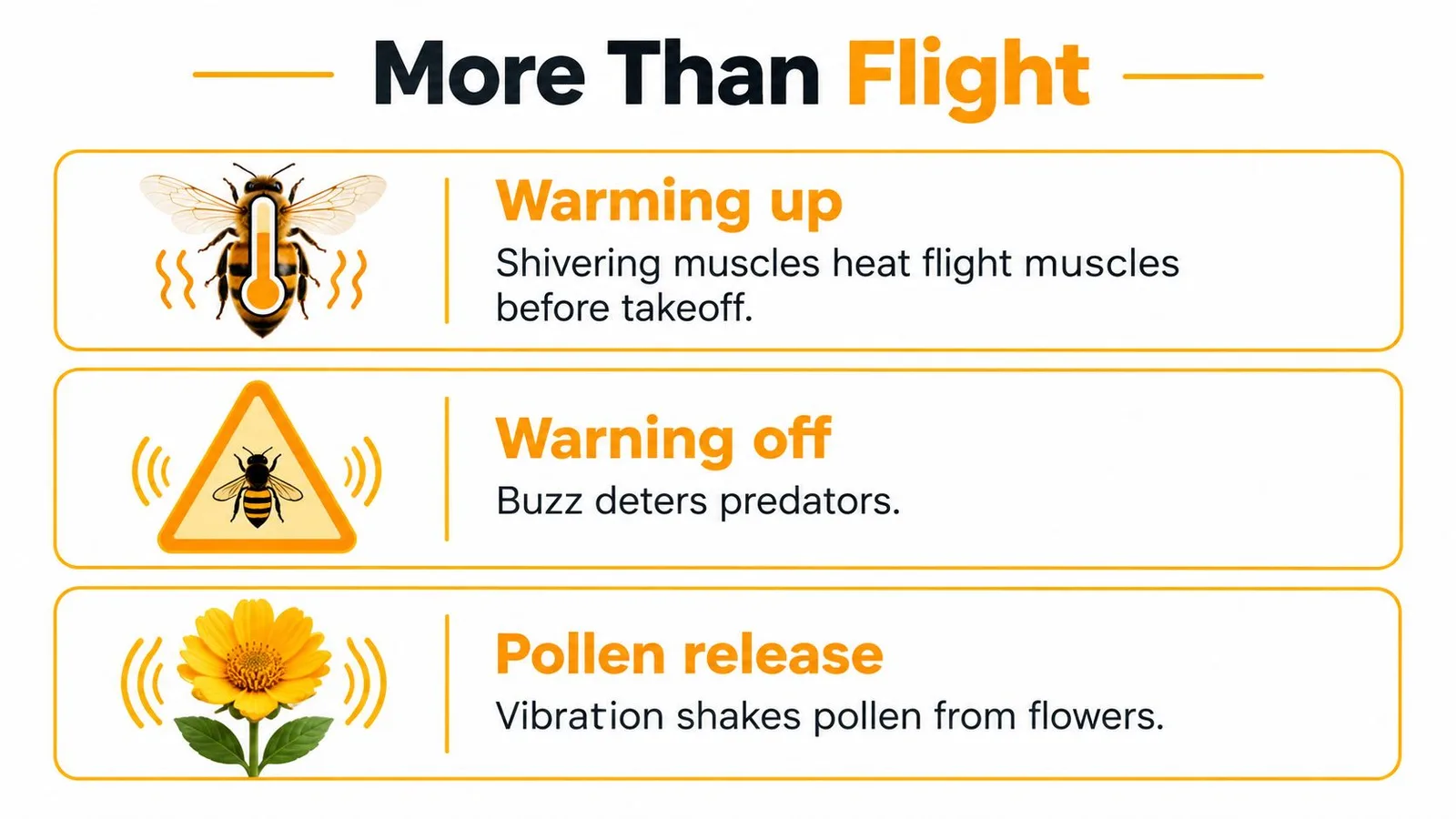
Warming is only the first entry in the catalogue. Bees also produce non-flight vibrations in situations that include defense, mating, and work inside the nest, cases where the muscles fire while the wings stay still. A comparative study of these vibrations recorded a mean fundamental frequency of roughly 205 Hz, with observed values spanning 40 to 488 Hz across buzzes from many individuals and species (research on the biomechanics of non-flight vibrations). That spread is wide enough that two buzzes from the same muscle system can sound nothing alike.
A pattern runs through all of this: one motor, many jobs. Contractions move the wings during flight. Before takeoff, similar contractions generate heat instead of lift. Pressed against a flower, the vibration becomes a harvesting tool. Elsewhere it becomes a warning, a mating signal, or a bit of construction work inside the nest.
So a single buzz can be a sound, a heater, and a tool all at once. Which of those things it is depends on what the bee happens to be doing.
Question 4 of 5
On a chilly morning, how does a bee warm up its flight muscles enough to take off?
Why No Two Bee Buzzes Sound Exactly Alike
Why does one bumblebee sound like a low drone while the bee on the next flower produces a thinner, higher whine? Three variables tune the note: body size, thoracic temperature, and what the bee happens to be doing. A larger bee vibrates at a lower frequency, while a warmer thorax pushes the pitch upward, the way a tightened string plays sharper.
Behavior reshapes the sound further. Flying, warming, defending, and vibrating a flower all run on the same muscle system, yet each produces a different acoustic signature. In the comparative study of non-flight vibrations cited earlier, defense buzzes averaged 0.76 seconds, though individual buzzes ranged from 0.05 to 43 seconds. A single label, "bee sound," covers events that differ wildly in length alone.
Even the energy behind the buzz gets spent differently from moment to moment. Physiological research found that only about 6% of the energy used by insect wing muscles becomes productive mechanical work, with most of the remainder released as heat (background on honeybee flight-muscle physiology). The same contraction can end up mostly as warmth or mostly as motion, which is one reason pitch and purpose shift together.
So the rule of thumb holds: body size shifts the pitch, warmth raises it, and behavior decides what the vibration accomplishes. Two bees buzzing side by side are two different instruments playing different parts. Listen closely, and the garden stops sounding like a single hum.
Question 5 of 5
What happens to most of the energy a honeybee's wing muscles use while it flies?
Quick Answers to the Follow-Up Questions
Do all bees buzz the same way? No. Species, body size, temperature, and behavior all shape the sound, and floral sonication is far from universal across bees.
Does a louder or longer buzz mean better pollination? Not necessarily. The sonication study cited earlier found that buzzing bees contacted stigmas more often than bees that did not vibrate the flower, yet the number and duration of individual buzzes showed no link to pollination efficiency. What matters is whether the vibration happens and reaches the right spot, not how long the bee keeps at it.
Do honeybees buzz-pollinate? Floral sonication is a specialized technique practiced by some bees rather than a shared trait of the whole family. Honeybees can buzz, but that does not mean they put the same flower-vibrating move to work.
Why does a bee sometimes buzz without flying? The wings may stay still because the muscles are busy elsewhere: warming up for takeoff, shaking pollen loose from a flower, or producing one of the non-flight vibrations described above. One motor, many jobs.
For more curiosity-led learning, Igneous AI, LLC offers Million Whys, with short interactive questions and explanations across topics including science and nature. Visit Igneous AI, LLC to explore a new why-question and follow the answer wherever your curiosity leads.
Keep Exploring


Related Posts
Music Trivia Questions With Answers
Music trivia questions with answers about instruments, pitch, echoes, vibration, tuning, and the hidden physics that makes sound feel alive today.
Why Does Music Give You Chills? Frisson Explained
Why does music give you chills? Frisson explained through dopamine, prediction, goose bumps, musical surprise, and why some songs create real closure.
Why Do Songs Get Stuck in Your Head?
Why do songs get stuck in your head? Earworm science explains catchy hooks, mental replay, stress, boredom, chewing gum, and practical ways to stop the loop.