

Why Do Airplanes Fly? Lift and Wing Physics Explained
On this page· 13
Airplanes fly because their wings generate lift, an upward force that can exceed the aircraft's weight, while engines supply thrust that overcomes drag. So why can a flat paper airplane, with no curved wing and no engine, still glide? That small puzzle shows why the usual one-sentence answer to why do airplanes fly falls short. Wing shape helps, but it isn't the whole story. The explanation lies in what a moving wing does to the air around it, and how a pilot keeps that effect working.
Four Forces That Keep a Plane Aloft
Every flight is a tug of war between four forces. Lift pulls up against weight, and thrust pulls forward against drag. You don't need all four to be equal at every moment. You need the right balance for what the airplane is doing right now.
If you want the downward pull in that balance explained on its own, it helps to understand how gravity works on Earth before thinking about how a wing opposes it. Gravity acts on the whole aircraft, fuel, passengers and cargo included, and it never switches off. Flight doesn't cancel gravity. It produces enough upward force to match it.
Think of a kite held steady in a breeze. The kite stays up because moving air pushes on its angled surface, while the string and your hand keep it from blowing away. An airplane works on the same basic trade, except its engines create the forward motion that keeps air flowing over the wings.
How the two pairs balance
Thrust and drag set the speed. When thrust is greater than drag, the airplane accelerates. When they're equal, speed holds steady. When drag is greater, the airplane slows down unless the pilot adds power or lowers the nose.
Lift and weight set the vertical motion. When lift equals weight, the airplane holds altitude. When lift is greater, it climbs. When lift is smaller, it descends in a controlled way, which is exactly what happens during a normal approach to land.
| Force | Direction | Produced by | Pilot controls it with |
|---|---|---|---|
| Lift | Upward, opposes gravity | Wings moving through air | Angle of attack, speed, flaps |
| Weight | Downward | Gravity acting on the aircraft's mass | Fuel and cargo loading |
| Thrust | Forward | Engines or propellers pushing air backward | Throttle |
| Drag | Backward, opposes motion | Air resistance on the body and wings | Streamlining, flap and gear settings |
Simple check: If a plane is cruising level at a steady speed, all four forces are balanced in pairs. Nothing exotic is happening.
That balance is also why a plane can't just point its nose up and climb forever. Raising the nose changes lift and drag, and the engines must supply enough thrust to keep the speed that the wings need.
Question 1 of 4
When a cruising airplane pushes its thrust above drag, what does the extra forward force make the plane do?
How a Wing Turns Air Into Lift
Hold your hand out of a moving car window, palm down and level. The air pushes it mostly backward. Now tilt your fingertips up slightly. Your hand gets pushed up as well as back, and if you relax your wrist, it wants to rise.
A wing does a refined version of the same thing. It's not flat like your hand, but the tilt is the part your hand already understands.
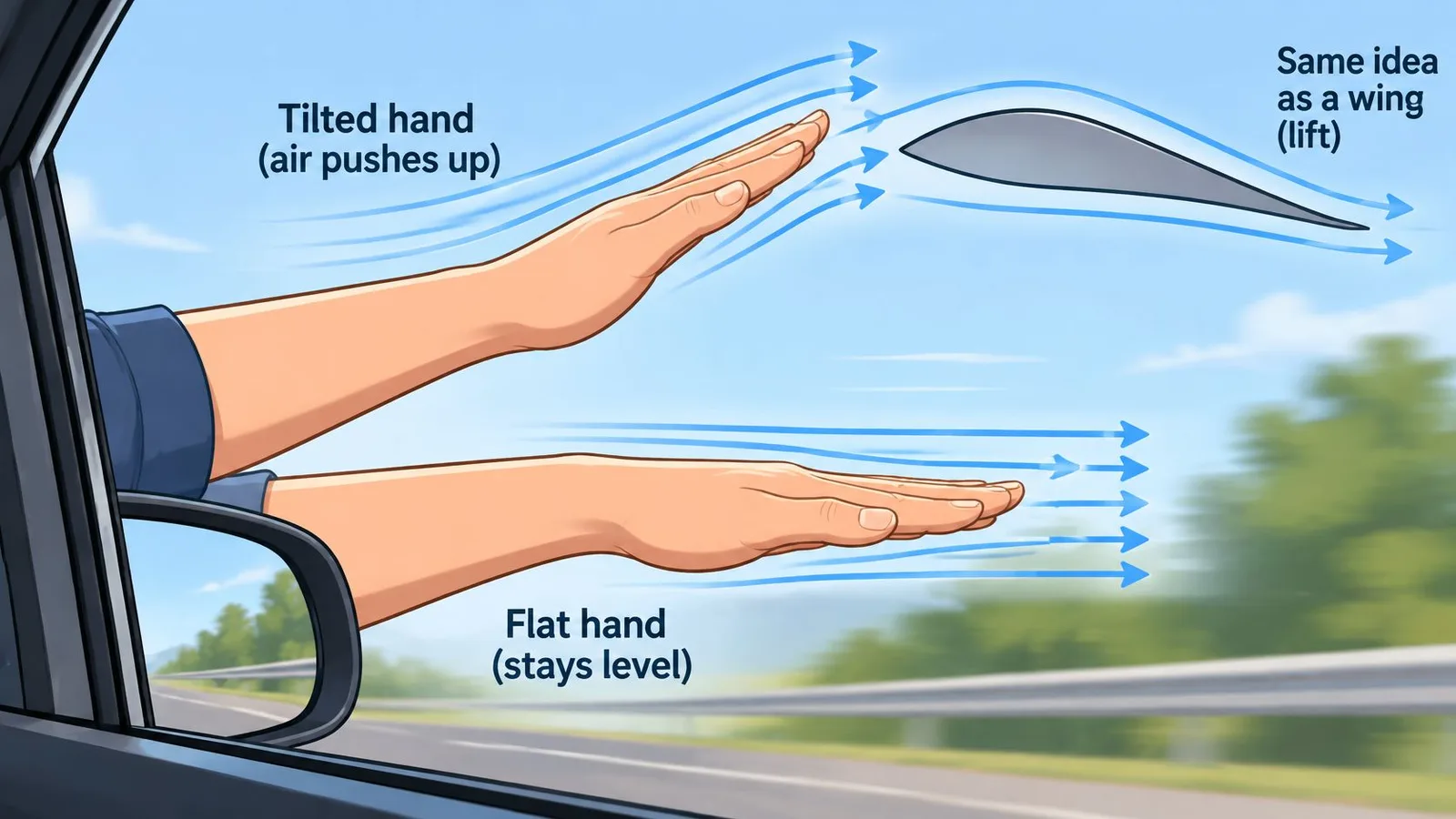
Two descriptions of one event
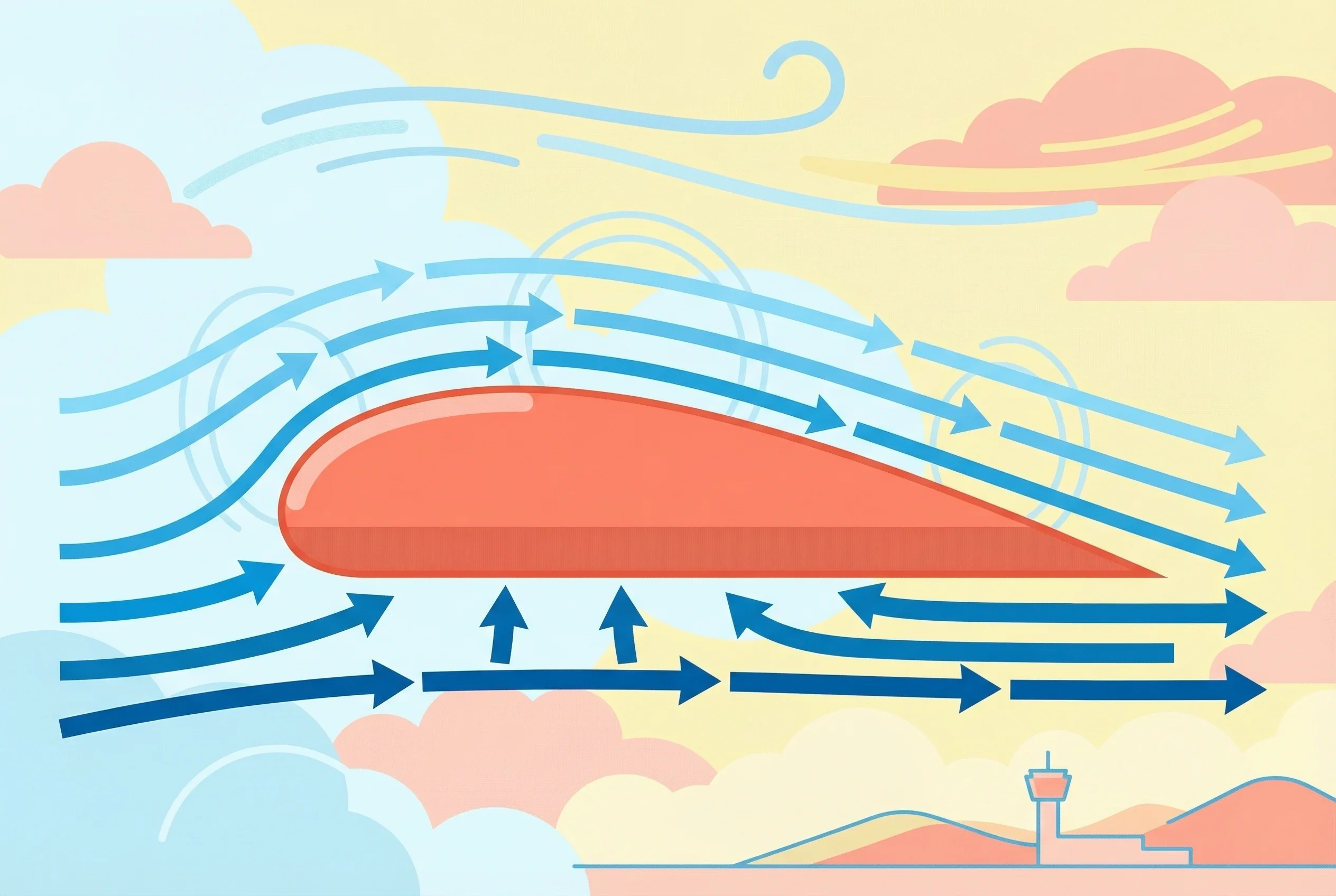
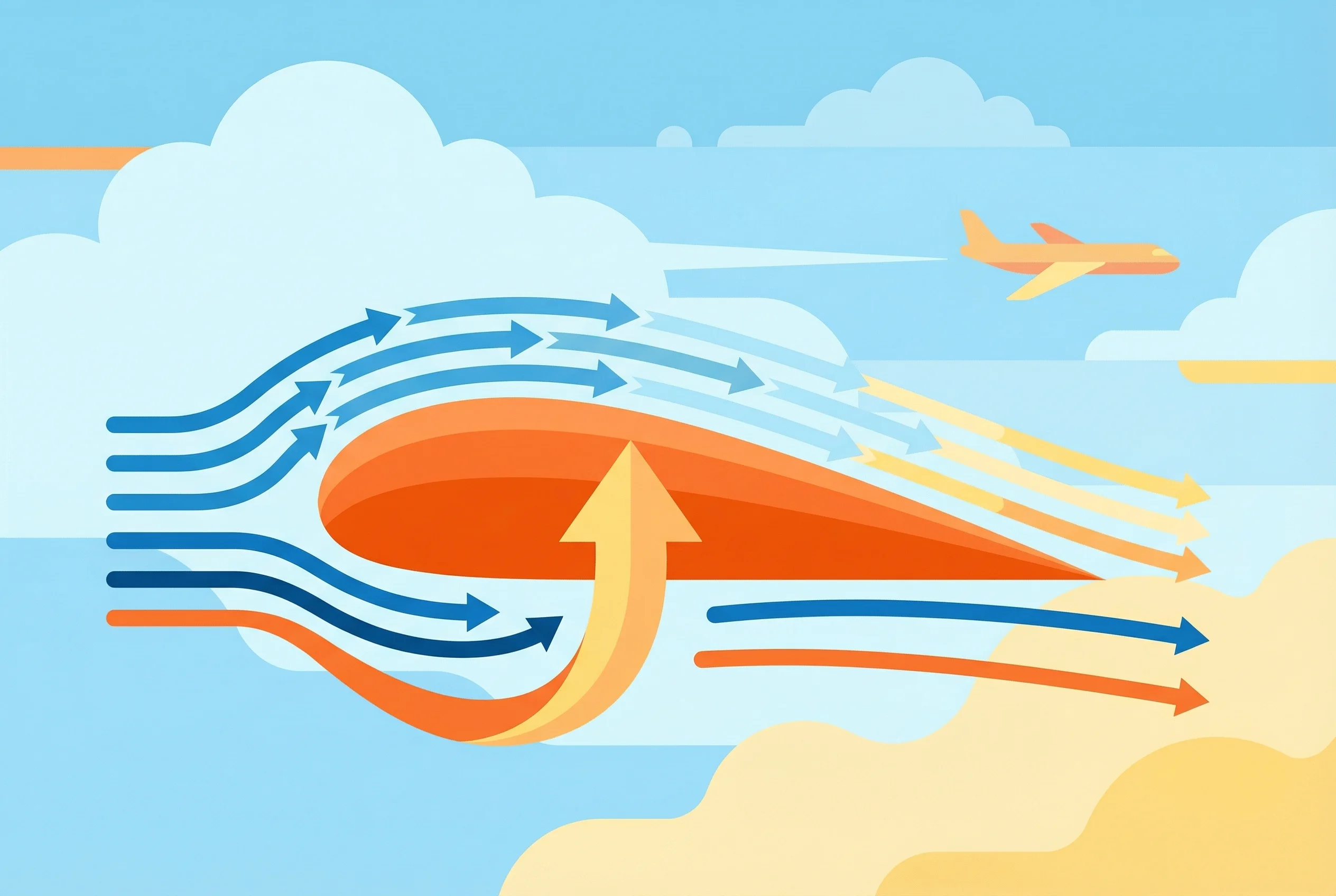
The Newton view follows the air. A wing with a curved upper surface and a positive angle of attack turns the oncoming air downward. Newton's third law gives the reaction. If the wing pushes air down, the air pushes the wing up.
The pressure view follows the forces on the wing surface. The airflow around the wing leaves a region of lower pressure above it and relatively higher pressure below it. Add up that pressure difference over the whole wing, and you get an upward force.
These aren't rival theories competing for a vote. The pressure pattern is what turns the air, and the turned air is what the pressure pattern produces. It's one flow described from two angles, the same way you'd describe a swimmer by either the push on their hands or the water moving backward.
Nature uses the same trick at smaller scales, which is part of the answer to why bees buzz when their wings beat the air fast enough to support their bodies. The scale and machinery differ, but moving air downward to get pushed upward is shared physics.
One condition matters before any of this works. The wing must be moving through air. A wing parked on a runway in calm conditions produces no lift at all, because there's no airflow to turn and no pressure difference to build.
Question 2 of 4
How do airplane wings create lift?
The Lift Equation and What Changes It
Engineers compress all of that airflow into one line, the lift equation, L = ½ρV²SC_L. The FAA Pilot's Handbook of Aeronautical Knowledge identifies lift as the force opposing gravity and notes that both Bernoulli's principle and Newton's laws operate whenever an airfoil generates lift. It also states that lift increases when airspeed, wing area, air density, or angle of attack increases.
Here's each symbol in plain words. L is lift. ρ (rho) is air density, how much air is packed into a given space. V is airspeed. S is wing area. C_L, the lift coefficient, captures how effectively the wing's shape, angle and flap setting turn airflow into lift.
Why speed dominates the equation
Speed appears as V², speed squared. Double the airspeed and you get four times the lift, if everything else stays the same. That's why a takeoff roll feels long at first and then suddenly the nose can rise. The last stretch of speed adds far more lift than the first.
Density works the other way at altitude. Air gets thinner as you climb, so ρ falls and the wing must compensate with more speed, more area or a higher lift coefficient. Hot days thin the air too, which is why high and hot airports need longer runways. If you're curious how that trade shapes real flight levels, you can explore airplane cruising altitudes and see why jets settle where thin air cuts drag but still supports the wing.
| Factor | Symbol | Effect on lift | Practical example |
|---|---|---|---|
| Airspeed | V | Lift scales with speed squared; doubling speed quadruples lift at the same settings | Long takeoff roll before rotation |
| Air density | rho | Lift falls as density falls with altitude or heat | Hot-day and high-altitude takeoffs need longer runways |
| Wing area | S | More area produces more lift | Flaps extend wing area for takeoff and landing |
| Lift coefficient | C_L | Rises with angle of attack and flap setting until the stall | Pilot raises the nose or extends flaps to add lift at low speed |
C_L isn't a fixed property stamped on the wing. It changes with angle of attack, flap setting, Mach number and how smoothly the air is flowing. Flaps raise it by increasing the wing's curve and area, but they also add drag, so pilots retract them once speed is available.
In steady, level flight, the pilot or autopilot juggles these levers so lift stays approximately equal to weight. Change any one lever, and another must move to keep the balance.
Why the Equal Transit Story Is Wrong
You've probably heard this version. Air traveling over the curved top of a wing has farther to go, so it must speed up to reunite with the air traveling underneath at the trailing edge. Faster air means lower pressure, and that's lift.
It sounds tidy. It's also wrong. NASA's educational page on Bernoulli and Newton explicitly labels this "equal transit theory" incorrect, because the two air streams do not need to meet simultaneously. Nothing in physics sets a deadline for two parcels of air to arrive together.
Three cases the timing story can't explain
- A flat plate: Tilt a flat board into the wind and it produces lift. Both sides are the same length, so there's no longer path and no race to win.
- A paper airplane: Its wings are flat folded paper. It glides because its angle to the airflow turns air downward, not because air hurries over a curve.
- Inverted flight: An aircraft can produce lift upside down when the pilot changes angle of attack so the wing still deflects air toward the ground relative to the flight path.
That last case is the sharpest test. If lift required the curved side to be on top, an upside-down wing would push the plane toward the ground. Aerobatic pilots stay airborne inverted because angle of attack, not which side is curved, does the decisive work.
Try the test question on any explanation you read. If the timing story were true, what would stop a flat board from flying? A correct model has to survive that question.
Bernoulli's principle itself isn't the problem. Pressure really is lower where the flow speeds up over the wing. The false step is the invented reason for the speedup. This pattern, a true fact bolted to a wrong cause, shows up across many common science misconceptions, and spotting the seam between the two is a useful habit.
A useful simplification leaves out detail. A false claim adds a rule that nature never made. Equal transit does the second.
Question 3 of 4
How can a flat board or an upside-down wing still create lift?
Angle of Attack, Stalls and Pilot Control
Angle of attack is the angle between the wing and the air coming toward it. It isn't the same as the angle of the fuselage to the ground. A plane can be nose-high but descending, meeting the air at a steep angle, or nose-level in a climb with a modest one.
Raise the angle a little and the wing turns more air downward, so lift grows. Drag grows too. Keep raising it and you reach the critical angle of attack, the point where the smooth flow over the top of the wing can no longer follow the surface.
The FAA advisory circular on stalls explains that beyond the critical angle, the upper-surface boundary layer separates, producing turbulent recirculating flow, a sharp reduction in lift, and a large increase in drag. That breakdown is a stall.
A stall is an angle problem, not a speed problem
Because the trigger is angle, an airfoil can stall at different airspeeds depending on weight, load factor, altitude, configuration and maneuver. The critical angle stays roughly constant for a given configuration, while the speed at which you reach it moves around. That's why pilots respect angle first and treat published stall speeds as valid only for specific conditions.
Turns make this concrete. In a level turn, load factor increases the lift required above aircraft weight, so the airplane must fly at a higher angle of attack or speed, and the stall speed rises approximately with the square root of load factor. Bank steeply at low speed and you can stall at a speed that was perfectly safe flying straight.
| Flight condition | Lift compared with weight | Result |
|---|---|---|
| Steady, level cruise | Approximately equal | Altitude and speed held |
| Climb | Greater than weight | Aircraft climbs |
| Descent | Less than weight | Aircraft descends |
| Steep turn | Lift equals load factor times weight | Higher angle of attack needed; stall speed rises |
| Beyond critical angle of attack | Drops sharply | Stall, with a large increase in drag |
The recovery feels backward the first time you hear it. To escape an impending stall, the pilot reduces angle of attack, lowering the nose even though that temporarily sacrifices altitude, then restores airspeed and energy. Pulling up harder deepens the stall.
The controls map onto this cleanly. The elevator sets pitch and therefore angle of attack, while thrust and configuration manage speed and drag. Each control answers a different part of the physics.
Question 4 of 4
What actually causes a wing to stall?
How Takeoff and Landing Use Ground Effect
If speed alone explained lift, every landing would be simple. Slow down, sink, touch the runway. Instead, passengers sometimes feel the airplane float, skimming above the concrete longer than expected before the wheels meet it.
The cause is ground effect. The FAA description in this NASA technical report states that proximity to the runway reduces upwash, downwash, and wingtip vortices, lowering induced drag and improving aircraft performance. Close to the surface, the ground partly blocks the swirling flow that normally trails from the wingtips.
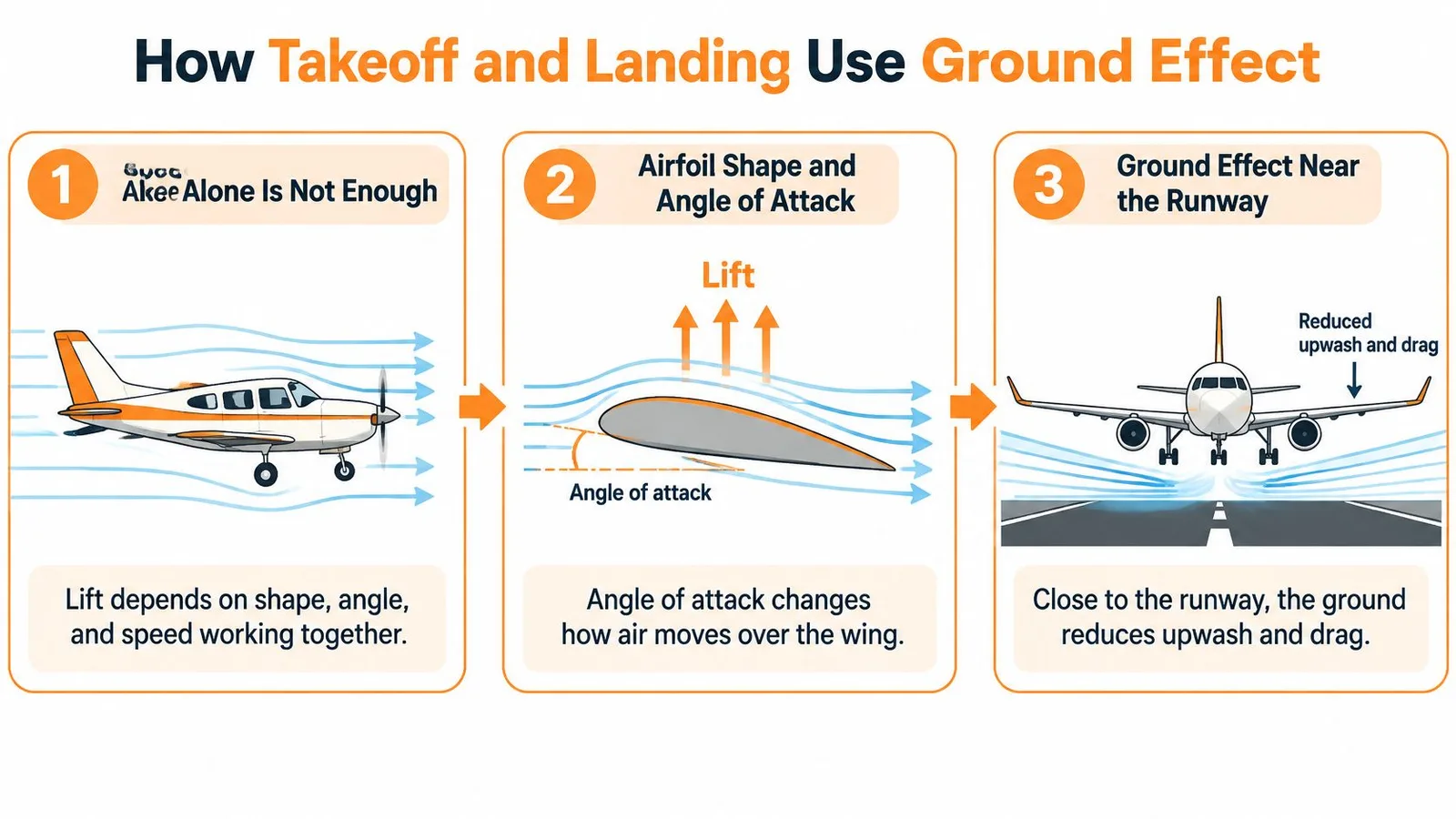
The airplane hasn't stopped obeying gravity during that float. With induced drag lower, it retains energy and produces lift more efficiently, so it settles more slowly than the pilot's speed alone would suggest. Managing pitch, power and touchdown point deliberately is how pilots keep a helpful effect from using up the runway.
One sequence from roll to touchdown
- Acceleration: The engines build speed along the runway while flaps add camber and area, so the wing can lift the aircraft at a speed the runway length allows.
- Rotation and liftoff: At the planned speed, the pilot raises the nose, angle of attack increases, lift exceeds weight, and ground effect briefly helps the airplane leave the surface.
- Climb out: As speed builds, flaps retract in stages. The wing returns to its clean shape, trading low-speed lift for lower drag in cruise.
- Approach and flare: Flaps extend again for a slow, steep approach. Near the ground, the pilot flares gently, lets ground effect cushion the descent, and touches down before the float carries the airplane too far.
What to watch for: On your next landing, notice the pause between the final descent and the wheels touching. That pause is ground effect doing visible work.
High-lift devices like flaps and slats exist because one fixed wing shape can't be best at both ends of the speed range. The wing changes geometry to match the job, then changes back.
Try a Two-Minute Test and Keep Asking Why
You need a stiff card and moving air, from a fan or a car window while someone else drives. Hold the card level in the airflow first. You'll feel it pushed backward, and not much else.
Now tilt the front edge up slightly. The card pushes up and back against your fingers. That upward part is lift in miniature, the backward part is drag, the moving air is the relative wind, and your tilt is the angle of attack.
Keep tilting, a little at a time. The upward push grows, then at a steep angle it suddenly weakens and the card starts to shake and flutter. The air has separated from the surface, the same breakdown that limits a real wing.
Write down what you felt at each tilt, level, slight, steep, too steep. Then match each note to the lift factors. You changed only the lift coefficient, through angle, while speed and area stayed fixed, and the result still swung from nothing to lift to breakdown.
Pick one question from what you just felt. Why did the flutter start where it did? Would a bigger card change it? Follow that single question one layer deeper, and test the answer with the card again.
Every answer here started as one small why, and Million Whys turns that habit into a daily routine with a 10-second question across science, engineering, nature and history, each answer choice explained whether it's right or wrong. Visit today, take the daily question, and follow your next why one layer deeper, the same way you just did with a card and moving air.
Keep Exploring
Related Posts
Why Is the Sky Blue? The Science of Light Scattering
Why is the sky blue? Follow sunlight through air molecules to see why noon turns blue, sunsets redden, Mars flips the palette, and blue oceans differ.
Fun Facts About Weather: Everyday Sky Physics
Fun facts about weather, explained through why raindrops flatten, clouds float, thunder rolls, snow survives warm layers, fog forms, and rainbows circle.
Why Do Bees Buzz? the Mechanics Behind the Sound
Why do bees buzz? Discover how flight muscles, wingbeat frequency, and temperature shape the sound, plus the hidden role buzzing plays in pollination.