

How Does Gravity Work on Earth? Causes and Examples
On this page· 15
Earth's gravity is the pull of its mass on every object, accelerating freely falling objects near the surface at about 9.8 m/s². Earth's mean surface gravity is 9.820 m/s², while the standard acceleration used as a reference is exactly 9.80665 m/s².
If gravity pulls everything downward, why doesn't a book resting on a table keep moving? The missing piece is that gravity describes an acceleration that would occur without another force balancing it. The table stops the book from falling, but it doesn't switch gravity off.
So, how does gravity work on Earth? Start with that measurable acceleration, called g, and use it to connect falling, weight, flowing water and orbiting spacecraft.
Earth's Gravity at a Glance and Where It Changes
How much does gravity vary from one spot on Earth to another? Less than you might expect, and in ways you can predict.
The unit m/s² means metres per second of speed gained each second. It measures how quickly velocity changes, not how fast an object already moves. A dropped object starts slowly and speeds up. Gravity never gives it one fixed falling speed.
NASA's Earth Fact Sheet reports Earth's mean surface gravity as 9.820 m/s², while the standard acceleration of gravity is defined as exactly 9.80665 m/s². The mean describes the surface in aggregate. The standard is an agreed reference for units and calculations, not a promise about your location.
Why your local value differs
Earth rotates and is not a perfect sphere. Its equatorial bulge puts the equator farther from the centre, and rotation reduces the effective downward acceleration measured against the ground. At the poles, that rotational reduction disappears.
Gravity strength at different places on Earth
| Location | Gravity compared with the standard reference | What changes it |
|---|---|---|
| Equator, sea level | About 9.78 m/s², below the standard reference | Rotation reduces effective downward acceleration, and Earth bulges outward |
| Standard reference value | Exactly 9.80665 m/s² | Agreed value used in units and calculations |
| North Pole, sea level | About 9.83 m/s², above the standard reference | Closer to Earth's centre, without the equator's rotational reduction |
| Mount Everest summit | Lower than sea-level values at the same latitude | Greater distance from Earth's centre |
The gap between the equator and the pole is roughly 0.05 m/s², about half a percent of the total pull. A bathroom scale will never notice it, but a sensitive gravimeter will. Height matters because moving away from Earth's centre weakens the attraction, and nearby mountains, underground rock and differences in rock density all leave small fingerprints in precision measurements.
That is why two terms matter. Local gravity is what an instrument measures at a place and time. Standard gravity stays fixed by definition. Your surroundings can change the former without touching the latter.
Practical rule: Use a local measurement for precision work. Use the standard reference when a calculation or instrument specification explicitly calls for it.
Earth's shape and rotation connect this topic to other fun facts about the Earth, and the practical lesson is simple: gravity is measurable, and the small differences between places follow clear physical causes.
Question 1 of 4
Why is the downward pull of gravity slightly stronger at the North Pole than at the equator?
Why Earth's Mass Pulls Everything Toward Its Centre
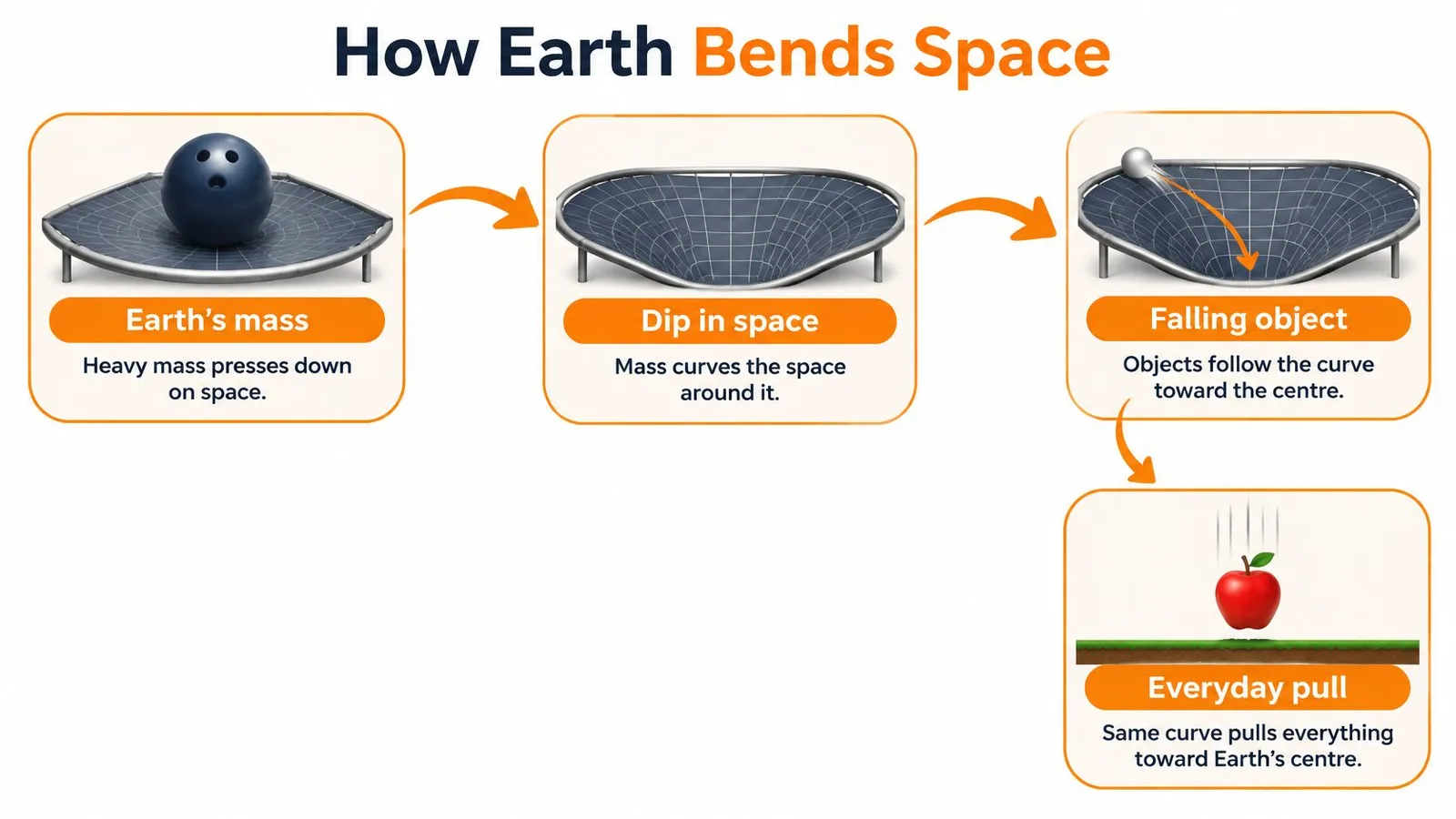
A bowling ball resting on a stretched trampoline makes a dip. Roll a marble nearby and its path bends toward the bowling ball. That gives you a visual starting point for understanding how mass affects motion around it.
The analogy has limits. A real trampoline bends because gravity already pulls the bowling ball downward; space doesn't need a supporting sheet or an outside downward force. In Einstein's description, mass and energy change the geometry of space and time, and freely moving objects follow paths through that geometry.
Mass and distance set the acceleration
For ordinary calculations near Earth, Newton's model is easier to use. Every bit of mass attracts every other bit, with a stronger attraction for larger masses and a weaker attraction across greater distances.
The compact expression is g = GM/r²:
- G is the gravitational constant, which sets the strength of gravitational attraction.
- M is Earth's mass.
- r is your distance from Earth's centre, not your height above the ground.
The squared distance in the denominator expresses the inverse-square rule. As distance from the centre grows, the pull weakens rapidly. For a nearly spherical planet, this formula gives a useful approximation outside its surface; detailed calculations also account for rotation and uneven mass distribution.
Say you lift a stone from the ground to a shelf. You've increased its distance from Earth's centre, but only slightly compared with the distance already separating it from the centre. Its gravitational acceleration therefore changes too little for you to notice by hand.
Why down points inward
Earth isn't attracting you from a single lump hidden at its centre. Its rocks, oceans and other material all contribute to the attraction. Because Earth is approximately spherical, sideways contributions largely balance, leaving a net pull directed approximately toward the middle.
A simple concept map keeps the relationships straight:
Earth's mass → gravitational attraction
Distance from Earth's centre → strength of attraction
Combined pull of Earth's material → local downward direction
Unbalanced gravitational attraction → falling acceleration
“Down” is therefore local. People standing on opposite sides of Earth have different downward directions, and both point inward.
Gravity needs no air, physical contact or continuing fuel supply. Mass can attract mass across empty space.
Mass Versus Weight and Why You Feel Pulled Down
Mass measures how much matter an object contains and how strongly it resists acceleration. Weight is the gravitational force acting on that mass.
They're related, but they aren't interchangeable.
Mass versus weight
| Quantity | What it measures | Unit | Changes with location? |
|---|---|---|---|
| Mass | Amount of matter in an object | kilograms (kg) | No |
| Weight | Force gravity exerts on that mass | newtons (N) | Yes |
The relationship is weight = mass × g. Take the same packed suitcase somewhere with weaker gravity: its mass stays the same, but its weight decreases. It still resists being pushed sideways because its inertia hasn't disappeared.
What your body actually feels
Standing still, you feel the floor pressing upward against your feet. Your muscles and skeleton carry that supporting force through your body. Gravity pulls downward, while the floor prevents you from accelerating through it.
An elevator changes that support force. When it accelerates upward, the floor pushes harder against you; when its acceleration is downward, the support force decreases. Direction of travel alone isn't enough to tell you how heavy you'll feel.
Feeling heavier means the support force on you has increased. It doesn't necessarily mean local gravity has become stronger.
A bathroom scale measures support force and usually converts it into a mass reading. A spring or electronic force scale therefore needs calibration; a balance compares masses differently by placing them in the same gravitational environment.
In everyday conversation, asking how heavy a suitcase is usually means asking for its mass. In physics, keeping mass and weight separate tells you what stays with the suitcase and what changes with its surroundings.
Question 2 of 4
Why do you feel heavier when an elevator starts moving upward?
How Fast Falling Objects Speed Up Each Second
Drop a metal spoon and a flat sheet of paper together. The spoon usually lands first, but that comparison mixes gravity with another force: air resistance. Crumpling the paper changes its fall without meaningfully changing its mass.
Free fall means gravity is the only force acting. Near Earth's surface, over a modest height, treating g as constant gives a useful model for how speed and distance change.
A calculated fall without air
The following is an illustrative calculation, not a set of measured drop results. It assumes an object starts from rest, air resistance is absent and the rounded near-surface value of g introduced above remains constant.
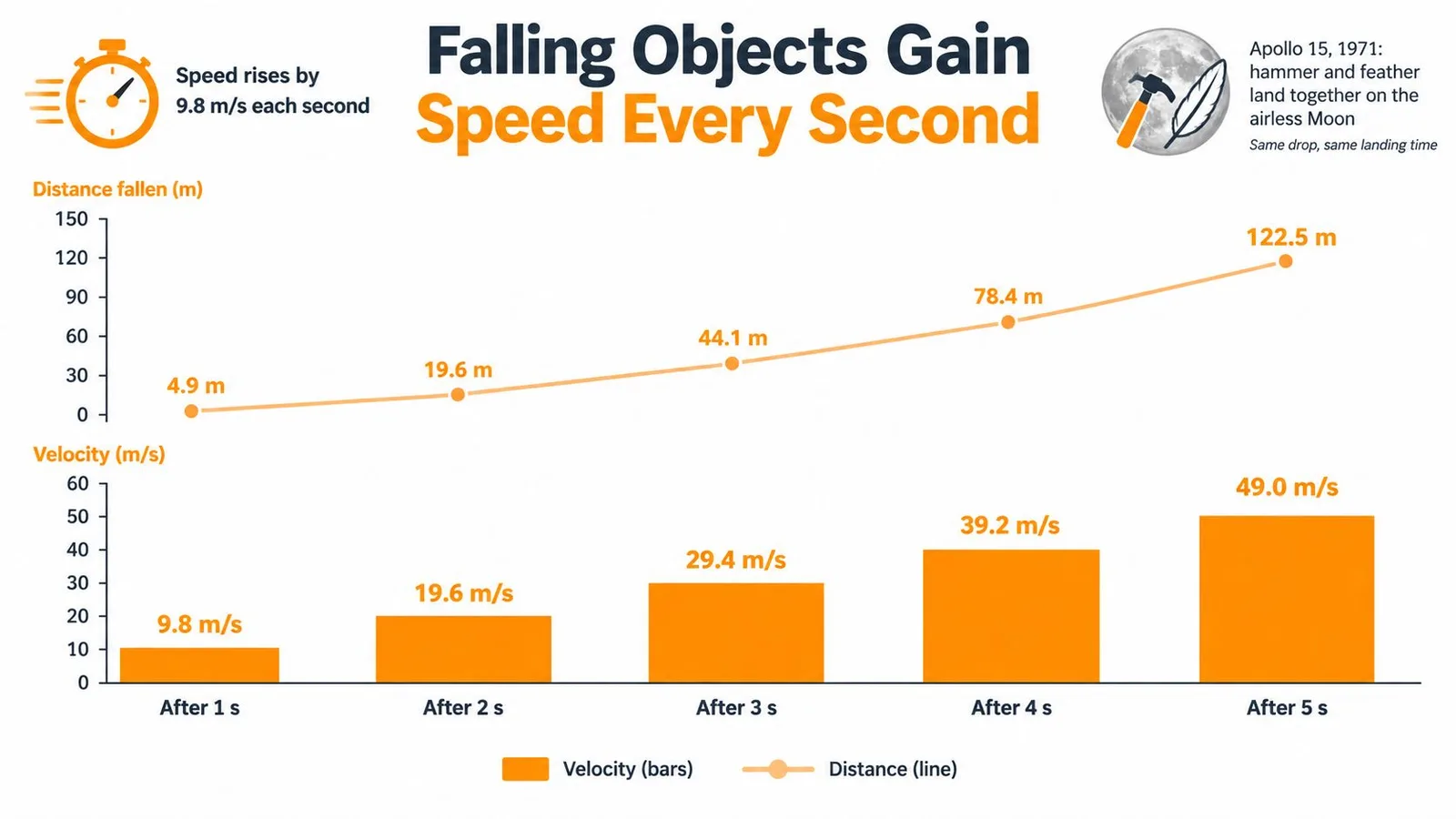
Using time t, the model is speed = g × t and distance = ½ × g × t².
Speed and distance of a dropped object over time
| Time falling (s) | Speed (m/s) | Distance fallen (m) |
|---|---|---|
| 1 | 9.8 | 4.9 |
| 2 | 19.6 | 19.6 |
| 3 | 29.4 | 44.1 |
| 4 | 39.2 | 78.4 |
| 5 | 49.0 | 122.5 |
Read across a row to distinguish speed from distance. Speed tells you how quickly the object is moving at that instant; distance tells you how far it has travelled since release. Distance grows faster because the object covers each later stretch while moving faster.
What air changes
Air pushes against a falling object. That drag generally increases with speed and depends on the object's shape, exposed area and orientation. A flat sheet of paper presents plenty of area relative to its mass, so drag strongly affects its motion.
Eventually, drag can balance weight. The object then reaches terminal velocity: it keeps falling, but no longer speeds up. Gravity hasn't stopped acting; the net force has become balanced.
On a speed-against-time graph, the ideal no-air model gives a straight rising line. A real fall with substantial drag bends away from that line and can flatten toward a terminal speed.
Reading a fall: A slower landing doesn't by itself reveal weaker gravity. Check the release, shape and air resistance before drawing that conclusion.
Mass alone doesn't determine the falling acceleration. Gravity pulls harder on a more massive object, but that object also resists acceleration more strongly, leaving the same gravitational acceleration when other forces are absent.
Everyday Effects of Gravity, From Tides to Orbits
A river flowing downhill and an astronaut floating inside a spacecraft can seem unrelated. Both make more sense when you ask which forces act, what supports the object and whether it's free to accelerate.
The familiar downward acceleration is the starting point, not a separate explanation for every situation.
- Water and rivers. Rainwater runs down a sloping driveway because gravity has a component along the slope, although friction, channels and obstacles determine the route.
- Atmosphere. Gravity keeps much of Earth's air near the planet, while gas pressure supports the air above it and decreases with altitude.
- Structures. Engineers design floors, bridge supports and dam foundations to transfer gravitational loads through materials and into the ground.
- Tides. Differences in the Moon's and Sun's gravitational attraction across Earth produce tidal forces that deform the oceans, while coastlines and ocean basins shape the local response.
- Orbits. A spacecraft moves sideways while gravity continually bends its path toward Earth, allowing it to keep falling around the planet rather than striking the surface.
Why orbiting people float
Inside an orbiting spacecraft, the crew, loose equipment and spacecraft are falling together. The floor doesn't need to hold astronauts up against gravity as a room's floor does on the ground. They experience very little supporting force, so they float relative to their surroundings.
An orbit is therefore a state of motion, not a region where gravity has been removed. Mission planners must match a launch to the required path and destination, which helps explain why rocket launches need a launch window.
Tides add a different ingredient: the pull isn't identical everywhere across a large object. This diagram illustrates the changing gravitational influences involved.
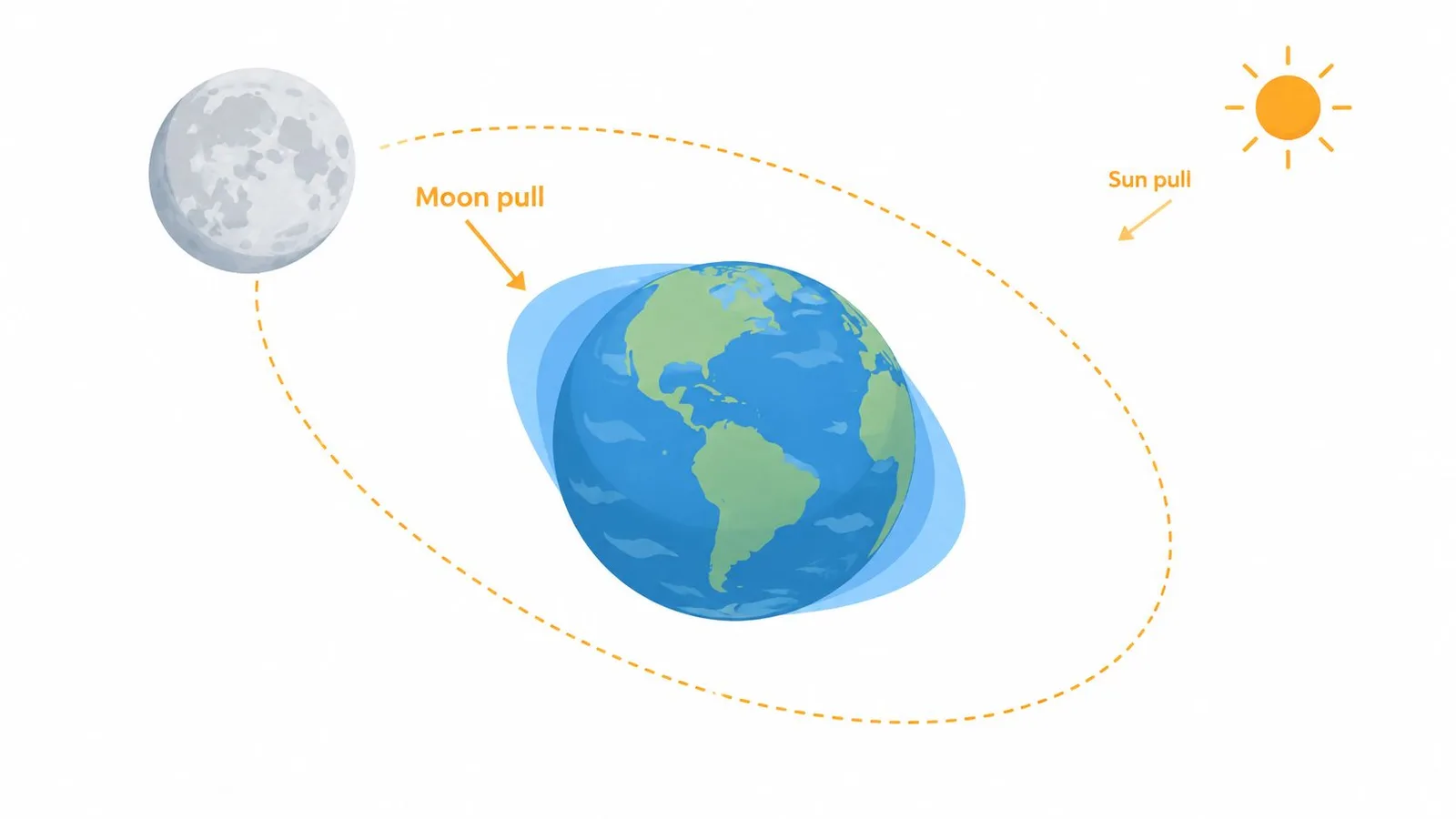
For everyday reasoning, separate gravity from the response it produces. A supported beam bends, water flows through a channel and a freely moving spacecraft follows a curved trajectory. The materials, constraints and motion differ; gravitational attraction remains part of the same physical picture.
Question 3 of 4
Why do astronauts float in space?
Gravity Myths That Get in the Way
Most gravity misconceptions come from treating a visible result as proof of its cause. Floating looks like gravity has vanished; a slow-falling feather looks like gravity barely affects it.
These distinctions help untangle those impressions.
- Myth: Floating proves there's no gravity. Floating tells you about relative motion and support forces. It isn't a reliable gravity detector.
- Myth: A heavier object must land first. A comparison only tests that claim fairly when release conditions and air effects are controlled. A bowling ball and a leaf make a poor test.
- Myth: Gravity needs air. Removing air removes drag, not gravitational attraction. A vacuum is useful precisely because it separates those effects.
- Myth: Gravity is strongest at Earth's exact centre. In an ideal symmetric Earth, surrounding material attracts equally in opposing directions, leaving no preferred downward direction there.
- Myth: Small objects don't exert gravity. Their attraction exists, but detecting it requires sensitive equipment and careful isolation from larger nearby influences.
A better question to ask
Instead of asking only whether gravity is present, ask what other forces are acting. Then identify whether the object is supported, accelerating or moving alongside something that shares its fall.
That habit also helps with other common science misconceptions. A familiar observation can be accurate while the explanation attached to it is wrong.
Question 4 of 4
Why is the net gravitational pull on you exactly zero at the very centre of a perfectly symmetric Earth?
Test Gravity Yourself With a Simple Drop Experiment
A home drop test can compare falling behaviour and give a rough local estimate of g. You'll need a tape measure, a phone with slow-motion video and small objects that won't damage the landing surface.
Keep people and pets clear, work from floor level and use a tray or thin protective mat. Don't drop heavy objects from stairs, windows or balconies.
- Choose contrasting objects. Start with small, compact objects of different masses, such as a rubber eraser and a wooden bead. Save a flat sheet of paper for a separate drag comparison.
- Measure the drop height. Measure from each object's lowest point to the landing surface. Matching the starting height removes an avoidable difference.
- Make a prediction. Write down which object you expect to land first and why. For a predicted time, use t = √(2h/g) with your measured height and the near-surface approximation.
- Record from the side. Keep the phone still and include both release and landing in the frame. Open your fingers without pushing either object.
- Inspect the video. Use frame timestamps to estimate elapsed time. Repeat the release because hand timing, motion blur and identifying contact can affect the result.
- Estimate local gravity cautiously. Rearrange the fall equation to g = 2h/t². Then repeat with flat and crumpled paper to see why drag can spoil that estimate.
Your result is a rough check, not a precision gravity survey. Small timing errors matter greatly in a short fall, so don't interpret every discrepancy as a real change in gravity.
Keep the prediction-first habit: guess, test and explain the mismatch rather than memorizing the answer.
Million Whys offers short interactive questions with explanations for every answer choice, including the tempting wrong ones. Visit Million Whys to test your reasoning about gravity and explore more everyday science questions.
Keep Exploring


Related Posts
Fun Facts About the Earth: Why It Never Sits Still
Fun facts about the earth: why Earth bulges, moves plates, shifts its magnetic field, loses air, trades tides with the Moon, and stays hot inside.
Earth Day 2026: 12 Weird Whys About the Planet You Live On
From a 19.5-hour day stuck for 1.5 billion years to a mantle-wind black hole beneath Tibet, 12 mechanism-rich, verifiably true facts about Earth — each a 'small why' that changes how you see the planet. Earth Day 2026 edition.