How Do Noise Cancelling Headphones Work
On this page· 15
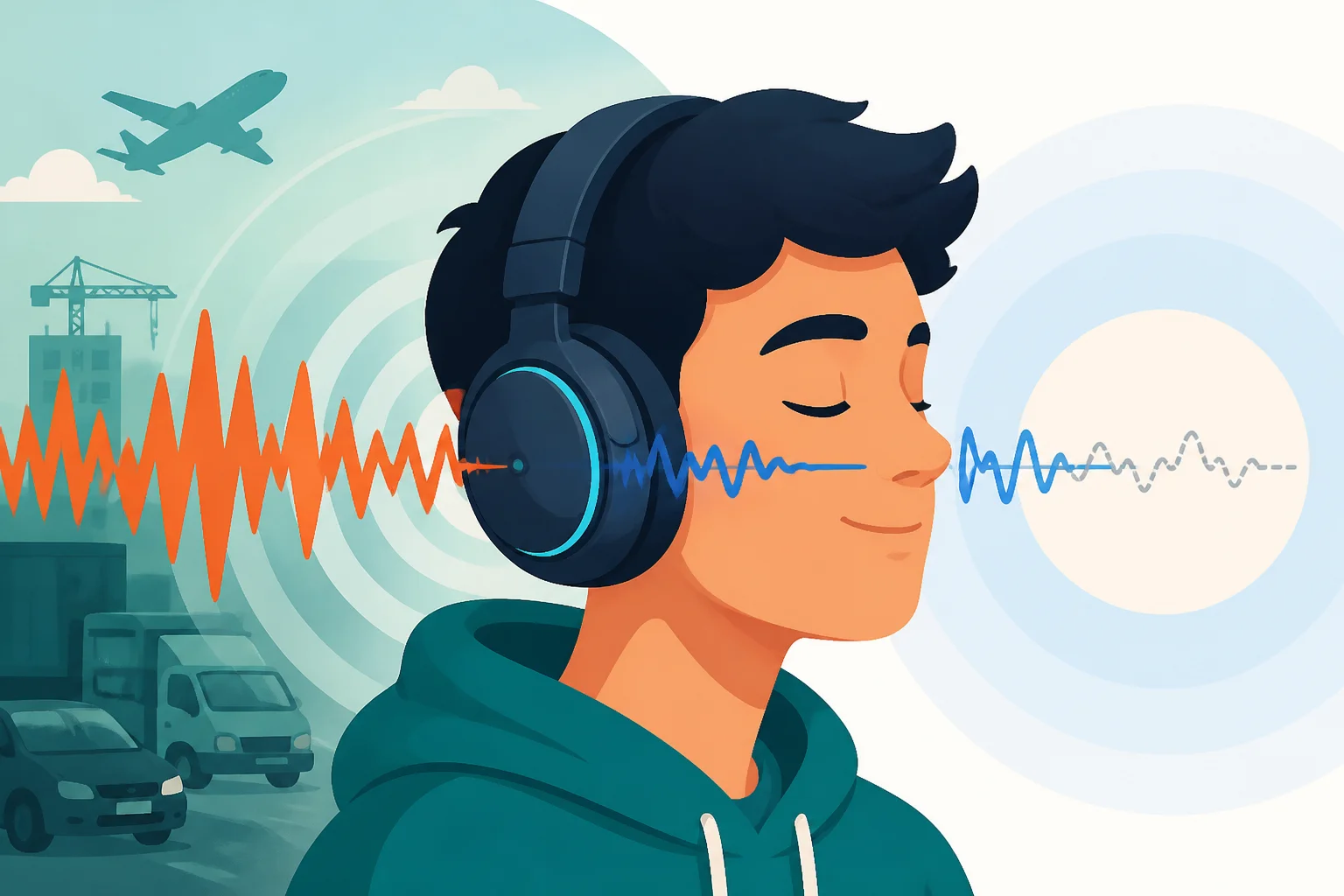
You're probably wearing, or at least hearing, this problem right now, the low drone of an office HVAC system, a train car, or the steady hum in a plane cabin that seems to sit inside your head. Noise-cancelling headphones don't create magic silence, they try to solve a timing problem, predicting a sound before it reaches your eardrum and then making a matching counter-sound in time to blunt it.
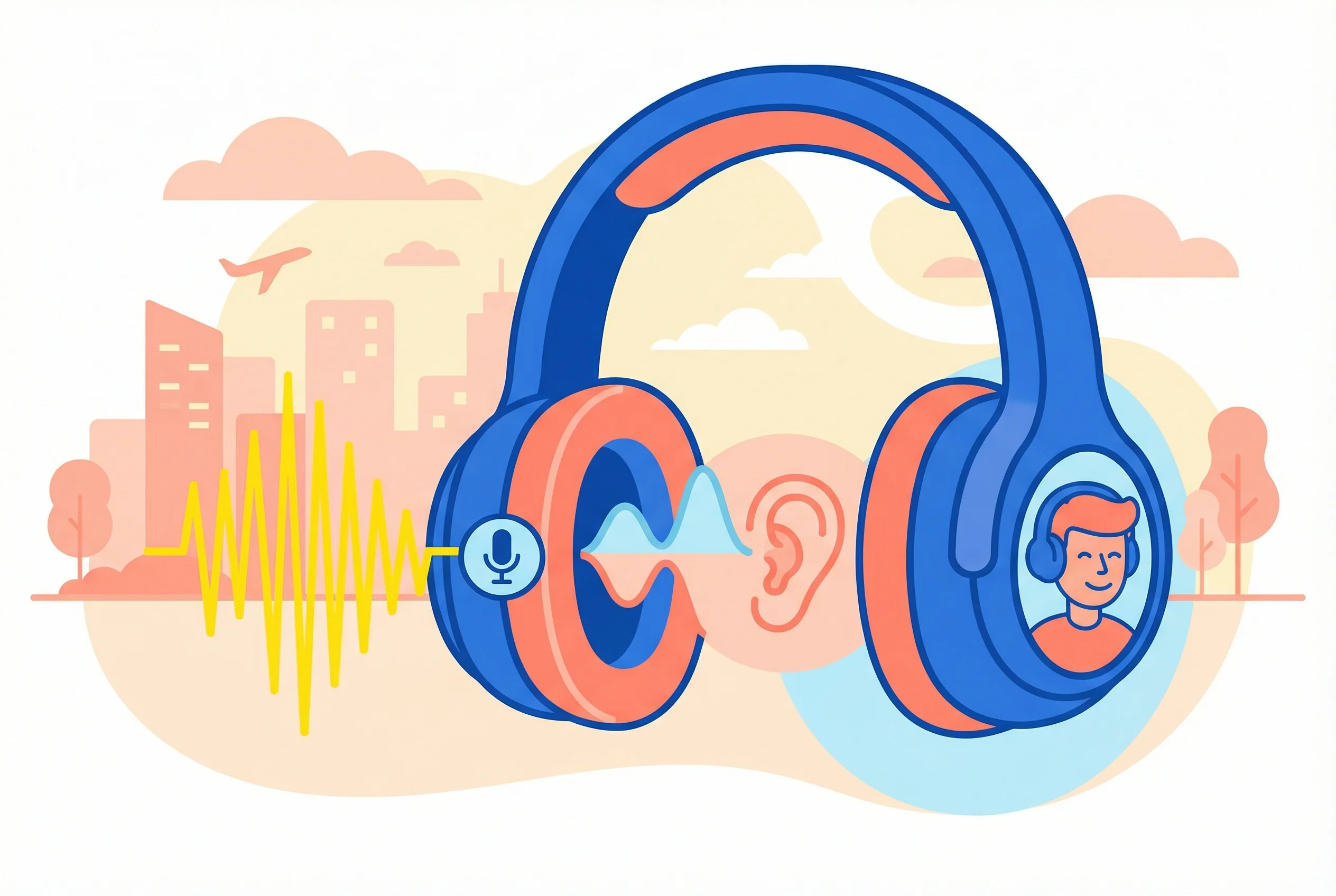
That's why the question behind how do noise cancelling headphones work is simpler than the marketing makes it sound. A microphone listens, a processor calculates, a speaker plays the opposite wave, and the ear cup seal blocks what electronics can't catch. The rest of this article breaks those parts apart one by one so the whole system stops feeling mysterious.

If you want a quick companion read while you're commuting, this guide pairs well with learning apps for commuting, because the best explanations are the ones you can finish in a few spare minutes.
The Moment Silence Is Supposed to Happen
You settle into a seat, close the tray table, and the engine starts its steady rumble. That's the moment ANC is supposed to earn its keep. The headphones are not trying to erase the world, they're trying to reduce the part of the world your brain finds hardest to ignore, the constant, predictable stuff.
The working parts are straightforward. A microphone detects the noise, a processor estimates what that sound will look like a moment later, and the speaker plays anti-noise, a signal with the opposite phase. The headphones also rely on an ear-cup seal or ear-tip seal, because some sound has to be stopped physically before the electronics even get a chance.
Practical rule: if a headphone sounds disappointing, don't blame the electronics first. Check the seal first, because leaking air ruins the system before the processor can help.
That's the entire promise in one sentence, and it helps explain why some products feel uncanny on a plane but only mildly helpful in a café. A fan hum, an engine drone, or ventilation noise gives the circuitry something stable to work with. Voices, dishes clattering, and sharp knocks change too fast to predict cleanly.
The phrase ANC stands for active noise cancellation, but the word “active” matters more than people realize. Passive padding is always part of the experience, and the electronics only handle the part that can be predicted fast enough to cancel. The rest of the article is really about those limits, because that's where most confusion starts.
Question 1 of 4
Why do noise-cancelling headphones silence a plane's engine rumble but barely touch the clatter of dishes in a café?
Destructive Interference Without the Jargon
Think of two equal pushes on a swing, one forward and one backward. If they land at the same time with the same strength, the swing barely moves. Sound behaves the same way, except the “swing” is the air near your ear, and the two pushes are pressure waves moving through it.
That idea is called destructive interference. One wave has a crest where the other has a trough, so when they meet, the air pressure at that spot drops. If the headphone speaker sends out the right opposite wave, the unwanted sound gets reduced before it reaches your eardrum.
Why timing matters more than people expect
This only works if the second wave arrives at the right moment. If it shows up too late, the noise has already moved on, and the canceling wave ends up fighting the next cycle instead of the current one. That's why ANC is a prediction system, not a brute-force volume knob.
The physics is easier to picture with water. If you drop two pebbles into a pond at just the right spacing, the ripples can flatten each other in places. Sound cancellation is similar, except the ear cup has to do the timing work in milliseconds, not seconds.
The analogy also explains why the system is always approximate. Human ears aren't identical test chambers, and headphone fit changes the distance sound travels. The microphones, the processor, and the speaker all introduce tiny delays, so the “equal and opposite” wave is an ideal, not a guarantee.
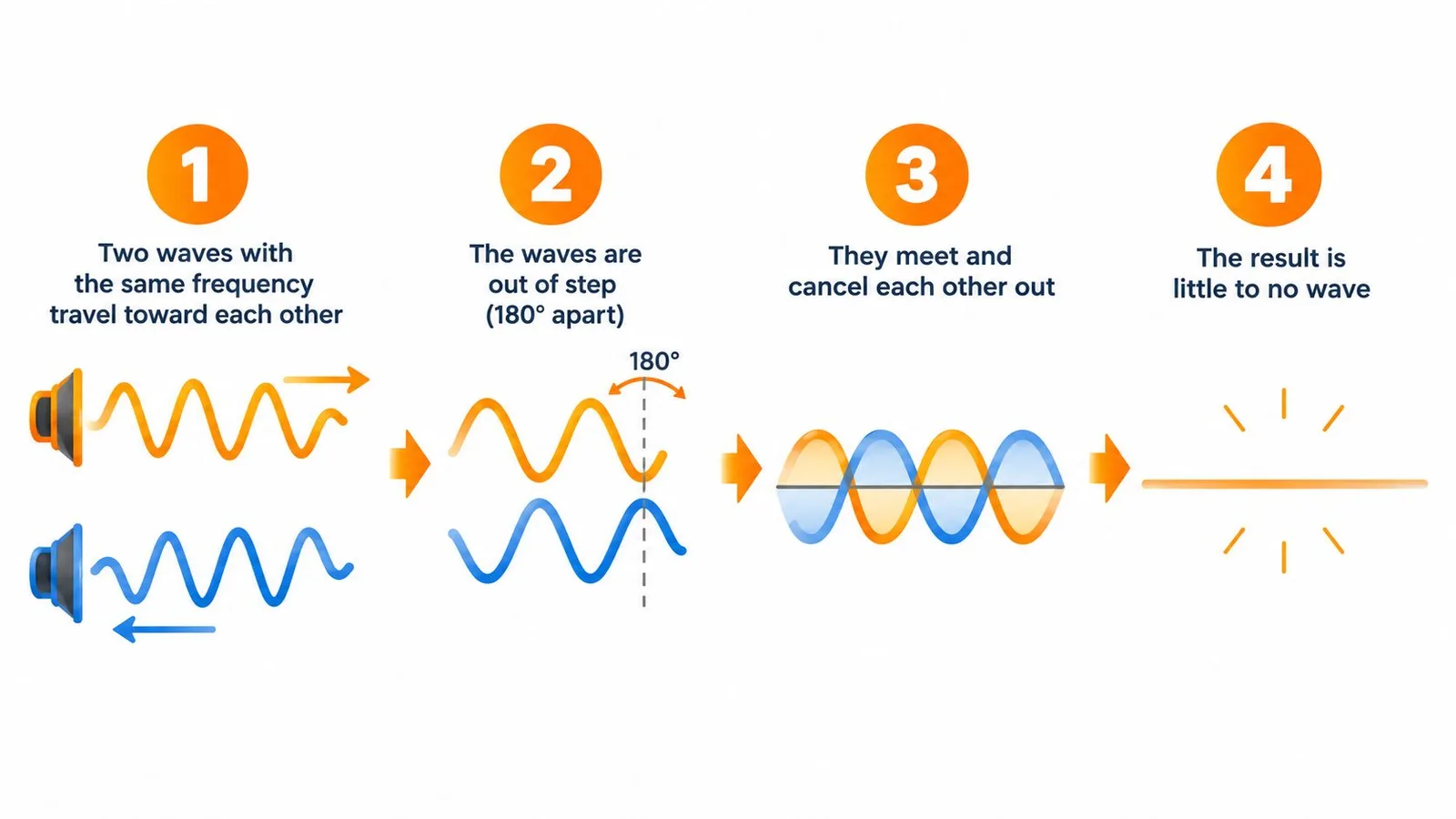
One engineering study of an entertainment-industry communication headset reported active attenuation of approximately 15 to 20 dB between 200 and 450 Hz, while another device reached a maximum of 18 dB at 125 Hz in the published measurements linked to this topic. A later earphone study found the strongest results at low frequencies such as 250 Hz, 500 Hz, and 1 kHz (engineering measurements and frequency behavior). That's the core clue readers should keep in mind: ANC works by subtraction, but only when the subtraction is timed well enough to matter.
Question 2 of 4
Why can noise-cancelling headphones never silence an unwanted sound completely, even when they are working well?
Passive Isolation and What ANC Cannot Replace
ANC gets the spotlight, but the physical shell still does a lot of work. Ear cups, foam, clamping force, and tip shape block sound by being a barrier. That matters because electronics can only cancel sound that makes it into the control field in the first place.
The split is mostly about frequency. Passive sealing tends to matter more as sounds get higher and more irregular, while ANC is strongest on low, steady noise. If the seal is poor, high-frequency sound sneaks around the cup and never becomes a clean target for the anti-noise wave.
The seal is part of the equation
Glasses arms, thick hair, and loose cushions create tiny leaks. Those leaks don't just reduce comfort, they let sound bypass the system entirely. For over-ear headphones, that's one reason a tight, even seal often matters more than any software setting buried in an app.
If you're comparing headphones for protection from noise, especially in daily life, it helps to separate blocking from canceling. A good resource for the physical side of that question is find hearing protection in Boca Raton, because the right fit and material choice matter long before any electronics turn on.
Passive isolation handles the obvious physical barrier. ANC handles the stubborn low-frequency part that keeps leaking through that barrier.
A quick mental test helps: if you remove the headphones and the noise gets much worse, the passive seal was doing real work. If the low drone disappears more than the sharp chatter, ANC is probably contributing. The best products do both jobs well, but they never turn one job into the other.
Question 3 of 4
Why does a loose seal around noise-cancelling headphones let in sharp sounds that the electronics can't clean up?
Inside the ANC Signal Path
The path from outside noise to reduced noise has four main stops. First, the microphone captures the surrounding sound. Then the digital signal processor estimates what that sound will look like by the time it reaches the ear. After that, the driver emits the anti-noise. Finally, the ear cup shape, padding, and your own head position decide how much of the result survives.
That round trip is why delay is the enemy. The system has to predict fast enough that the canceling wave meets the incoming wave at the right phase, not just somewhere nearby in time. If the timing slips, the headphone can still reduce some energy, but the effect weakens quickly.
Why milliseconds matter
The word “fast” sounds vague until you think about what the hardware is doing. The microphone needs to notice the noise, the processor needs to estimate it, and the speaker needs to reproduce the opposite wave before the original sound reaches the eardrum. Every step eats part of the time budget.
An internal link that helps here is understanding AI, because the ANC processor is making a prediction from a signal it samples, then updating that estimate as the acoustic picture changes. The comparison isn't perfect, but it's useful: the system is constantly refining its guess, not freezing the world.
The last step is the ear
The ear canal, the cup geometry, and the listener's head all shape the final result. That's why two people can wear the same model and report different performance. One fit might close off leakage cleanly, while another leaves just enough opening for the noise field to break down.
A published review of ANC headphone distortion and attenuation notes that performance usually stays concentrated below about 1 kHz, and that product comparisons should use frequency-dependent curves rather than a single advertised decibel figure (published engineering comparison). That's the practical takeaway, because the signal path only works as well as its weakest timing link.
Feedforward, Feedback, and Hybrid Microphone Setups
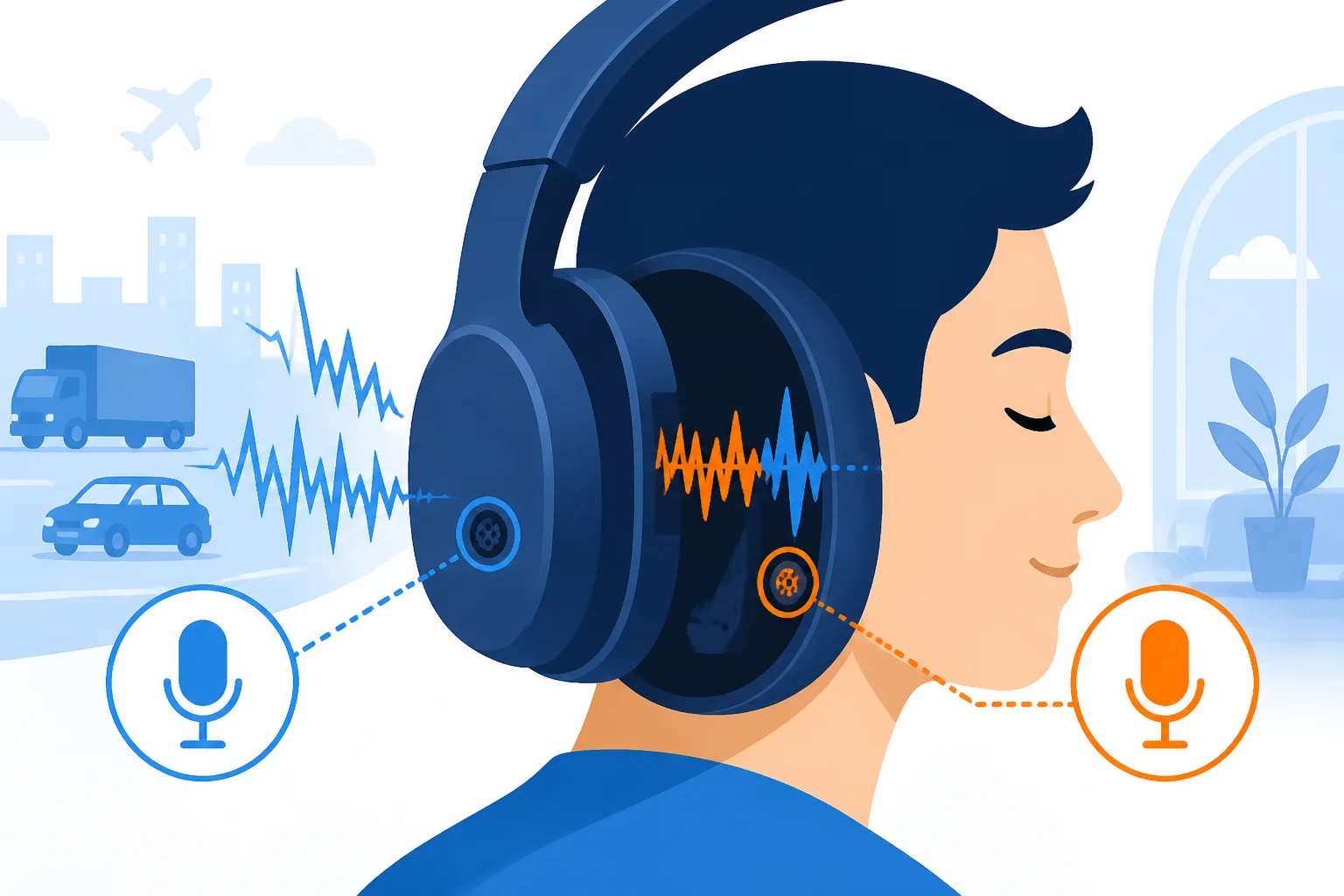
The location of the microphone changes what the system knows and when it knows it. A feedforward microphone sits outside the ear cup and hears the noise early. A feedback microphone sits inside the cup and measures what reaches your ear. A hybrid system combines both.
Feedforward designs are good at seeing trouble first. They get a head start on steady outside noise, which gives the processor more time to guess the incoming wave. Their weakness is that they can't fully know how the sound changed after it bounced off the cup, your face, or the space around you.
Feedback designs are better at checking the final result. They hear the residual sound inside the cup and let the system correct errors caused by seal changes, imperfect fit, or modeling mistakes. Their weakness is that they're reacting to what has already arrived, so the correction loop has less room to work.
Why hybrid systems show up so often
Hybrid ANC uses both microphones because each one covers the other's blind spot. The outside mic gives the prediction, the inside mic verifies the result at the listener's ear. That's why hybrid setups show up so often in premium headphones, especially when manufacturers want decent performance across more than one listening environment.
Wind noise is a useful example of the tradeoff. An outside microphone can catch too much of it, while an inside microphone can be less bothered by it but slower to anticipate the incoming sound. A hybrid arrangement doesn't remove every compromise, but it gives the system two chances to respond.
Short version: feedforward predicts, feedback corrects, hybrid does both.
That vocabulary is enough to read most spec sheets without getting lost in marketing language. If a product only says it has ANC, that doesn't tell you how it hears the world. The microphone arrangement tells you a lot more about what kind of noise the headphones are trying to beat.
Question 4 of 4
Why does a hybrid noise-cancelling headphone need a microphone both outside and inside the ear cup?
Why Some Sounds Disappear and Others Walk Right Through
ANC works like a prediction system. The microphones and processor are trying to guess what noise will reach your eardrum a moment later, then generate the opposite signal before that wave arrives. If the sound changes slowly, prediction is easier. If it changes fast, the system has less time to react.
That is why steady low noises are the easiest target. Aircraft engines, HVAC hum, train rumble, and road noise move in broad, regular patterns, so the electronics can keep up with the next wave more often. Voices, dishes, footsteps, and sudden clacks are harder, because their shape shifts too quickly from one instant to the next.
The measurements cited earlier already show the pattern: attenuation concentrates in the low, slow-moving bands, and the advertised decibel figure is always an average across a curve, not a flat wall. That is the lesson behind any spec sheet claim. A number on the box can sound absolute, while the actual performance changes with frequency, timing, and fit.
Read the number the right way
A large reduction on a product page does not mean every sound is reduced equally. ANC is selective, because it has to be. It can only cancel what it can predict well enough to oppose at the right moment.
That is also why a calm voice can still cut through while a cabin rumble fades into the background. The voice has sharper edges and more rapid changes, so the system is always chasing it rather than meeting it in time. For a nearby example of how the ear reacts differently to different sound patterns, why music gives you chills points to the same basic fact from another angle. The brain does not treat all acoustic patterns the same, and ANC has to work inside that constraint.
Fit, Seal, and What You Can Actually Control
A lot of disappointing ANC is just bad contact. Glasses break the seal. Hair lifts the cushion. A slightly wrong ear-tip size leaves a leak. Once air escapes, high-frequency sound follows, and no amount of software can fully patch that gap.
A 30-second check before you blame the headphones
- Move your jaw: if the sound changes a lot, the seal is unstable.
- Shake your head gently: if one side opens up, the cups aren't sitting evenly.
- Check your glasses arms: thin or thick frames can create different leaks where they touch the cushion.
- Test the cushion compression: foam that's too soft or worn out won't hold shape well.
- Try a different tip or position: the smallest fit change can matter more than a setting in the app.
Over-ear headphones usually do a better job with passive blocking than simple in-ear tricks, especially when the goal is to tame higher frequencies. In-ear designs can seal very well too, but only when the tip fits the canal cleanly and stays put. Either way, the seal is the part you can control in a few seconds.
The useful habit is to treat the headphones like a system, not a gadget. If the low rumble is there but the chatter leaks through, the seal needs attention. If both are present, the problem may be fit, not the ANC circuitry itself.
The Mental Model to Carry Away
Think of ANC as a prediction game with a physical finish line. Microphones sample the noise, the processor guesses what will arrive at your eardrum a moment later, the speaker emits the opposite wave, and the ear cup seal cleans up what electronics can't reach. That idea stretches from Paul Lueg's 1933 patent and its 1936 grant, through Bernard Widrow's 1975 adaptive noise canceller, to Sennheiser's 1987 airline headset, Bose's 1989 commercial ANC headset, and Sony's 2008 digital MDR-NC500D (development history).
That's the whole trick, really. The better the prediction, the better the silence. For more short, mechanism-first explanations like this, Million Whys turns everyday questions into quick explanations you can finish before the next stop.
Igneous AI, LLC builds Million Whys, a micro-learning platform with short, explained questions across science, engineering, and everyday topics. If you like understanding how things work, visit Igneous AI, LLC and explore more quick explanations in the same style.