

Why Do Cats Purr? the Science Behind the Sound
On this page· 15
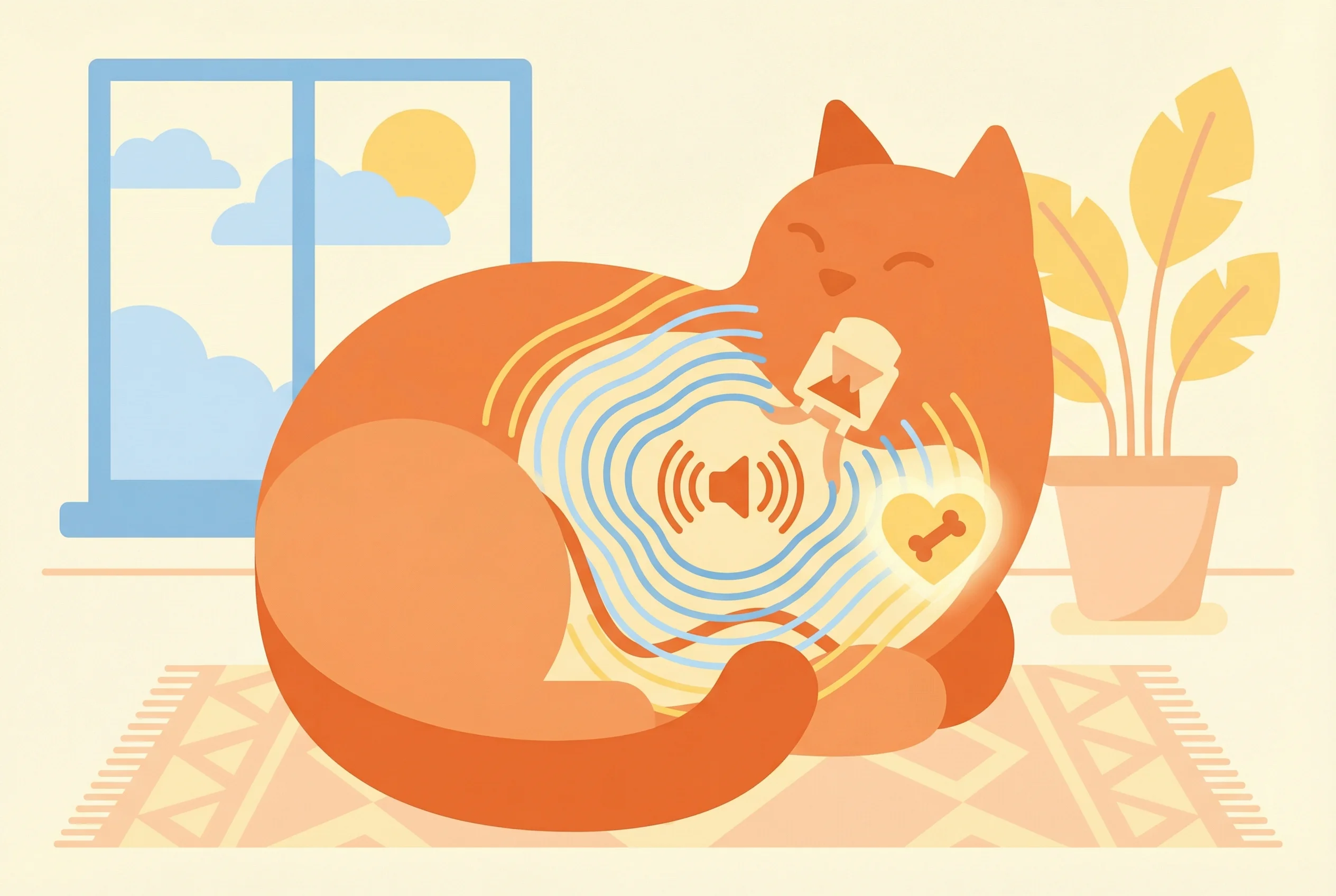
A purr is a rhythmic sound made in the larynx while a cat breathes, used mainly for contact, comfort and possible self-soothing, and it doesn't on its own prove the cat is happy.
If purring means everything is fine, why might a frightened cat make that same sound on a veterinary examination table? That question reveals the gap in the familiar explanation. To understand a purr, you need to separate how the sound is produced from what the cat may be experiencing.
The Short Answer Before the Science
Cats purr as air moves through their larynx, or voice box, during breathing in and out. But when people ask why do cats purr, they're usually asking about meaning rather than anatomy. The answer isn't a single emotion: purring can accompany friendly contact, anticipation of food, or an attempt to cope with an uncomfortable situation, as the NC State University College of Veterinary Medicine explains. Communication and comfort are useful ways to understand the behavior; self-soothing is a plausible explanation in stressful settings, rather than a settled finding. Purring may also contribute to contact between mothers and kittens, although assigning it an exact message goes beyond what we can confidently establish.
Think of a person humming while concentrating. The hum might feel pleasant, help them settle, or be audible to someone nearby, without carrying a precise message. A cat's purr is similarly richer than a simple declaration of happiness. Scientists have a clearer account of its sound-producing machinery than of every purpose it serves, especially during fear or pain. Read the whole cat, not just the sound: a loose body, ordinary breathing, normal eating, and willing social contact provide a different picture from tension, withdrawal, or a change in appetite. You don't need to identify the cat's exact emotion to notice that something deserves attention.
Curious? Try one 👇
Why is the sky blue?
Jump into the daily quiz →What a Purr Means in Each Situation
Use the situation as your starting point, then check whether the cat's other behavior supports your first impression. Live Science's explanation of feline purring emphasizes that cats may purr when content, frightened, injured, or in pain, so the sound alone can't distinguish comfort from coping.
Likely reasons for a purr and the signs to check
| Situation | Likely reason for the purr | Other signs to check |
|---|---|---|
| Relaxed petting or lap time | Social contentment and bonding | Slow blinking, loose body, soft eyes |
| Waiting for food or before a meal | Anticipation and communication | Following you to the kitchen, meowing, weaving around your feet |
| Kneading and nursing | Comfort linked to kittenhood | Rhythmic paw pressing, half-closed eyes, relaxed posture |
| Meeting a new person or entering a new home | Possible self-soothing and reassurance | Ears forward or flattened, slow tail movement, sniffing exits |
| Vet visit or handling | Possible stress coping, since purring can continue under stress | Crouching, dilated pupils, rapid breathing, tense body |
| Illness or injury | Possible self-soothing, not proof of comfort | Hiding, reduced eating, limping, abnormal breathing |
Start with what the cat is doing
During lap time, notice whether your cat chooses to stay, rests loosely, and welcomes continued contact. Stop stroking briefly and let the cat decide whether to approach again. Willing participation is more informative than assuming that a purr gives permission for unlimited petting.
Before a meal, the same sound may accompany purposeful activity around you. Following you toward the food cupboard suggests a different immediate context from settling down to sleep. Kneading adds another clue: rhythmic paw pressing alongside a relaxed body often fits the familiar comfort pattern associated with nursing.
Give uncertainty room
A new home or unfamiliar person creates a less clear situation. Let the cat investigate without blocking an exit or insisting on contact. Ear position and movement can help, but no isolated gesture provides a complete emotional translation.
At the vet, a tucked posture may look superficially like a cat curled on a sofa. The surroundings, muscle tension, and breathing help distinguish those situations. Illness or injury requires even more caution because an apparently gentle sound can distract you from a meaningful change.
Practical rule: When purring and the rest of the cat's behavior seem to disagree, investigate the behavior rather than dismissing it.
The same interpretation problem appears when asking why dogs wag their tails: a familiar signal needs context. Hiding, crouching, reduced eating, or fast breathing should outweigh a reassuring impression of the sound.
How the Larynx Turns Breath Into a Purr
An older explanation placed the source of purring in blood flowing through the inferior vena cava, a large vein. Researchers now favor the vocal folds inside the larynx. The important change is not only the location, but how much of the repeated vibration the tissues can produce without a separate muscular command for every cycle.
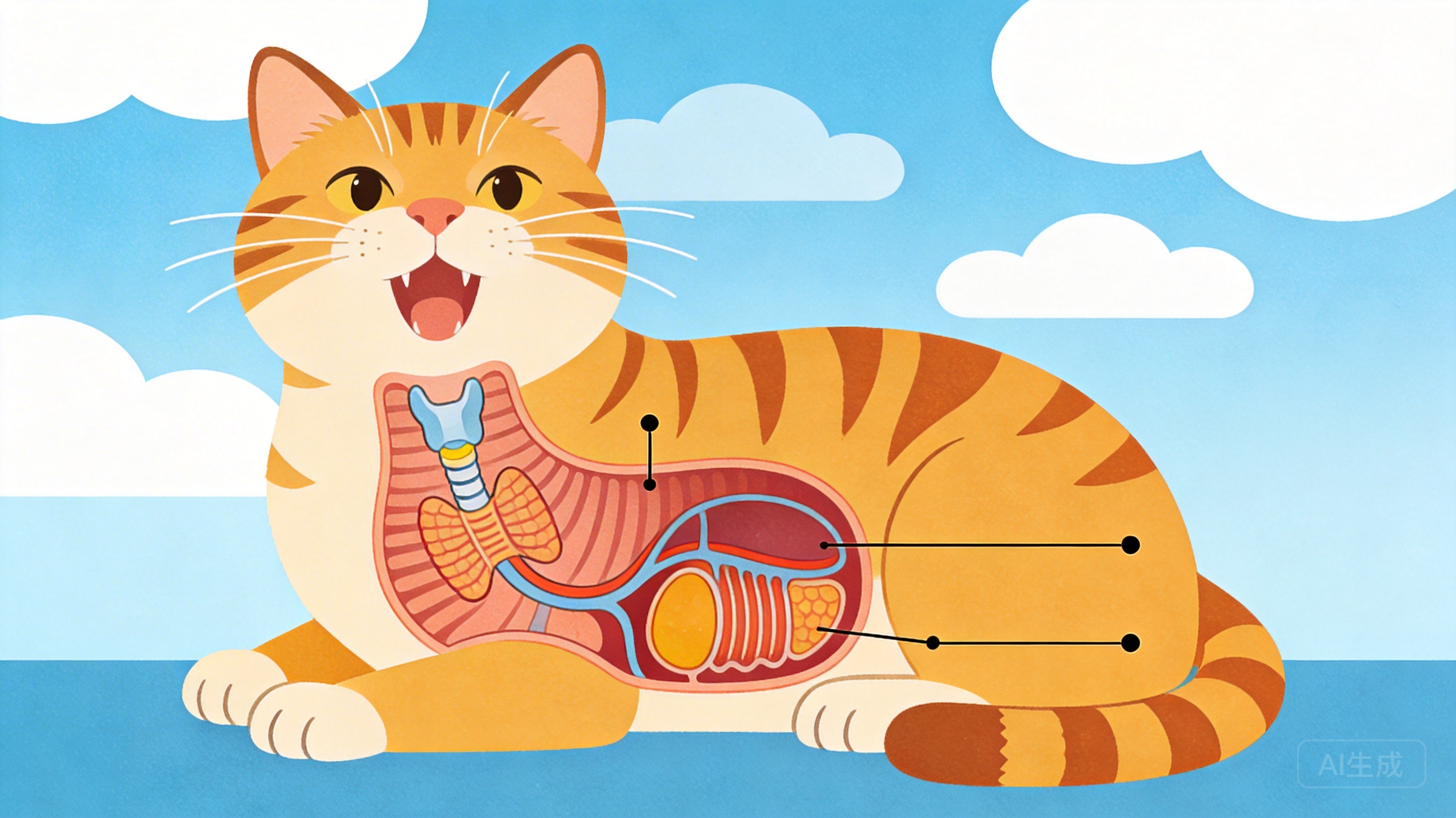
A University of Veterinary Medicine Vienna report on the 2023 study describes excised cat larynges producing self-sustained oscillations at 25–30 Hz without neural input or muscular contraction. That makes anatomy and airflow central to the explanation, rather than treating the voice box as a muscle-powered switch that must actively flip throughout the sound.
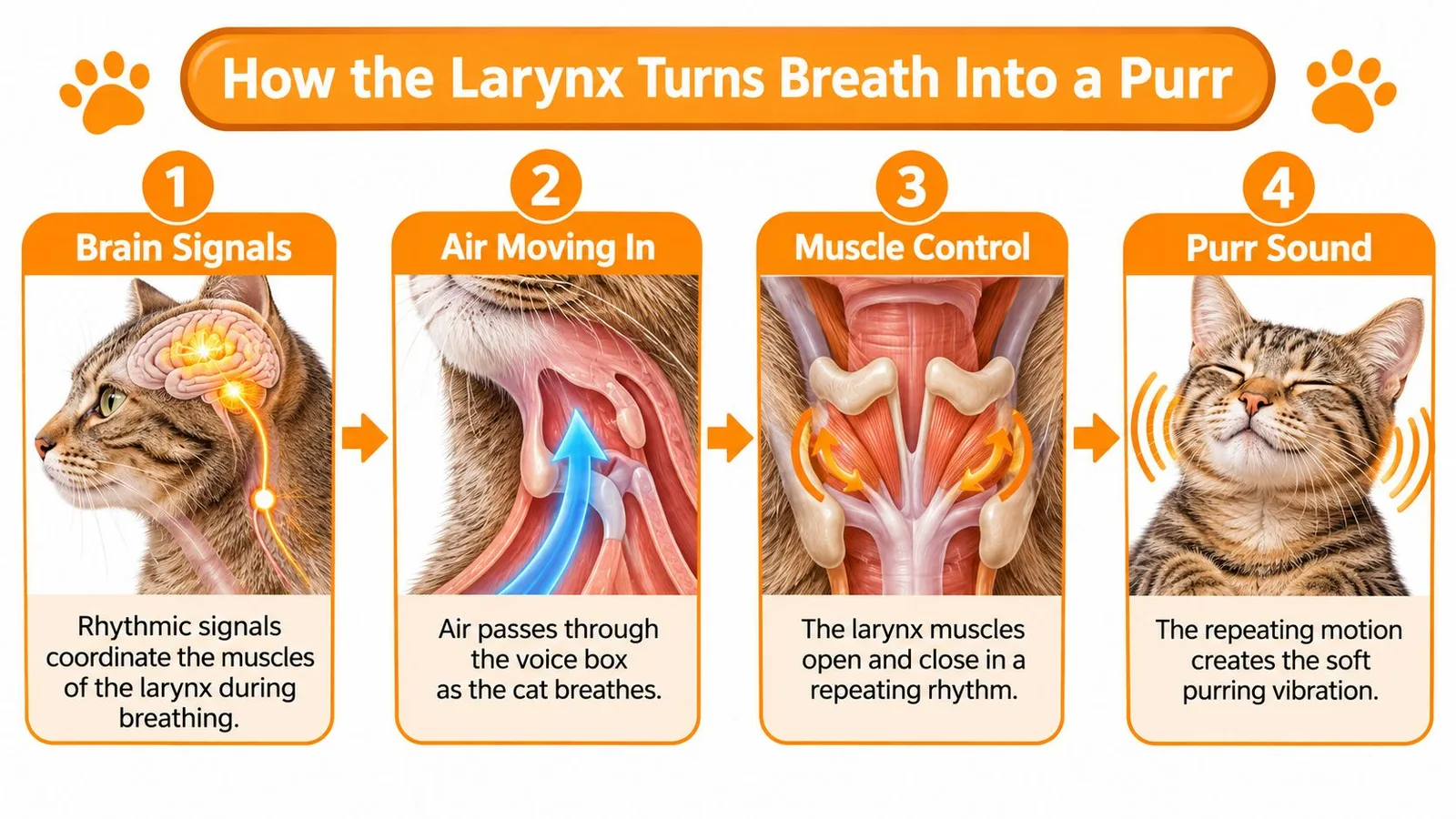
Follow the air through the voice box
The nervous system sets the conditions. In a living cat, the brain helps initiate and regulate vocal behavior. Muscles position the structures of the larynx during breathing. This control matters, but it doesn't necessarily mean the brain commands every individual vibration.
Breath supplies moving air. Air passes through the voice box and interacts with the vocal folds. Once the tissues are suitably positioned, airflow can supply the energy for repeated movement. Think of setting up a system that can oscillate, rather than manually pushing it through every motion.
Specialized tissue makes slow vibration possible. The Current Biology experimental study01230-7) found embedded connective-tissue structures up to 4 mm in the vocal folds and reported that all eight excised domestic-cat larynges produced low-frequency oscillations when supplied with warm, humidified air. Added tissue mass offers an explanation for how a small voice box can generate such a low sound.
The folds can sustain their own oscillation. The experiment challenges the idea that active muscle contraction must power each vibration. It doesn't show that a living cat's nervous system is irrelevant. Neural control may still influence when purring starts, its intensity, and transitions during breathing.
The sound accompanies breathing in and out. This gives purring its sustained, rolling character. What you hear as a hum comes from repeated tissue movement interacting with airflow, rather than from a separate organ devoted solely to purring.
Anatomy isn't an emotion detector
The illustration simplifies the process; its muscle-control stage shouldn't be read as proof that muscles actively drive every vibration. The distinction between starting a sound and sustaining its vibration is important.
Comparing this with why bees buzz offers a useful learning habit: identify what physically vibrates before asking what the sound means. Knowing how a cat produces a purr doesn't reveal whether that particular cat feels secure, hungry, frightened, or sore.
Can a Purr Heal? What the Evidence Shows
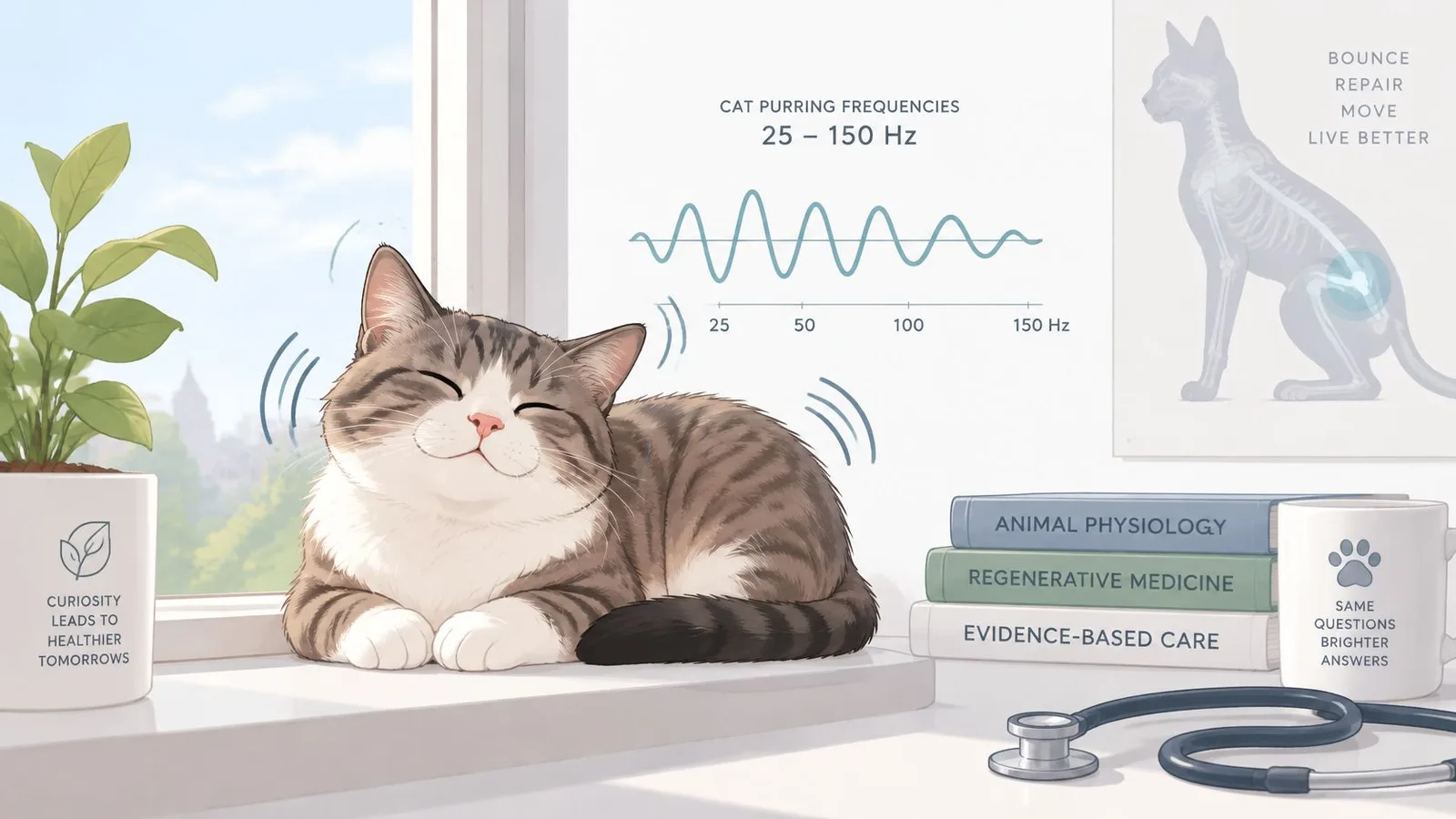
The idea that purring might promote healing has a physical rationale worth investigating. In an acoustic study published through the Acoustical Society of America, purring-related frequencies across several felid species spanned roughly 25–150 Hz, with prominent components near 25 and 50 Hz in domestic cats and some other felids. The authors connected these frequencies with vibration ranges investigated in biomedical work involving bone growth, fracture treatment, pain modulation, swelling, muscle conditioning, and wound recovery.
That comparison supports a hypothesis. It doesn't establish a treatment effect. A sound can occupy a frequency range of biological interest without delivering the same mechanical exposure as a therapeutic device.
Frequency overlap isn't a clinical result
To establish healing, investigators would need to measure an actual outcome in cats and separate the effect of purring from treatment, rest, nutrition, and ordinary recovery. The acoustic findings don't provide that controlled comparison. They therefore don't demonstrate that purring repairs fractures or makes wounds close faster.
Important questions remain about the strength of the vibration, how it reaches a particular tissue, and how long any relevant exposure lasts. Matching a frequency alone doesn't answer those questions. Nor does the observation that an injured cat purrs show that the sound improves the injury.
A possible biological mechanism is a reason to test a claim, not a reason to treat it as established care.
Apply that distinction to an injured cat
Say your cat starts limping, then climbs onto your lap and purrs. The contact may be comforting, but you still haven't learned why the cat is limping, whether movement hurts, or whether the problem needs treatment.
Don't use the sound as evidence that a sore leg is improving. Watch weight-bearing and movement, avoid repeatedly pressing the painful area, and contact your veterinarian for guidance.
The self-soothing explanation needs similar care. Purring during distress is compatible with an attempt to settle, but that doesn't prove the attempt succeeds or relieves pain. Comfort, pain relief, and tissue repair are different outcomes. A cat may seek closeness while still needing medical help, and an owner can provide gentle companionship without making a healing claim.
How Purring Changes From Kittens to Adults
Consider a kitten nestled beside its mother during nursing. In that setting, purring belongs to close physical contact, feeding, warmth, and rest. It's reasonable to interpret it as part of early social communication, but translating it into a precise message such as being fully fed or completely safe would overstate what we know.
The mother may purr during this contact too. Mutual sound and touch could contribute to a settled interaction, although that possibility shouldn't become a claim that researchers have established a specific emotional effect. A plausible function isn't the same as a tested explanation.
Familiar behavior in a new setting
Later, an adult cat may press its paws into a blanket beside a trusted person and begin purring. The setting has changed, but the combination resembles an earlier comfort pattern. Exploring why cats knead helps distinguish that paw movement from the sound that accompanies it.
Adult social life also offers different contexts: resting near a companion, accepting grooming, or settling beside a person. The useful question is whether the cat participates freely and behaves normally before and afterward, rather than whether every purr has retained a kittenhood purpose.
- For a kitten: Notice whether nursing and settling appear comfortable, rather than using the sound alone to judge feeding.
- For an adult: Learn which everyday activities normally bring out purring.
- For an older cat: Pay attention when the familiar pattern changes alongside movement, appetite, or social contact.
Learn the individual's normal pattern
Some cats purr conspicuously; others are quieter or do it less often. You can't rank their happiness by loudness, and a cat that rarely purrs isn't automatically unhappy.
A change from the individual's usual behavior is more useful than comparison with another cat. If a normally sociable cat begins withdrawing, don't let continued purring erase that observation. Likewise, a quiet cat that eats normally, moves comfortably, and seeks familiar company doesn't need to match a more vocal companion.
When to Call a Vet Despite the Purr
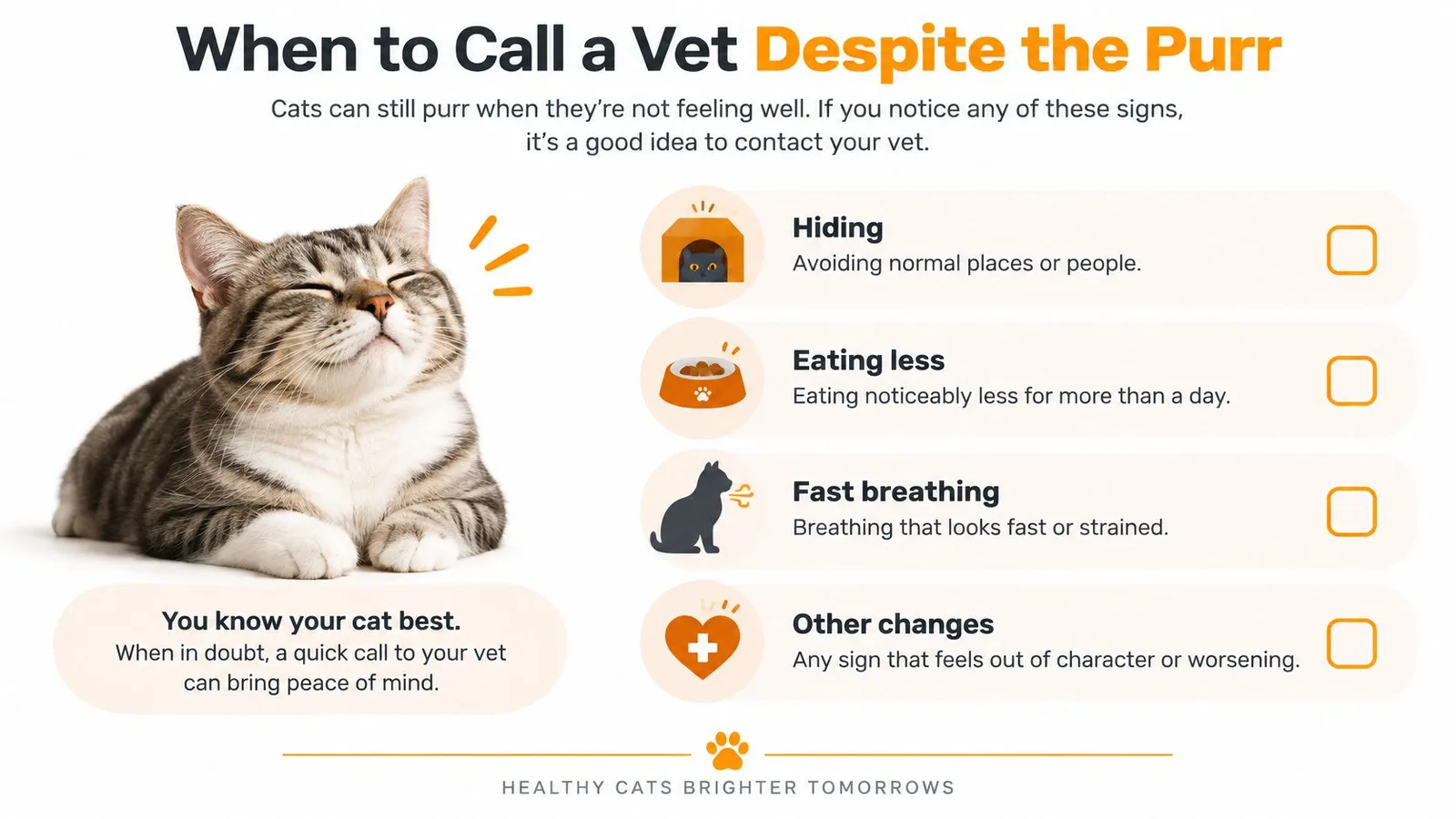
Contact a veterinarian when purring accompanies signs of illness, pain, or a meaningful behavioral change. You don't need to identify the exact cause before asking for help. Your job is to notice what changed and describe it clearly.
Use observable signs rather than trying to decide whether the purr sounds happy or worried.
- Hiding or withdrawal: Your cat avoids familiar resting places, people, or normal activities.
- Reduced eating: Meals are left unfinished or interest in food noticeably drops. Don't wait for purring to stop before seeking advice.
- Breathing changes: Breathing looks fast, strained, or effortful at rest. Open-mouth breathing or obvious breathing difficulty warrants emergency veterinary attention.
- Movement changes: Your cat limps, avoids jumping, or seems reluctant to stand or walk.
- Litter box changes: Urination, defecation, or litter box visits differ from the usual pattern.
- Other discomfort signals: Unusual vocalization, persistent tension, marked pupil changes in context, or sensitivity to touch accompany the sound.
Bring observations, not an emotional diagnosis
Before calling, note what was happening when the purring began. Was your cat resting, being handled, approaching food, or trying to move? Record a short video of posture and breathing if you can do so without upsetting the cat or delaying urgent care.
Write down appetite changes, litter box changes, movement difficulties, and when you first noticed them. Tell the clinic about medications and any possible injury. Don't repeatedly manipulate a sore limb or force your cat into a position for a clearer recording.
For help organizing questions about nonurgent changes, the pet health resources from Bandana Rx can complement a conversation with your veterinarian. General information can help you prepare, but it can't assess your cat's condition.
A useful description is “she's purring but won't put weight on her leg,” not “she seems fine because she's purring.”
A relaxed cat with normal eating, ordinary breathing, comfortable movement, and willing social engagement gives you a reassuring overall picture. If those signs change or you're uncertain, call the clinic, describe what you've observed, and arrange the recommended assessment.
Everyday animal behavior offers plenty of questions worth testing rather than guessing at. Visit Million Whys for short interactive questions and explanations for each answer choice, and turn your curiosity about purring into a broader understanding of how animals behave.
Curious? Try one 👇
Why is the sky blue?
Jump into the daily quiz →Keep Exploring

Related Posts
Why Do Cats Knead? Kitten Instincts and What It Means
Why do cats knead? Learn how kneading starts in kittenhood, what it means in adult cats, and when to worry.
Why Do Dogs Wag Their Tails? What Each Wag Really Means
Why Do Dogs Wag Their Tails? Wag direction, height and speed signal emotion and intent. Learn what each wag means and when to back off.
Why Do Bees Buzz? the Mechanics Behind the Sound
Why do bees buzz? Discover how flight muscles, wingbeat frequency, and temperature shape the sound, plus the hidden role buzzing plays in pollination.