

Why Do Dogs Wag Their Tails? What Each Wag Really Means
On this page· 17
A tail wag is an emotional communication signal whose meaning depends on its direction, height, speed and the situation, not merely on whether the dog is happy. That answer sounds less tidy than the advice most of us grew up with, which is exactly why it is more useful. A wagging tail tells you a dog is activated, but it doesn't tell you on its own whether that dog wants a greeting, needs space, or is about to retreat.
Dogs Wag to Send a Message, Not Just to Show Joy
If you ask why do dogs wag their tails, the most honest short answer is to communicate. The tail is a moving signal that carries information about a dog's emotional state, motivation and likely next action, which makes it closer to a message than to a mood gauge.
That message is built for distance. A tail in motion is visible across a yard or a dog park, so it reaches other dogs before close-range cues like posture shifts or facial tension can. Reviews of the behavior research describe wagging as one of the primary visual channels dogs use to negotiate greetings, competition and space with each other.
The puzzle for owners is that the same moving tail shows up before very different moments. You've seen a wag during a joyful reunion. Dogs also wag while guarding food, meeting a tense stranger dog, or hoping an interaction will end.
The Turn Signal Analogy
A wag works like a car's turn signal. A blinking indicator tells you the car is about to do something. Which side blinks, how fast the car is moving and what the surrounding traffic looks like decide what that something will be.
Dogs give you the same kinds of variables: direction, height and speed, read alongside the social context. Learn to read them together and you'll move from asking whether a dog is wagging to understanding what the dog is probably saying, including the cases where a wag looks friendly and means something else.
Question 1 of 4
What is a dog's tail wag telling another dog that sees it from across a field?
Reading Wag Direction, Height and Speed
Speed is the detail your eye catches first, which is exactly why it belongs last. A fast tail feels like information, yet it is the least reliable of the three signals on its own.
Reading order here works like reading a person's mood. How quickly someone talks tells you very little until you have noticed their expression and posture. With dogs, direction and height are the expression and posture. Check them before you trust what the tempo seems to say.
A Three-Step Reading Order
- Start with direction. A wag that sweeps with greater amplitude toward the dog's right points toward approach and positive engagement. A wag biased toward the dog's left points toward withdrawal, conflict or a defensive response. The difference is subtle, so treat direction as a first clue and confirm it against the rest of the body.
- Check height and stiffness. Carriage changes what the movement means. A high tail can signal confidence, arousal or willingness to approach. A low or tucked tail shrinks the dog's apparent outline and tends to accompany fear, anxiety or appeasement.
- Check speed last. Fast movement with a high, rigid tail can reflect intense arousal or assertiveness. Fast movement held close to the body can reflect nervousness or internal conflict. Same tempo, different message.
One caveat about the tail itself: its length may change how clearly the message travels. In experiments run with robotic dog models, longer tails conveyed movement cues more effectively than shorter tails. That result comes from robots, so it shows tail length can matter mechanically without proving how much signal a real dog loses. The practical takeaway holds either way. If a tail is hard to read, for whatever reason, shift your attention to the rest of the body.
Tail Signals and Their Likely Meanings
| Tail signal | Likely meaning | Check alongside |
|---|---|---|
| Broad wag, mostly to the dog's right, mid-to-high | Relaxed, positive approach | Loose body, soft eyes, relaxed mouth |
| Wag biased to the left | Withdrawal, defensive or conflicted | Stiff body, freezing, lip-licking |
| High, stiff, fast wag | Intense arousal or assertiveness | Forward weight, fixed stare, raised hackles |
| Low, tight, fast wag close to the body | Nervousness or internal conflict | Ears back, crouch, avoidance |
| Low or tucked, slow or still | Fear, anxiety or appeasement | Turning away, lowered head |
| Loose, wide, slow wiggle with play bow | Invitation to play | Bouncy stance, relaxed face |
Use the table as a starting point for your read. The true verdict comes from pairing the tail with ear position, facial tension, weight distribution, gaze and whether the dog can disengage.
A loose dog that can turn away is generally less concerning than a rigid, forward-weighted, fixated dog, even if both tails move at similar speeds.
That contrast is the one to remember in real life. Two dogs can wag at the same speed while feeling opposite things, and the body around the tail is what separates a relaxed greeting from a dog you should leave alone.
Question 2 of 4
In experiments with remote-controlled robot dogs, why did a longer tail send clearer tail-motion signals to real dogs than a short tail?
Three Layers Behind a Wag's Meaning
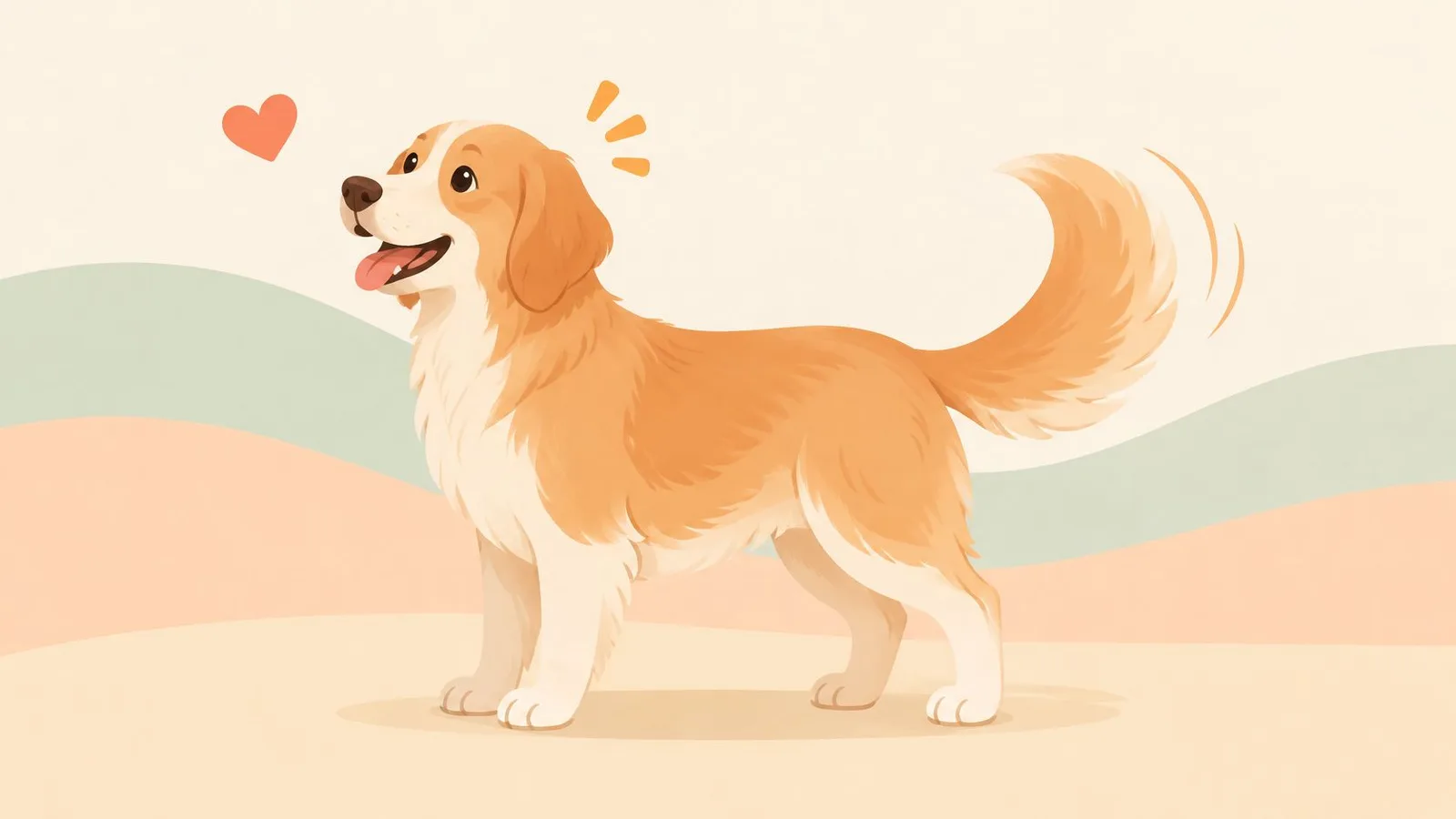
A wag makes more sense when you build it in three layers. Each layer adds something the previous one can't explain on its own.
Layer One Is Emotion Made Visible
First, the tail is an emotional readout. A 2024 scientific review organized the evidence using Tinbergen's framework and concluded that tail movement conveys a dog's emotional state, motivation and likely behavior. When dogs view positive stimuli such as their owner, their tails move with greater amplitude toward the dog's right. When they encounter negative or threatening stimuli, such as an unfamiliar dog displaying aggression, the wag becomes more strongly biased to the left.
Layer Two Is the Brain Behind the Bias
Second, brain lateralization explains why direction can carry meaning. Each hemisphere of the brain primarily controls the opposite side of the body, a bit like crossed wires. Emotional processing on one side of the brain tends to show up as stronger movement on the opposite side of the tail.
The usual reading is that a right bias reflects approach-related processing, while a left bias reflects withdrawal or defensive processing. Treat that as a tendency, not a code. Context, arousal level and the individual dog all shift the picture, and later evidence in this article shows the same bias can precede different behavior. The tail offers a clue about which system is more active, then the rest of the body fills in the details.
Layer Three Is Visibility
Third, movement is easy to spot. A wagging tail stands out against a background far better than a still posture does, which is one reason a tail works well as a signal at all.
Animals broadcast internal states through visible signals in many ways, and interesting facts about chameleons show how color changes can play a similar role for a very different species.
Here is a familiar scene. You come through the front door and your dog greets you with a broad, loose wag at mid height that leans right, hips swinging. Read layer by layer, the signal suggests a dog in a positive state whose movement you can register from across the room. Read the tail alone, and you only know something is happening.
Core idea: A wag says a dog is emotionally activated. Direction, speed, height and social context tell you what kind of activation it is.
Question 3 of 4
Why does a dog's tail tend to wag more to its right when it's happy and more to its left when it's anxious?
How Dogs Read Each Other's Wags
At a busy dog park, two dogs spot each other across the grass. Before either one moves, both tails are already swinging, and each dog is reading the other's signal. Watching how dogs respond to wags is the strongest evidence that the tail functions as a social message, not just a reflex humans happen to notice.
What Happened in the 2007 Study
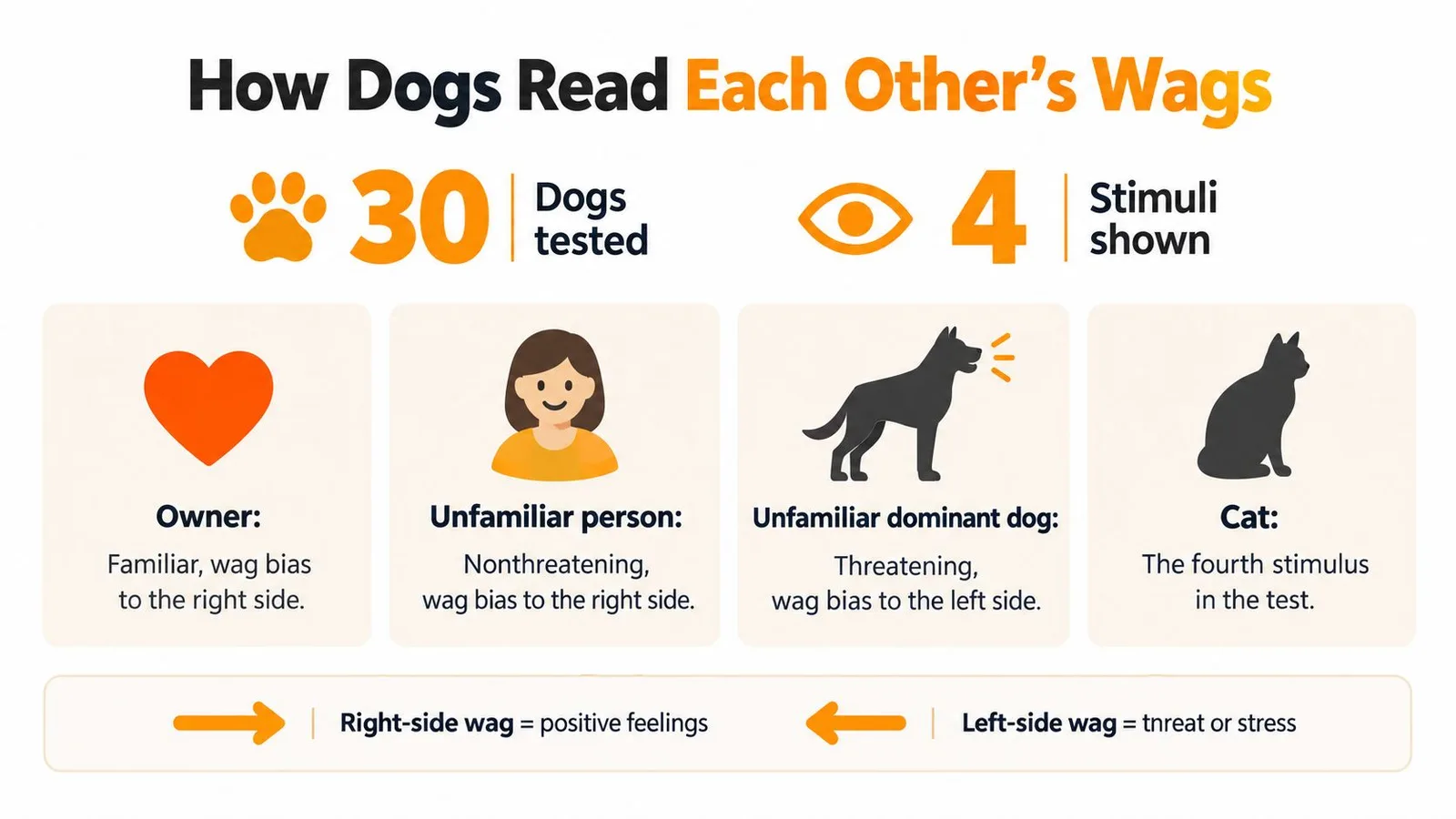
In a 2007 study, researchers videotaped 30 dogs while each one faced a single stimulus: the dog's owner, an unfamiliar person, an unfamiliar dominant dog, or a cat.
Familiar, nonthreatening sights produced wags biased to the dog's right. The dominant stranger produced a left-biased wag, matching withdrawal-related processing rather than approach. That showed dogs produce directional wags. The next question was whether other dogs notice them.
The Playback Experiments
Follow-up work flipped the setup. Instead of measuring the wagger, researchers measured the watcher. Dogs viewed a realistic dog or silhouette wagging predominantly to the viewer's right, matching the approach pattern, and stayed relatively relaxed. When the displayed dog wagged predominantly to its left, watchers showed anxiety-related responses, including increased heart rate. These playback results come from experiments testing whether dogs interpret asymmetric wagging in other dogs.
Why Direction Is One Cue, Not a Code
Wag direction works like a turn signal read alongside traffic, not a command. In playback setups, the tail is isolated as the main moving cue, so dogs react to it strongly and cleanly. In a live encounter, dogs weigh direction against posture, distance, stiffness and familiarity, and no single cue settles the decision on its own. Other social species combine signals the same way: facts about swans and their social displays show displays whose meaning shifts with posture and situation rather than one motion alone.
The practical takeaway comes straight from the playback design: watch the watching dog. A dog that stiffens, hesitates or pulls back when it sees a left-leaning wag is doing exactly what those studies measured, reading the tail first and the greeting second.
When a Wag Does Not Mean Friendly
The most common mistake is treating a wagging dog as a friendly dog. Wagging is a motor output shaped by emotional valence and brain lateralization, and tail wagging is not a simple synonym for friendliness. Because the direction cue is subtle, treat it as supplementary evidence, never as a standalone test you can pass or fail a dog on.
Three Wags That Mislead
- The stiff, high wag. The tail is up, rigid and moving in short, fast arcs while the dog stares and goes still between movements. Freezing paired with a fixed gaze means the dog is intensely aroused, and the wag is part of a warning display rather than an invitation.
- The low, tight, rapid wag. This one looks busy and almost cheerful because it moves fast. Held close to the body, though, it can signal anxiety or conflict, a dog torn between approaching and retreating.
- The wag with mixed messages. The tail moves while the dog growls, licks its lips or keeps turning its head away. Those signals don't cancel each other out. The uncomfortable ones deserve more weight than the wag.
A food bowl makes this concrete. A child walks toward a dog that's eating, sees the tail moving fast and keeps coming, because fast looks happy. But the dog is stiff over the bowl, weight forward, hard-eyed and guarding. The tail alone misleads, while the posture and the guarding context reveal the actual risk.
Practical rule: Never approach a dog only because its tail is moving, and treat any conflicting signal as a reason to slow down and give space.
The same fast wag can come from play or from conflict, which is why speed can't settle the question. When the tail says one thing and the body says another, believe the body and back off. That habit protects you, and it also respects a dog that was already trying to tell you something.
Question 4 of 4
A dog holds its tail high and stiff, whipping it in short fast arcs while staring at you and going still between wags. What is that wag most likely signalling?
How to Respond When a Dog Wags at You
A wagging tail works like a turn signal on a car. It confirms the dog intends something, but it never tells you what, so you still have to check the mirrors. The mirrors here are the face, the posture and the setting, and the routine below covers all three in a few seconds.
A Seven-Step Checklist
- Read the whole body first. Ears, face, weight distribution and gaze confirm or contradict whatever the tail suggests. A soft face with evenly balanced weight supports a friendly reading. A hard stare paired with a forward lean points the other way.
- Check direction, height and stiffness. A loose, broad, mid-height wag reads very differently from a high, rigid one, even at identical speed. Compare what you see against the patterns from earlier rather than judging the tail on movement alone.
- Stay low and side-on. Crouching slightly and turning your body sideways is less confrontational than leaning over a dog from above. Looming can feel like pressure, especially to a nervous animal.
- Let the dog come to you. Offer a closed hand at the dog's level so it can sniff and choose for itself. A dog that walks over freely is volunteering information, which beats anything you could guess from the tail.
- Ask the owner first. Permission matters with any dog you do not know, because owners often know triggers you cannot see. When no owner is around to ask, treat that absence as extra reason for caution.
- Watch for escalation signs. Freezing, lip-licking, growling or drifting away all mean the dog needs space. Give it that space right away instead of testing whether the dog means it.
- Stop if a loose wag turns stiff. Dogs change their minds mid-greeting. A wag that tightens and rises while the rest of the body goes still is your cue to end the interaction calmly.
Every step comes down to one decision rule. Approach only when the body, the tail and the context agree, and back off when any one of them disagrees. Agreement means a loose body, a compatible wag and a setting with nothing worth guarding or fearing.
That is the whole test. One mismatched signal is reason enough to pause, because waiting costs you a few seconds while guessing wrong can cost the dog its trust and you a bite.
If reading tails leaves you curious about why animals behave the way they do, Igneous AI, LLC builds Million Whys, a micro-learning platform that delivers a daily 10-second why-question with an explanation attached to every answer choice, correct or not. For a lighter starting point, browse this collection of surprising random animal facts, or visit millionwhys.com to try today's 10-second question and follow your next why wherever it leads.
Keep Exploring
Why do dogs wag their tails?
Animal Behavior
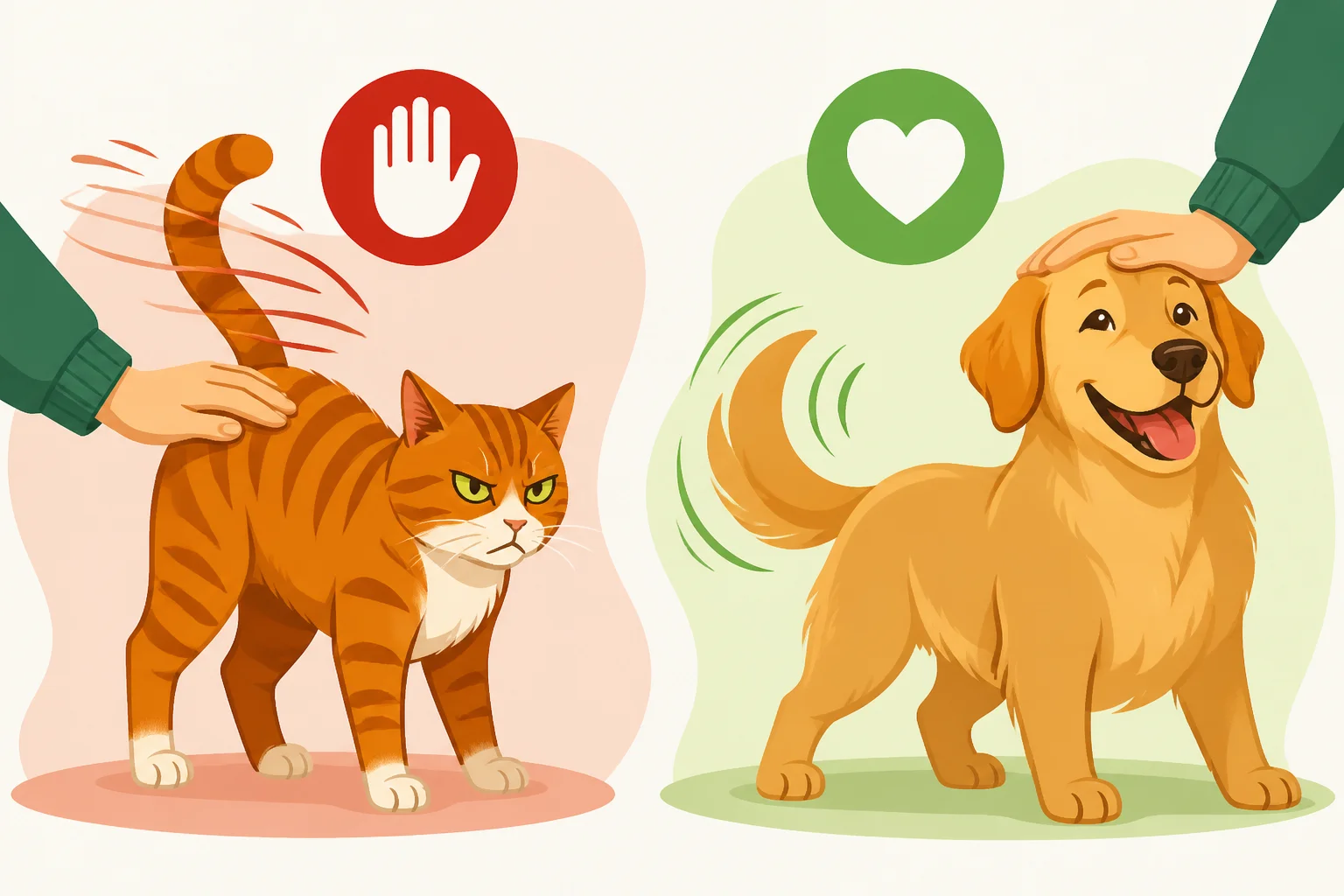
Why does a cat's fast tail swish during petting mean you should stop, while a dog's wag usually means keep going?
Animal Behavior
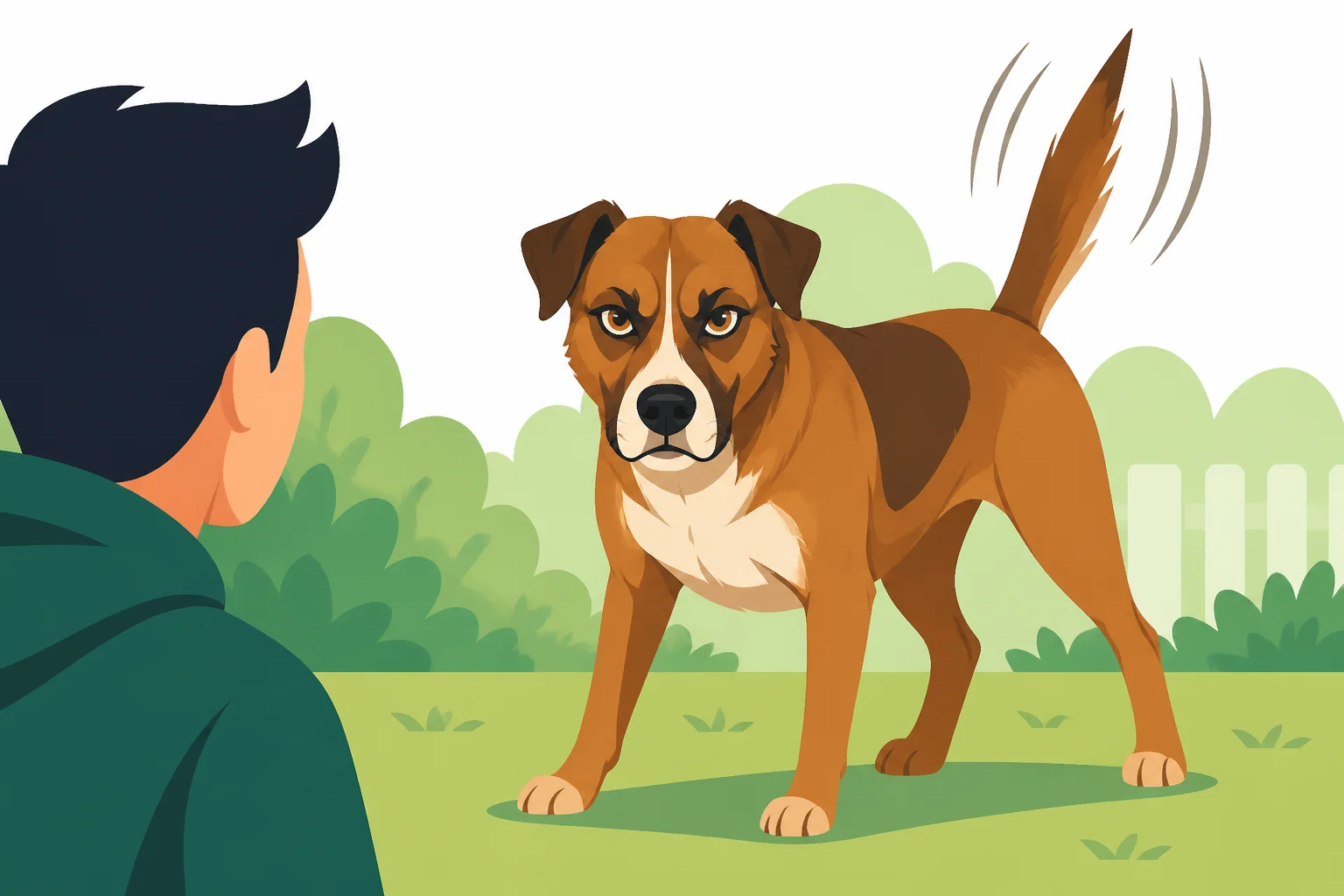
A dog holds its tail high and stiff, whipping it in short fast arcs while staring at you and going still between wags. What is that wag most likely signalling?
Animal Behavior