

What Is Active Recall and Why It Beats Rereading
On this page· 13
What do your notes do for you the night before an exam? Usually another read-through, which skips the move that makes studying stick. Active recall means closing the notes and producing the material from memory before you check it. Students who study this way hold a clear edge two days later over those who reread.
Yet rereading feels smarter. It produces a warm confidence that the material is already yours, while retrieval feels clumsy and a wrong answer feels like failure. That wrong answer still counts: reaching for a memory is what strengthens it. Two questions remain: how hard should recall feel, and does a correct answer prove real understanding?
Active Recall Defined and How It Differs from Rereading
Think of memory as a muscle and study methods as ways of spending an hour at the gym. Rereading your notes is watching someone else lift the weight. You see the movement, you follow the logic, you could describe the set afterwards. None of that puts strain on your own muscles. Retrieval is lifting the weight yourself: awkward, effortful, and the only version that produces growth.
Active recall is the act of producing information from memory before you check the source. That is the whole definition. The production can be spoken, written, drawn, or typed. What matters is the sequence: memory first, source second.
Why rereading feels like learning
When a sentence sits in front of you and your brain says "yes, I know this," you are experiencing recognition, not retrieval. Recognizing a song in a shop is trivial. Playing it on a guitar is not. The two abilities live in different places, and rereading only ever trains the first.
That fluency is pleasant, which is why it survives as the default study habit for so many people. It also explains why students who reread predict they'll do better than students who test themselves, right up until the delayed exam marks arrive.
Six study methods side by side
| Study method | What you do | Memory demand | Typical result |
|---|---|---|---|
| Rereading notes | Read the same material again | Low, mostly recognition | Feels familiar, weak recall later |
| Highlighting | Mark key sentences while reading | Low | Attention without retrieval |
| Replaying a lecture | Watch or listen to the source again | Low | Fluency that fades quickly |
| Summarizing with notes open | Rewrite material while looking at it | Moderate | Better than rereading, less than closed-book recall |
| Closed-book recall | Close notes and write what you remember | High | Stronger memory after a delay |
| Practice questions | Answer before checking the answer | High | Strong retention when feedback follows |
Scan that table for the rows you used last week. Most learners stop in the first three, where the material still looks familiar and the session feels smooth.
The five-second test: if you couldn't produce the answer with the notes shut, you haven't learned it yet. You've only read it until you attempt recall and then check the source.
Question 1 of 5
Why does rereading your notes feel so productive yet leave you blank at the exam, while trying to recall them first works better?
The Testing Effect Behind Active Recall
Henry Roediger and Jeffrey Karpicke designed the study often cited when people quote the science of retrieval. Students read prose passages, then either restudied the passage or took a free-recall test, writing down everything they could remember with nothing in front of them. Both groups came back later for a final recall test.
The early result is the one that traps people. Right after studying, repeated reading appeared to have the edge, so the method that felt better also looked better in the short run. The chart below shows what happened once a delay was added.
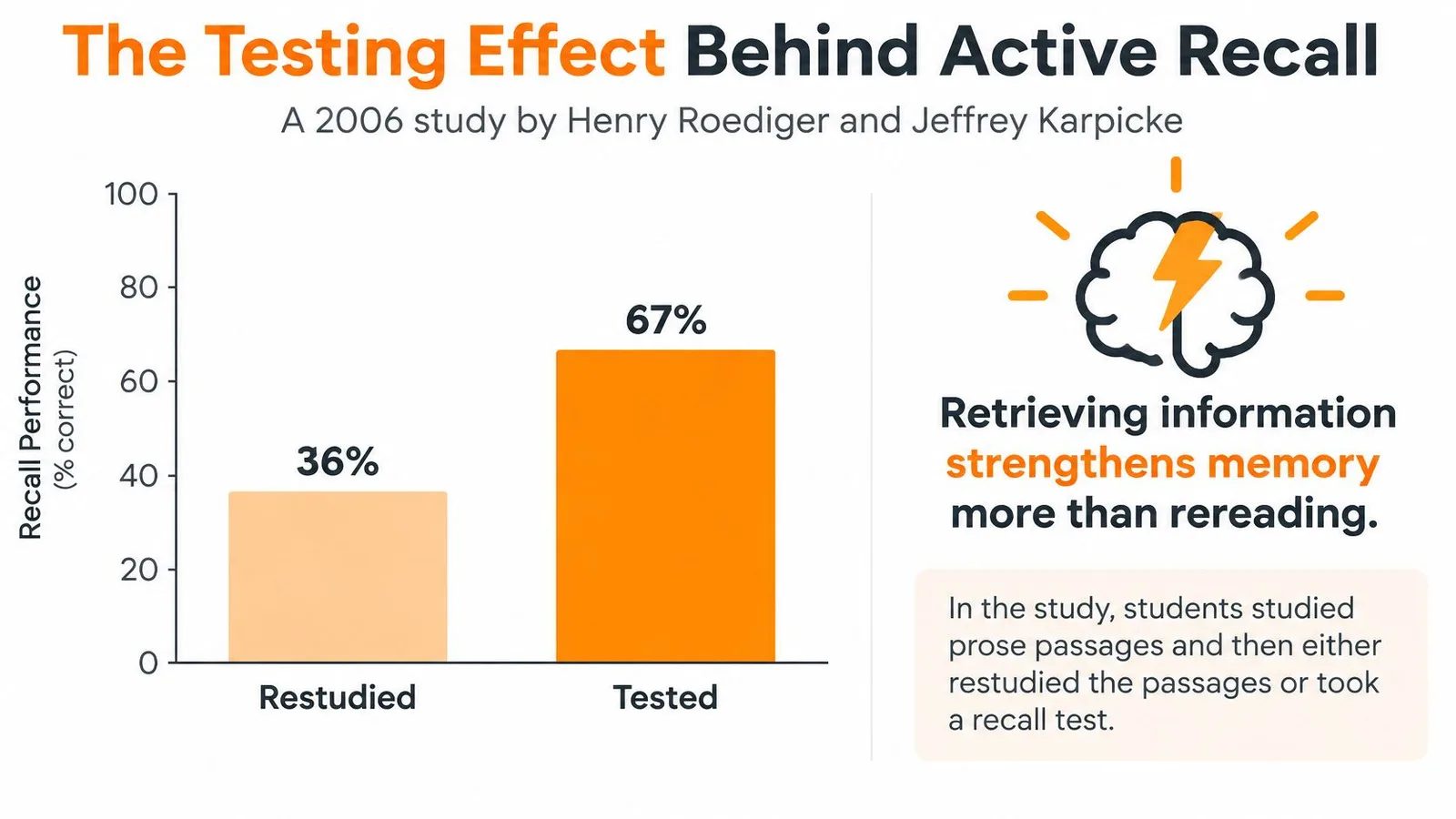
The numbers, published in the 2006 Psychological Science paper from Roediger and Karpicke, ran the opposite way to the students' instincts.
| Delay | Tested group | Restudied group |
|---|---|---|
| After 2 days | 68% | 54% |
| After 1 week | 56% | 42% |
Why producing an answer beats seeing it again
The mechanism is plain once you drop the jargon. Pulling an answer out of memory is a hard, narrow search. You have to find the trace, rebuild it, and push it back out in words. That effort strengthens your later access to the same answer in a way that one more read never does, because another read never requires the search at all.
The same study makes a second point that matters more than exam season. The advantage held after a week, which means this is about durable memory, not a trick for the test on Friday. Every quiz you take is a learning event, not just a score.
For a closer look at the experiments behind this effect and the variations researchers have tested since, the full breakdown of the testing effect is worth your time.
The discomfort of drawing a blank is not a sign the method is failing. It is the sensation of the search happening, and the search is what builds the memory.
Question 2 of 5
One group rereads an article several times, while another reads it once and then closes the book and writes down everything it can recall. Why does the recall group remember more of the article a week later?
Recognition, Cued and Free Recall Compared
Ask the same student about the water cycle three different ways and you will get three different verdicts on what they know. A multiple-choice question, a fill-in-the-blank, and a blank page each demand a different depth of search, and each leaves you with a different kind of knowledge.
| Format | Example prompt | Memory search | Best used for |
|---|---|---|---|
| Recognition | Multiple-choice question on the water cycle | Low: pick a familiar answer from the options | Quick checks and spotting distractors |
| Cued recall | Fill in the blank: evaporation turns liquid water into ? | Medium: produce the answer from a cue | Key terms and specific facts |
| Free recall | Write everything you know about the water cycle on a blank page | High: rebuild the topic with no cues | Understanding structure and connections |
Three prompts, one topic, three very different workouts. The gap between them is like the gap between spotting a weight you recognize on the rack and lifting it unassisted: one shows the shape is familiar, the other shows you can move it. Recognition hands you the answer set, so a correct pick only proves the right option looked familiar. Cued recall hands you a starting point. Free recall hands you nothing and asks you to reconstruct the whole system, which is why it exposes gaps the other two formats pass over.
Choose the format by the goal
Two questions decide which prompt earns its place. First, how hard do you want the search to be? Second, what would a correct answer prove? Teaching guidance summarized in the New South Wales explicit teaching review draws the practical line: short-answer prompts can improve retention of the specifically targeted information, while free-recall tasks may preserve a broader range of material. Reach for the narrow format when you need a term, a date, or a formula available on demand. Reach for the wide format when you need to see how the pieces fit.
Multiple-choice questions do involve retrieval, just a shallower search. That makes them excellent for a fast check and for studying why each distractor is wrong, and weaker as your only preparation before an exam.
The same gap between recognizing a label and producing the skill shows up outside the classroom. Systems for the recognition of language training credentials exist precisely because a certificate on file and the ability to hold a conversation are two different claims, one verified by lookup, the other only by retrieval.
A wrong answer still counts as retrieval
The last thing to compare is what each format does with failure. A missed blank or a garbled water cycle written from memory is still a retrieval attempt, and the failed search marks exactly where your memory bends. Whatever the prompt, the cycle stays the same: attempt an answer, inspect the explanation, correct the misconception, and schedule another attempt after a longer interval. Skip the inspection step and you can rehearse a confident error for weeks, and recognition formats are the most likely to hide it, since a familiar-looking wrong option can feel right.
Question 3 of 5
Why does answering a fill-in-the-blank question feel harder than picking from a multiple-choice list, even when both cover the same material?
How to Practice Active Recall in One Study Session
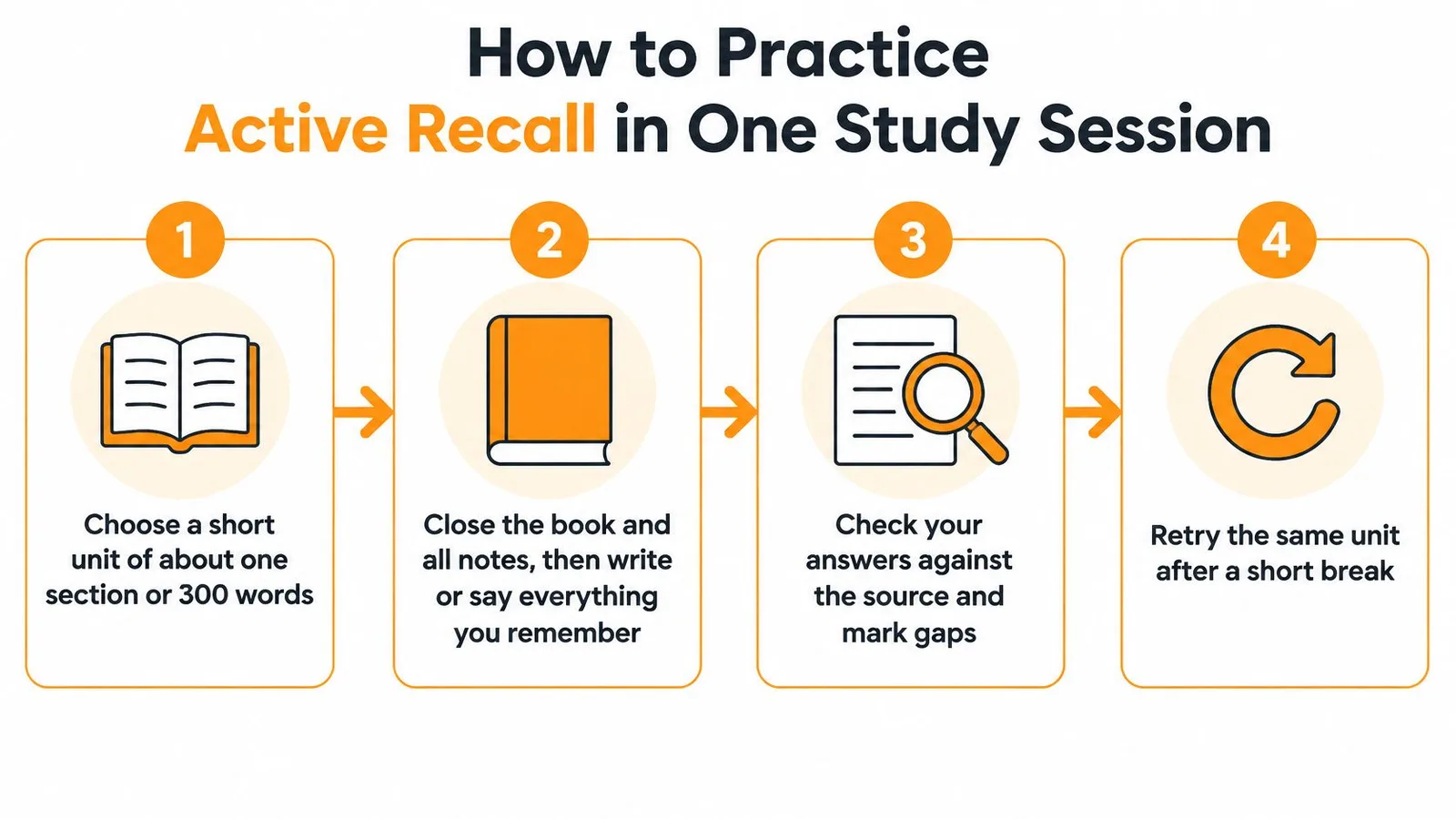
What does the method look like when you sit down tonight with one chapter and twenty minutes? It is a five-step loop, and each step exists because of a specific way the attempt fails without it.
- Choose a short unit. One section, or about 300 words, keeps a single attempt manageable. Longer units turn recall into a vague summary of a whole chapter, and vagueness hides gaps.
- Close everything. Book shut, notes face down, tabs closed. If the answer is visible, your brain stops searching and starts recognizing, which is the rereading habit in disguise.
- Write or say what you remember. No structure required. A messy list of fragments shows what your memory holds, while a tidy paragraph copied from the page only shows what the page holds.
- Check and mark the gaps. Compare the attempt against the source and flag every miss and every confident error. A wrong answer still counts as retrieval. You pulled something out of memory, and surfacing it is what lets the correction happen.
- Retry the missed points later. Come back at least a day afterwards rather than immediately. A gap forces memory to rebuild the answer instead of echoing a fresh one.
A student working through photosynthesis can watch the loop run. She writes the light-dependent steps from memory, gets most of the sequence down, then notices she has written nothing at all about the light-independent reactions. The check step surfaces that hole, she rewrites the section in her own words against the chapter, and she retries it the next morning. Fifteen minutes, one visible gap closed.
How hard should the attempt be
This is the question most definitions skip, and the useful answer works like a weight at the gym: too light and nothing adapts, too heavy and the rep fails before it does any work. The evidence puts numbers on that intuition. A 2007 Karpicke and Roediger experiment comparing repeated testing with repeated studying found 40% versus 30% on delayed retention, a large effect size of d = 1.01, and their analysis also found that repeatedly recalling items already recalled improved retention by more than 100% compared with dropping those items from further testing, as reported in the Journal of Memory and Language paper.
The wider research base points the same direction. Meta-analyses of the testing effect find that testing-style practice beats simple exposure in the large majority of comparisons, with a moderate overall benefit. Difficulty then sets the size of the payoff. When an initial attempt mostly fails, the gain shrinks toward zero; when most of the material comes back with a few misses, the gain is considerably larger.
Practical rule: aim for attempts you get roughly right and slightly wrong. If you are failing most of a section, shrink the unit or reread once before trying again. A struggle that ends in repeated failure just teaches frustration.
If your study time is already tight, these time-saving revision techniques pair well with this loop, and the same logic of matching the method to the material is what adaptive learning systems try to automate.
Question 4 of 5
Why can testing yourself on a chapter several times in one study session beat rereading it when you check a week later?
Where Active Recall Falls Short
A correct answer is not proof of understanding. That's the claim worth testing, because most popular explanations of active recall imply that remembering an answer means you can use the concept somewhere else.
Sometimes you can, and sometimes you can't. A review summarized by the Carnegie Mellon Eberly Center's retrieval practice guidance reports a moderate benefit for new questions across 192 results (d = 0.40). Transfer weakened when cues and answers were reversed, when material had been read but not tested, and when practice leaned on worked examples alone.
Here's the failure in miniature. A student memorizes that mitochondria produce ATP and passes a multiple-choice quiz on cell organelles. Ask why a muscle cell with heavy energy demand contains far more mitochondria than a skin cell, and the answer doesn't come. The label was stored. The mechanism never was.
Four fixes that make knowledge travel
- Vary the context. Ask the same idea from a different angle, in a different subject, or with the numbers changed.
- Demand explanations, not labels. "Why does this happen" beats "what is this called" every time you want transfer.
- Mix recall with prediction. Ask what would happen next before you reveal whether you're right.
- Explain every option. Feedback that only confirms the right answer leaves the wrong ones intact for next time.
Two misconceptions are worth clearing up directly. Flashcards are one form of active recall, not the definition of it, and they suit definitions and vocabulary better than processes and systems. And retrieval without checking your answers produces little lasting gain, because nothing corrects the errors you just rehearsed.
Your own transfer test is simple: restate the same idea in a new setting and see whether the answer still arrives. When you pick a quiz app or a question deck, look for explanations attached to every option, not just the correct one.
Build a Week of Active Recall
Pick one familiar topic you half understand, say why ice floats or why inflation erodes savings, and give it four short sessions. Ten minutes a day is the whole commitment.
- Day 1: Write two sentences from memory explaining the phenomenon. Check the source and mark exactly what you left out.
- Day 2: Retry only the missed point, no notes, and stop once you can state it cleanly.
- Day 4: Rewrite the full explanation in your own words, then answer a new question about the same idea in an unfamiliar setting.
- Day 7: Do a free-recall brain dump on a blank page, compare it with the source, and note what's still missing.
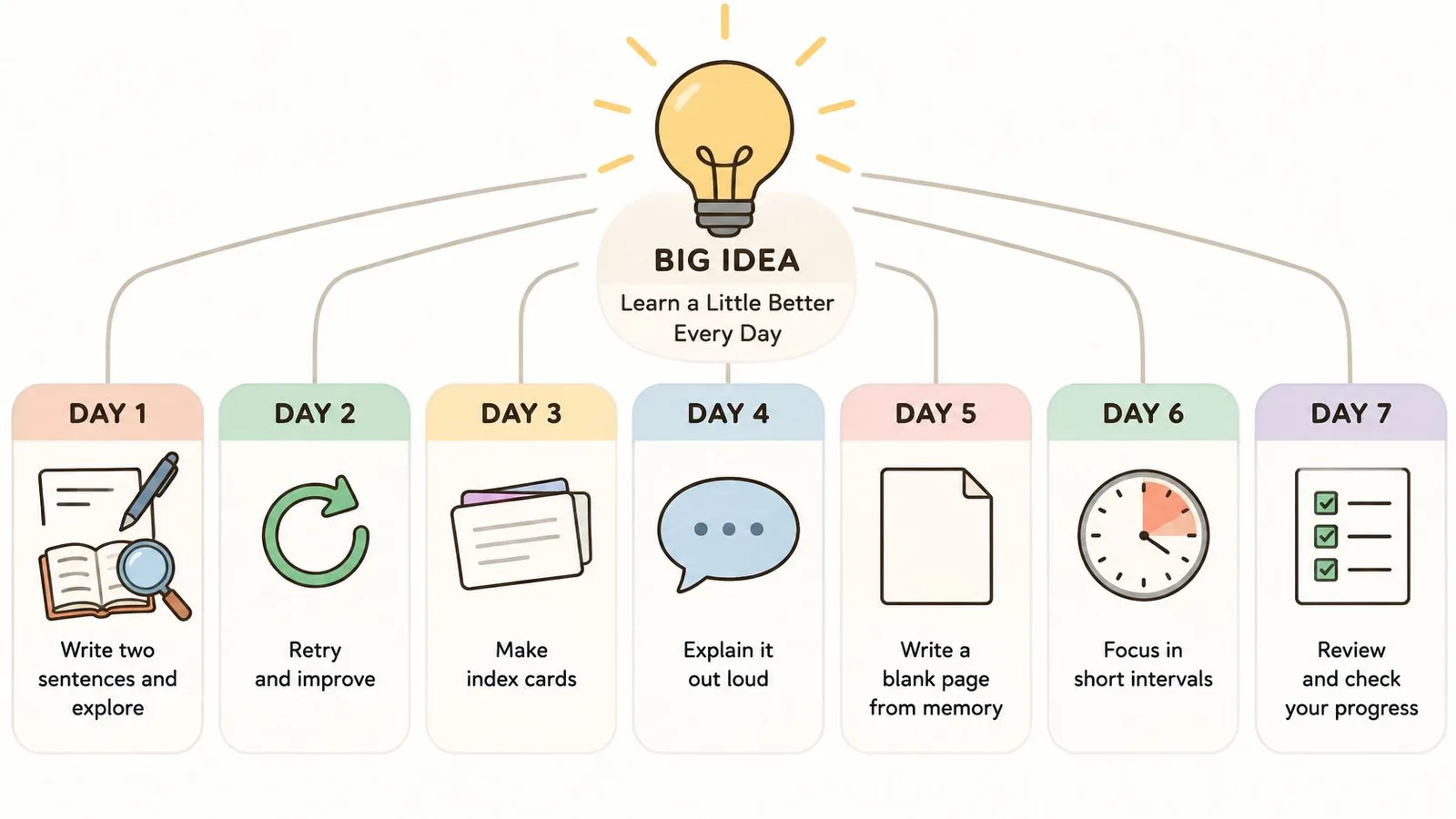
Spacing does the quiet work here. Each retry after a gap asks memory to rebuild the answer from scratch, which is a harder and more productive task than repeating something still fresh. If you want a deeper treatment of interval lengths, this guide to ongoing skill retention with spaced review explains how the gaps stretch over time.
In Million Whys, the practice starts with one question about something familiar, and the user follows up on whatever still puzzles them and looks for the same idea in another field. That follow-up step is the transfer test built into an ordinary day, and the wider habit of learning new things through small repeated questions is exactly what a week like this trains.
Keep the promise modest. A schedule like this builds retention and makes transfer more likely over time. It doesn't guarantee a score, and it won't rescue you from a topic you've never opened.
If you want a low-friction way to run this loop daily, Million Whys turns one question into a retrieval attempt: you predict an answer before the reveal, then read why every option, including the wrong ones, is right or wrong. It takes about ten seconds, and the explanation for each choice is what turns a guess into a correction. Visit Million Whys and start with the question of the day.
Question 5 of 5
Why does retrying something after a gap teach you more than repeating it while it's still fresh?
Keep Exploring

Why does rereading your notes feel so productive yet leave you blank at the exam, while trying to recall them first works better?
Psychology & Behavior

Why does self-quizzing help you remember better than re-reading notes?
Psychology & Behavior
After you read a fact once, why can trying to recall it from memory help you remember it better than reading it again?
Psychology & Behavior
Related Posts
Testing Effect: Why Trivia Beats Re-Reading
The testing effect explains why answering a question first can make memory stronger than re-reading. Here is the research, the limits, and the trivia link.
Daily Quiz Apps in 2026: Why 5 Questions a Day Beats Cramming
Wordle, Bing's homepage quiz, QuizStreak, Quizl, Duolingo and MillionWhys — what daily quiz apps get right about memory, and which habit is worth keeping.
Free Flashcard App: What It Can and Can't Teach
Looking for a free flashcard app? Compare Anki, Knowt, Brainscape, and MillionWhys for memory, spaced repetition, and curiosity-first learning.