

What Is Adaptive Learning? How the Feedback Loop Works
On this page· 12
Adaptive learning can produce meaningful gains, but a system's label does not guarantee them. The key question is whether it detects a gap in understanding and changes instruction in response.
Advice about choosing a platform often focuses on matching a “learning style” or finding the smartest AI. Neither tells you whether learning is happening. Sorting content by preference can make a feed feel personal, while the algorithm behind a platform matters less than what it does with a learner's answers.
Look for a diagnostic loop. The system should respond to how you reasoned, explain why an answer works or falls short, and check whether the idea still makes sense later. A recommendation feed serves more of what you like. A learning loop uses evidence of misunderstanding to shape what comes next.
What Adaptive Learning Actually Changes
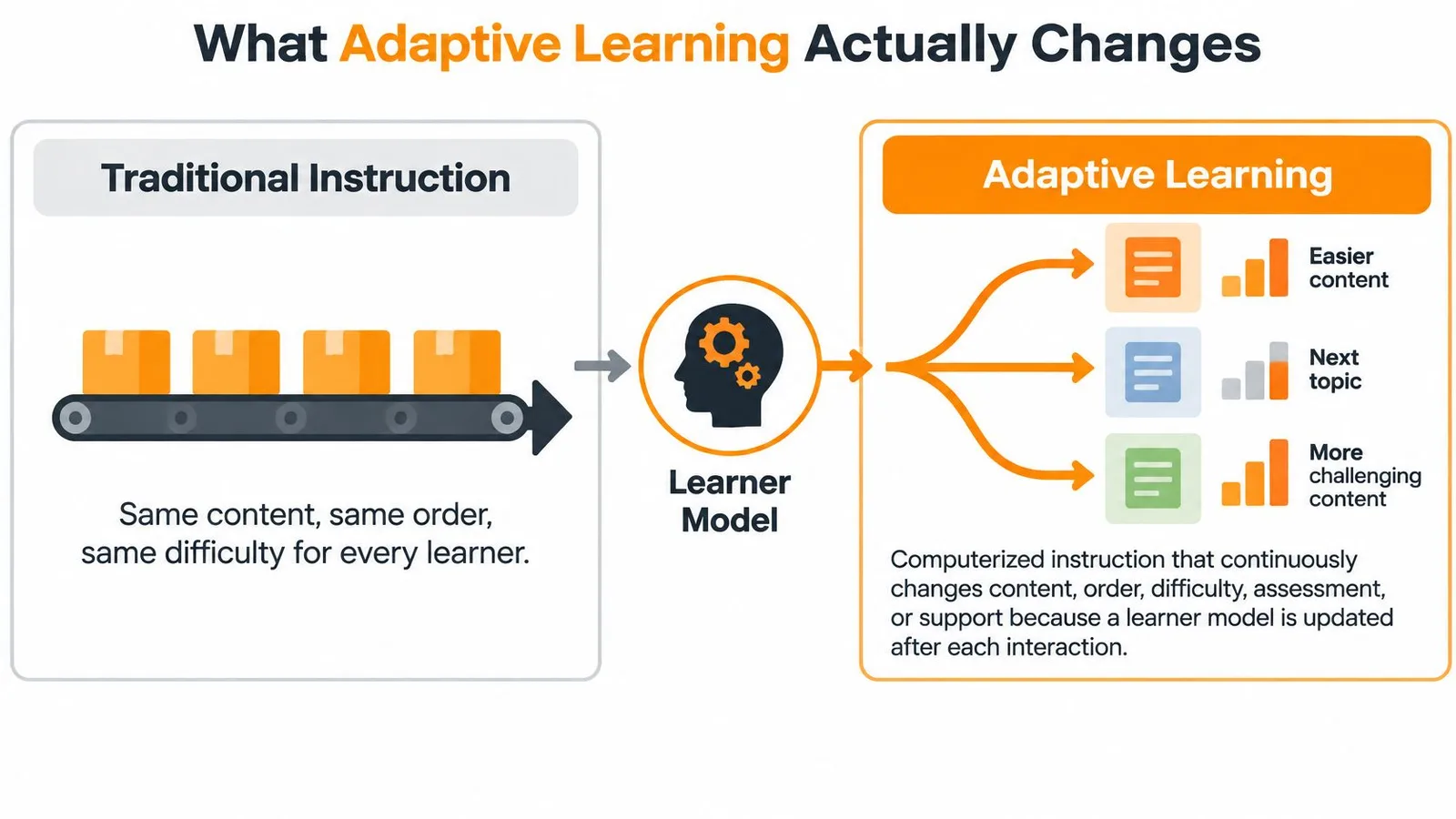
Adaptive learning is a computerized instructional approach that continuously modifies content, presentation, sequencing, assessment, or support using an evolving learner model. That's the definition a systematic literature review of adaptive learning works from, and the load-bearing word is evolving. The content changes because the system's estimate of your knowledge changed, not because a course designer wrote the branch months ago.
Three products get called adaptive, and only one of them earns it.
| Approach | What changes | What the system knows | Typical result |
|---|---|---|---|
| Fixed course | Nothing for the individual | A class plan, or nothing at all | Same lessons for every learner |
| Preference personalization | Topic filters and recommendations | Stated interests | More of what you already like |
| Adaptive learning | Path, difficulty, feedback, or support | Estimated mastery and misconceptions | A next task aimed at a specific gap |
The middle row is where most confusion lives. Showing you more astronomy because you tapped astronomy is a recommendation feed. It never asks whether you understand why stars fuse, and it never changes the explanation when you don't.
Practical rule: if the system can't tell you what you misunderstood, it isn't adapting to your learning. It's adapting to your clicks.
What feeds the model is unglamorous: responses, correctness, response time, confidence, prior achievement, and sometimes behavioral signals. None of that is a personality profile. Each is a noisy reading of whether a particular idea is in your head yet, which is why a single item should never settle the question.
The definition sharpens when you look at how intelligent tutoring systems rank their parts. Expert definitions put real-time cognitive diagnosis, also called student modeling, first, with adaptive remediation second. Diagnosis before action. That ordering is the whole discipline in two words.
Two concrete pictures help. An intelligent tutoring system watches a student work a problem step by step, sees the step where the method breaks, and changes the hint and the following problem. An adaptive practice platform reorders the next ten questions after each answer, so a cluster of misses on one idea pulls in an easier item and a contrast case instead of another round of the same thing.
The category has money behind it now. Mordor Intelligence values the adaptive learning market at USD 5.13 billion in 2025, which is exactly why the definition is worth keeping strict rather than letting every recommendation engine borrow the label. If you're comparing platforms, browse CBE-aligned digital learning options with that table open, and ask which row each product sits in.
Whether a tool deserves the name comes down to the loop. Four beats, repeated on every item, decide whether the next question aims at a gap or at your taste.
Curious? Try one 👇
Why is the sky blue?
Jump into the daily quiz →The Closed Loop Behind the Next Question
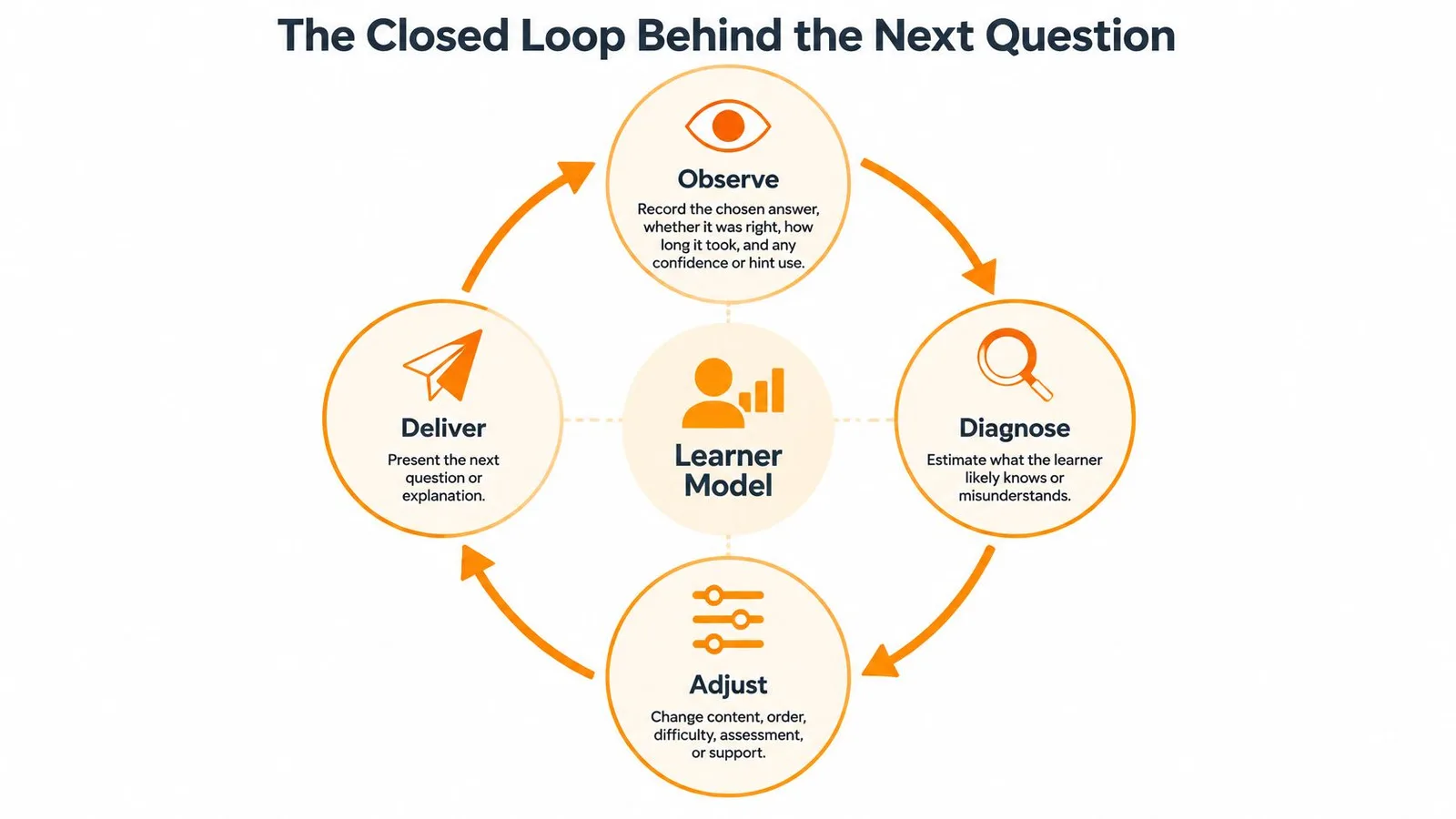
The engine is a feedback loop with four beats, and once you can name them, vendor claims become easy to grade. Watch what the system does between your answer and the next question.
- Observe the interaction. Record which option was chosen, whether it was right, how long it took, whether a hint was open, and any confidence rating. The chosen option carries more information than the verdict, because the verdict is one bit and the option is a fingerprint.
- Diagnose mastery or a specific misconception. A wrong answer to a known distractor points at a particular faulty model, not at carelessness. Random misses look different from systematic ones, and a decent engine treats them differently.
- Select the next move. An easier item, a worked contrast between two mechanisms, a sharper explanation, or a stretch question. Adaptation becomes visible when something about the treatment changes.
- Update the model after that next interaction. The estimate moves again. Without this step the system freezes, and one lucky guess becomes a permanent label.
What the model is not
A learner model is a running estimate, not a verdict about who you are. It holds a probability that you understand a given idea, plus guesses about which wrong idea you're holding instead. One item is weak evidence, and a good engine weights it accordingly until the pattern repeats.
Then there's the cold start. With no history, the system has nothing to diagnose, so it has to begin broad and tighten after the first handful of answers. An app that treats your opening question as a fixed verdict on your level will misjudge you for a week.
The speed trap
Fast and correct can mean two very different things. It can mean fluency, when an idea is automatic, or it can mean you recognized a surface cue and never touched the reasoning. Time alone shouldn't mark a concept learned, which is why follow-up items that strip the cue matter more than a fast streak.
Here's how it looks in miniature. You miss an item about why a coastal city has milder winters than an inland one at the same latitude. The next card doesn't repeat the question. It puts the ocean's heat capacity side by side with dry land's, then asks you to predict which place swings more between day and night. Answer a cluster of those correctly and difficulty climbs.
A loop you can trust leaves fingerprints. You should sometimes see why the next item appeared, whether that's a line of text or a pattern in what keeps coming back.
How Large the Learning Gains Actually Are
Adaptive learning can produce meaningful gains, but the comparison group changes what those gains mean. A 2024 meta-analysis of 45 independent studies of AI-enabled adaptive learning reported a medium-to-large positive effect on cognitive outcomes compared with non-adaptive interventions, Hedges g = 0.70. The effect varied with study and learner characteristics. The specific AI technique was not a significant moderator, so the algorithm's label alone is a poor guide to its value.
| Comparison | Effect (Hedges g) | What it means |
|---|---|---|
| AI adaptive vs non-adaptive instruction | 0.70 | Medium-to-large cognitive gain across 45 studies |
| Intelligent tutoring vs large-group teaching | 0.42 | Clear gain over whole-class instruction |
| Intelligent tutoring vs non-tutoring software | 0.57 | Gain over computer lessons that do not tutor |
| Intelligent tutoring vs textbooks or workbooks | 0.35 | Smaller but positive gain over static materials |
| Intelligent tutoring vs human tutoring or small groups | No clear advantage | A person or a small group can match the software |
These effects are measured in standard deviations. A result of 0.70 indicates a meaningful shift relative to the comparison group, not a transformation in every learner's understanding. Nor does it show that software replaces a teacher. The comparison with human tutoring and small-group teaching shows no clear advantage for intelligent tutoring.
To judge learning, look beyond the score right after a question. Compare the adaptive approach with a fixed baseline, then check delayed retention, transfer to a new context, whether misconceptions recur, and engagement. Immediate accuracy is the weakest measure on its own: a learner can answer correctly after seeing an explanation without having changed the underlying idea.
Retrieval practice helps explain why answering questions can strengthen memory more than rereading, especially when the effortful attempt is followed by correction. That's the principle behind the testing effect.
Ask four questions about any claimed gain: compared with what? Measured over how long? Tested immediately or later? And did the same misconception return?
How Micro-Learning Apps Run the Same Loop
A spare-moment app compresses the same four beats into about ten seconds, and the compression is the interesting part. You predict an answer before you know it. The system records the choice, the speed, and the follow-up. What comes next depends on that record, not on the category you browsed last week.
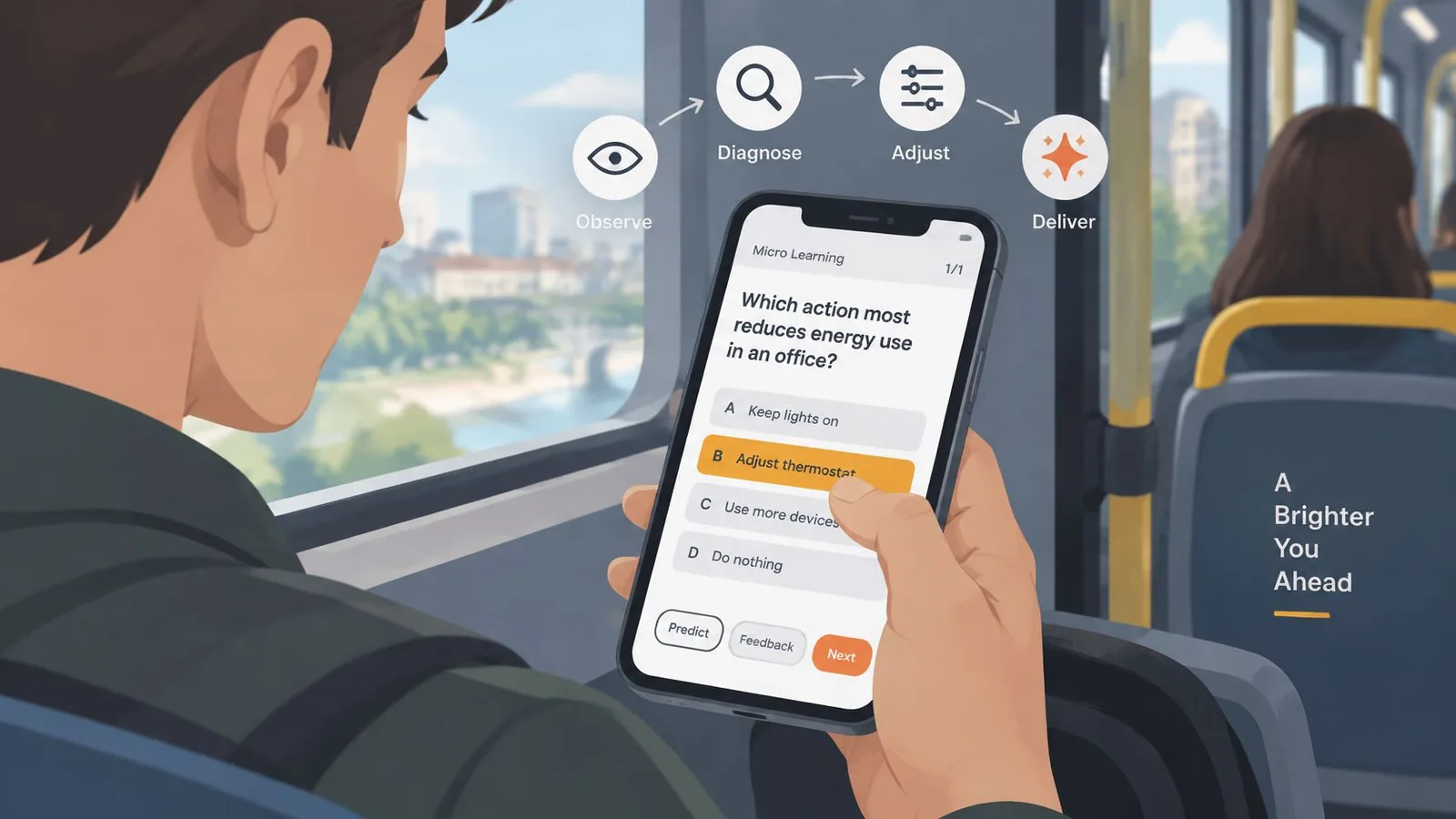
The format earns its place for three unglamorous reasons. A short why-question fits the gaps between other tasks, so practice happens in a queue rather than waiting for a free evening. Repeated predictions are retrieval practice, pulling an answer out of memory instead of rereading it. Every answer leaves a diagnostic mark, so a session produces evidence about your reasoning rather than a completion tick.
Wrong options are where the diagnosis lives. If three distractors each represent a different misconception, the one you chose tells the system something a right-or-wrong flag never could. Choose the option that confuses correlation with causation, and the next card can put the two side by side instead of marking you wrong.
Three ways the path changes
Difficulty. After several solid predictions, items get less obvious and the surface cues disappear. After a cluster of the same error, they get more contrastive, pairing the correct mechanism with the tempting one until the difference is sharp.
Explanation depth. Every option gets unpacked, including the wrong ones, so the reason a plausible alternative fails is stated rather than implied. Marking a letter correct and moving on gives the loop nothing to diagnose and you nothing to repair.
Persistence. A follow-up asked on the explanation screen becomes a later check that the correction stuck. That's the difference between finishing a card and changing an answer you'd give tomorrow.
A streak that counts daily opens measures habit. A path that changes because of an answer pattern measures learning. Both can coexist, but only one of them tells you anything about what's in someone's head.
Interest settings decide which fields appear in a feed, and that's a reasonable job for them. Answer patterns should decide the treatment inside a field. When the two get confused, you get a steady diet of your favorite subject with no increase in difficulty.
In each Million Whys session, the user makes a prediction and then explores why each answer choice makes sense or falls short, which keeps the diagnosis and the explanation attached to the same ten-second interaction. If you want a wider view of how short sessions compound, this piece on learning new things in small increments covers the habit side.
Who the Algorithm Can Misread
Averages hide the people a model handles badly. A 2025 systematic review covering 142 empirical studies of adaptive learning flags models trained on demographically narrow data that perform inequitably across learner populations, plus computational demands that disadvantage low-resource institutions. Other reviews keep finding thin real-world rollout, weak long-term assessment, and sparse coverage outside STEM.
The exclusion paths are concrete enough to walk through.
- Language and curriculum mismatch. A model trained mostly on one country's curriculum reads a perfectly reasonable answer as a misconception, then "remediates" knowledge the learner already had.
- Opaque sequencing. If no reason is given for the next item, a learner who suspects the path is wrong has nothing to challenge. The recommendation stands because it's unexamined.
- Diagnostic data becoming a profile. Answers collected to estimate mastery can drift into behavioral profiling when privacy controls are missing or vague.
- A heavy app on a weak connection. The adapted path exists only for people with good devices and reliable bandwidth, which narrows who benefits.
Unequal infrastructure and narrow training data can widen the very gaps a product claims to close, and the risk grows with confidence rather than shrinking.
Four checks cover most of it. Whose data trained this thing? Can you see why each item appeared? Can you override it or take a different route? Does it work on a modest phone and a weak signal?
Transparent reasons, privacy controls, low-bandwidth access, human review, and real user agency belong in the design, not in the marketing appendix. For a broader look at where these systems stumble, see how AI is used for learning and what it still gets wrong.
When Adaptation Works and How to Test It
Reviews report positive outcomes, but they don't report uniform ones. One recent meta-analysis of adaptive learning research found very high heterogeneity across studies (I² = 82.98%), with evidence concentrated in short- and medium-term interventions. That variance matters more than the headline. An average gain can hide tools that teach and tools that mostly speed up completion.
The variation traces to study quality, intervention length, subject area, learner characteristics, geography, teacher involvement, and how the thing was integrated into a classroom. A tool that works in a six-week optics unit with a teacher nearby is not automatically a tool that works alone for a year.
The conditions a loop needs
- Knowledge split into checkable pieces. If one item tests four ideas at once, a miss tells the model nothing about which one failed.
- Wrong answers mapped to distinct misconceptions. Distractors have to be built from how people get the idea wrong, not filled in to reach four options.
- Enough interactions to update on. One answer is one data point. Adaptation needs a sequence before it can say anything about you.
- Feedback that explains why. The reason an idea works, and the reason the attractive alternative doesn't, is the repair mechanism.
- A later item that applies the idea in a new context. Transfer gets tested here, and a confident guess goes to die.
Personalization is not automatically better learning. That sentence is the whole argument, and it cuts against the most common claim in this category.
Three signs it's optimizing clicks
Watch for these, because each one looks like progress on a dashboard.
- Speed or streaks rise while the same error returns next week. Fluency on a familiar card isn't understanding, and the returning error is the honest signal.
- Immediate accuracy climbs while transfer stays flat. If you can pick the right option and can't use the idea anywhere else, the loop tuned recognition.
- Every personalized interaction is counted as learning. Recommendations you followed, cards you opened, minutes you spent. None of those is evidence that a misconception changed.
A one-session test you can run
Before committing to a month of anything, spend one session checking the machinery.
Answer once without looking. Give the system a real signal instead of a hinted one, and note what you weren't sure about.
Miss something on purpose and watch the next move. Did the following item or explanation change because of that miss, or because of a topic you follow? If you can't tell, that's information too.
Read the reasons the other options fail. If only the correct letter gets marked, the loop is thin. Explanations for distractors are what turn a wrong answer into a repair.
The next day, explain the idea with a new example and no card. If you can't, the session optimized a click. Delayed recall with a fresh case is the cheapest transfer test that exists.
Override a recommendation you distrust. Pick something the app didn't suggest. A system that lets you step outside the path and then adjusts to what you did is one worth staying with.
Pass means the path reacted to your reasoning and the idea survived without the card. Fail means it tracked your interests and called it teaching. The personalization features we build, including topic preferences in your Profile that shape which questions and exploration paths you see, only matter if the answer pattern inside a topic does the harder work of deciding what comes next.
A curiosity-first format has to clear a higher bar than a course, because nobody is being graded. Every why-question has to survive its own explanation, and the follow-up has to show whether the correction held. That's the whole test, applied one question at a time.
Million Whys turns curiosity into a daily practice of ten-second why-questions across science, nature, engineering, history, and psychology, with an explanation attached to every answer choice so wrong options get diagnosed instead of just marked. Each session asks you to predict first and then explore why each choice holds up or falls short, and your answers shape what comes next. Visit Million Whys and try one question today, then check the next day whether the idea still holds without the card.
Curious? Try one 👇
Why is the sky blue?
Jump into the daily quiz →Keep Exploring
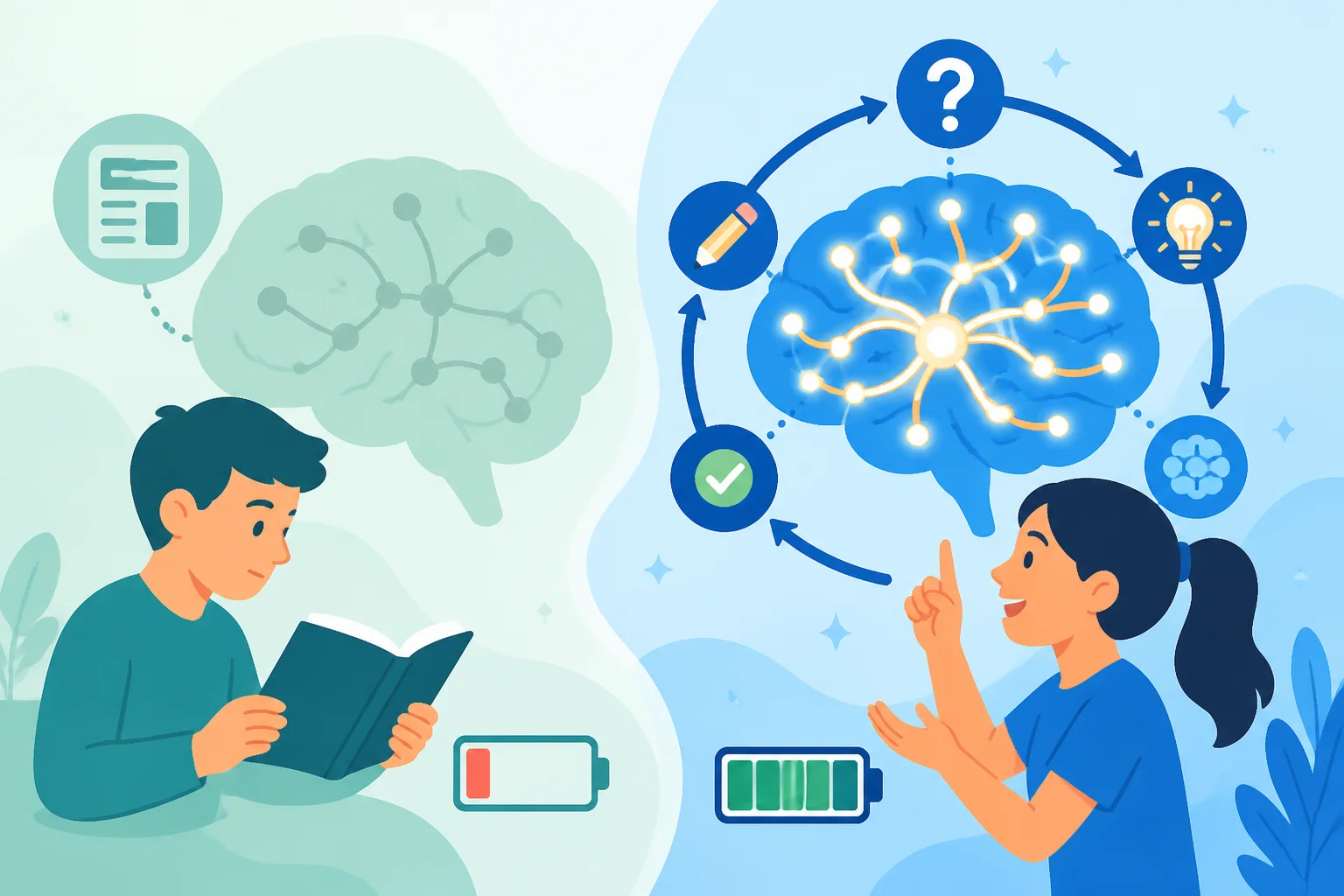
How does a question-based learning loop actually change what your brain does compared with reading a short summary?
Psychology & Behavior
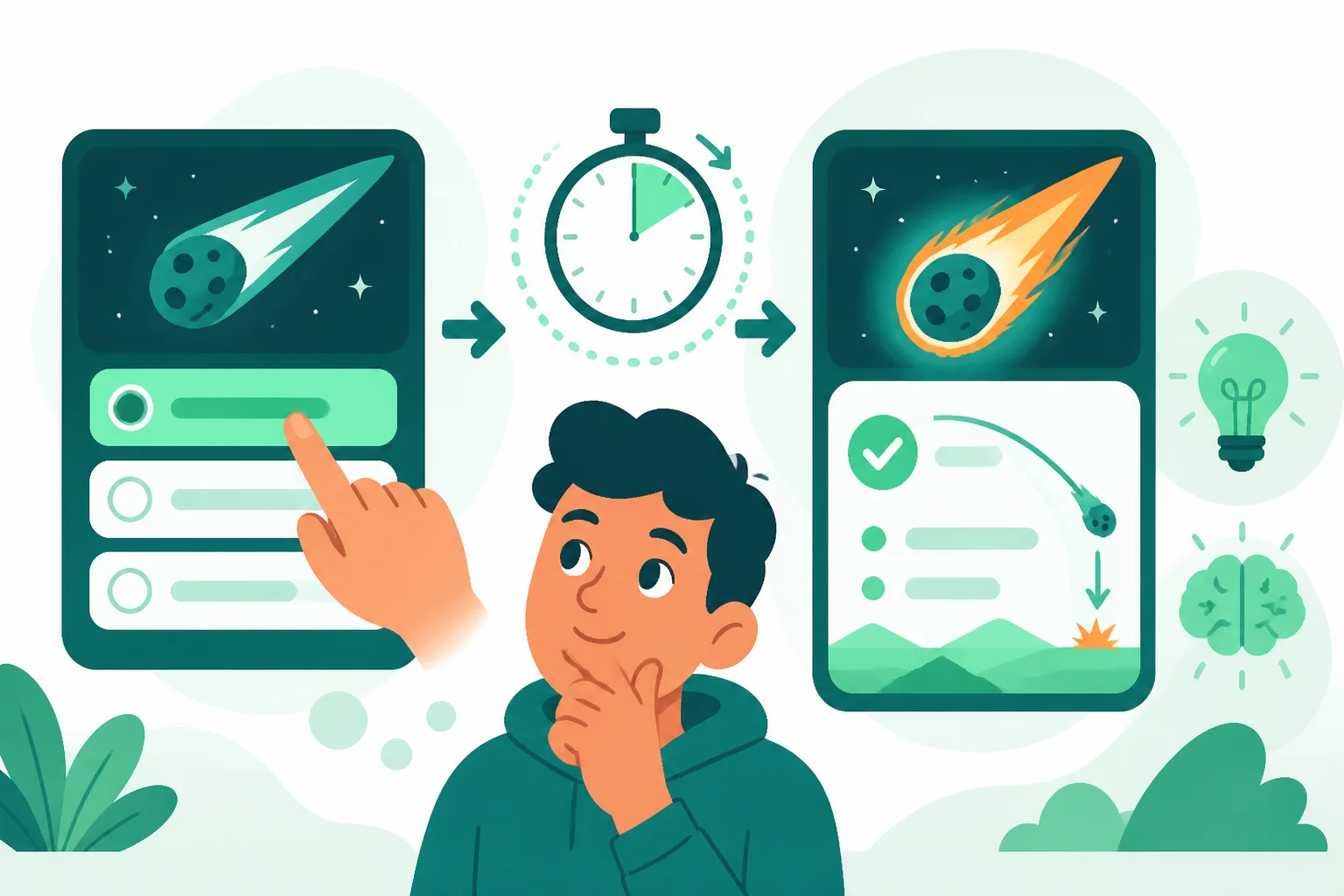
Why might a roughly 10-second learning loop ask you to choose an answer before revealing an explanation, instead of simply presenting an idea?
Psychology & Behavior
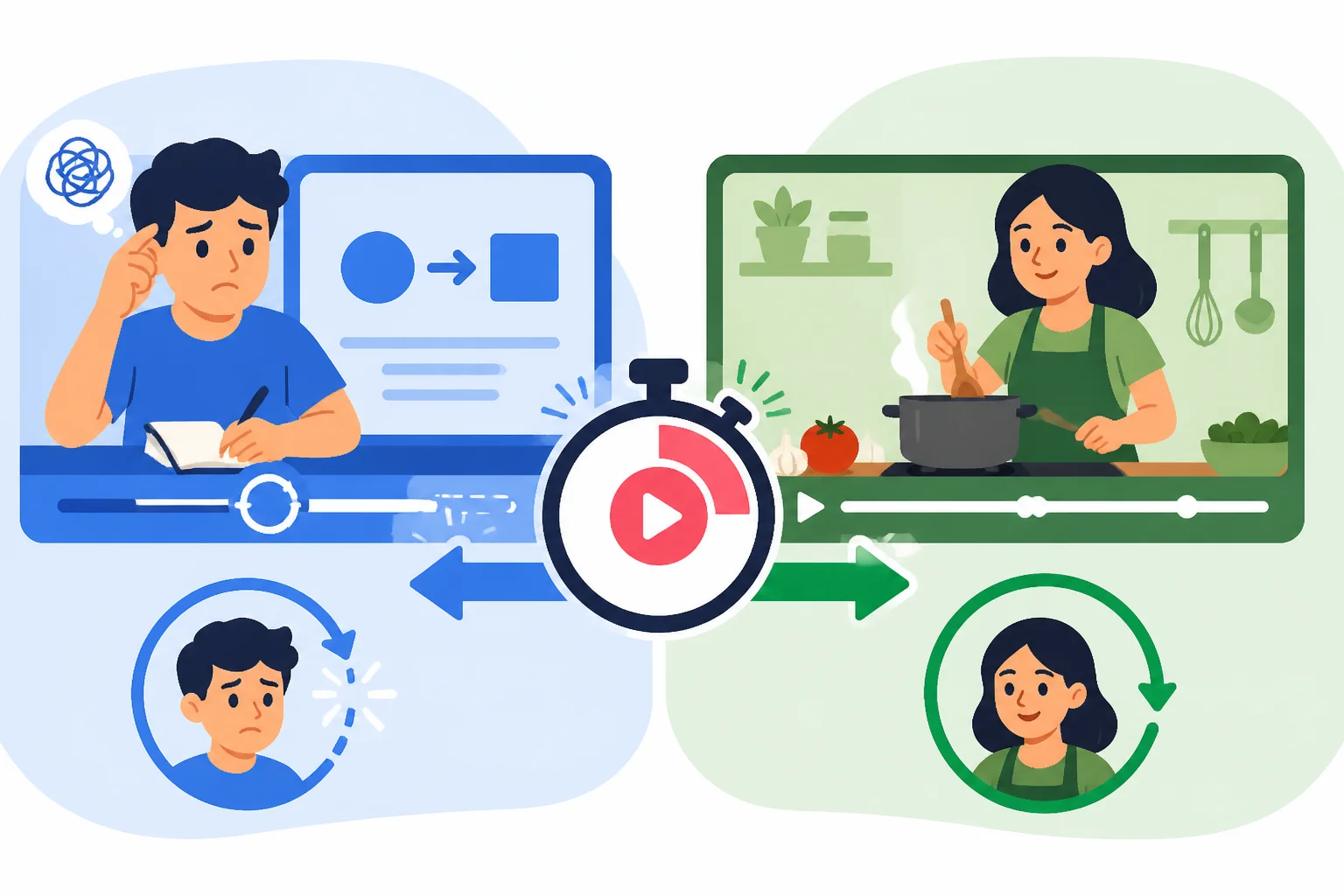
Why does a 5-second ad break hurt a 10-second learning loop more than the same ad in a recipe video?
Psychology & Behavior
Related Posts
AI for Learning Works When Curiosity Leads
AI for learning works when curiosity leads: use AI to expose gaps, close them with real explanations, and turn each answer into a better why, not a shortcut.
Learning Anything Starts With Tiny Questions
Learning anything works better when the unit is a tiny question: curiosity opens the gap, real answers close it, and knowledge compounds over time.
Learning New Things Every Day: A Practical Guide
Practical strategies for learning new things every day, from micro-learning and spaced practice to habit routines and tools that actually stick