

Learning New Things Every Day: A Practical Guide
On this page· 20
You're waiting for a meeting to start, phone in hand, with just enough time to wonder about something but not enough time to start anything. A question catches your eye. You guess the answer, discover why you were wrong, and then someone joins the call. That tiny exchange can count as learning new things, provided you do more than glance at an interesting fact.
Why 10 Seconds Is the Real Unit of Modern Learning
The meeting ends, and your question disappears beneath messages, errands, and whatever needs doing next. By evening, the course you meant to start feels like another obligation. You're still curious. You just don't have an empty evening waiting to be filled.
Advice about learning often starts with protecting a study block. That's sensible for an exam or a demanding skill, but it's a poor entry requirement for everyday curiosity. A parent waiting outside a bedroom, a commuter at a bus stop, and a worker between calls need something they can begin and leave without preparation.
Start with the time you actually have
Time pressure isn't a discipline problem. Among adults who participate in or want to participate in adult learning, 48% identify work or family time constraints as their main barrier, compared with 14% citing suitable opportunities and 13% citing cost, according to the OECD's analysis of barriers to adult learning.
Treat 10 seconds as a design constraint, not a scientifically established ideal duration. Can you encounter a useful question, commit to an answer, and begin understanding the explanation within that opening? Sometimes you'll need longer, and that's fine.
A tiny learning moment should leave you with something more useful than the feeling that you've consumed content.
That distinction changes what you choose. A surprising headline might entertain you. A focused question can expose something you don't understand.
For a short interaction, look for:
- A bounded question: Something narrower than “understand economics.”
- A meaningful distinction: An explanation that separates plausible answers.
- An easy stopping point: Enough closure to leave, with an optional route back.
You don't need to pretend fragmented attention is ideal for everything. Complex work still deserves protected time. But casual learning shouldn't depend on winning a scheduling battle before you're allowed to begin.
Question 1 of 3
According to OECD surveys, what is the main reason adults who want to learn give for not taking part in adult learning?
The Science Behind Learning in Small Bursts
A short session isn't automatically effective. You can skim a paragraph without thinking, just as you can sit through a long lecture without understanding it. What you do during the session matters more than calling it micro-learning.
The strongest foundation here is retrieval practice, trying to produce an answer before checking it. A systematic review of classroom retrieval practice examined 49 effect sizes involving 5,374 participants and found that 57% of experiments showed medium or large benefits compared with conventional conditions such as restudying, although only 6% were conducted in non-WEIRD countries.
Pull an answer out, then examine it
Suppose you've just learned a coworker's name. Reading it again and trying to say it without looking are different tasks. The latter reveals whether you can retrieve it.
The review found benefits across different retrieval formats and delayed assessments. That supports asking questions and returning to them later. It does not establish that any particular tiny session beats a thoughtful longer one.
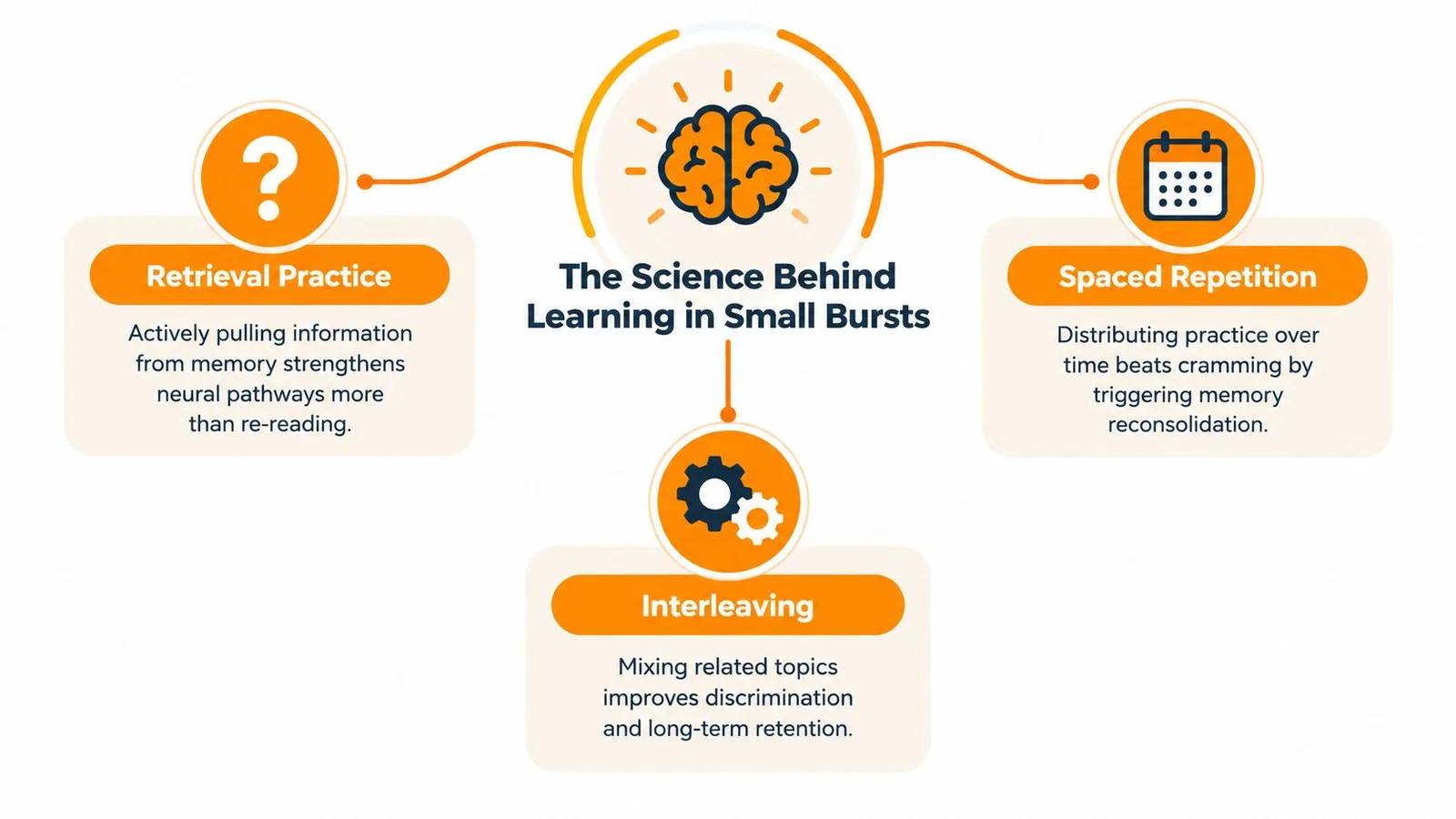
Use the diagram as a planning map, not as proof that every mechanism named in it has been established by the review. For a practical routine:
- Retrieve: Answer before revealing.
- Space your returns: Revisit an earlier question on another day rather than only repeating it immediately.
- Explain and distinguish: Say why your answer fits and why a nearby alternative doesn't. Mixing related questions gives you opportunities to make those distinctions.
These are useful design choices, but the evidence discussed here is specifically strongest for retrieval practice. Don't turn a sensible routine into an unsupported promise about memory.
Ordinary learning deserves thoughtful design
This isn't an activity reserved for dedicated students. The OECD's account of where and how adults learn reports that approximately 40% of adults across participating countries undertake formal or non-formal learning in a typical year.
The opportunity is to make an ordinary encounter with information more active. A question, an attempted answer, and useful feedback make a credible learning event, even when they don't resemble a lesson.
Question 2 of 3
Why does self-quizzing help you remember better than re-reading notes?
Five Micro-Learning Techniques That Actually Work
You don't need a different app for every technique. A saved article, a question card, or a note on your phone can support each approach. Choose the one that matches the kind of confusion in front of you.

When you have a guess
Prediction-then-explain is the simplest place to start. At breakfast, a parent reads a question about an unfamiliar word and chooses its likely meaning before opening the explanation. The important part is committing, not merely thinking that every option sounds possible.
Use this when you're tempted to reveal the answer immediately. For more on the distinction between checking knowledge and practicing it, explore this guide to the testing effect. After checking, name what your prediction overlooked.
Misconception flipping starts with a tempting explanation rather than a blank question. On the bus, a student considers whether recognizing an answer is enough to demonstrate understanding. They compare that belief with a stricter test: explaining the answer without the choices visible.
This fits moments when you feel confident but can't explain your confidence. Ask which part of the wrong answer made it attractive.
When a topic feels too large
Between meetings, a professional reading a project update can use one-cause-one-effect. Instead of trying to understand every delay, they ask which dependency prevented the next task from starting. The exercise is to describe a bounded causal connection, then check whether the evidence supports it.
Two other techniques help you extend that small explanation:
- Cross-domain linking: Connect the unfamiliar idea to something you know. You might compare a project dependency to a recipe step that must happen before the next can begin. Then identify where the analogy stops working.
- Follow-up rabbit holes: Save the question the explanation creates. After learning what a term means, ask how someone would recognize an example, or what evidence would contradict the explanation.
A useful rabbit hole has a direction. Opening unrelated tabs isn't the same as pursuing a question.
You can mix these approaches without building a formal study sequence. Predict when you have an intuition, examine misconceptions when you're overconfident, and narrow the scope when you feel lost. If an interaction needs more time than you have, save the unresolved question rather than rushing yourself into a false sense of understanding.
Building a Daily Learning Habit That Survives Real Life
Choose an existing event, not an aspirational version of your day. “After I pour my morning coffee” is more concrete than “when I have time.” If mornings are unpredictable, use closing your work laptop or arriving at a regular bus stop.
The routine can be anchor, prompt, reflect. The anchor tells you when to begin, the prompt gives you something specific to consider, and the reflection tells you whether the encounter was worth keeping.
Make the next action obvious
Use Apple Notes, Google Keep, or a paper card to hold your next question. Keep the answer out of immediate view. If you prefer notifications, make the reminder name the action, such as “Open the saved question,” rather than deliver a vague demand to improve yourself.
For help making the cue feel manageable rather than punitive, Pretty Progress offers daily motivation tips that stick. Use such advice to simplify the routine, not to assemble an elaborate reminder system.
A workable setup might look like this:
- Anchor: Put the question beside something you already use.
- Prompt: Open a ready-made question rather than searching for a topic.
- Reflect: Note what surprised you, what remains uncertain, or where you could use the idea.
Reflection doesn't need its own journal. A phrase beneath the question is enough: “I confused the definition with an example.”
Plan for the missed day
A streak can be enjoyable, but I'd treat it as decoration rather than the purpose of the habit. This account of a 777-day Duolingo streak offers a relevant starting point for thinking about sustained app use and what you want from it.
Recovery rule: After a missed day, answer the next available question. Don't assign yourself a backlog.
If the routine repeatedly fails, change the setup before blaming yourself. Move the cue, reduce the preparation, or choose a format you can leave unfinished. Avoid attaching learning to driving or another activity that needs your attention.
A durable habit needs a modest version for difficult days. Your minimum can be opening yesterday's question and noticing what you still remember.
Choosing Tools and Formats That Fit Your 10 Seconds
Start with the task, not the app store. Do you need a ready-made question, an explanation you can inspect, or somewhere to collect unfinished thoughts? Those are different jobs.
The comparison below is a selection guide, not a measured ranking. Features vary, so check the particular product or resource before committing.
Comparing Daily Learning Formats
| Format | Fits 10-second window | Tests you before revealing | Explains wrong answers | Topic breadth | Effort to maintain |
|---|---|---|---|---|---|
| Micro-learning apps | Often, with short cards | Depends on design | Look for option-level feedback | Catalog-dependent | Low with ready-made prompts |
| Podcasts | Better for resuming than completing | Only if prompts are included | Episode-dependent | Broad across shows | Requires a listening queue |
| Video explainers | A short segment can fit | Usually needs your own pause | Creator-dependent | Broad across channels | Requires selection and stopping |
| Books and long-form articles | Useful for a saved passage | Usually self-directed | Depends on the text | Broad | Requires bookmarks or notes |
| Structured courses | Usually needs a longer slot | Often includes exercises | Course-dependent | Course-specific | Requires continuity |
| AI chat assistants | A brief exchange can fit | Can be requested | Can be requested, but verify it | Broad | Requires prompting and checking |
For a starting point, choose a question-based format that makes you answer before revealing the explanation. That recommendation follows from the retrieval evidence, not from a claim that apps universally outperform books or audio.
If you're comparing products, use this guide to microlearning apps for work as a shortlist to investigate. Evaluate the actual experience rather than relying on the label “microlearning.”
Check the explanation, not just the interface
Try a sample question and inspect what happens after a wrong answer:
- Reasoning: Does it explain why the alternative seemed plausible?
- Traceability: Can you inspect support for claims that matter?
- Control: Can you revisit, stop, or save a follow-up without losing your place?
AI chat assistants can provide questions on request, but a polished explanation isn't verification. Ask for supporting material and check that it supports the answer, particularly for consequential topics.
Keep the format you already enjoy if you can make it active. Pause a podcast to predict the explanation, close a book to summarize a passage, or write a question beside an article. You don't have to replace a reading habit with an app to learn deliberately.
What to Actually Judge Your Learning By
Finishing a card proves that you finished a card. It doesn't establish that you understood it, can use it, or know when the explanation might fail. Points and certificates can record participation without answering those questions.
That gap deserves attention. The AI-literacy research discussed in a systematic review includes classroom findings in which 25% of students retained a rudimentary view of AI after instruction, while about one-third held only partially correct views. That isn't evidence against short sessions specifically, but it is a warning against equating instruction with understanding.
Look for a change you can describe
Better progress checks ask what happened to your thinking:
- Changed action: Would you approach a relevant task or question differently?
- Corrected belief: Can you name an assumption you revised?
- Useful uncertainty: Can you identify what you still need to check?
You might finish a learning interaction less certain than you began. If you've discovered that an explanation depends on conditions you hadn't considered, that can be progress rather than failure.
Understanding includes knowing where your explanation stops.
Novelty alone isn't enough. A fact can be memorable while its explanation remains oversimplified, so ask what evidence supports it and what would make you reconsider it. You don't need to investigate every casual question exhaustively, but confidence should match the quality of the support.
Short isn't the same as shallow
A brief question can introduce a distinction worth exploring. Depth requires something further: comparing explanations, examining evidence, applying ideas, and receiving feedback. Don't ask the introductory card to do all of that work.
Judge the small encounter by whether it creates a sound starting point. Judge deeper learning by what you can explain and do afterward, not by how long you kept a screen open.
Question 3 of 3
What most likely explains why students finish a lesson about AI and still give only a vague or partly wrong account of how it works?
Your Week of Tiny Learnings and Common Questions
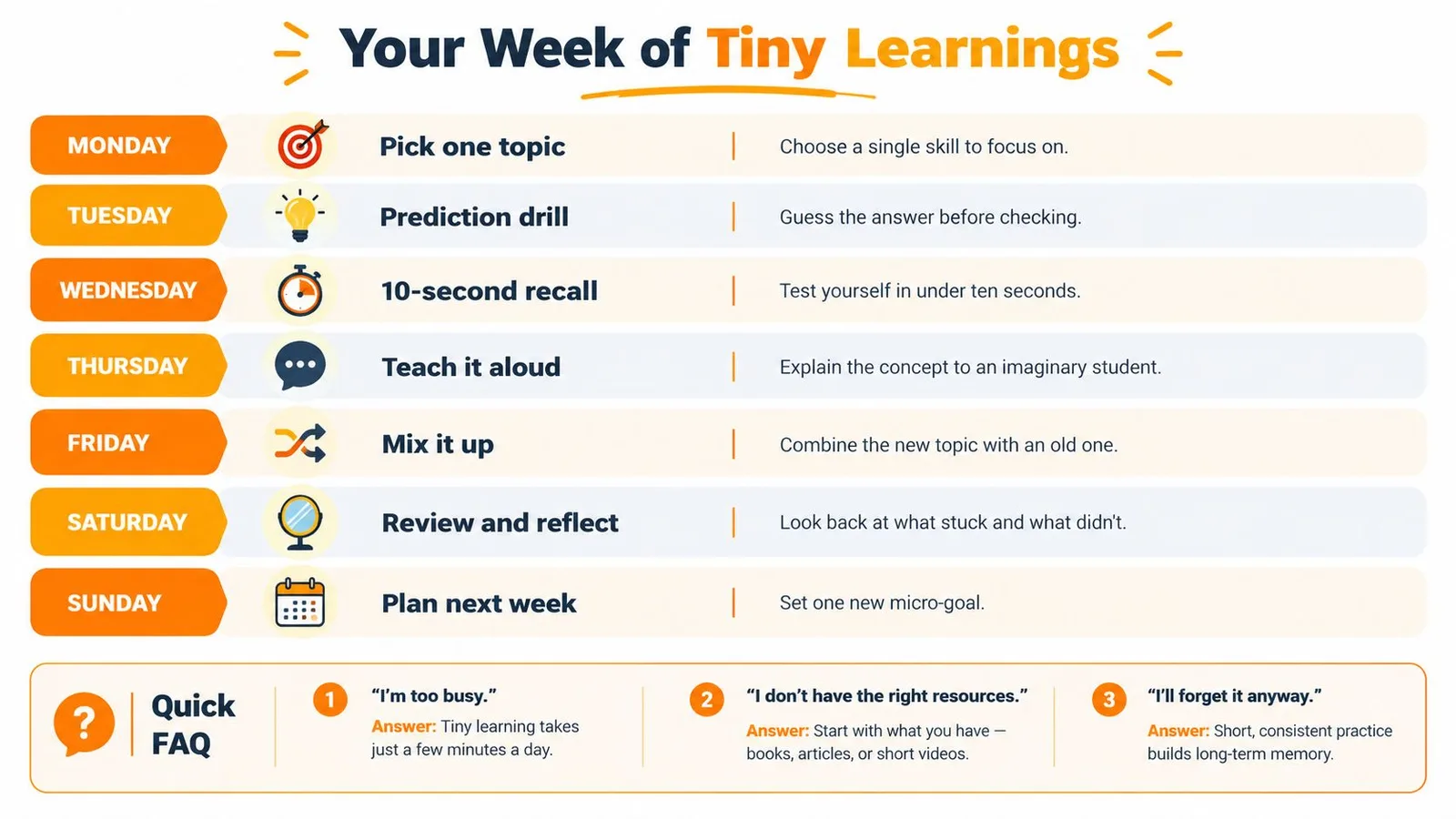
Try this as a proposed weekly experiment, not a scientifically prescribed schedule: a daily 10-second question, an optional five-minute follow-up, and a 30-second reflection. Keep one topic nearby so your questions have somewhere to accumulate.
A simple weekly experiment
- Monday: Choose a topic and write what you want to understand.
- Tuesday: Predict an answer before checking.
- Wednesday: Recall an earlier explanation without looking.
- Thursday: Explain the idea aloud in plain language.
- Friday: Compare it with a related idea and name a difference.
- Saturday: Revisit an answer you got wrong.
- Sunday: Choose a follow-up question for the coming week.
Common questions
Can this build deep expertise?
It can support a beginning and continued practice. Expertise also requires sustained work, application, and feedback beyond quick questions.
How do I stop forgetting?
Return to earlier prompts and attempt them before checking. Let mistakes identify what needs another visit.
What if I run out of curiosity?
Borrow a question from an ordinary encounter: an unfamiliar word, a confusing instruction, or something someone couldn't explain.
How can I involve kids or a partner?
Invite a guess and discuss the reasoning without keeping score. Let them decline or choose the next question.
You don't need an ambitious syllabus tomorrow. Choose a cue, prepare a question, and leave yourself somewhere to record what changed.
Igneous AI, LLC develops Million Whys, a platform offering daily 10-second why-questions with explanations for every answer choice and optional follow-up exploration. Visit Igneous AI, LLC to try a question, make your prediction before revealing the answer, and save whatever you want to understand next.
Keep Exploring
Why does a long daily streak in a learning app not prove you are actually learning anything?
Psychology & Behavior
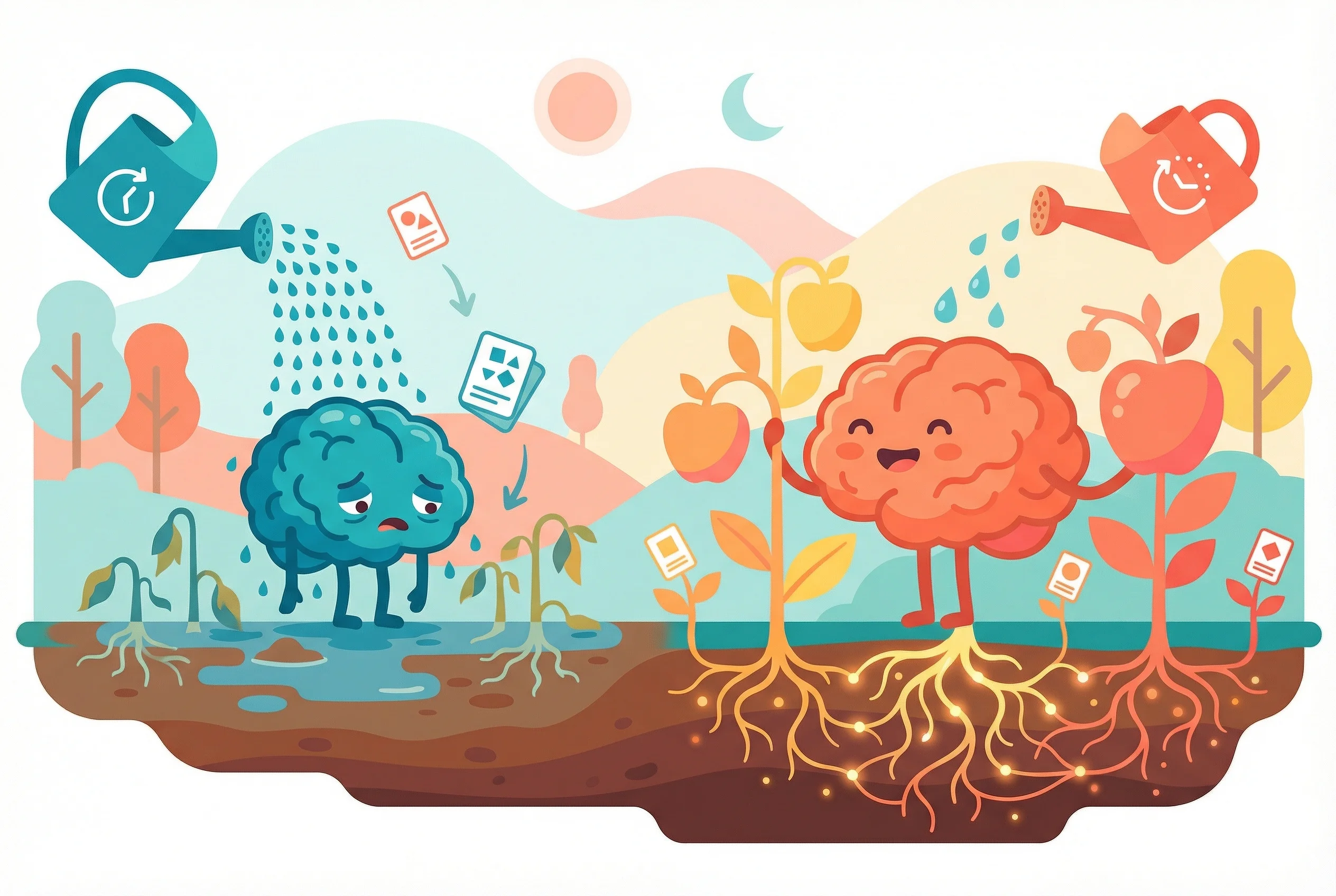
Why does reviewing flashcards every few days work better than daily practice?
Psychology & Behavior
Why do daily learning apps feel so different to use, even when they cover the same subjects?
Technology
Related Posts
Best App to Learn Something New Every Day
Best app to learn something new every day, compared by daily habit fit: Million Whys, Imprint, Kinnu, Blinkist, DailyArt, Brilliant, and why each works.
Daily Quiz Apps in 2026: Why 5 Questions a Day Beats Cramming
Wordle, Bing's homepage quiz, QuizStreak, Quizl, Duolingo and MillionWhys — what daily quiz apps get right about memory, and which habit is worth keeping.
Learning Anything Starts With Tiny Questions
Learning anything works better when the unit is a tiny question: curiosity opens the gap, real answers close it, and knowledge compounds over time.