Daily Quiz Apps in 2026: Why 5 Questions a Day Beats Cramming
On this page· 23
Updated August 2026
Wordle proved that a tiny daily question can become a shared ritual. But a ritual and a memory tool are not automatically the same thing. The useful question is not which daily quiz app can preserve the longest streak; it is which one gives you the payoff you actually came for: a puzzle solved, a fact understood, a skill rehearsed, or a small information gap properly closed.
TL;DR
The best daily quiz apps do one job clearly. Wordle is a shared word puzzle, Bing folds quizzes into its homepage and Rewards ecosystem, QuizStreak gives one hard question with clues, Quizl offers five general-trivia questions, Duolingo builds structured skills, and MillionWhys turns general curiosity into short questions with explanations. A daily schedule can make practice easier to return to, but it becomes spaced repetition only when material reappears over time; a streak alone measures attendance, not understanding.
The short answer
Choose Wordle for a finite social puzzle, QuizStreak for one demanding trivia prompt, Quizl for a quick five-question score, Bing if Microsoft Rewards already fits your routine, and Duolingo for sequenced language, math, music, or chess practice. Choose MillionWhys Daily when you want general-knowledge questions whose answers explain the mechanism instead of merely revealing a score. None is universally best because they train different things.
How we picked these daily quiz apps
We used four criteria. First, completion: can a normal session end cleanly, or does the app keep manufacturing unfinished business? Second, answer quality: does it explain why an answer is right? Third, return value: does tomorrow's visit deepen anything, or merely reset the counter? Fourth, fit: is the product honest about whether it is a puzzle, rewards program, structured course, or curiosity feed?
That last distinction matters. A crossword can be excellent without teaching general knowledge systematically. A language path can be excellent without answering the strange body question that appeared while you waited for coffee. We prefer tools that do their own job well over apps that promise a vague upgrade to your brain.

Photo: Wikimedia Commons, CC BY 2.0.
Why daily can help memory — and why daily is not enough
Two effects are often collapsed into one. Retrieval practice means trying to bring an answer to mind. In Roediger and Karpicke's 2006 experiments, taking recall tests improved delayed retention more than repeatedly reading the same prose, even without feedback (Psychological Science). A quiz can create that retrieval attempt; merely scrolling past a fact cannot.
Spacing means distributing encounters across time. A meta-analysis covering 839 assessments found that distributed practice generally beat massed practice for long-term retention, with the useful gap depending partly on how long the learner needed to remember the material (Cepeda et al., 2006). Opening an app every day distributes sessions. It does not automatically space the same knowledge. If every question is new and never returns, you have a daily ritual, not spaced repetition.
Feedback is the third piece. In a 2005 word-pair experiment, showing the correct answer after an error improved later retention (Pashler, Cepeda, Wixted, and Rohrer). That does not mean every explanation produces durable understanding. It means the moment after a wrong guess is valuable: the gap is visible, attention is awake, and a clear correction can close it. A useful daily quiz makes that moment count.
Question 1 of 3
Why does answering a quiz question usually improve delayed recall more than rereading the same prose?
The daily quiz landscape in 2026
Wordle — best for a shared, finite ritual
Wordle gives everyone the same word puzzle and then ends. That scarcity makes scores easy to compare and keeps the session small. It exercises word search and pattern constraint, but it does not explain a body mechanism or build a broad curriculum. Play it when the puzzle itself is the payoff (official Wordle page).
Bing homepage quiz and Microsoft Rewards — best for existing Rewards users
Bing attaches a quiz to its changing homepage image, with links for learning more about the subject. Microsoft Rewards separately offers daily quizzes and trivia on a personalized dashboard; points and availability can vary by market. This is a sensible extra if you already use Bing, not a reason by itself to reorganize your curiosity around a rewards account (Microsoft Support; Microsoft Rewards).
QuizStreak — best for one hard question with a clue ladder
QuizStreak's official rules are unusually specific: one daily question, three optional clues that become progressively easier, streaks, a comparative QScore, and league play. The clue ladder makes the information gap adjustable instead of immediately giving the answer. It is a good fit if one stubborn question is more satisfying than a rapid set (QuizStreak).
Quizl — best for a quick five-question trivia score
Quizl currently serves five multiple-choice general-trivia questions for each date. It reveals which choices are correct and tracks the result; it does not attach a mechanism explanation to each answer. The live site is ad-supported, so treat it as a compact web quiz rather than an ad-free minimalist tool (Quizl).
Duolingo — best for structured skills
Duolingo is no longer languages only. Its current course picker includes language courses plus Math, Music, and Chess, and the core course content is free; Super removes ads and adds practice conveniences, while Max adds AI-powered features. Its strength is sequence: a designed path revisits component skills. That is useful when a subject has a clear progression, but it is different from roaming across whatever question catches your attention today (Duolingo's course guide; free and subscription model).
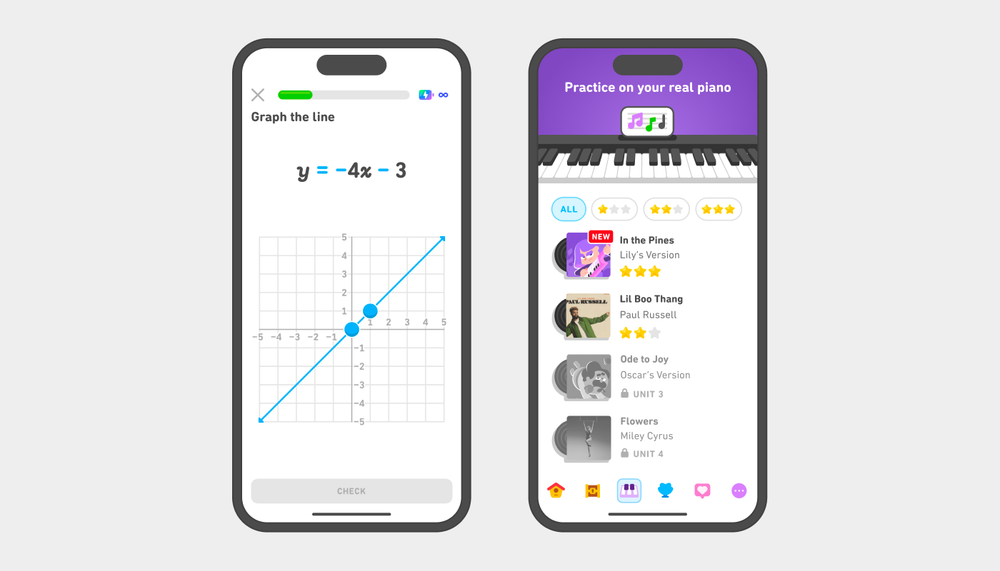
Image: Duolingo's official 2025 product highlights.
MillionWhys Daily — best for mechanism-first general curiosity
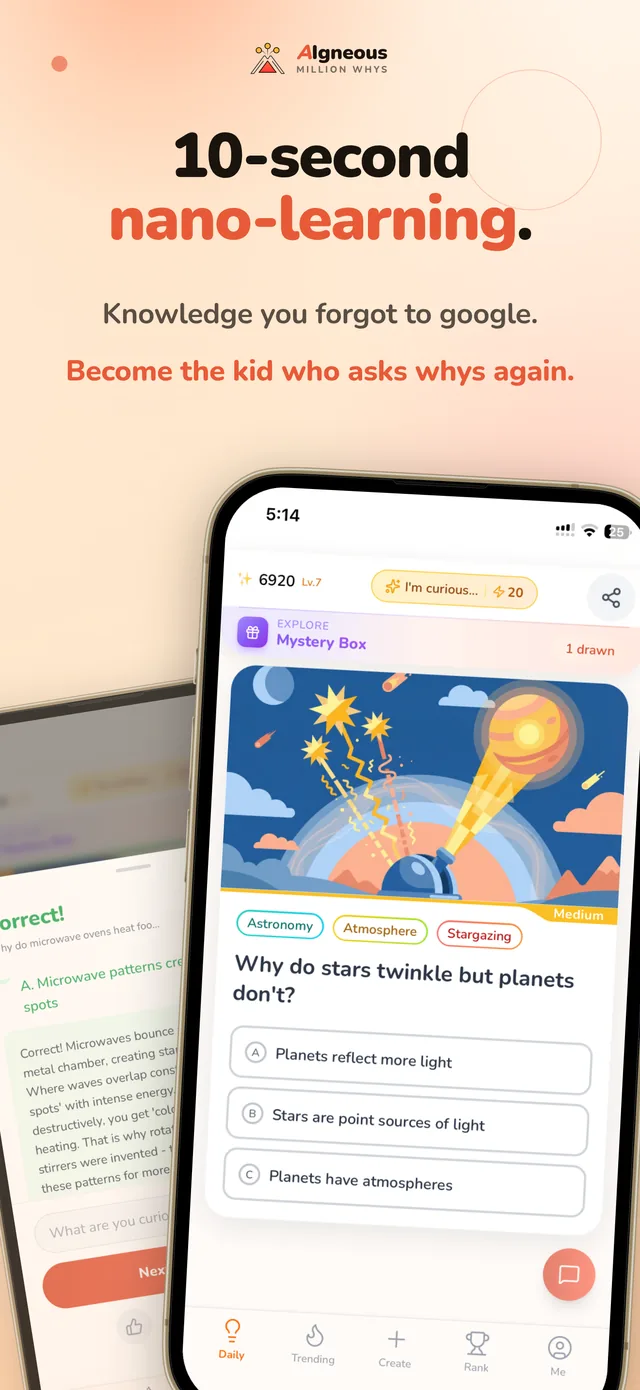
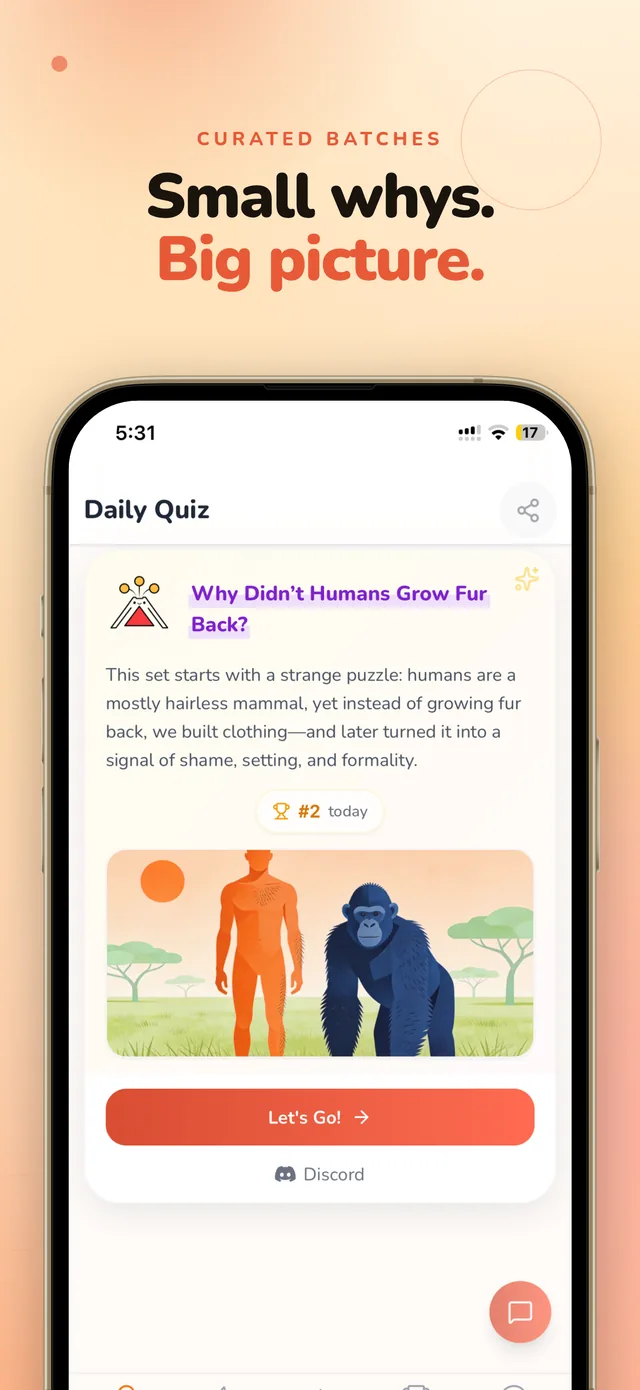
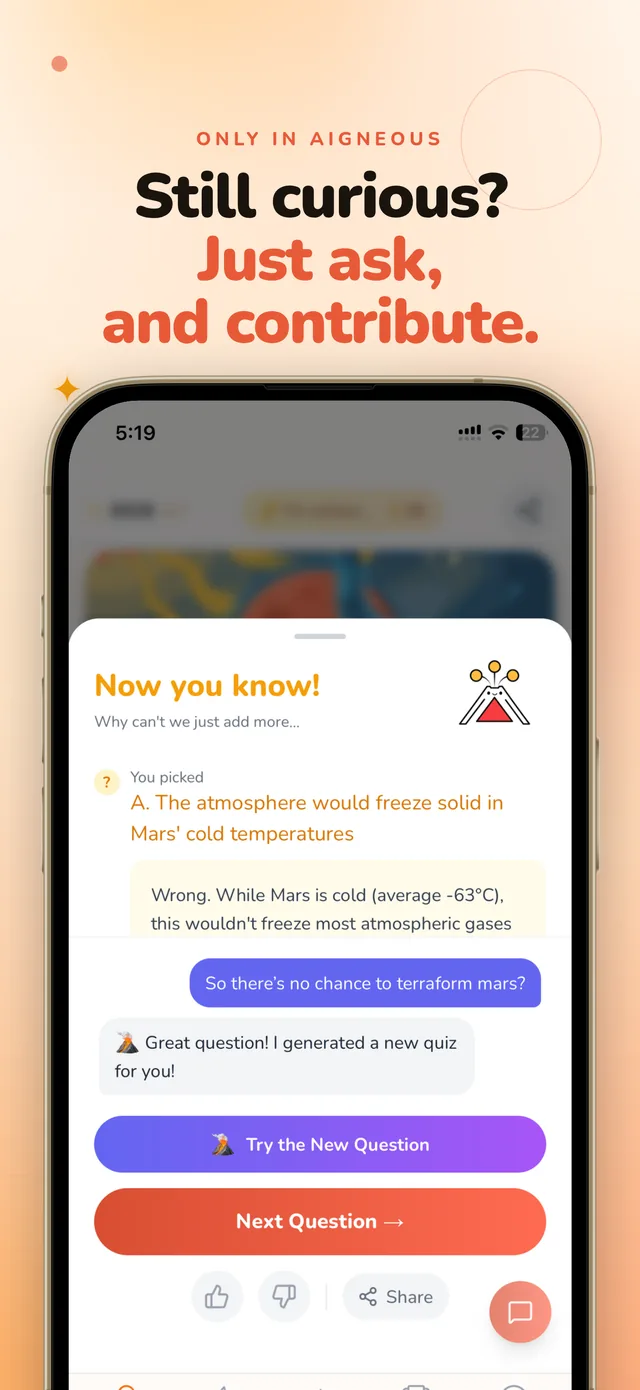
MillionWhys Daily starts with a multiple-choice question, then gives the explanation that closes the gap. Topics can jump from sleep to weather to animal behavior because the primitive is not a chapter; it is one question. The product is built for the ten-second window, and you can continue beyond the first set when one answer opens the next question.
Question 2 of 3
Why would QuizStreak give one daily question with three optional clues that become easier step by step?
Daily quiz apps side by side
| App | Best for | Daily unit | Answer closure | Return model |
|---|---|---|---|---|
| Wordle | Shared word puzzle | One fixed puzzle | Solution, not explanation | A new puzzle tomorrow |
| Bing / Rewards | Existing Microsoft users | Homepage and dashboard quizzes | Answer plus follow-up links | Daily sets and rewards |
| QuizStreak | Hard single-question trivia | One question, three clues | Answer reveal | Streak, QScore, leagues |
| Quizl | Fast general trivia | Five questions | Correct choice shown | New dated quiz |
| Duolingo | Sequenced skills | Short course lessons | Correction inside a path | Progress, quests, streaks |
| MillionWhys | Cross-domain curiosity | Question plus explanation | Mechanism after each answer | Next information gap |
What a daily quiz habit does — and does not — do for memory
A daily quiz can make retrieval frequent, give errors immediate feedback, and lower the effort needed to begin. It can also help a fact become easier to retrieve when the same idea returns in a different form. Those are real, bounded benefits.
It does not strengthen a general-purpose memory muscle. Remembering today's capital, bird, or molecule does not guarantee better recall for unrelated material. Multiple-choice questions also provide recognition cues; that is often easier than producing an answer from scratch. And if an app never resurfaces earlier material, the calendar is spaced but the knowledge is not. The honest claim is narrower and more useful: a well-designed daily question can improve memory for the thing you actually tried to retrieve and then understood.
This is also why volume is a poor shortcut. Thirty-five rushed questions on Sunday are not automatically worse than five careful questions each day, and five daily guesses are not automatically good. The quality of the retrieval attempt, correction, and later re-encounter matters more than the streak graphic.
Question 3 of 3
Why can someone score highly on a multiple-choice quiz yet struggle to produce the same answers without choices?
What people usually miss: closure matters more than streak pressure
Curiosity is strongest when you know enough to feel the missing piece. A clue, a plausible wrong answer, or a familiar phenomenon can make that gap vivid. But the loop only becomes satisfying when the answer delivers real closure. An unexplained green check can end the screen without ending the question.

Photo: Wikimedia Commons, CC BY-SA 4.0.
That is the useful split between attention loops. A streak says, “do not break the chain.” A curiosity loop says, “you were half-sure; now you know why.” The first can bring you back. The second leaves residue. The best daily quiz apps use the first lightly and spend most of their effort on the second.
Related videos
FAQ
Do daily quiz apps actually improve memory?
They can improve later recall for material you actively retrieve, especially when mistakes receive clear feedback and ideas reappear over time. They do not automatically improve memory in general.
Is a new quiz every day the same as spaced repetition?
No. Daily sessions are distributed in time, but spaced repetition requires the same knowledge to return after a delay. An app with entirely new questions can build a ritual without revisiting earlier memory traces.
Which daily quiz app is best for general knowledge?
Quizl is a fast five-question score, QuizStreak is one hard clue-driven question, and MillionWhys adds a mechanism explanation after each answer. Pick based on whether you want speed, difficulty, or closure.
Does Duolingo offer subjects besides languages?
Yes. Duolingo's current course picker includes Math, Music, and Chess as well as language courses. It remains a structured skill-path product rather than an open-ended general-trivia feed.
Is a long streak proof that I am learning?
No. It proves consistent attendance. Evidence of learning is more specific: can you retrieve the idea later, explain it, and connect it to a new question?
What does this have to do with AIgneous Million Whys?
MillionWhys is our answer to the general-curiosity version of this problem: one small question, a real explanation, and then the next gap. It treats fragmented questions as the natural input to learning, not as pieces of a course you failed to finish. Try today's questions and judge the closure, not the streak.
Sources
- Roediger & Karpicke (2006), Test-Enhanced Learning — Psychological Science
- Cepeda et al. (2006), Distributed Practice in Verbal Recall Tasks — Psychological Bulletin
- Pashler, Cepeda, Wixted & Rohrer (2005), When Does Feedback Facilitate Learning of Words?
- Microsoft Support — Bing homepage quiz
- QuizStreak — official rules and current daily format
- Duolingo — current course picker and subjects
Keep Exploring
Why do free daily quiz apps make you commit to a guess before they explain the answer?
Psychology & Behavior
Why would QuizStreak give one daily question with three optional clues that become easier step by step?
Film, TV & Games
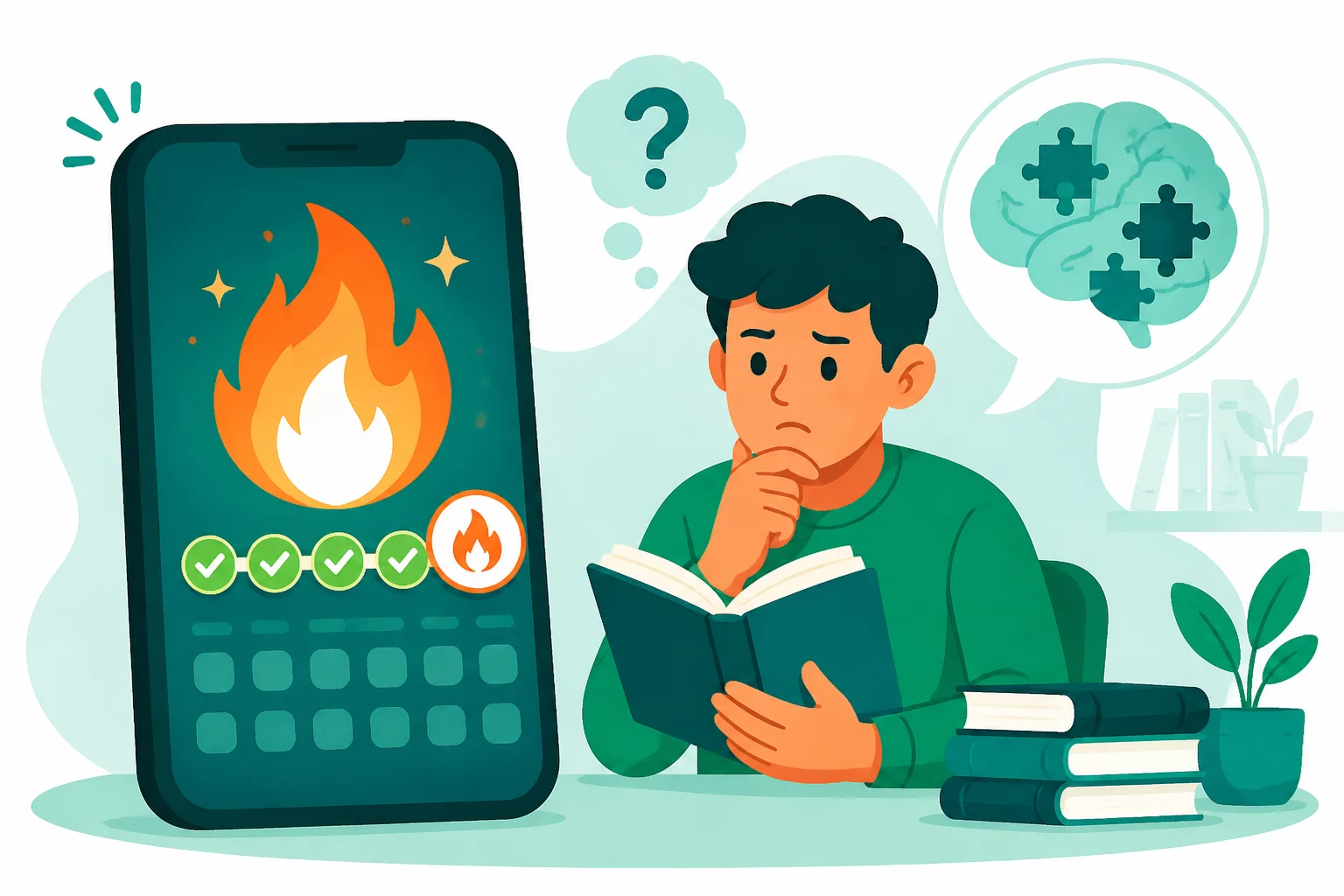
Why does a long daily streak in a learning app not prove you are actually learning anything?
Psychology & Behavior
Related Posts
10 Best Trivia Apps for 2026: Choose by How You Want to Play
Compare 10 trivia apps and web quizzes for reasoning, general knowledge, friend duels, music and parties. Find the format that fits how you want to learn or play.
The Best Learning Apps of 2026: 8 Tools Ranked by How They Actually Teach
From Anki to Duolingo to MillionWhys — how 8 learning apps compare on retention, curriculum, adaptivity, and explanation quality. Pick the one that fits what you actually want out of your next 15 minutes.
Best App to Learn Something New Every Day
Best app to learn something new every day, compared by daily habit fit: Million Whys, Imprint, Kinnu, Blinkist, DailyArt, Brilliant, and why each works.