App to Learn New Things: Curiosity, Not Cramming
The best app to learn new things is not always the one with the biggest course catalog. If the job is "teach me something new in the spare ten seconds before I open a feed," the real question is smaller: does the app create a clear information gap, close it with a satisfying answer, and leave you a little more curious than before?
TL;DR
An app to learn new things should match the moment you actually have: seconds for curiosity, minutes for guided practice, and longer blocks for courses. Million Whys fits the 10-second curiosity window; Brilliant fits interactive STEM lessons; Khan Academy fits structured free education; Blinkist fits compressed book ideas; Duolingo fits language practice. The best choice depends less on "learning app" as a category and more on whether you want discovery, practice, summaries, or a course path.
The short answer: use Million Whys when you want tiny curiosity sparks, Brilliant when you want interactive math and science, Khan Academy when you want a free structured lesson path, Blinkist when you want condensed nonfiction ideas, and Duolingo when the thing you want to learn is a language. Do not force one app to do every job.
Curious? Try one 👇
Why is the sky blue?
Jump into the daily quiz →Start with the learning moment, not the app store category
"Learn new things" sounds broad, but the moment is usually specific. You might be waiting for coffee, winding down before bed, commuting, or trying to replace a reflexive scroll. In those cases, the barrier is not ambition. The barrier is friction. A 30-minute lesson can be excellent and still be the wrong size for the moment.
That is the Million Whys thesis from the vault: learning input is naturally fragmented. People do not experience knowledge first as a syllabus. They experience it as one question at a time: why does this happen, what is that thing, how does this mechanism work? Structure can emerge later. The first unit is often a tiny gap.
Curiosity research gives that feeling a name. Loewenstein's information-gap theory describes curiosity as attention to a gap between what you know and what you want to know in his 1994 review. Kang and colleagues later found that curiosity while reading trivia questions was associated with reward-related brain activity and better memory for surprising answers in a 2009 Psychological Science study. The product lesson is simple: a good learning app should not merely display information. It should make the gap visible, then close it cleanly.

The comparison that actually matters
A clean comparison starts with the unit of learning. Some apps are course-first. Some are practice-first. Some are summary-first. Million Whys is question-first: one multiple-choice question, one fact-checked explanation, one small piece of closure. That makes it closer to a healthier scroll replacement than a miniature school.
| App | Best learning unit | Best for | Watch-out |
|---|---|---|---|
| Million Whys | One 10-second why-question | Curiosity, general knowledge, idle moments | Not a test-prep or language course |
| Brilliant | Interactive lesson | Math, data, AI, science, and technical thinking | Needs more focus than a quick curiosity tap |
| Khan Academy | Structured lesson and practice | Free course-style education | Feels like school, which can be right or wrong |
| Blinkist | Condensed book insight | Nonfiction ideas in short formats | Starts from books, not spontaneous questions |
| Duolingo | Daily language practice | Languages and habit rhythm | The rhythm is not the same as general curiosity |
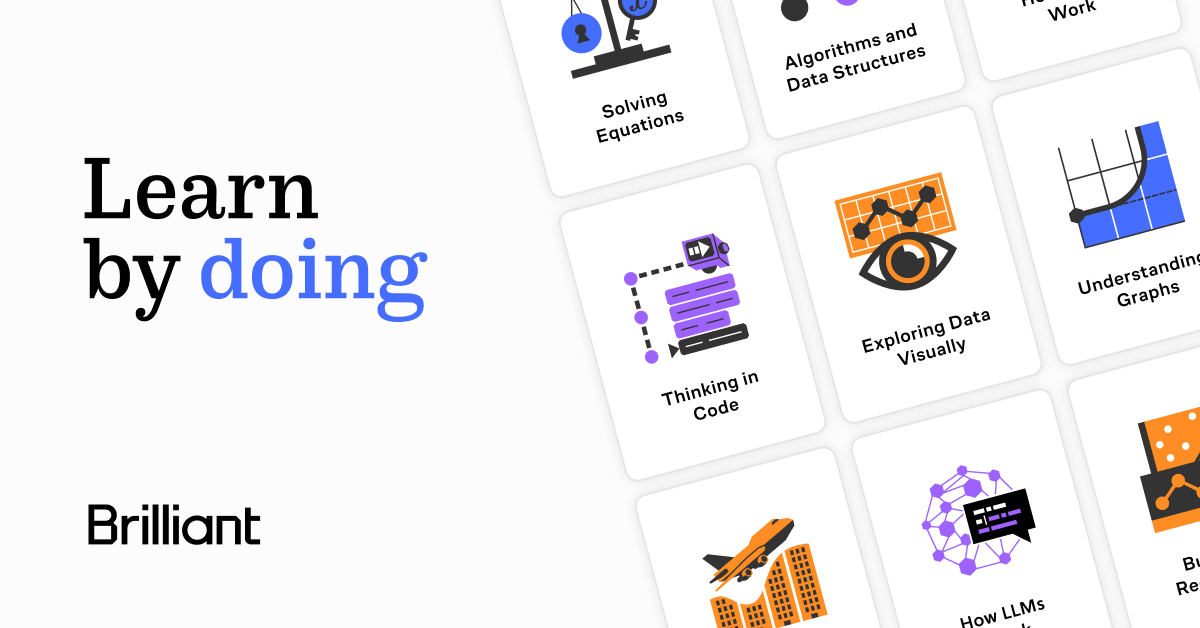
Brilliant: best when the thing is hard and interactive
Brilliant is strong when you want to build skill through guided interaction. Its own course page presents topics across math, programming, data analysis, AI, science, and more on Brilliant.org. That is a very different promise from "show me one surprising thing." Brilliant asks for more attention because the learning object is bigger.
That is not a weakness. It is a fit question. If you want to understand probability, neural networks, or calculus through puzzles, give Brilliant the focus it deserves. If you have ten seconds and want to know why beavers have orange teeth, Brilliant is probably too heavy for that moment.
Khan Academy: best when you want a path
Khan Academy is the clean answer when the need is structured, free education. The organization describes its mission as providing free, world-class education, and its product shape follows that mission: courses, lessons, practice, and progression from a nonprofit academy. It is excellent when you know the subject you want and are ready to follow a path.
But "I want to learn new things" is often pre-path. You may not know what subject you want. You may just want a small spark that reveals the next gap. That is where a question-first product feels more natural: it does not require you to choose a course before curiosity has even appeared.

Blinkist: best when the source is a book
Blinkist is useful when the object you want compressed is a nonfiction book or podcast-like idea. Blinkist's help center describes multiple content types, including Blinks and Shortcasts in its official support article. That makes Blinkist a good "give me the gist" app.
The tradeoff is that a book-summary app starts from a catalog. Million Whys starts from a question. One says, "Here is the idea inside this book." The other says, "Here is a tiny mystery you did not know you wanted closed." Both can teach you something new. They just begin from different psychological doors.

Duolingo: best when the new thing is a language
Duolingo is a language-learning habit machine. Its app and web product are built around practice, progression, and returning daily; the Super Duolingo page emphasizes practice on web or mobile through Duolingo's own product page, and Duolingo has publicly announced large course expansions through investor releases. If you want Spanish, Japanese, or French practice, that focus matters.
But general knowledge is not a language tree. There is no universal order where everyone must learn volcanoes before memory, then beavers, then Roman etiquette. General curiosity is bottom-up. It starts wherever the gap appears. The useful lesson from Duolingo is not "copy the streak." It is that tiny daily interactions can work when the unit is small enough.
What people usually miss
Most lists of apps to learn new things rank features: videos, quizzes, streaks, certificates, price. Those details matter, but they sit on top of a deeper split. Does the app assume learning begins with a fixed curriculum, or does it let curiosity decide the entry point?
Million Whys is built around three choices from the positioning matrix: 10 seconds, not 10 minutes; curiosity, not guilt; emergent curriculum, not a fixed catalog. The third is the important one. If users can turn their own "why is this?" moments into future questions, the curriculum becomes a living map of what people are wondering about, not a shelf of what an editor already approved.

The Million Whys angle: closure without the school feeling
Million Whys is for the moment before "serious learning" starts. You see a question, make a guess, and get the explanation. The small prediction matters because it turns reading into active closure. Even a wrong guess is useful: it reveals the shape of the gap, then the answer snaps it shut.
That is why the app should not be framed as a study tool. There is no exam at the end of wondering why rainbows form, why owls fly quietly, or why companies buy back their own stock. The payoff is cleaner: you leave knowing one real thing you did not know before. Do that often enough and knowledge starts to compound.
Related videos
- Josh Kaufman: The first 20 hours, how to learn anything
- TED-Ed: How to practice effectively for just about anything
FAQ
What is the best app to learn new things every day?
If you want a tiny daily curiosity habit, choose a question-first app like Million Whys. If you want a subject path, choose Khan Academy, Brilliant, Duolingo, or another app built for that specific category.
Is learning in 10 seconds real learning?
It can be, if the unit is small enough and the answer gives real closure. Ten seconds will not teach a full discipline, but it can teach one fact, mechanism, or question that becomes the next step.
Should I use a course app or a curiosity app?
Use a course app when you already know the subject and want sequence. Use a curiosity app when you want discovery first: one question that helps you notice what you want to understand next.
Are streaks necessary for learning apps?
No. Streaks can help some people return, but they can also turn learning into guilt. A curiosity-first habit works better when the reward is the answer itself, not fear of losing a counter.
What does this have to do with AIgneous Million Whys?
AIgneous Million Whys is built for the "learn one new thing now" moment: 10-second questions, fact-checked explanations, no fixed subject ceiling, and a curriculum that grows from what curious people actually ask.
Keep reading
Sources
George Loewenstein: The Psychology of Curiosity
Kang et al.: Epistemic curiosity activates reward circuitry and enhances memory
Curious? Try one 👇
Why is the sky blue?
Jump into the daily quiz →Keep Exploring
Related Posts
Best Free Microlearning Apps 2026
Best free microlearning apps 2026: compare Duolingo, Khan Academy, Brilliant, Quizlet, Anki, Deepstash, and MillionWhys for tiny curiosity-led learning.
Best App to Learn Something New Every Day
Best app to learn something new every day, compared by daily habit fit: Million Whys, Imprint, Kinnu, Blinkist, DailyArt, Brilliant, and why each works.
The Best Learning Apps of 2026: 8 Tools Ranked by How They Actually Teach
From Anki to Duolingo to MillionWhys — how 8 learning apps compare on retention, curriculum, adaptivity, and explanation quality. Pick the one that fits what you actually want out of your next 15 minutes.