AI Learning Apps for Curious Adults
On this page· 17
Most lists of AI learning apps start with a feature checklist: chatbot, flashcards, tutor, summary, price. That is useful, but it misses the stranger question underneath: when does AI actually make you more curious, and when does it quietly do the thinking for you? The best one leaves you with real closure, then a better next question.
TL;DR
AI learning apps split into two jobs: answer machines that help you ask and reason, and curriculum machines that guide you through a fixed path. ChatGPT, Khanmigo, Duolingo Max, Quizlet, Brilliant, and MillionWhys each solve a different learning moment. If your goal is everyday curiosity rather than coursework, look for short active questions, real explanations, and a system that turns one answer into the next wonder.
The short answer: choose ChatGPT for flexible questions, Khanmigo for guided tutoring, Duolingo Max for language conversation, Quizlet for known material, Brilliant for interactive STEM lessons, and MillionWhys for a 10-second curiosity loop that starts from questions instead of a syllabus.

Curious? Try one 👇
Why is the sky blue?
Jump into the daily quiz →What an AI learning app is really choosing for you
An AI learning app quietly makes three choices on your behalf: the unit of learning, the source of direction, and the way closure happens. The unit might be a chat turn, a lesson, a flashcard, a practice conversation, or one tiny question. The direction might come from you, from a curriculum team, from uploaded notes, or from a community's shared curiosity. The closure might be a correct answer, a worked hint, a remembered card, or the small satisfying moment when a half-known thing finally snaps into place.
That matters because curiosity is not just a mood. George Loewenstein's information-gap theory describes curiosity as the feeling that appears when you can perceive a gap between what you know and what you want to know. The sweet spot is not total ignorance or total certainty; it is the half-knowing zone where the answer feels close enough to chase. MillionWhys' internal product thesis takes that seriously: learning input is naturally fragmented, often one question at a time, and structure should emerge after many fragments rather than being forced before curiosity has a chance to move.

The quick comparison: which AI learning app fits which moment?
| App | Best learning moment | AI role | Pricing / access note | Curiosity fit |
|---|---|---|---|---|
| ChatGPT | Open-ended questions, explanations, drafts, practice prompts | General reasoning and dialogue | OpenAI lists Free, Go, Plus, Pro, Business, and Enterprise plans on its pricing page | High if you ask actively; weak if you outsource the whole thought |
| Khanmigo | Guided tutoring around Khan Academy-style skills | Personalized tutoring, writing, debate, coaching, coding feedback | Khanmigo's pricing page says teachers can start free; learner and family plans are $4/month or $44/year before tax | Strong for structured help; less native for wandering curiosity |
| Duolingo Max | Language conversation practice | AI-powered Video Call and Roleplay | Duolingo describes Max as a tier above Super Duolingo | Great rhythm, narrow subject boundary |
| Quizlet | Turning known material into practice | AI-generated flashcards, practice tests, study guides, summaries, homework help | Quizlet's help center describes Plus tiers for advanced tools and usage levels | Good after you already know what you need to practice |
| Brilliant | Interactive math, science, programming, data, and AI lessons | Koji, a tutor embedded inside courses | Brilliant Premium includes Koji plus unlimited, ad-free course access; pricing is shown on its subscribe page | Excellent for course-shaped curiosity |
| MillionWhys | Idle moments when you want one real answer | Fact-checked question generation and explanation flow | Built as a lightweight curiosity app, not a course subscription | Highest for general-knowledge curiosity and 10-second closure |
ChatGPT: best when you bring the question
ChatGPT is the broadest AI learning app because it is not only a learning app. OpenAI's pricing page describes Free access with limited GPT-5.5 Instant, Plus with expanded reasoning, deep research, memory, projects, tasks, and custom GPTs, and Pro with higher usage and GPT-5.5 Pro access. That breadth is the point: you can ask for an analogy, a Socratic quiz, a worked example, or a reading plan.
The risk is also the breadth. If you ask ChatGPT to explain something, you may get a beautiful answer before you have felt the gap yourself. Used well, it is a curiosity amplifier: ask it to give you three competing explanations, then make you predict which one is right. Used lazily, it becomes a very polished answer vending machine. The difference is not the model; it is whether you stay in the loop.

Khanmigo: best for guided tutoring, not wandering
Khanmigo is closer to the classic dream of an AI tutor. Its official pricing page says teachers can get started free, while learner and family plans are listed at $4/month or $44/year before tax. The same page describes personalized tutoring on Khan Academy content, writing and debate prompts with immediate feedback, career coaching, coding feedback, chat history, parent controls, and district tools.
That makes Khanmigo strong when the learner already accepts the lane: math, writing, coding, admissions, or other Khan Academy-shaped work. If your need is school-adjacent support, that is a real advantage. If your need is a random evening question like why mirrors work, the structure is heavier than the moment requires.

Duolingo Max: best AI rhythm, fixed subject
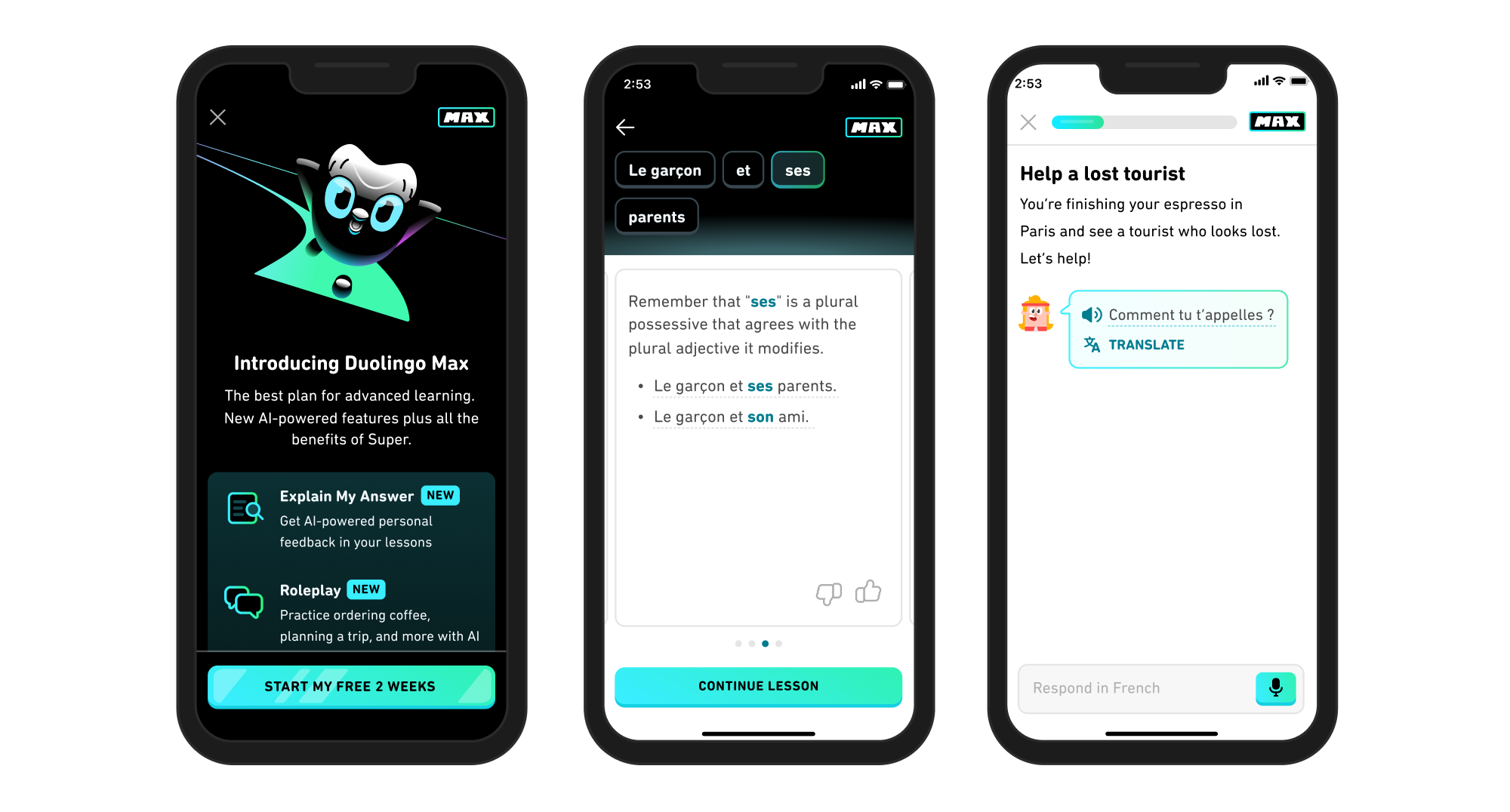
Duolingo Max shows one powerful use of AI in a narrow lane. Duolingo describes Max as a subscription tier above Super Duolingo, with AI-powered Video Call and Roleplay. Its Max announcement says Video Call lets learners speak with Lily in real time and review a transcript afterward, while Roleplay lets learners practice real-world conversation scenarios and receive feedback. Duolingo also states that English speakers learning Spanish, French, German, Italian, and Portuguese have access to both Video Call and Roleplay, while Japanese, Korean, and Chinese learners can use Video Call.
The interesting part is the rhythm. Duolingo understands the short daily window. But the direction is still top-down: the course exists first, and AI makes it more responsive. For general knowledge, that rhythm needs a different source of direction: what people actually wonder.
Quizlet and Brilliant: strong after the shape is known
Quizlet is excellent when the material already exists. Its AI study tools page describes AI-generated practice tests, study guides, a PDF summarizer, an AI flashcard maker, and homework help. Its subscription help center describes Plus plans for advanced tools such as practice tests, study guides, Learn, Test, expert solutions, and offline studying. In plain English: Quizlet helps you convert known material into practice.
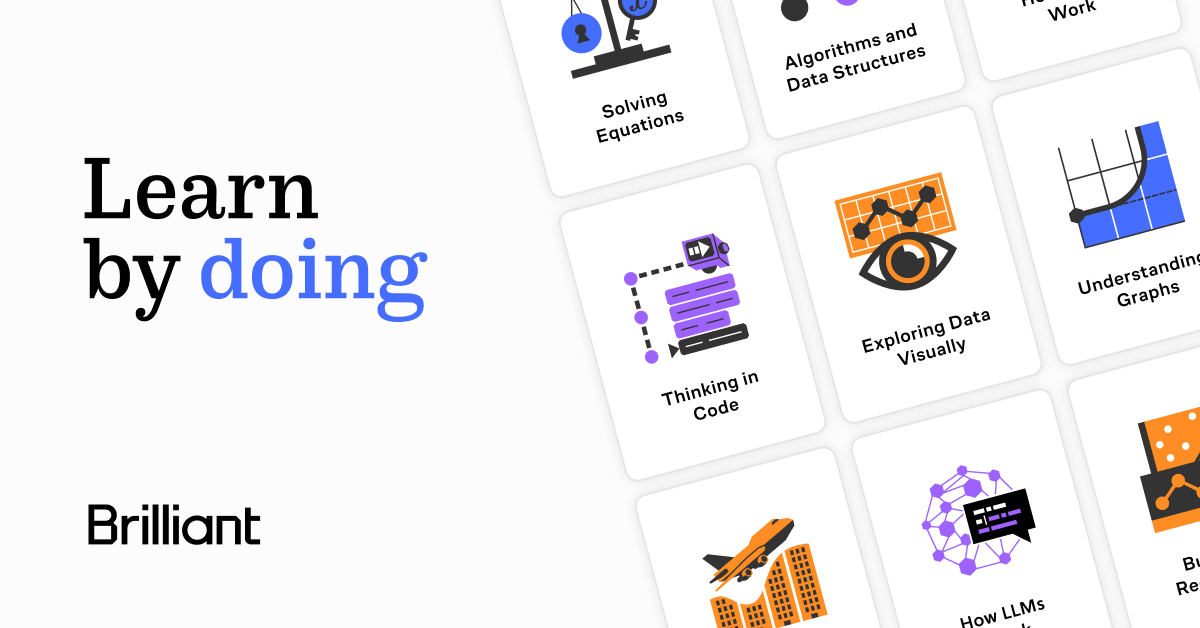
Brilliant chooses a different shape. Its help center says Brilliant Premium includes Koji, a personal tutor inside courses, plus unlimited ad-free access, the ability to jump ahead, and family plans covering up to six members. Brilliant is at its best when curiosity wants a path through math, programming, data analysis, AI, or science. It is not trying to be a loose commons of every why people have in their heads.
Where MillionWhys fits: curiosity before curriculum
MillionWhys starts one unit smaller than most AI learning apps. The unit is one question, answered actively. You see a prompt, make a prediction, then get the explanation. That 10-second loop matters because it gives the mind a small gap and a real closure. You are not passively receiving a summary. You are making a tiny bet about how the world works, then updating your model.
The deeper difference is where the curriculum comes from. Fixed-catalog apps teach what their content team has shipped. MillionWhys is built around emergent curriculum: users' questions and community curiosity define the frontier. One person's "wait, why does that happen?" can become a fact-checked question for the next person. That is why the product should not be framed as an exam tool. It is closer to a demand-side knowledge commons: a shared map of what humans are actually wondering about.
What people usually miss
The common mistake is treating AI learning as a race toward smoother answers. Smoothness can be useful, but it can also erase the friction where learning begins. If an app answers before you notice your own uncertainty, it may create the feeling of understanding without the experience of earning it. The better question is: does the app help you notice the gap, make a prediction, receive closure, and leave with a sharper next question?
That is why the best AI learning app depends less on intelligence in the abstract and more on learning shape. ChatGPT is flexible. Khanmigo is guided. Duolingo Max is conversational. Quizlet is practice-heavy. Brilliant is course-shaped. MillionWhys is curiosity-shaped. Pick the shape that matches the moment.
Related videos
FAQ
What are the best AI learning apps in 2026?
The best AI learning apps depend on the job. ChatGPT is strongest for open-ended explanation and questioning; Khanmigo for guided tutoring; Duolingo Max for language conversation; Quizlet for turning existing notes into practice; Brilliant for interactive STEM lessons; and MillionWhys for short curiosity-driven general knowledge.
Are AI learning apps better than traditional courses?
Not always. Courses are useful when a field has a clear sequence. AI learning apps are strongest when they adapt the explanation, help you ask better questions, or turn a loose curiosity into a concrete next step.
Which AI learning app is best for adults?
Adults often need lower-friction learning than a school-style course. ChatGPT and MillionWhys fit spontaneous questions; Brilliant and Khanmigo fit structured skill growth; Quizlet fits practice when the material is already chosen.
Are AI learning apps reliable?
They can be reliable when they cite sources, constrain the task, or work inside reviewed content. For open-ended chat, you still need to verify important claims. A good app makes uncertainty visible instead of pretending every answer is final.
What does this have to do with AIgneous Million Whys?
AIgneous Million Whys is the curiosity-first version of an AI learning app: one active question, one fact-checked explanation, and one small piece of closure at a time. It is built for people who want their idle moments to compound into better questions, not for people trying to cram for an exam.
Curious? Try one 👇
Why is the sky blue?
Jump into the daily quiz →Keep Exploring
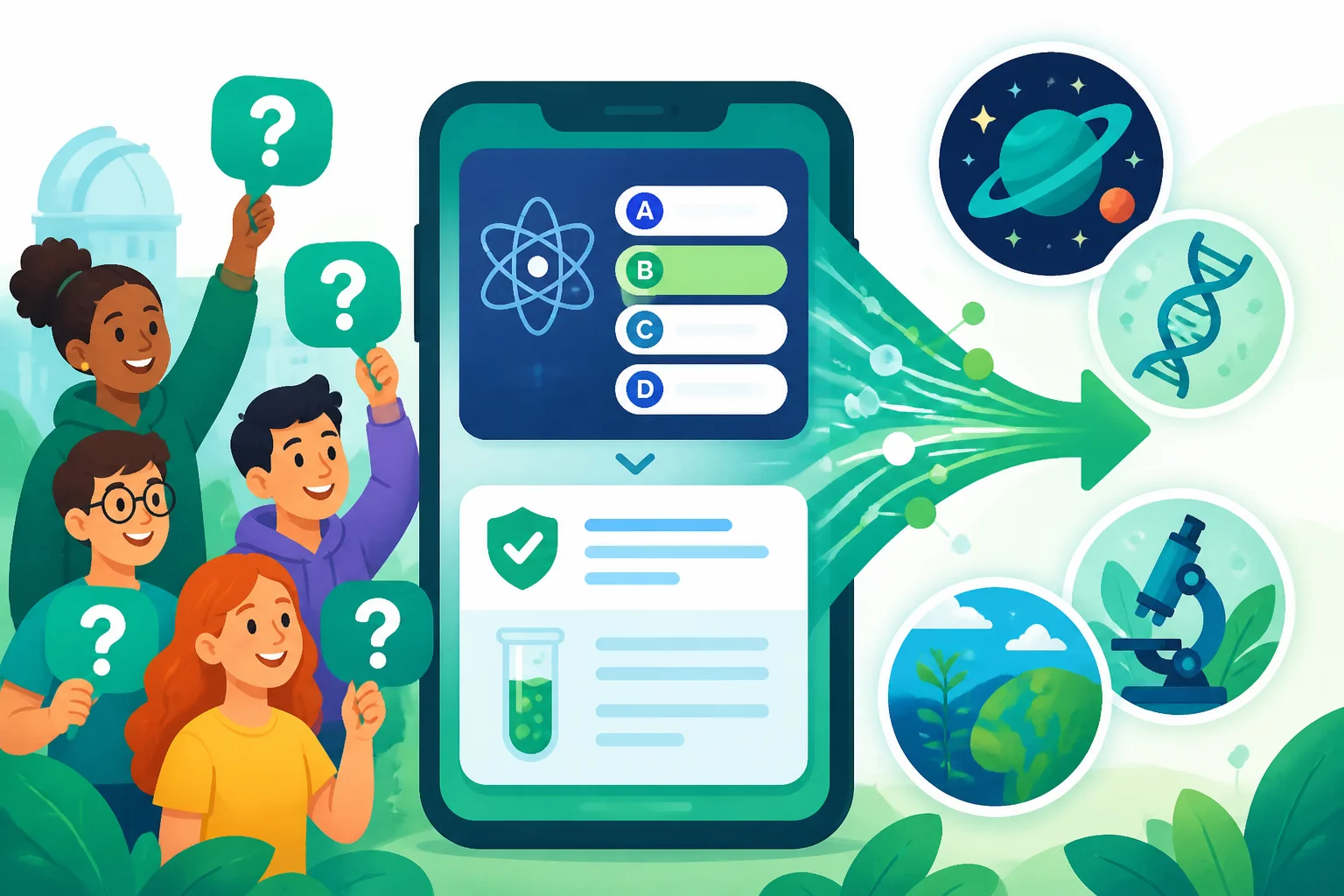
Why might MillionWhys-a learning app that asks a multiple-choice question before a fact-checked explanation-let community questions shape future topics instead of following only a fixed course?
Media & Society

Why do people mix up Claude, GPT, and AI apps?
Technology
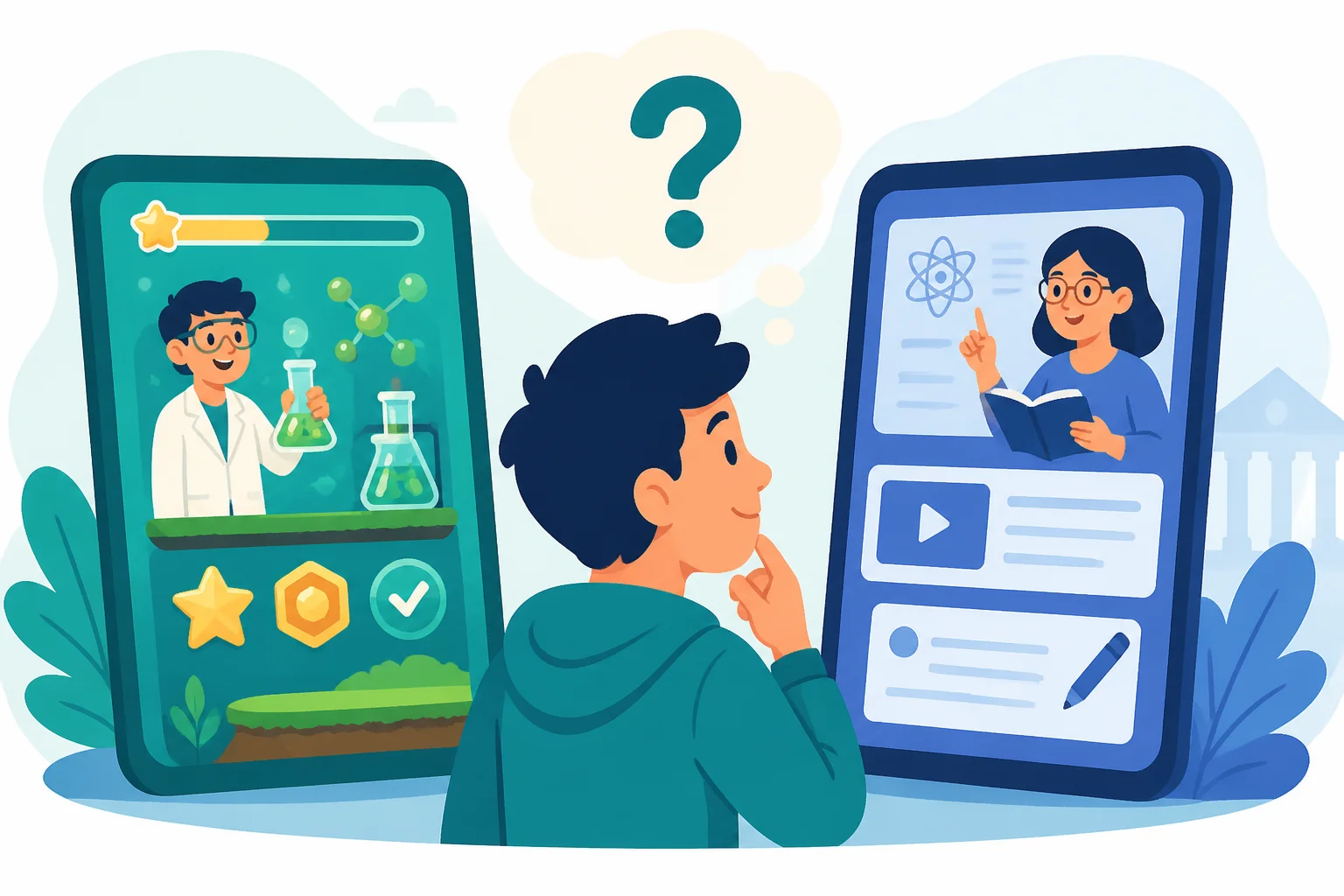
Why do daily learning apps feel so different to use, even when they cover the same subjects?
Technology
Related Posts
App to Learn New Things: Curiosity, Not Cramming
Looking for an app to learn new things? Compare Million Whys, Brilliant, Khan, Blinkist, and Duolingo by learning moment, not hype.
Alternative to Duolingo for General Knowledge
Looking for an alternative to Duolingo for general knowledge? Compare Duolingo, Brilliant, Khan, Quizlet, Blinkist, Anki, and MillionWhys today.
Duolingo for General Knowledge: Best Apps
Duolingo for general knowledge means tiny daily sessions beyond languages. Compare Million Whys, Kinnu, Imprint, Brilliant, Nerdish, and Blinkist.