

Alternative to Duolingo for General Knowledge
On this page· 15
If you search for an alternative to Duolingo, the honest first question is not "which app also has a mascot?" It is "what are you trying to learn?" Duolingo is excellent at turning language practice into a daily loop. But if the thing you want is general knowledge, science, history, psychology, random questions, or the small discoveries that make idle phone time feel less wasted, copying Duolingo's language tree is the wrong target. You want the rhythm without the narrow curriculum.
TL;DR
The best alternative to Duolingo for general knowledge is not another language app. Look for a learning loop that is short, curiosity-led, source-aware, and broad enough to handle whatever you wonder about next. MillionWhys fits the "Duolingo but for general knowledge" search intent because it keeps the tiny daily interaction but drops the fixed language syllabus and streak guilt.
Short answer: If you want language practice, stay with Duolingo or compare language-specific apps. If you want a general-knowledge alternative to Duolingo, compare apps by learning unit, curriculum source, pressure model, and topic range. Duolingo's own investor update describes a language-course platform that recently expanded with 148 new language courses, while tools like Brilliant, Khan Academy, Quizlet, Blinkist, Anki, and MillionWhys solve different learning jobs.
Curious? Try one 👇
Why is the sky blue?
Jump into the daily quiz →Start with the job: language habit or curiosity habit?
Duolingo's core job is language learning. Its 2025 investor release says the company launched 148 new language courses, more than doubling its course offering, and frames the flagship app as the world's most popular way to learn languages. That matters because many "Duolingo alternatives" are really Spanish, French, or Japanese alternatives. They compete on speaking practice, grammar explanations, placement tests, and course depth.
That is a different job from "I want to learn something new every day." A curious adult may want to know why rainbows are curved, why weightlifters hold their breath, how GPS knows where you are, or why octopuses have blue blood. Those questions do not fit a language tree. They fit a bottom-up curiosity loop: one question, one answer, one explanation, then the next gap appears.
This distinction keeps the recommendation honest. If your search intent is "help me keep my Spanish alive," a general-knowledge app is not the right answer. If your search intent is "I like the daily bite-size feeling, but I do not want another language course," then the field changes. You are choosing between formats for curiosity, not substitutes for grammar practice.

The comparison that actually matters
A useful comparison separates format from subject. Duolingo proved that a tiny interaction can become a habit. That does not mean every subject should be forced into Duolingo's path structure. The MillionWhys positioning matrix makes the split simple: 10 seconds, not 10 minutes; curiosity, not guilt; emergent curriculum, not fixed catalog. In plainer terms, a good general-knowledge alternative should be small enough for the coffee line and broad enough for whatever question your brain throws at you.
| App | Best for | Learning unit | Curriculum source | Pressure model |
|---|---|---|---|---|
| Duolingo | Language practice | Short lessons | Prebuilt language courses | Streaks, reminders, game-like progress |
| Brilliant | Math, science, computer science | Interactive lessons and practice sets | Expert-built course catalog | Course progress, streaks, XP, premium access |
| Khan Academy | School-aligned learning | Videos, exercises, dashboards | Structured academic materials | Self-paced, curriculum-aligned |
| Quizlet | Studying known material | Flashcards, tests, study guides | User-created and class materials | Study tools and subscription tiers |
| Blinkist | Book ideas fast | 15-minute Blinks, Guides, Shorts | Nonfiction and curated learning content | Library completion and daily content |
| MillionWhys | General curiosity | One multiple-choice question plus explanation | Community curiosity plus fact-checking | Curiosity sparks, not streak guilt |
Where the big apps win
Duolingo wins when the subject has a clear sequence. Languages have vocabulary, grammar, listening, and reading skills that can be ordered into courses. The company's Super Duolingo page emphasizes convenience features such as no ads and unlimited hearts, while the broader product keeps learners inside a familiar daily practice loop. If your goal is to practice a language every day, that loop is the point.
Brilliant wins when you want interactive STEM problem solving. Its help center says free users get limited daily keys, while Premium unlocks unlimited lessons and practice sets, ad-free access, and the ability to jump to any lesson. That is a strong fit for people who want math, science, computer science, or data science in a lesson format.
Khan Academy wins when you want a free academic learning path. UNESCO describes Khan Academy as a nonprofit offering free, world-class learning materials across math, science, computing, and humanities, reaching learners in more than 190 countries and localized into more than 50 languages. If you need school-aligned explanations and practice exercises, that structure is useful.

Where Quizlet, Anki, and Blinkist fit
Quizlet is strongest when you already know what you need to study. Its help center describes flashcards, practice questions, interactive diagrams, activities, Study Guides, Learn, Test, Expert Solutions, and subscription options. That is very different from a curiosity app. Quizlet helps you rehearse a defined set; it does not decide what weird question you should bump into next.
Blinkist compresses books into fast idea units. Its help center says Blinks are summaries of bestselling nonfiction books that can be read or listened to in around 15 minutes, and it also offers Guides and Shorts. That is useful when you want a book's argument quickly. It is less useful when you want one atomic answer to one question.

Anki is powerful for spaced repetition, especially when you care about long-term memory. The Anki manual describes active recall testing and spaced repetition as its core concepts. But Anki is a memory machine, not a curiosity machine. It is best after you have chosen the material. MillionWhys is better at the earlier moment: "I did not even know I wanted to know that."
What people usually miss
The mistake is treating "Duolingo alternative" as a feature checklist. Streak? Mascot? XP? Leaderboard? Those are surface mechanics. The deeper question is whether the subject is naturally top-down or bottom-up. A language course is top-down: a curriculum designer can sequence grammar and vocabulary. Everyday curiosity is bottom-up: one question appears, then another, and structure emerges after many fragments.
That is why a general-knowledge Duolingo alternative should not pretend to be a giant school course. It should feel like replacing a few seconds of scrolling with one small discovery. The learning unit should be smaller than a lesson, more active than an article headline, and more flexible than a fixed catalog.

The MillionWhys angle: Duolingo's rhythm without Duolingo's guilt
MillionWhys is not trying to be a language tutor, a school replacement, or a flashcard deck. It uses the short daily rhythm that made Duolingo feel approachable, then points that rhythm at general knowledge. You answer one multiple-choice question, read a concise explanation, and leave with a fact you can retell. The product philosophy from the vault is specific: learning input is naturally fragmented; structure is the output, not the starting point.
That matters for adults who are done with school but not done learning. You may not want a 30-minute lesson. You may not want a streak scolding you. You may just want your phone to leave a little useful residue. In that case, the right alternative to Duolingo is not "Duolingo for Spanish but different." It is "Duolingo's 10-second habit energy, but for the questions the world keeps throwing at you."
The practical test is simple: would you open the app when you only have a few seconds? If the answer is no, it is probably a course, library, or study tool. Those can be excellent. They just solve a different problem from replacing a scroll impulse with one small piece of understanding.
Related videos
FAQ
What is the best alternative to Duolingo for general knowledge?
For general knowledge, look for a curiosity-first app rather than a language app. MillionWhys is built around one short question and explanation at a time, which fits random curiosity better than a fixed language tree.
Is Brilliant a Duolingo alternative?
Brilliant can be an alternative if you want interactive STEM lessons. It is not a general curiosity replacement because its strength is a structured math, science, and computing course catalog.
Is Quizlet a good Duolingo alternative?
Quizlet is good for studying known material with flashcards, tests, and study guides. It is less suited to the "teach me something surprising every day" job because it starts from material you or someone else already chose.
Should I use Blinkist instead?
Use Blinkist if you want compressed book ideas in roughly 15-minute summaries. Use a question-first app if you want a smaller unit: one surprising fact or mechanism at a time.
What does this have to do with AIgneous Million Whys?
AIgneous Million Whys is the curiosity version of the daily learning loop: 10-second questions, fact-checked explanations, no fixed subject ceiling, and no streak guilt. It is for the person who likes Duolingo's rhythm but wants to learn why the world works the way it does.
Curious? Try one 👇
Why is the sky blue?
Jump into the daily quiz →Keep Exploring

Why does Duolingo's short, bite-sized lesson format still feel like steady progress rather than random practice?
Language & Linguistics
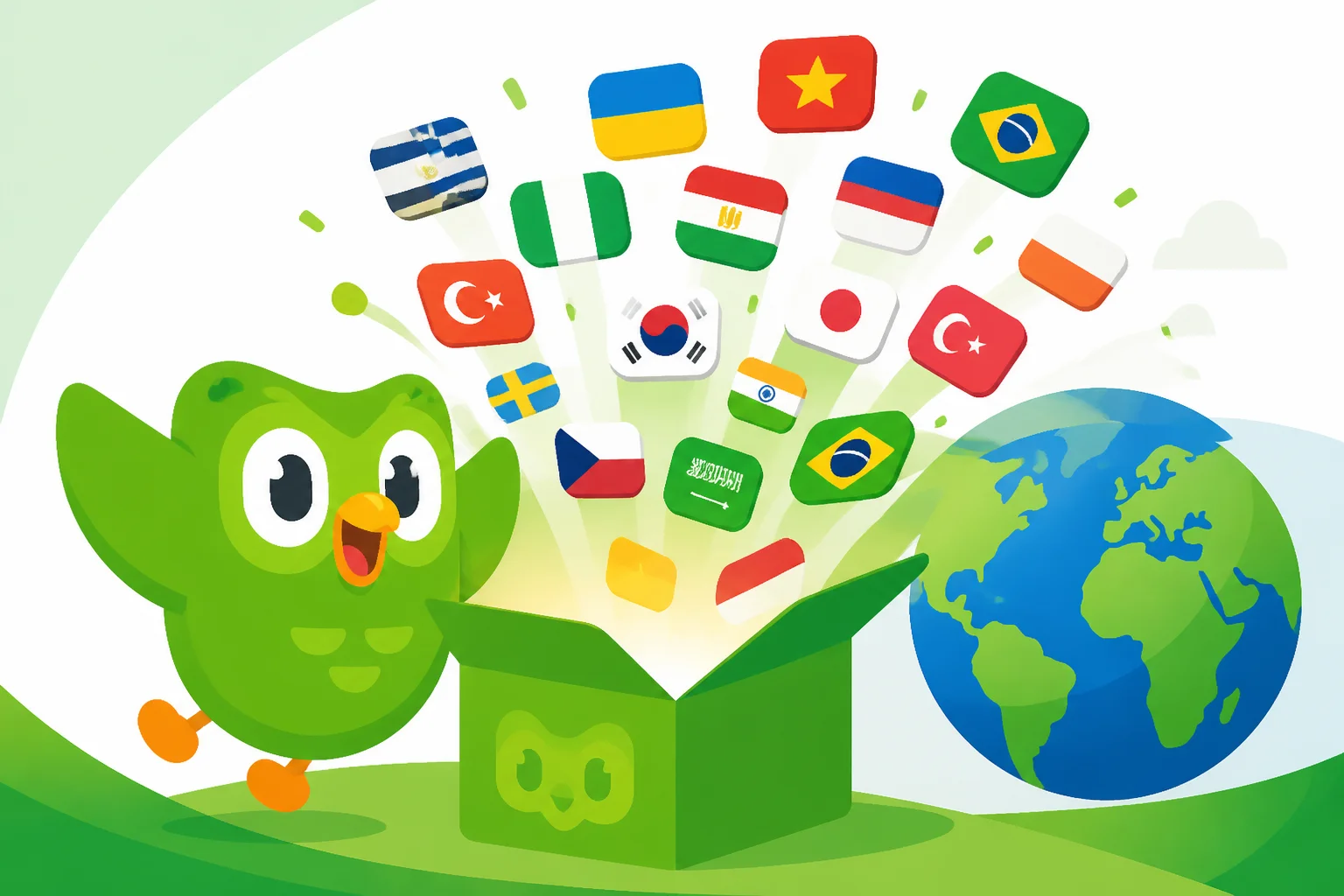
What did Duolingo actually add when it launched 148 new language courses in 2025?
Language & Linguistics

Why do daily learning apps feel so different to use, even when they cover the same subjects?
Technology
Related Posts
Duolingo for General Knowledge: Best Apps
Duolingo for general knowledge means tiny daily sessions beyond languages. Compare Million Whys, Kinnu, Imprint, Brilliant, Nerdish, and Blinkist.
Apps Like Duolingo Without the Streak Pressure
Apps like Duolingo can mean language practice or a curiosity habit. Compare Duolingo, Babbel, Busuu, Anki, Brilliant, Khan, and MillionWhys for adults.
AI Learning Apps for Curious Adults
Compare AI learning apps for curious adults: ChatGPT, Khanmigo, Duolingo Max, Quizlet, Brilliant, and MillionWhys without exam-cram habits here today.