
Science Facts of the Day: 10 Facts That Surprise
On this page· 24
Why can you remember a surprising science claim but struggle to explain why it's true? Often, the missing piece isn't another fact. It's the mechanism connecting the fact to something you already understand.
The best science facts of the day give you that connection. Blue blood becomes more interesting when you understand how animals transport oxygen. Boiling water becomes stranger when you realize that temperature isn't the only thing controlling it. An old window becomes a lesson in why a plausible explanation still needs evidence.
Try predicting each answer before reading the explanation. Don't worry about being wrong. A tempting mistake gives you something useful to examine: the assumption that made your answer feel right.
- Make a prediction. Choose an explanation, not just a yes-or-no answer.
- Look for the mechanism. Ask what's moving, changing, reacting, or being measured.
- Test the boundary. Ask when the claim would stop being true.
These science facts span biology, chemistry, physics, astronomy, and Earth history. Read them together or choose a different question each day. The point isn't to collect impressive lines for a quiz. It's to leave with an explanation you could give someone else, plus a follow-up question you want answered.
1. Why Do Octopuses Have Blue Blood and Specialized Hearts?
Predict first: Does blue blood mean an octopus carries oxygen in the same way we do, just with a different pigment?
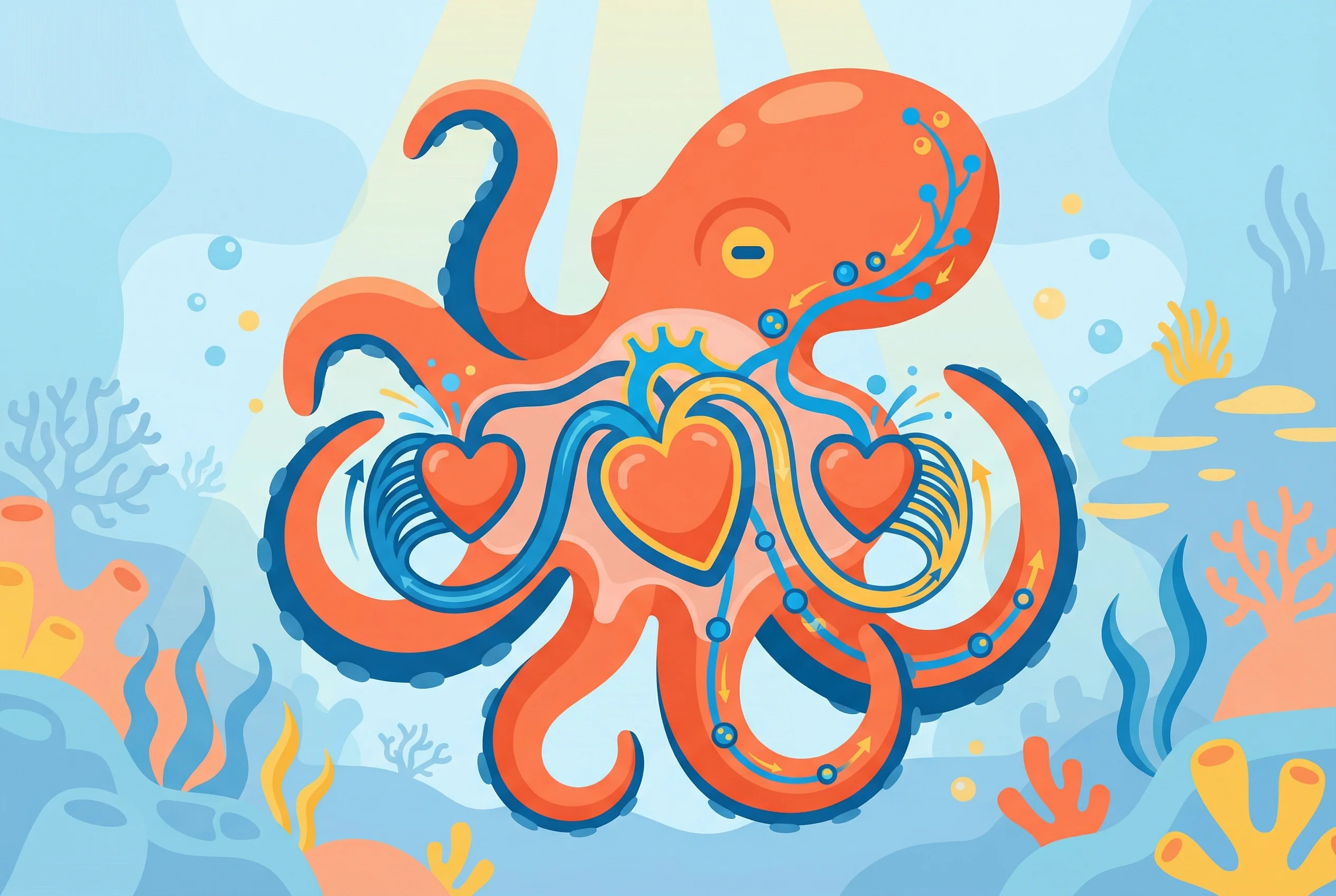
Not quite. Human blood uses hemoglobin, an iron-containing protein, to transport oxygen. Octopuses use hemocyanin, which contains copper and looks blue when oxygenated. The color comes from the chemistry of the oxygen-carrying molecule, not from seawater passing through the animal.

Follow the oxygen delivery route
An octopus uses branchial hearts to move blood through its gills and a systemic heart to send oxygenated blood around its body. Think of pumping stations serving different parts of a delivery network. Moving blood through the gas-exchange equipment and delivering it to working tissues are related but distinct jobs.
Hemocyanin can support oxygen transport in cold marine environments. That doesn't mean every octopus lives in deep, oxygen-poor water, or that blue blood is universally better than red blood. Different oxygen carriers function within different physiological systems.
The misconception to drop: All animals use the same blood chemistry.
For a classroom example, draw an oxygen molecule traveling from seawater through a gill and onward to muscle. Label the carrier separately from the pumps. If you add a species name, these scientific naming tips from Divegrade help distinguish a common name from a scientific one.
Question 1 of 6
Why is octopus blood blue instead of red like human blood?
2. Why Can Honey Last So Long Without Spoiling?
A jar of honey turns cloudy and grainy in the cupboard. Would you throw it away, or has something other than spoilage happened?
Crystallization alone doesn't mean honey has spoiled. Some dissolved sugars have formed crystals, changing the texture without necessarily making the honey unsafe. The more interesting question is why properly stored honey resists microbial growth in the first place.
Water content isn't the whole story
Microbes need available water to grow. Honey contains concentrated sugars that leave little water readily available to them, and its acidity creates another obstacle. Think of a microbe arriving at a pantry where the supplies are present but mostly locked away.
Honey also has chemistry that can produce hydrogen peroxide under suitable conditions, including dilution. That antimicrobial mechanism doesn't mean a watered-down jar will remain protected indefinitely. Dilution changes the conditions that make concentrated honey resistant to spoilage.
Storage rule: Keep honey tightly closed and use a clean, dry utensil. Its long shelf life depends on maintaining the right conditions, not on a magical inability to change.
For crystallized honey, place the closed jar in warm water and stir when practical. Gentle warming can loosen the crystals without aggressively heating the honey.
The misconception to drop: Honey can never spoil, regardless of storage. Moisture entering a jar can make fermentation possible, so an unconditional never is less useful than understanding why concentrated honey keeps well.
Question 2 of 6
Why can honey last for thousands of years without spoiling?
3. Why Are Bananas Berries but Strawberries Aren't?
Choose your rule: Should a berry be small and sweet, or should its classification depend on how it develops from a flower?
In everyday cooking, appearance and use often decide the category. In botany, developmental anatomy matters. A botanical berry develops from an ovary into a fleshy fruit with seeds contained within it.
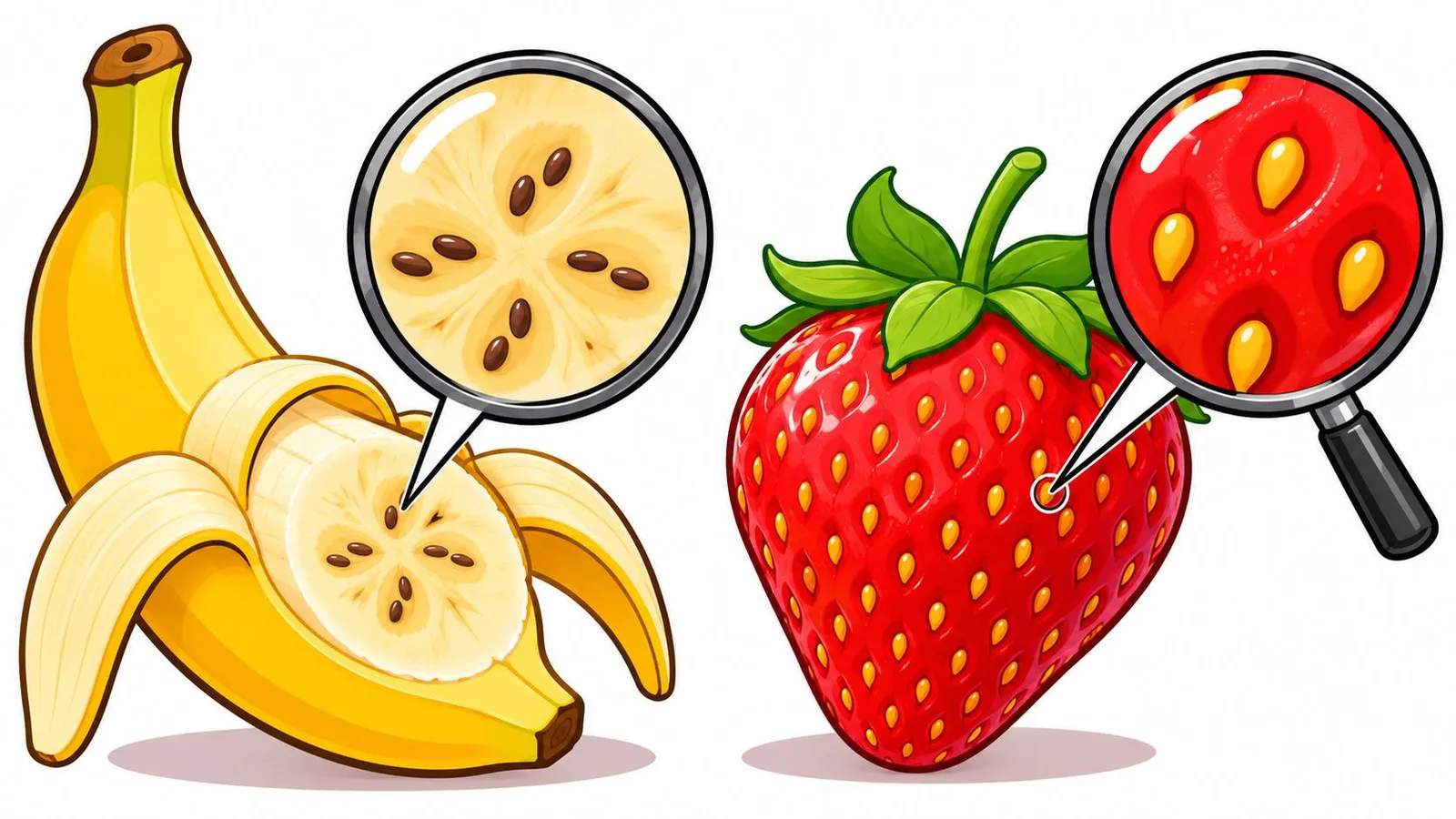
Bananas fit that general developmental pattern, even though cultivated bananas usually have tiny, undeveloped seeds. Strawberries develop differently, so their familiar kitchen label doesn't determine their botanical classification.
Look beyond the supermarket label
The strawberry's fleshy red portion develops largely from the flower's receptacle. The small structures commonly called seeds on its surface are individual dry fruits, each containing a seed.
Try comparing a sliced tomato with a strawberry using a hand lens. In the tomato, you can see seeds surrounded by fleshy fruit tissue. On the strawberry, examine the separate surface structures and the tissue supporting them.
- Culinary classification helps people describe flavor, preparation, and use.
- Botanical classification helps people describe plant structures and development.
The misconception to drop: A scientific definition makes the everyday definition wrong. The definitions answer different questions. You don't need to rename a fruit salad, but you do need to know which classification system a science question is using.
Question 3 of 6
What makes a strawberry not count as a botanical berry?
4. Why Does Sunlight Show Us the Sun's Past?
Look toward a sunlit wall, not directly at the Sun. Is the light illuminating that wall arriving instantly from its source?
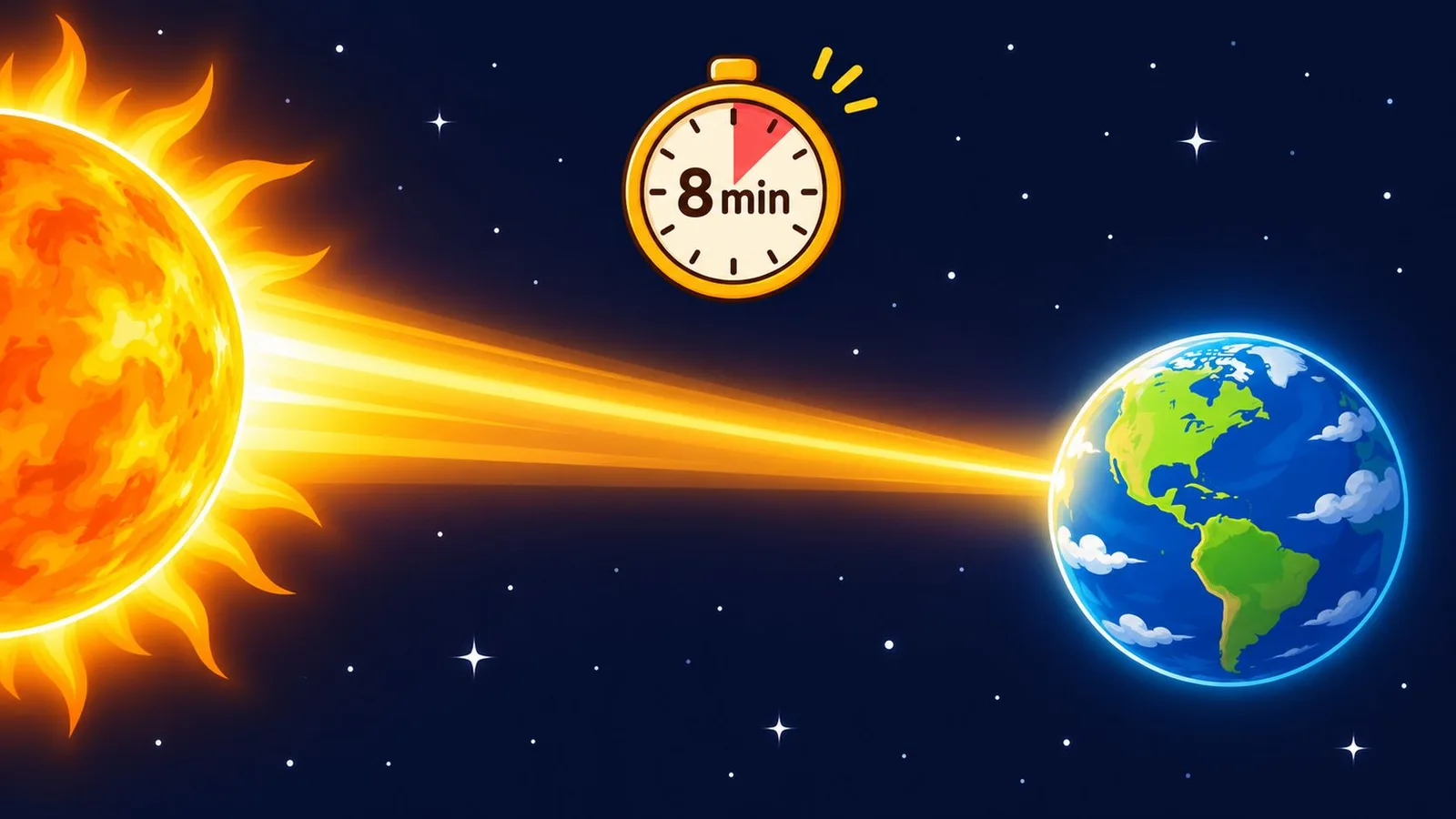
No. Light travels extremely quickly, but it doesn't travel instantaneously. Because space separates Earth from the Sun, sunlight spends time traveling before it reaches your surroundings.
That means the sunlight you receive carries information about the Sun when that light departed. Seeing is always a process of receiving a signal, even when the delay is too small to notice in ordinary life.
Think of light as a delivered message
A postcard tells you something about its sender at the time it was written, not necessarily at the moment you open it. Light works similarly as an information carrier, although its travel follows very different physical rules.
Astronomers use this connection between distance and travel time when interpreting distant objects. Engineers also account for signal delays when communicating with spacecraft. An instruction cannot arrive before the signal carrying it.
The misconception to drop: A telescope shows everything as it exists at a universal present moment. It collects arriving light, which began its journey earlier.
For a follow-up, separate travel time from appearance. The question of why the Sun looks yellow concerns how light reaches and is perceived by an observer, rather than how long it travels.
5. Why Might Hot Water Sometimes Freeze Before Cooler Water?
Suppose you place warm and cool water in a freezer. Must the cooler sample always become ice first?
Under carefully matched, simple conditions, the cooler sample has less heat to lose. But real freezing experiments can involve changes in water mass, airflow, circulation, contact with the freezer surface, and the way ice formation begins. Those differences can complicate the result.
The reported phenomenon in which initially warmer water freezes sooner under certain conditions is called the Mpemba effect. It isn't a dependable shortcut for making ice.
Define what you mean by frozen
An experiment becomes difficult to interpret if the finish line is vague. Detecting the first ice crystal isn't the same as finding that the entire sample has solidified.
A useful comparison would track:
- Starting conditions. Record water temperature, mass, container material, and placement.
- Changes during cooling. Watch for evaporation and differences in circulation or thermal contact.
- The endpoint. Decide whether you're measuring cooling, initial ice formation, or complete freezing.
Supercooling adds another complication: liquid water can cool below its usual freezing point before ice formation begins. A temperature reading alone therefore doesn't always tell you whether freezing has started.
The misconception to drop: Hot water always freezes faster, or a surprising result proves a universal law.
Use this question to practice separating an observation from competing explanations. Then explore why ice floats on water, a different question about what happens when water forms its solid structure.
6. Why Can a Thunderstorm Generate Electricity?
Make a prediction: Does lightning require a cloud to rub against the ground?
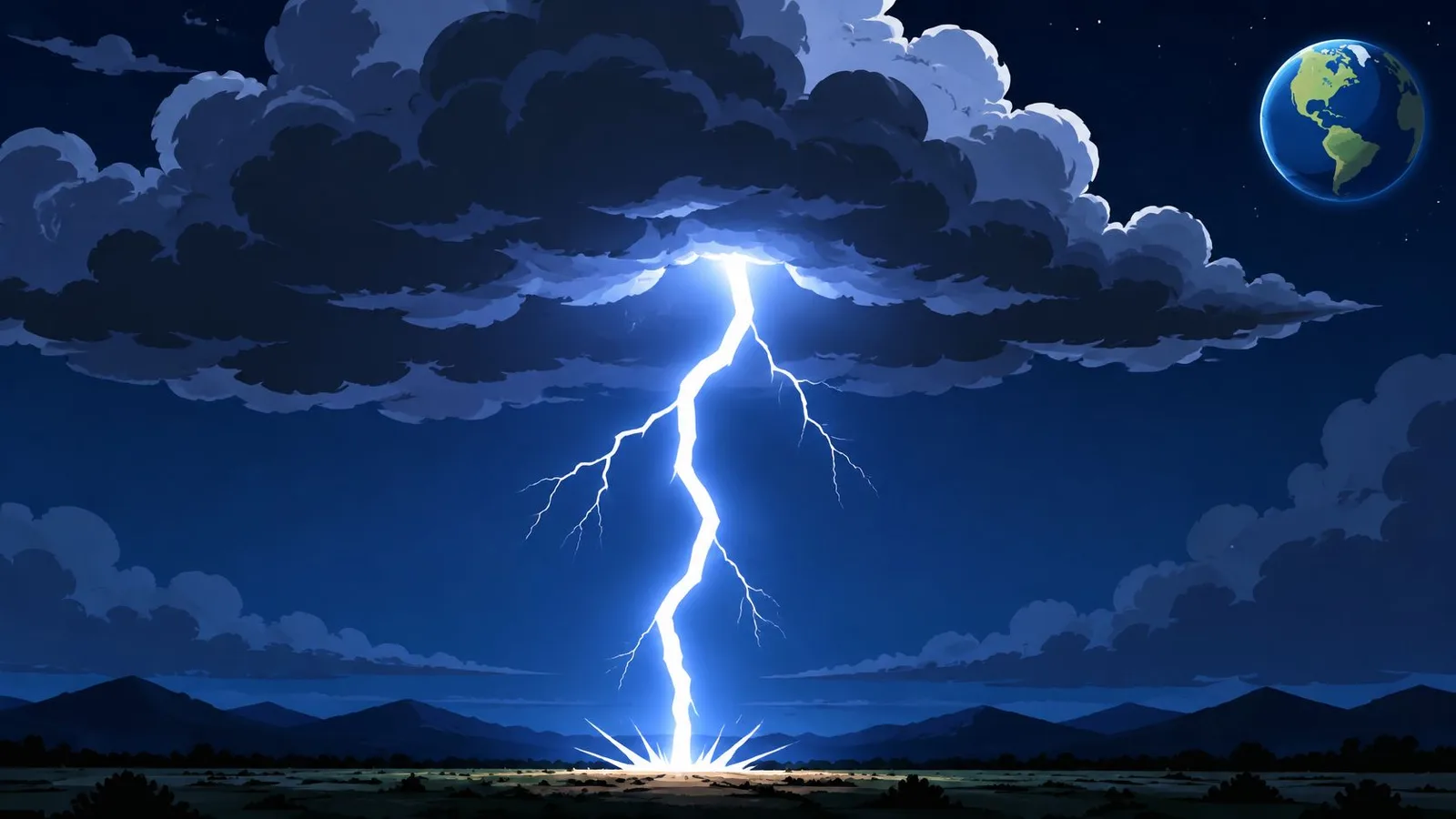
No. Inside a thunderstorm, moving water droplets, ice particles, and collisions help separate electric charge. Air currents move particles through different parts of the cloud, contributing to regions with different electrical conditions.
Air ordinarily resists the movement of electric charge. When the electrical conditions become strong enough, a conducting pathway can develop and a discharge can occur. Lightning is that electrical discharge, not sunlight reflected by rain.
A familiar spark, on a very different scale
A small static spark after walking across a carpet offers a useful analogy: separated charge can discharge when conditions permit. A thunderstorm, however, is a complex moving system, not a giant carpet experiment.
Lightning rapidly heats the surrounding air. The air expands, producing the pressure disturbance we hear as thunder. You generally see a flash before hearing its thunder because light reaches you faster than sound.
Don't use a flash-to-thunder calculation as permission to stay outside. If you hear thunder, seek a substantial building or an enclosed hard-topped vehicle.
The misconception to drop: Every lightning flash strikes the ground. Discharges can also occur within clouds and between them.
For a practical example, consider a building's lightning-protection system. Its purpose is to provide a designed conducting route toward ground, not to make the surrounding storm disappear.
Question 4 of 6
Why do we see lightning before thunder?
7. Why Is Your Body Also a Microbial Ecosystem?
A bacterium lives in your gut. Does its presence automatically mean you have an infection?
No. Many microbes inhabit the body without causing disease, and some contribute to processes such as digestion and immune development. Location and circumstances matter: a microbe that belongs in a particular environment can cause trouble somewhere else.
The useful surprise isn't a dramatic bacteria-to-human-cell ratio. It's that your body's normal functioning includes interactions with other organisms.
Count cells carefully, interpret them cautiously
Comparisons between bacterial and human cell counts depend on what researchers count and which body they model. Body size, microbial populations, and the inclusion of different cell types affect the estimate. A fixed slogan hides those assumptions.
Think of the gut as a habitat with changing resources and conditions. Diet, medications, illness, and other influences can affect which microbes thrive there. That doesn't mean every change is harmful or that everyone needs the same intervention.
- Presence isn't diagnosis. Finding bacteria doesn't, by itself, establish disease.
- Different microbes do different things. Bacteria aren't interchangeable with viruses.
- A food isn't a guaranteed treatment. Fermented foods and probiotic products shouldn't be treated as universal fixes.
The misconception to drop: All microbes are enemies that should be eliminated.
A useful everyday application is understanding why identifying the cause of an illness matters. This guide to comparing viral and bacterial infections offers a starting point for distinguishing those categories, rather than treating every infection as the same biological problem.
8. Why Aren't Old Windows Evidence That Glass Flows?
An old pane is thicker along its lower edge. Does that observation prove the glass slowly drained downward?
It's an appealing explanation because the shape seems to match the story. But an uneven object doesn't tell you when or how its unevenness developed. You need evidence about its manufacture and installation before concluding that it changed afterward.
Ordinary window glass is an amorphous solid. Its atoms lack the long-range repeating arrangement found in a crystal, but that doesn't make the pane an ordinary liquid.
Separate a structure from a behavior
Think of a neatly arranged crowd and a disordered crowd standing still. Their arrangements differ, but disorder alone doesn't tell you that either crowd is flowing.
Historical glassmaking methods could produce panes with uneven thickness. Installing a pane with a thicker edge downward can explain the observation without requiring noticeable room-temperature flow.
Evidence habit: Ask whether an object could have started in the condition you're trying to explain.
The misconception to drop: An irregular atomic arrangement means a material must behave like a liquid.
For a practical exercise, compare the claims this pane is uneven and this pane became uneven after installation. The latter requires additional evidence. Work on scientific misinformation helps explain why examining a tempting mental model matters, rather than merely replacing a false slogan with a correct one.
Question 5 of 6
Why are the panes in very old windows often thicker at the bottom?
9. Why Can Water Boil Without Becoming Very Hot?
Predict the outcome: If you remove air from above a container of water, does boiling become harder or easier?
It becomes easier because boiling depends on surrounding pressure, not temperature alone. A liquid boils when its vapor pressure matches the pressure around it, allowing vapor bubbles to form and grow within the liquid.
Lowering the surrounding pressure lowers the temperature needed for boiling. Under sufficiently low pressure, water can boil near room temperature.
Give the bubbles room to grow
Think of the surrounding pressure as an external squeeze. A vapor bubble must withstand that squeeze rather than collapse. Reduce it, and bubbles can survive under conditions where they otherwise couldn't.
A laboratory vacuum chamber demonstrates the principle without requiring the water to become conventionally hot. As evaporation removes energy, the remaining water can also cool, so sustained boiling may require additional heat input.
- At altitude, lower air pressure means water boils at a lower temperature, which can affect cooking.
- In a pressure cooker, higher pressure allows liquid water to reach a higher temperature before boiling.
The misconception to drop: Boiling always means the same temperature, or bubbling alone proves that water is dangerously hot.
Don't improvise a vacuum vessel from ordinary kitchen glass. For a safer conceptual follow-up, explore why water is wet, which shifts attention from pressure to interactions between water and surfaces.
Question 6 of 6
Why can water in a vacuum chamber start boiling while it is still cool to the touch?
10. Why Can Sharks Be Older Than Trees Without Being Unchanged?
Which claim is stronger: Shark ancestry predates trees, or modern shark species have existed unchanged since before forests?
Those statements aren't equivalent. The comparison concerns the history of a broad evolutionary lineage, not the uninterrupted existence of every species alive today. An ancient family history doesn't make its living members identical to their distant ancestors.
Fossils allow paleontologists to compare the appearance of shark relatives with the emergence of tree-like plants. Interpreting the comparison also requires care about what qualifies as a shark or a tree.
Draw branches, not a ladder
Evolution isn't a procession in which newer organisms automatically replace older ones. Lineages branch, populations change, and many branches become extinct. Living sharks represent surviving branches with their own evolutionary histories.
A useful classroom activity is to draw a branching family tree. Mark extinct branches separately from branches that reach the present, then distinguish the age of the overall group from the age of a particular species.
The misconception to drop: A long-lived lineage has stopped evolving or reached perfection.
Deep time itself rests on physical evidence. The U.S. Geological Survey estimates Earth's age at approximately 4.54 billion years, primarily using lead-isotope dating of materials connected to the early Solar System. Radioactive decay provides a clock, while comparisons among materials help scientists test the interpretation.
That timescale gives evolutionary history room to unfold. It doesn't turn survival into a guarantee: an ancient lineage can still contain species vulnerable to present-day environmental pressures.
10 Science Facts of the Day at a Glance
Use each question to predict an explanation before reading the mechanism. A familiar label can hide a surprising process, and a careful answer often depends on the conditions.
| Fact | Field | Core Mechanism | Common Myth Busted | Best Follow-Up Question |
|---|---|---|---|---|
| Octopuses Have Three Hearts and Blue Blood | Marine biology | Two hearts pump blood through the gills; a third circulates it to the body. Copper-based hemocyanin carries oxygen. | Octopuses have one heart, or their blood is red like ours. | Why is blood red in most animals but blue in some? |
| Honey Resists Spoilage When It Is Stored Properly | Food science | Low water content, high acidity, and concentrated sugar inhibit microbes; an enzyme can also produce hydrogen peroxide when diluted. | Honey can never spoil, regardless of storage or moisture. | Why does honey last so long? |
| Bananas Are Botanical Berries, but Strawberries Are Not | Botany | Botanical berries develop from one ovary and have seeds within the flesh; strawberry “seeds” are achenes on the outside. | Everyday fruit names match botanical classifications. | Why are grains like wheat technically fruits? |
| Sunlight Takes About Eight Minutes to Reach Earth | Astronomy and physics | Light travels across the average Earth–Sun distance in about 8 minutes and 20 seconds. | We see the Sun as it is right now. | What do we see when we look at distant stars? |
| Hot Water May Sometimes Freeze Faster Than Cold Water | Physics | Under certain conditions, effects such as evaporation, convection, dissolved gases, or supercooling may influence freezing time. | Hot water always freezes faster than cold water. | Which conditions might make the Mpemba effect occur? |
| Lightning Strikes Earth Dozens of Times Every Second | Atmospheric science | Charge separation in storm clouds can trigger electrical discharges that rapidly heat air, producing thunder. | Lightning is a rare event worldwide. | How can the time between a flash and thunder help estimate distance? |
| Estimates of Bacterial-to-Human Cell Counts Vary | Microbiology | Microbes, mostly in the gut, contribute to digestion, immune function, and vitamin production. Estimates of bacterial-to-human cell counts vary with how cells are counted. | The body has ten times more bacterial cells than human cells. | What roles do microbes play in the body? |
| Glass Is Not Slowly Flowing and Old Windows Do Not Sag Because of It | Materials science | Glass is an amorphous solid; uneven old panes generally reflect historical manufacturing and installation methods. | Glass flows at room temperature, causing old windows to sag. | Why might old window panes have uneven thickness? |
| Water Can Boil at Room Temperature Under Low Pressure | Chemistry and physics | Lowering surrounding pressure lowers water's boiling point; at about 0.023 atmospheres, it boils near 20°C. | Water always boils at 100°C. | What happens to water's boiling point when pressure changes? |
| Sharks Are Older Than Trees | Paleontology | Fossil evidence places sharks earlier than the first known trees, with shark lineages persisting through multiple mass extinctions. | Trees appeared before sharks. | Why do some lineages persist through mass extinctions? |
Turn One Fact Into a Daily Curiosity Habit
Remembering that octopus blood is blue is a start. Explaining the oxygen-carrying chemistry is more useful. Asking why different animals evolved different transport systems takes you beyond recall and into a question you can investigate.
The same pattern works across subjects. With honey, ask which conditions prevent microbial growth. With boiling, ask what changes when pressure changes. With old glass, ask whether an observation distinguishes the proposed explanation from a simpler alternative.
Make uncertainty part of the answer
You don't need to sound certain about everything to understand science. Some explanations are well established; others depend on particular experimental conditions. The useful response is to name that difference plainly.
A study of prospective science-museum visitors found that communicating uncertainty didn't reduce trust or interest in the tested information. That's a reason to include limitations, not a promise that every audience will react identically. Explain what scientists observed, what they infer, and what evidence could change the conclusion.
Try keeping a small curiosity notebook with these prompts:
- My prediction. What did I expect, and why?
- The mechanism. What process explains the result?
- The boundary. Under what conditions might the claim fail?
- My next question. Where else might the same principle apply?
You can use the notebook alone, with a student, or around a family dinner table. Ask someone to explain their reasoning before revealing the answer. A mistaken prediction is useful when it exposes the assumption that needs attention.
Follow the question that stays interesting
For a shared activity, explore British Science Week and choose a question that can become a discussion, demonstration, or small investigation. Favor activities where participants can predict an outcome and compare it with what happens.
At Million Whys, our Daily Wonder changes each day, and every answer choice comes with a fact-checked explanation. Follow-up questions can become new questions, so curiosity doesn't have to end when an answer appears.
The lasting habit is simple: pause before the reveal, explain afterward, and follow whatever still puzzles you. A good fact isn't the end of learning. It gives you a better question to ask next.
Visit Million Whys for daily why-questions and explanations for every answer choice. Try predicting a science answer before revealing it, then follow the explanation into the next question that catches your curiosity.
Keep Exploring
Related Posts
10 Crazy Facts About the World, Explained by Science
Discover 10 crazy facts about the world, from honey that never spoils to lightning hotter than the Sun. Each one comes with a clear, science-backed explanation.
Fun Facts About Psychology: 10 Surprising Findings
Discover 10 fun facts about psychology, from the bystander effect to the Ben Franklin effect, with clear explanations of why each one happens.
Cool Fact of the Day: Questions With Answers
A cool fact of the day collection with real questions, answers, images, and explanations about nature, space, light, bodies, everyday physics, and more.