

Why Is Water Wet? Forces, Not a Feeling
On this page· 14
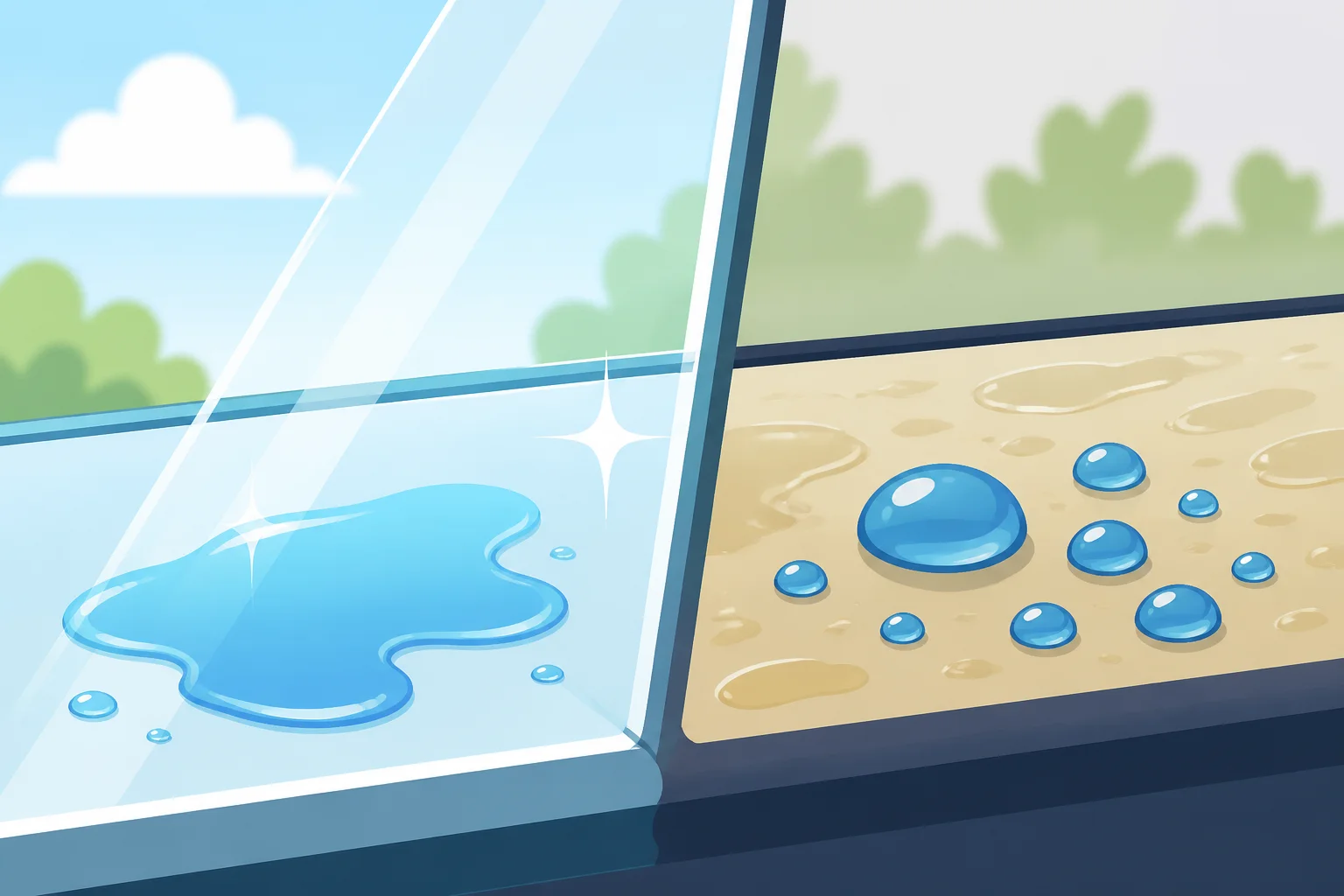
Water isn't wet as a substance: wetness is what happens when adhesion between water and a surface competes with cohesion among water molecules. A contact angle below 90° generally signals favorable wetting, while above 90° signals poor wetting and beading.
That sounds like a neat answer until you turn on a tap. Your hand comes away soaked, yet a raindrop can sit on waxed paint as a tight bead. The popular advice that water is “wet” misses the distinction that explains both scenes: wetness describes an interaction, not a feeling built into the liquid.
The question “why is water wet?” becomes easier to answer when you ask what water is touching, how the molecules attract one another, and whether the liquid spreads, beads, wicks, or rolls away.
Is Water Wet? The Definition Debate and the Short Answer
Water from a tap clings to your skin; a raindrop on waxed paint stays rounded. Both are water, but they behave differently because wetness depends on the surface they meet. Water is the liquid doing the wetting, while wet describes its relationship with a material such as skin, cloth, glass, soil, or another film of water.
There's a reasonable word-based objection: if “wet” means covered by a liquid, pure water isn't covered by another substance, so calling the water itself wet sounds like a category mistake. That's a useful distinction in everyday language, but it doesn't explain what happens when water touches a hand or a shirt.
The surface changes the answer
The cold cling on skin and the dark patch on fabric are physical clues. Adhesion is attraction between water and another material. Cohesion is attraction among water molecules. When adhesion pulls water across a surface, the liquid spreads or clings; cohesion helps keep the water together as a drop or film.
This force balance resolves the apparent contradiction. Water can spread over one material and bead on another without changing its identity. On a water-attracting surface, adhesion helps draw the liquid outward. On wax, the attractions among water molecules can prevail, keeping the drop compact.
A common argument says that water must be wet because each water molecule is surrounded by other water molecules. But that mixes up three different arrangements: water inside a bulk liquid, water in a thin surface film, and water gathered into a bead. The argument can't explain why the same water spreads on one material and avoids another.
What a scientist means by wetting
In the lab, researchers describe a surface by observing what water does on it. Does the drop spread? Does it remain rounded? Does it wick into pores? Does it roll away? Those outcomes give wettability a practical meaning tied to a specific liquid–surface interface.
If a drop merges into a puddle, the boundary between that drop and the puddle disappears. Calling the water in the puddle “wet” adds little: the useful question is how water interacts with the solid beneath it or with another material it touches.
So water isn't wet in the same way a shirt is wet. It's the liquid whose attractions determine whether a particular surface becomes wet. Contact angles, surface tension, and materials that change a drop's shape make that verdict testable.
Question 1 of 5
Why does the same water spread out on clean glass but stay as a rounded bead on a waxed car?
Contact Angles That Sort Wet from Beaded
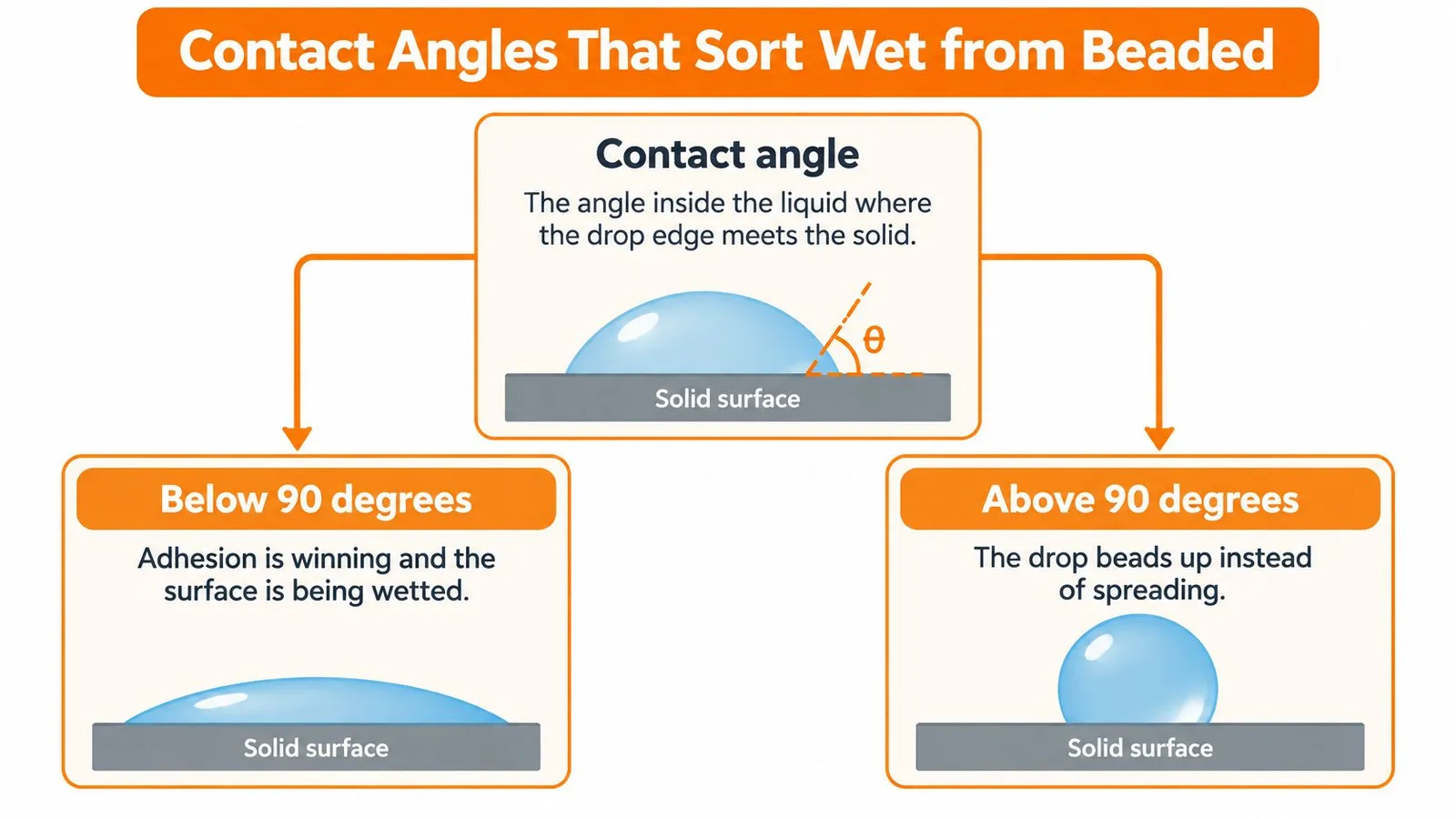
A contact angle is measured inside a drop where its edge meets a solid surface. A small angle means the drop spreads; a large angle means it stays rounded. The bands below offer a practical way to classify what you see.
| Band | Contact angle | What you see | Force balance |
|---|---|---|---|
| Superhydrophilic | About 20° or lower | Strong spreading and wicking | Adhesion overwhelms cohesion |
| Favorable wetting | Below 90° | Drop flattens and wets the solid | Adhesion wins at the interface |
| Poor wetting | Above 90° | Rounded bead | Cohesion and surface tension win |
| Superhydrophobic | 150° or higher | Extreme bead that may roll off | Texture plus low surface energy |
A 2026 meta-analysis of 110 contact-angle measurements published from 1995 through 2025 identified angles of approximately 20° or lower as superhydrophilic and 150° or higher as superhydrophobic, according to the meta-analysis of contact-angle measurements. The middle distinction is straightforward: below 90°, wetting is generally favorable; above 90°, wetting is generally poor.
Why the angle changes
Think of a drop as a soft balloon resting on a table. Cohesion is water holding onto water; adhesion is water holding onto the solid. The drop's shape is the compromise between those attractions, not a sign that the liquid has changed.
A water-attracting surface pulls the edge outward, making the drop flatter and the angle lower. On a water-repelling surface, cohesion keeps the drop rounded and the angle larger. This force balance can be expressed using Young's equation, proposed by Thomas Young in 1805: γSL − γSV + γLV cos θ = 0. Here, γSL, γSV, and γLV are the solid–liquid, solid–vapor, and liquid–vapor interfacial tensions, and θ is the contact angle.
The equation gives a quantitative foundation to the everyday observation: wetness isn't a separate substance or a single property of a water molecule. It's the observable result of intermolecular forces at an interface, a useful way to describe coatings, paints, biological tissues, soil, and industrial materials, as outlined in the account of contact angles and wetting theory.
When you encounter a new surface, identify the angle band before judging it from the word “wet.” If you're curious how the same principle helps protect a vehicle's finish, protect paint with a hydrophobic coating is one practical application to explore.
Question 2 of 5
When scientists measure a water drop's contact angle on a surface, what exactly are they measuring?
Hydrogen Bonds Behind the Surface Tension
Water's surface can resist stretching even while water spreads across a surface. The key is to separate cohesion within the liquid from adhesion between water and another material. At about 293 K, or 20°C, water's equilibrium surface tension is 72.8 mN/m, a measurable sign of strong cohesion. Hydrogen bonding between neighboring water molecules contributes to this tension, as described in the study of water's surface tension.
Each water molecule has partially positive hydrogen atoms and a partially negative oxygen atom. Neighboring molecules can therefore form hydrogen bonds. Inside a pool, a molecule is surrounded by water in many directions. At the air–water boundary, it has fewer water neighbors above it, so the surface resists expanding.
A boundary that resists stretching
A crowd near a doorway offers a useful comparison. People in the middle have neighbors all around; people at the edge have fewer on one side. At water's surface, this imbalance makes it energetically costly to create more exposed area. Surface tension is not a physical skin, though it helps explain why a drop tends to minimize its surface area.
Under ordinary conditions, water's surface tension is roughly 72 mN/m, several times higher than that of many oils. This strong cohesion helps water resist stretching at its surface. It can also help water rise through narrow spaces when water is attracted to the walls.
That same balance explains why small insects can be supported at the water's surface and why water can rise through a narrow tube when it attracts the tube's wall. Cohesion can help a drop bead, but it does not determine the outcome alone. When adhesion to a solid offsets or exceeds cohesion, water can spread instead.
Cohesion doesn't rule out wetting
Clean glass and metals commonly attract water, while waxes and many oils encourage beading. The liquid's cohesion remains; what changes is its interaction with the boundary. In window cleaning, how pure water cleans windows provides a practical example involving water and glass.
These forces make wetness more than a sensation, such as a soaked hand. At an interface, it is a relationship that can be measured through how water meets a surface. Water's facts about ice offer another way to explore how molecular behavior shapes what we notice in everyday life.
Question 3 of 5
What makes water's surface at 20°C harder to stretch than a layer of cooking oil?
Surfaces That Flip the Same Drop
The same drop can spread, bead, or roll, depending on the surface. Clean glass and clean metals commonly attract water, while wax and many oils encourage a rounded drop. The discussion of surfaces that change water's wetting behavior describes how surface chemistry, energy, roughness, and texture can shift that balance.
| Surface | Angle or class | What the drop does |
|---|---|---|
| Clean glass and clean metals | Typically below 90° | Spreads and sheets |
| Wax, many oils, and oil-coated materials | Above 90° | Stays a rounded bead |
| Lotus-like coating | Can exceed 150° | Beads and can roll off |
| Treated PLA before ultraviolet exposure | About 147.2° | Highly water-repellent |
| Same PLA after two hours of ultraviolet light | About 22.5° | Strongly wicking |
| Laser-engineered aluminum, 2025 | 162.81 ± 2.26° static; sliding 6.06 ± 0.44° | Wetting strongly suppressed |
One liquid, different interfaces
A lotus leaf gives a memorable example of extreme beading. Its waxy chemistry and microscopic bumps help produce a highly water-repellent surface. The drop can bead and roll away, sometimes carrying dust with it. The water didn't stop being the same liquid; the interface changed.
Engineers can also make one material behave in sharply different ways. A 2025 study reported that ultraviolet exposure lowered the contact angle on treated polylactic acid, or PLA, from about 147.2° to 22.5° after two hours, switching the surface from highly water-repellent to strongly wicking. In a separate 2025 study, laser-engineered aluminum reached a static contact angle of 162.81 ± 2.26° and a sliding angle of 6.06 ± 0.44°, demonstrating how its structure can strongly suppress wetting.
Fabric is a mixed case. Water may bead on a coating at the surface but still travel between fibers and into the threads. That's why the useful prediction isn't “fabric repels water” or “fabric absorbs water.” The coating, fiber arrangement, and liquid's route into the material all matter.
Read the material, then predict the drop
Pick the surface first, then use its angle class to predict whether water should spread, bead, or roll. Roughness can support either outcome: attractive chemistry and connected pores can encourage wicking, while a combination of texture and water-repelling chemistry can help preserve a bead.
The comparison table illustrates the broader point. A surface treatment can change the same material from highly water-repellent to strongly water-attracting, while a carefully textured metal can resist wetting. Wetness belongs to the interface, not to water alone.
Question 4 of 5
Why do water droplets roll off lotus leaves like tiny balls?
Wetness That Starts Before You Can See It
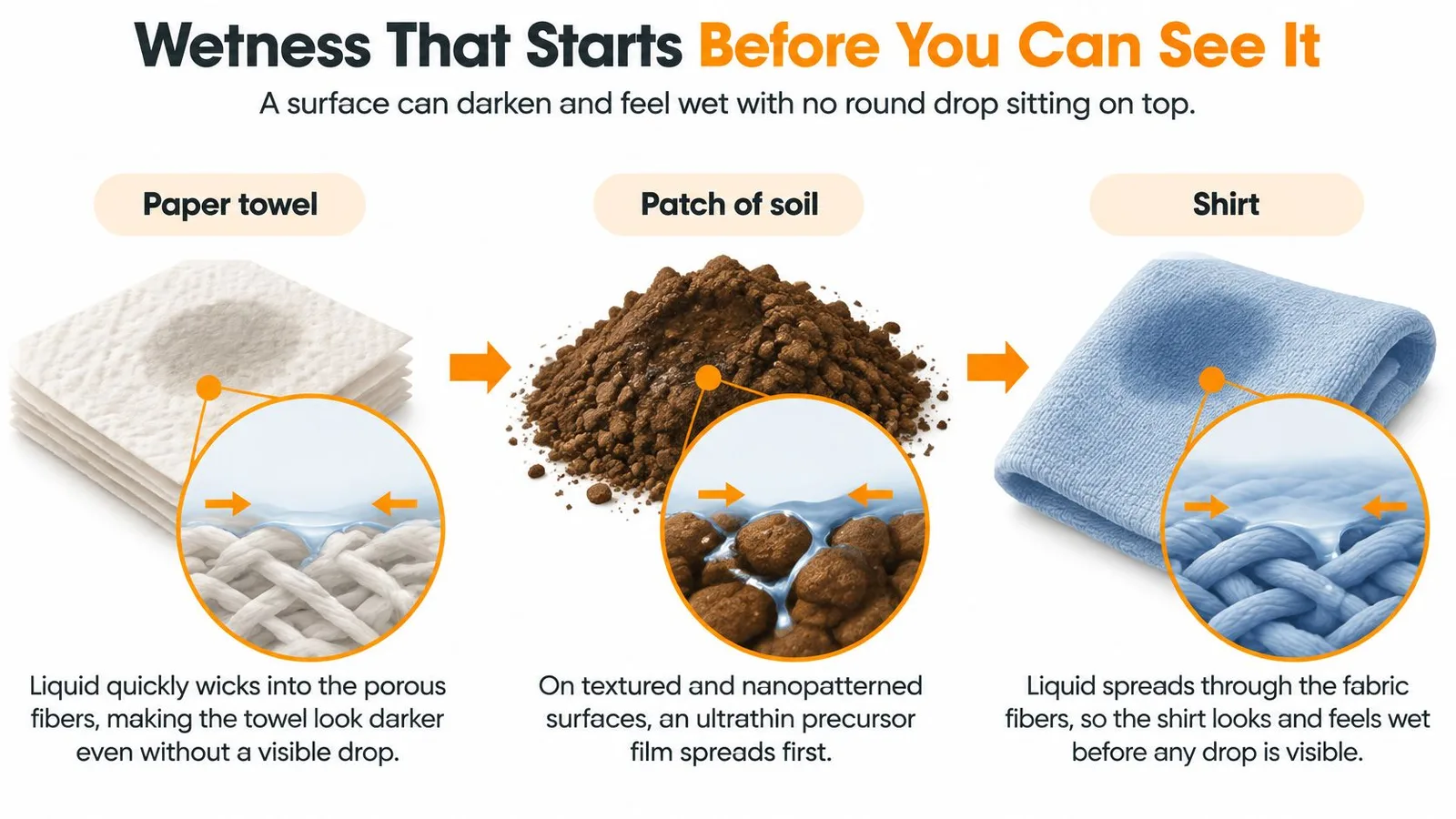
A paper towel can darken and feel wet even when you can't see a round drop sitting on top. Water has entered the material rather than gathering into a visible bead. This raises a useful question: can a surface be wet before water appears to spread?
On some textured or nanopatterned surfaces, an ultrathin precursor film can move ahead of the visible drop. In nanopillar experiments, wetting happened in two stages: first the thin film formed, then capillary action drew more water into the tiny structures. The study of precursor-film wetting and capillary filling describes why a surface can become wet before its visible drop changes shape.
Three ways water can meet a surface
Think of a sidewalk after light rain. A patch darkens as water moves into the grain, even if no puddle forms there. Paper towels, cloth, soil, plant tissues, and other porous materials have tiny spaces that can draw water inward. A related everyday topic, wet-bulb temperature, also shows how water can affect what we feel without appearing as a pool.
Now separate three outcomes. A drop can sit on a surface as a bead. It can disappear into pores. Or an unseen film can spread ahead of the main drop while the surface still looks dry. They're different results of water interacting with a material, not competing definitions of wetness.
Roughness alone doesn't tell you which outcome to expect. A textured surface may channel water when its chemistry attracts it, or help maintain repellency when its geometry and chemistry support a bead. Hydrophilic surfaces are generally classified below 90°, while superhydrophobic surfaces are above 150°.
Visible spreading is not the definition of wetting. Water can occupy pores or advance as a thin film before your eyes register a spreading drop.
Before the next spill, make a prediction: will water stay as a drop, enter pores, or form an unseen film? Then look for the clue, a bead, a darkening patch, or water moving through tiny features.
Question 5 of 5
Why does a surface covered in tiny nanopillars start to look wet before the drop sitting on it visibly changes shape?
Predict the Next Drop Then Check
Turn the explanation into a quick experiment. You don't need measuring equipment; you need to name the surface and pay attention to what the drop does.
- Name the surface. Say “clean glass,” “waxed paper,” “cloth,” “soil,” or “leaf,” rather than asking what water does in general.
- Predict the outcome. Expect spreading on a surface that attracts water, beading when cohesion holds the drop together, and rolling on a strongly water-repellent, lotus-like surface. If the material has pores, predict that water may enter them even if no drop remains visible.
- Check what happened. A low, flattened edge suggests the water spread across the solid. A tall, rounded bead stayed gathered. A patch of darkened paper towel or fabric points to water moving into its texture.
Try a drop on clean glass beside one on waxed paper. Then compare a drop on a paper towel with one on a plastic lid. Write down your predictions first; the contrast will make it easier to notice how much the surface controls what happens.
The verdict is simple: water is the liquid, and wet describes the interface where it meets a surface. Repeat the three steps the next time you see a spill at home, and ask whether the water spread, beaded, or disappeared into pores.
Million Whys turns everyday curiosity into short interactive questions with explanations for every answer choice. Its Daily Wonder is a featured question that changes every day, with a curated knowledge card, image, and detailed explanation, a good fit for exploring questions like why water beads on one surface and spreads on another. Visit Million Whys to keep following questions sparked by the ordinary world around you.
Keep Exploring
Related Posts
Why Does Ice Float on Water? the Density Answer
Why does ice float on water? Ordinary ice is about 917 kg/m³, about 8.3% less dense than liquid water, so roughly that share stays above.
Facts About Ice: Why Frozen Water Gets Weird
Facts about ice: why frozen water floats, expands, makes six-sided snowflakes, turns slippery, rejects sea salt, reflects sunlight, and shapes life on Earth.
Fun Facts About Weather: Everyday Sky Physics
Fun facts about weather, explained through why raindrops flatten, clouds float, thunder rolls, snow survives warm layers, fog forms, and rainbows circle.