

Why Does Ice Float on Water? the Density Answer
On this page· 19
Ordinary ice near 0 °C is about 917 kg/m³, roughly 8.3% less dense than liquid water near 1,000 kg/m³, so about 8.3% of an idealized cube sits above fresh water.
But if hydrogen bonds make ice less dense, why doesn't liquid water, which also has hydrogen bonds, hold the same empty spaces? That's the missing step in many explanations of why ice floats on water.
The useful distinction isn't bonds versus no bonds. It's a fixed molecular framework versus a network that keeps rearranging. Understanding that difference explains both the ice cube in your glass and the limits of the familiar claim that ice always floats.
The Density Numbers That Make Ice Float
Density means mass divided by volume. It tells you how much matter occupies a given amount of space, not how heavy an object is overall.
A large ice block can weigh more than a small glass of water and still float. Floating compares the block with the water it displaces, not with an arbitrarily chosen glassful.
At approximately 0 °C, ordinary ice has a density of about 917 kilograms per cubic meter, compared with about 1,000 kilograms per cubic meter for liquid water near its maximum density, a difference of roughly 8.3%, according to Britannica's explanation of ice. In that idealized comparison, approximately 91.7% of the ice's volume is submerged and about 8.3% remains above the surface.
Why the cube stops sinking
Drop an ice cube into a glass and it pushes some water aside. The displaced water produces an upward buoyant force.
As more of the cube enters the water, it displaces more water and receives more upward support. It stops descending when that support balances its weight, before the entire cube goes underwater.
The practical rule is simple: a floating object displaces its own weight in liquid. Because ordinary ice is less dense than fresh water, a fully submerged cube would displace water heavier than itself.
Density of ordinary ice and liquid water
| State and temperature | Density | What that means for floating |
|---|---|---|
| Ordinary ice near 0 °C | 917 kg/m³ | About 8.3% less dense than water near 1,000 kg/m³; about 8.3% of its volume stays above fresh water and about 91.7% is submerged |
| Liquid water at 0 °C | 0.9998 g/cm³ | Slightly less dense than the 4 °C maximum, so it stays above that heavier layer |
| Liquid water at 4 °C | 1.0000 g/cm³, about 1,000 kg/m³ | Maximum density; this water sinks beneath less-dense water |
| Liquid water at 10 °C | 0.9997 g/cm³ | Slightly less dense than water at 4 °C; as it cools toward 4 °C, it becomes denser and tends to sink |
The liquid-water entries show small differences. The transition to ordinary ice produces a much larger change, enough to leave part of a floating cube exposed.
Same substance, different amount of space
Freezing doesn't turn water into a different chemical substance. The molecules remain H₂O.
Instead, the same mass occupies more space. Divide that unchanged mass by a larger volume and the density falls.
Floating rule: Compare the object's average density with the liquid's density, not its total weight or its size.
This also explains why making a cube bigger doesn't automatically make it sink. A larger cube weighs more, but it can also displace more water.
The density comparison gives the floating result. It doesn't yet explain why the solid takes up more space, especially when hydrogen bonds exist in both phases.
Question 1 of 6
Why does roughly a tenth of a floating ice cube stick up above the waterline?
How a Hexagonal Lattice Holds Empty Space
Think of a water molecule as a small, bent unit with hydrogen attached to oxygen. Oxygen attracts the shared electrons more strongly, leaving the oxygen end partly negative and the hydrogen ends partly positive.
A hydrogen on one molecule can therefore attract the oxygen region of a neighboring molecule. That attraction is a hydrogen bond. It's different from the chemical bonds holding the atoms together inside each water molecule.
In ordinary ice, these attractions favor particular directions rather than any arrangement that brings molecules close together. The CORDIS explanation of why ice floats describes an open tetrahedral network in which each molecule is arranged around approximately four neighbors.
A framework rather than a tight pile
A tetrahedral arrangement describes the positions of nearby molecules in three dimensions. Hexagonal describes the repeating structure of the larger crystal. Those descriptions refer to different scales, so they aren't competing explanations.
The important point is that the molecules don't settle into every available gap. Their preferred bonding arrangement preserves open regions throughout the solid.
A scaffold makes a useful comparison. Fixed beams and joints hold an open framework even though loose pieces of the same material could fit into a smaller space.
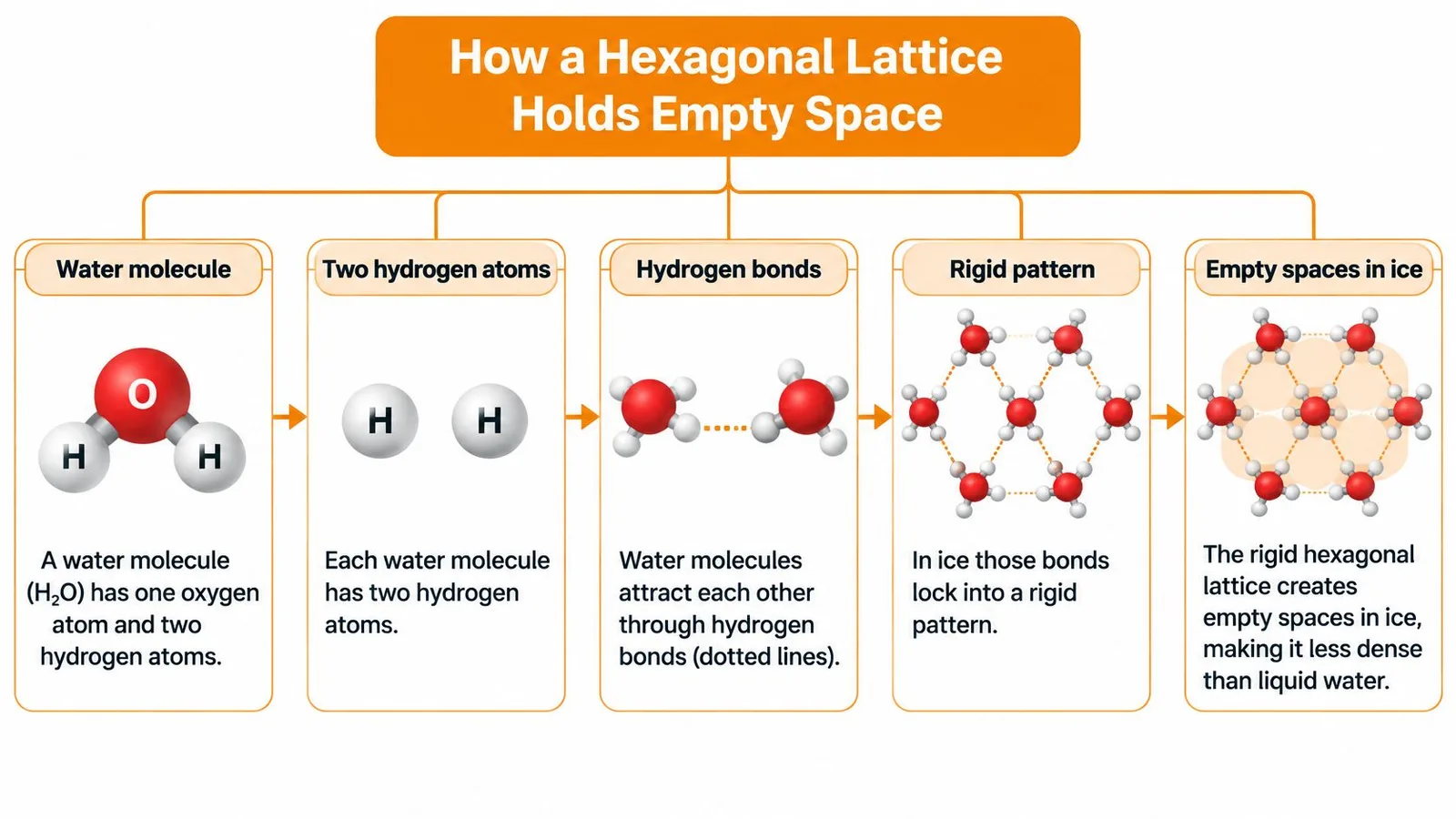
The analogy has a limit: molecules aren't beams, and an ice crystal isn't motionless. Molecules still vibrate, but they remain organized around relatively fixed positions instead of moving freely through the material.
That organization produces a solid that resists changing shape while retaining more space between its molecules.
A rigid solid doesn't have to be a tightly packed solid. Ice is firm because its molecules form an organized framework, not because they fill every gap.
What the empty spaces aren't
The open regions in an ice crystal aren't little bubbles of air. They're spaces created by the arrangement of the water molecules themselves.
Cloudy ice can contain trapped air, and air can change a piece of ice's average density. But a clear cube doesn't need bubbles to float.
- The atoms don't become lighter. Freezing changes their arrangement, not their identity.
- The molecules don't swell. More space appears between molecules in the crystal.
- Hardness doesn't prove high density. A material can hold its shape while maintaining an open internal structure.
Many substances pack more closely when they freeze. Their solids can therefore sink in their own liquids. Water's ordinary crystal arrangement does the opposite.
This distinction matters when using the scaffold analogy. It's not just that freezing makes molecules orderly. It's that the particular order adopted by ordinary ice holds them farther apart on average than they are in the liquid.
Question 2 of 6
Why does ordinary ice float on water, even though most forms of ice are denser than liquid water?
Why Liquid Water Fills Gaps Ice Cannot
Liquid water's molecules still form hydrogen bonds. The shortcut that says those bonds vanish during melting misses the change that matters: in liquid water, the bonds continually rearrange.
A 2024 Max Planck Institute for Polymer Research report states that hydrogen bonds in liquid water break and reform about 1 trillion times per second. This rapid turnover helps explain how the liquid can change shape at the molecular level. As the molecules shift among neighbors, some can occupy spaces that the rigid ice lattice holds open.
A flexible network can occupy less space
A scaffold with joints that release and reconnect can shift into gaps that a fixed frame preserves. Liquid water behaves similarly: its hydrogen-bond network changes as molecules move, allowing the arrangement to become more compact than ice.
The molecules do not need to eliminate every gap. They only need to occupy a smaller volume on average than the same collection of molecules occupies in the solid.
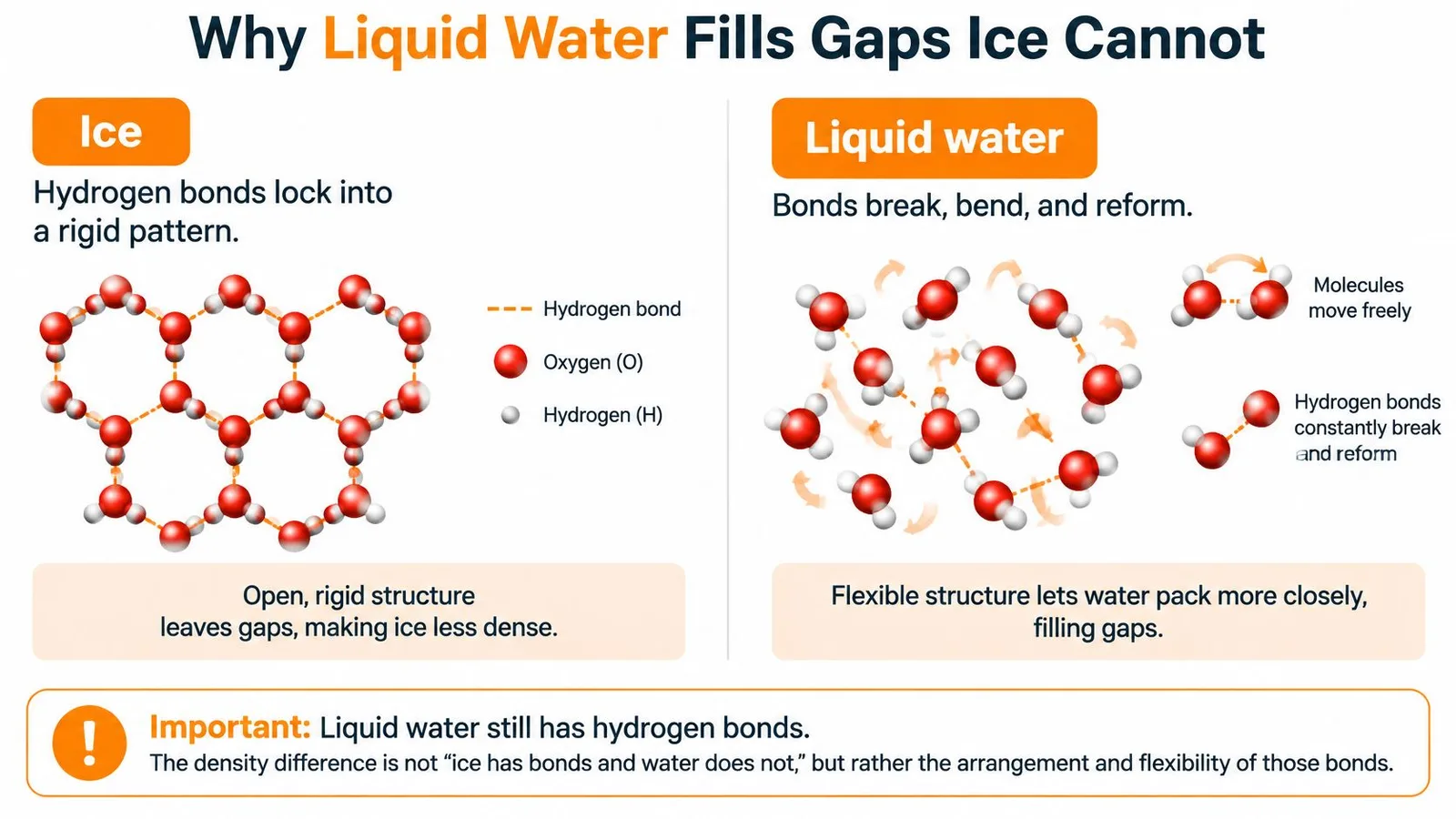
Disorder does not automatically mean worse packing. A tidy arrangement of folding chairs can leave broad aisles, while a less orderly arrangement can use some of that space. In the same way, liquid water's shifting local patterns let molecules move into spaces that the regular ice lattice preserves.
Replace the shortcut with the full chain
- Incorrect shortcut: Liquid water has no hydrogen bonds, so its molecules can pack closely.
- Useful explanation: Liquid water has a flexible hydrogen-bond network, so its molecules can rearrange into some of the spaces maintained by the solid.
Hydrogen bonds remain important; their arrangement changes. When ice melts, the persistent crystal framework gives way, while temporary hydrogen bonds continue to form and break.
The liquid is not a collection of tiny ice crystals with permanently empty centers. Its local arrangements keep changing, and density reflects the average volume of the sample rather than one frozen snapshot.
Why this distinction reaches beyond floating
Hydrogen bonds also affect how water interacts with surfaces, a related question explored in why water is wet. Wetting concerns contact with another material; floating depends on density and displaced liquid.
For ordinary ice, the chain is straightforward: a rigid, directional bond network holds an open lattice; liquid water's rearranging bonds let molecules occupy some of those gaps; and the liquid can pack into less space. That density difference is why ordinary surface ice floats. Not every solid phase of H₂O shares this behavior.
Question 3 of 6
Why is liquid water denser than ice even though both are made of the same water molecules?
How Water Gets Heaviest Near 4 Degrees
Cooling water doesn't always make it denser. The direction of the change reverses before freezing, which helps determine where winter ice forms in a lake.
The Chemistry LibreTexts guide to hydrogen bonds places liquid water's greatest density at approximately 3.98 °C, commonly rounded to 4 °C. Its representative values are about 1.0000 g/cm³ at 4 °C, 0.9998 g/cm³ at 0 °C, and 0.9997 g/cm³ at 10 °C.
These values describe fresh liquid water under ordinary conditions. They shouldn't be treated as a universal temperature rule for salty oceans.
Cooling can produce opposite density changes
At warmer temperatures, cooling generally lets water contract. The same mass occupies less volume, so its density increases.
In a lake, surface water cooled by cold air can then sink beneath less-dense water. This movement carries cooling below the immediate surface.
Once water cools below its density maximum, however, increasingly open hydrogen-bond arrangements outweigh that ordinary contraction. Further cooling makes the liquid expand slightly instead.
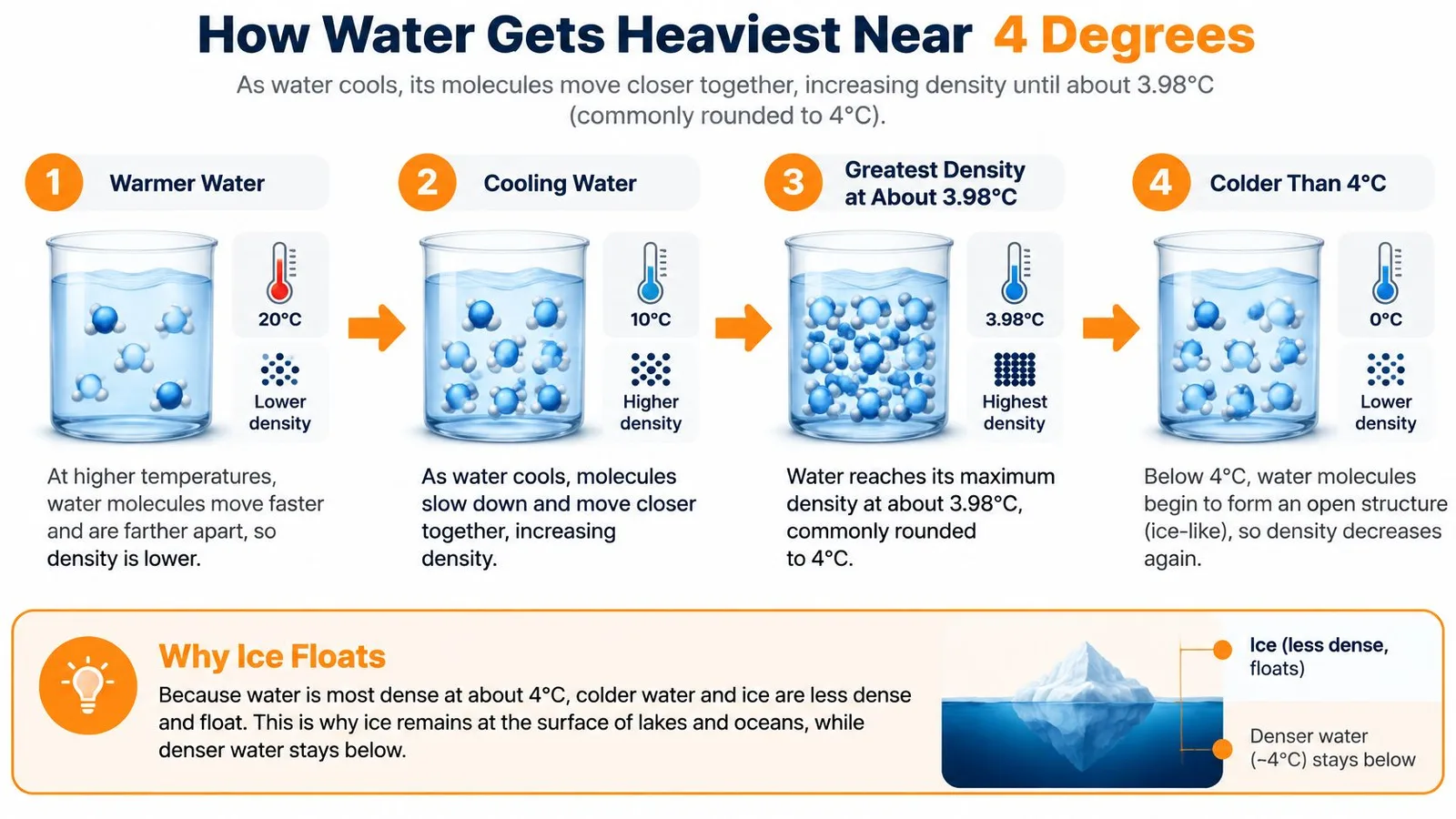
The change doesn't mean the liquid suddenly becomes a rigid crystal. It means its average molecular organization becomes somewhat more open before freezing.
The actual freezing transition produces a much larger structural change. The slight expansion of cold liquid and the formation of solid ice are related, but they aren't the same event.
Follow the surface water through winter
A simple freshwater lake gives a concrete sequence:
- Early cooling: Surface water loses heat, becomes denser, and can descend into warmer water below.
- Near the density maximum: The heavier water can accumulate deeper in the lake.
- Further surface cooling: Colder water becomes less dense than the layer beneath it and tends to remain above it.
- Surface freezing: Ice forms where the water meets the cold air, with liquid water remaining underneath.
Lake insight: The coldest water isn't necessarily the heaviest water. Temperature and density stop moving together near the freezing point.
Wind, currents, lake depth, and recent weather can complicate the neat layering. A real lake isn't a set of sealed containers, and its temperatures won't always match a classroom diagram exactly.
Still, the density reversal explains the basic winter arrangement. Water can remain liquid below a frozen surface rather than the lake having to freeze from the bottom upward.
It also corrects a common cause-and-effect mistake. The deeper water isn't heavier because it's deeper. Its temperature-dependent density helps determine where it settles.
Question 4 of 6
Why do lakes freeze from top down?
What a Floating Ice Cover Does for Life
A frozen lake can look solid from shore while remaining a liquid habitat beneath the surface. Fish and other aquatic organisms occupy water below the ice, not the frozen lid itself.
That lid and the water's layering do different jobs. Density differences keep the colder surface water above heavier water, while the ice cover slows heat transfer from the underlying water to the cold air.
A lid slows cooling but doesn't stop it
Without direct exposure to moving cold air, the water beneath an ice sheet loses heat less readily. Snow on the ice can provide additional insulation.
Neither ice nor snow supplies heat to the lake. They slow its escape. Ice can keep thickening during cold weather, and a sufficiently shallow body of water can still freeze through.
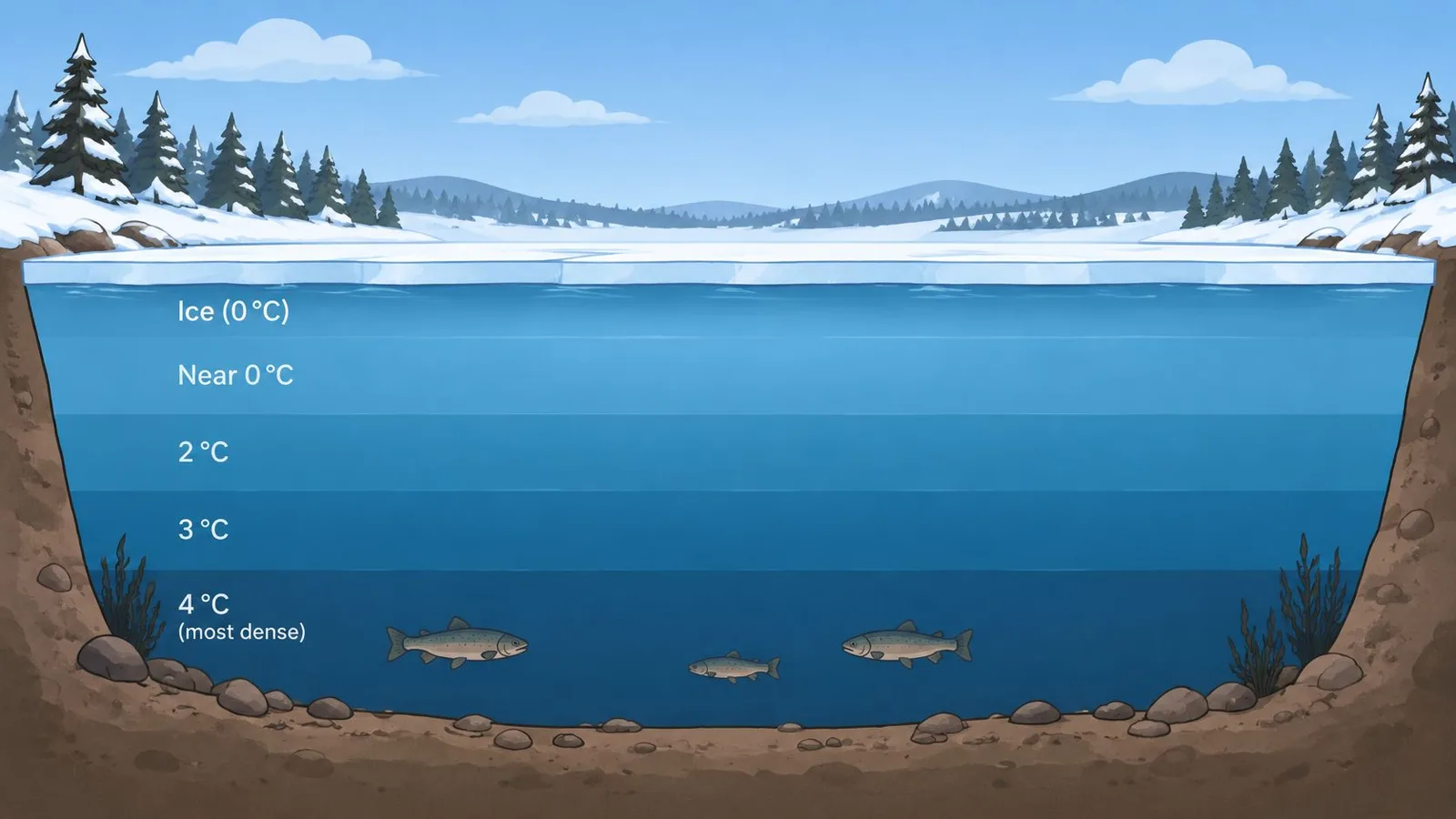
For aquatic life, retaining liquid water is necessary but not sufficient. Organisms also need suitable oxygen levels and other habitat conditions.
An ice cover can restrict exchange with the air. Snow can reduce the light reaching underwater plants. So floating ice helps preserve a winter habitat without guaranteeing that every organism will survive every winter.
An ice-covered lake isn't a frozen lake all the way down, and liquid water beneath the cover isn't automatically a healthy habitat.
An iceberg shows buoyancy on a larger scale
An iceberg offers a different view of the same floating balance. Much of its volume lies below the surface, even when its exposed cliffs look enormous.
The visible height doesn't directly reveal the submerged shape. A broad underwater section can support a narrower peak, while a flatter berg spreads its exposed volume over a wider area.
Real icebergs also contain trapped air and float in salty water rather than an idealized freshwater reference. Those details affect the balance, so a fixed classroom fraction shouldn't be assigned to every berg.
- Shape changes the silhouette. The visible tip may be tall and narrow or low and broad.
- Air changes average density. Bubbles can make a piece of ice less dense than a bubble-free crystal.
- Ocean water changes the comparison. Dissolved salts make the supporting liquid denser than fresh water.
An iceberg is a floating piece of glacier ice. Sea ice forms from ocean water and can create a seasonal surface cover with liquid ocean beneath it. For related distinctions and ocean phenomena, explore these fun facts about the ocean.
These familiar scenes involve ordinary ice under surface conditions. They don't establish how every possible solid form of water behaves.
Question 5 of 6
Why don't lakes freeze solid in winter, killing all the fish?
When Ordinary Ice Is Not the Ice You Mean
An ice cube in a drink is ordinary ice Ih, the familiar low-pressure hexagonal form. Under everyday atmospheric conditions, it's less dense than the surrounding water and floats.
The broader claim that every kind of ice must float is too strong. The WorldAtlas explanation of ice and floating distinguishes ordinary surface ice from high-pressure phases and notes that seawater's greater density generally makes ice float more readily, while salt is largely excluded from the crystal.
Pressure changes which crystal can form
H₂O identifies the substance, not a single possible solid arrangement. Under sufficient pressure, water can form ice phases with different crystal structures.
Some of those structures pack molecules more closely than ordinary surface ice. The everyday assumption that the solid must be less dense than the liquid therefore isn't universal.
For a high-pressure phase, you need to compare that solid with liquid water under the relevant pressure and temperature. Comparing it with an everyday freshwater value would answer the wrong question.
When the ice-floats rule holds
| Case | Density clue | Does it float |
|---|---|---|
| Ordinary ice Ih at surface pressure | Less dense than fresh liquid water | Yes; most of its volume is submerged |
| Fresh water near its density maximum | The reference liquid for the everyday comparison | Not a floating solid; it provides the supporting liquid |
| Ice in seawater | The crystal is less dense than the salty liquid | Yes, generally more readily; salt stays mostly in the brine |
| High-pressure ice phases | Exact densities aren't specified; the crystal structure and pressure set the comparison | Not always; some structures are not less dense than liquid water |
An unspecified density isn't a reason to invent a value. It's a reason to keep the claim conditional on the actual phase and surrounding liquid.
High-pressure ice is relevant to planetary interiors, where familiar kitchen conditions no longer apply. A cube from a home freezer doesn't become one of those phases just because it's large or very cold.
Salt changes the supporting liquid too
Seawater introduces a separate issue. Dissolved salt increases the density of the liquid that supports the ice.
As seawater freezes, much of the salt remains in the unfrozen liquid rather than entering the ice crystal. Natural sea ice can retain pockets of salty brine, so it isn't necessarily a perfectly pure block.
Pressure and salinity therefore modify different parts of the comparison:
- Pressure can change the solid structure. The resulting ice may no longer have the open arrangement associated with ordinary surface ice.
- Salt changes the liquid's density. The supporting water can be denser even when the ice remains the familiar kind.
For another surface-ice setting, these facts about glaciers connect frozen water with ice on land.
The accurate everyday statement is that ordinary ice at Earth-surface pressure floats on water. That keeps the kitchen answer intact without turning it into a rule for every solid phase of H₂O.
Million Whys offers short, interactive questions with explanations for every answer choice, including the tempting wrong ones. Turn this topic into a prediction about molecular packing, lake freezing, or high-pressure ice, then visit Million Whys to explore more everyday science questions.
Question 6 of 6
Why can some forms of solid water be denser than the liquid water around them, while ordinary ice cubes float?
Keep Exploring
Related Posts
Facts About Ice: Why Frozen Water Gets Weird
Facts about ice: why frozen water floats, expands, makes six-sided snowflakes, turns slippery, rejects sea salt, reflects sunlight, and shapes life on Earth.
Why Is Water Wet? Forces, Not a Feeling
Why is water wet? It is an interface effect: adhesion versus cohesion, surface tension near 72.8 mN/m, and contact angles that make water spread or bead.
Facts About Glaciers: Ice That Moves
Facts about glaciers: how snow becomes moving ice, why glacier ice turns blue, how glaciers shape valleys, and when melting land ice raises sea level.