

Facts About Glaciers: Ice That Moves
On this page· 16
Glaciers look still because we usually meet them in photographs: a blue cliff, a white valley, a frozen tongue running between mountains. The better fact about glaciers is that they are not still at all. They are slow rivers made of compressed snow, heavy enough to bend, slide, grind rock, store fresh water, and leave whole landscapes rewritten behind them. Once you know that, a glacier stops being scenery and starts looking like a question with weight: how can something frozen keep moving?
TL;DR
Glaciers form where snow survives summer, piles up for years, compresses into dense ice, and becomes heavy enough to flow under gravity. They matter because they store a large share of Earth's fresh water, shape valleys and fjords, feed rivers, and raise sea level when land ice melts into the ocean. The satisfying trick is this: a glacier is solid enough to carve bedrock, but under its own weight it behaves like a very slow fluid.
Short answer: a glacier is a long-lived mass of land ice that forms from accumulated snow and moves under its own weight. NSIDC describes glaciers as part of the cryosphere and notes that they gain mass through accumulation and lose mass through melting, sublimation, and calving; NASA's glacier overview puts the same idea in simpler terms, explaining that gravity makes glacier ice change shape and move. That movement is why a glacier is different from a snowfield.
Curious? Try one 👇
Why is the sky blue?
Jump into the daily quiz →1. A glacier begins as snow that refuses to leave
The first step is not drama. It is leftovers. Snow falls in a place cold enough that some of it survives the melt season. More snow lands on top. The buried layers get squeezed, lose air, and turn first into firn, then into dense glacial ice. NSIDC's glacier quick facts explain this accumulation-loss balance as the core accounting system of a glacier: if snowfall and compaction beat melting and calving over time, the glacier grows; if loss beats gain, it retreats.
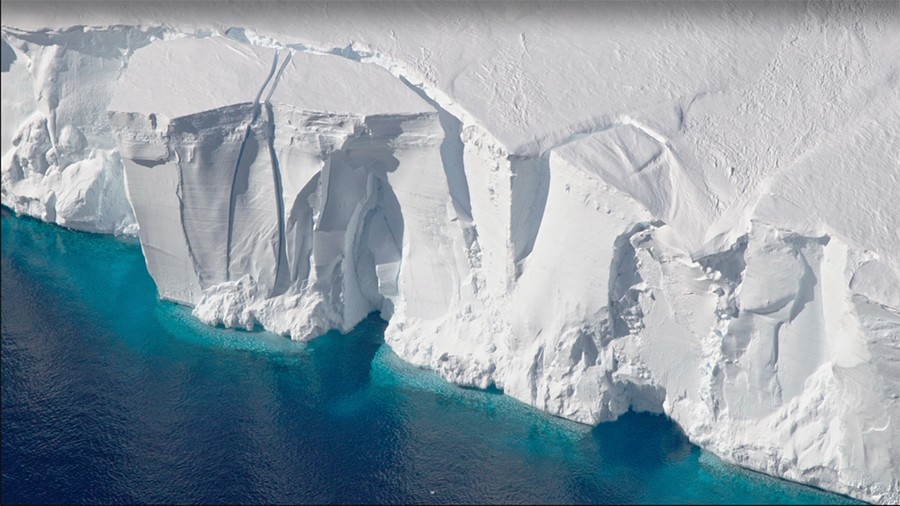
This is why the phrase "glacier retreat" can be confusing. A retreating glacier is not necessarily flowing backward. The ice may still be moving downhill, but the front edge shrinks because melt, calving, or sublimation removes ice faster than the glacier delivers new ice to the terminus. The front moves uphill even while the ice inside keeps flowing downhill. That little reversal is one of the best entry points into glacier science: the visible edge and the moving body are not the same thing.
2. Solid ice can flow because it is under pressure
A glacier does not flow because the ice has become liquid. It flows because thick ice deforms under its own weight. NSIDC's science overview describes glacier motion through internal deformation, basal sliding, and deformation of the sediment or rock beneath the glacier. In plain language: the ice crystals slowly change shape, the bottom can slip where pressure and meltwater reduce friction, and the bed below can sometimes deform too.
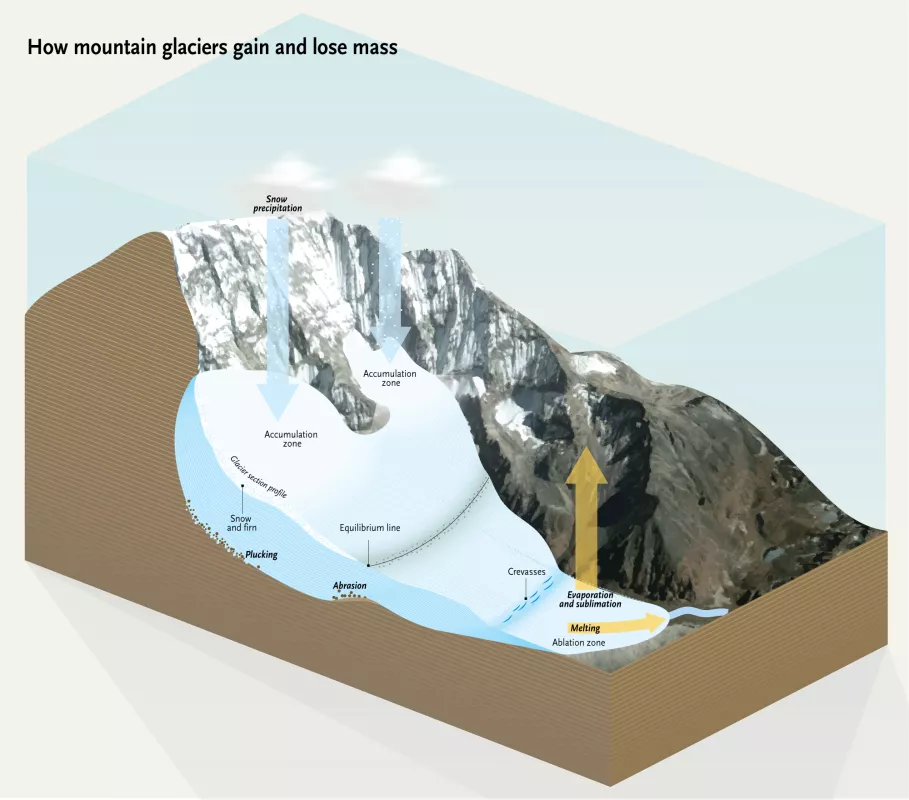
That is the reason crevasses open near the surface. The top part of a glacier is brittle, so it cracks when the ice stretches over uneven ground. Deeper ice is under more pressure and can deform more plastically. The whole body becomes a layered compromise: brittle enough to split, plastic enough to flow, and heavy enough to drag rock fragments like sandpaper across the land beneath it.
NASA's "At glacial speed" visualization makes this visible with satellite-derived maps of ice velocity. Some ice creeps slowly; outlet glaciers and ice streams can move much faster, especially where they funnel ice from an ice sheet toward the ocean. The still photograph is the trap. From above, over time, the glacier is doing work.
3. Blue glacier ice is old snow with the air squeezed out
Fresh snow is white because it is full of tiny surfaces and air pockets that scatter light in many directions. Dense glacier ice has fewer bubbles and a longer path for light to travel. NASA explains that ice appears blue because water molecules absorb more of the longer red wavelengths, leaving more blue light to return to your eyes; dense glacial ice looks bluer because compression squeezes out air bubbles. NSIDC gives the same useful correction: white glacier ice still has many tiny bubbles, while deeper compact ice can show a stronger blue.
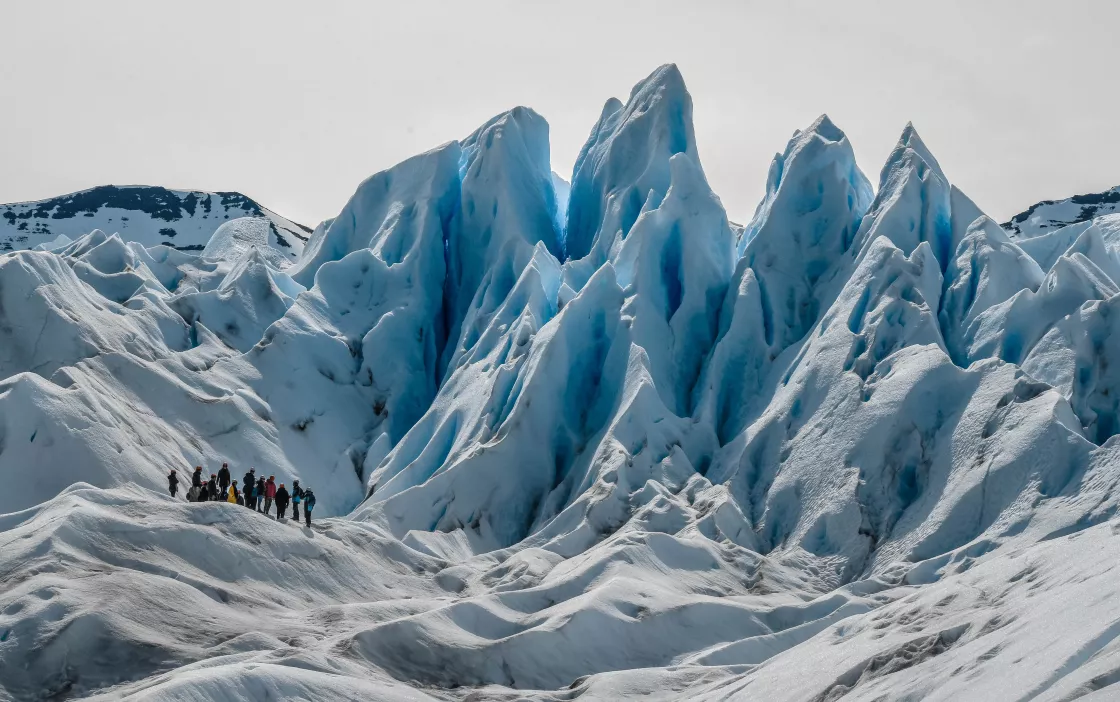
That color is a tiny closure moment. The blue is evidence of compression, age, and missing air. It is also a reminder that "ice" is not one visual category. Snow, firn, bubble-rich ice, blue ice, dirty debris-covered ice, refrozen melt ponds, and floating icebergs all tell slightly different stories about pressure, melt, weathering, and motion.
4. Glaciers are fresh-water vaults, not just frozen scenery
One of the biggest facts about glaciers is also one of the easiest to misread: most glacier importance is not in the pretty ice face. It is in storage. NSIDC's quick facts cite the USGS figure that glaciers and ice caps store about 68.7 percent of the world's fresh water. If all land ice melted, global sea level would rise roughly 70 meters, or about 230 feet. That number is not a forecast for this century; it is a scale check. The point is that land ice is a planet-size water account.
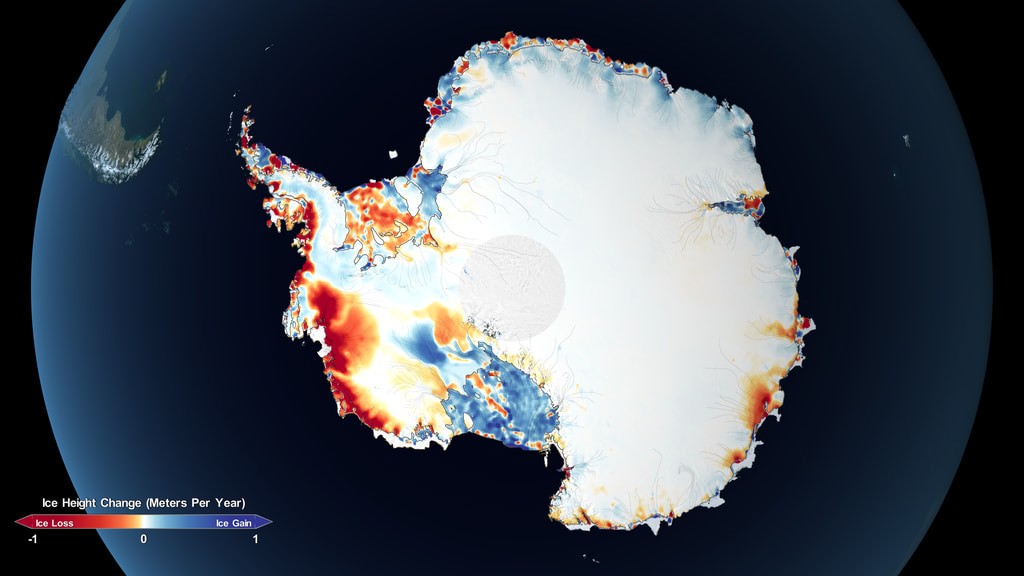
This also solves the classic glass-of-water confusion. Floating sea ice is already displacing ocean water, so melting sea ice has little direct effect on sea level. Land ice is different. When a mountain glacier or ice sheet melts and the water reaches the ocean, it adds water that was previously stored on land. NASA's sea-level explainers repeatedly separate those two mechanisms: sea level rises because the ocean warms and expands, and because land ice from glaciers and ice sheets adds water to the ocean.
For people living downstream, the story is not only sea level. Mountain glaciers often act like seasonal reservoirs, releasing meltwater during warm months. A shrinking glacier can temporarily increase runoff, then later reduce summer water reliability once the stored ice is depleted. That is why glacier loss can be a local water problem before it becomes an abstract global number.
5. Glaciers carve landscapes by dragging time across rock
Glaciers do not simply sit on a landscape. They abrade it, pluck blocks from it, and carry sediment away. The National Park Service describes Glacier National Park's terrain as evidence of this work: glaciers are large enough to flow under gravity, grow when winter snow exceeds summer melt, retreat when melt outpaces accumulation, and leave carved landforms that are still visible after the active ice is gone.
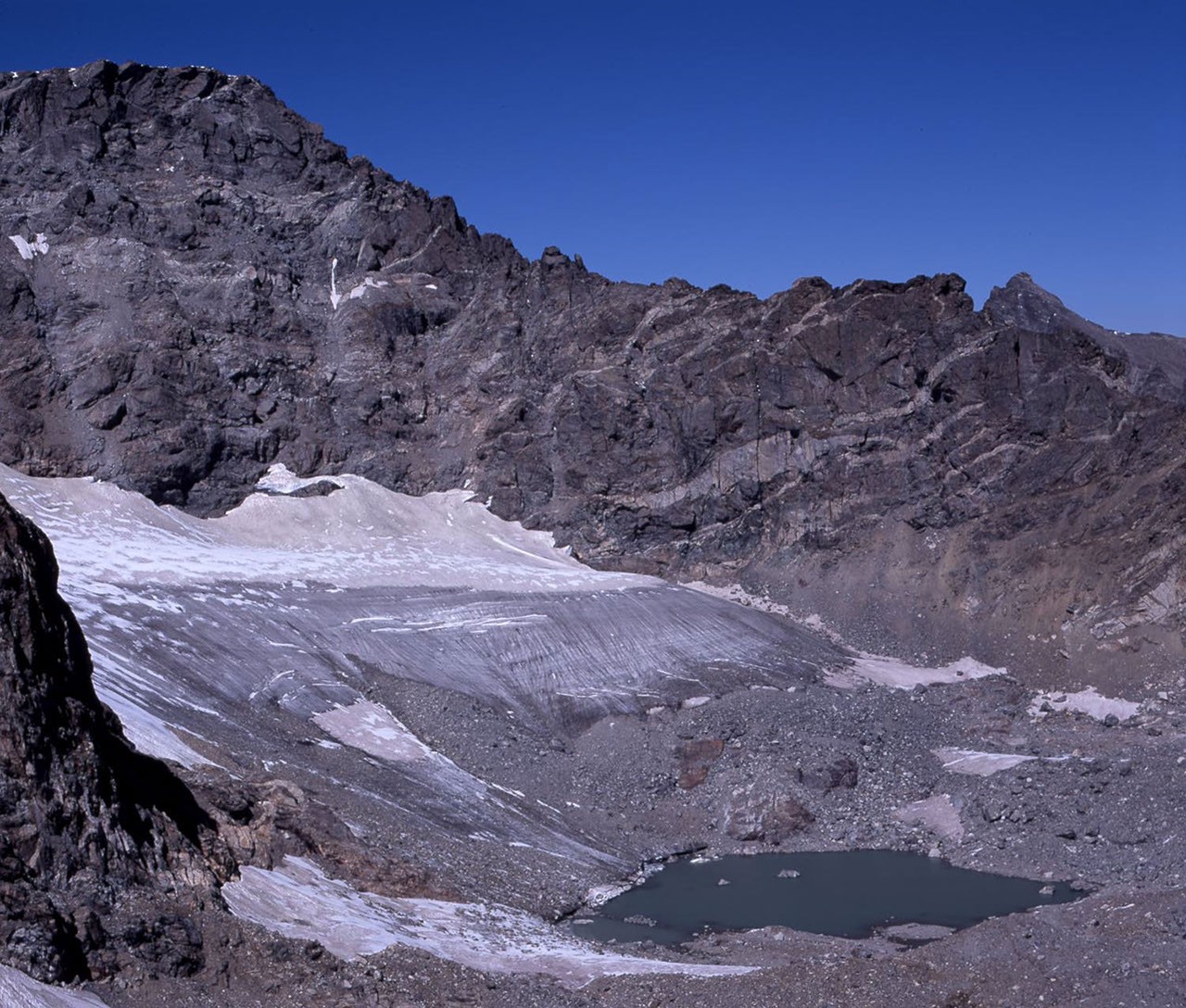
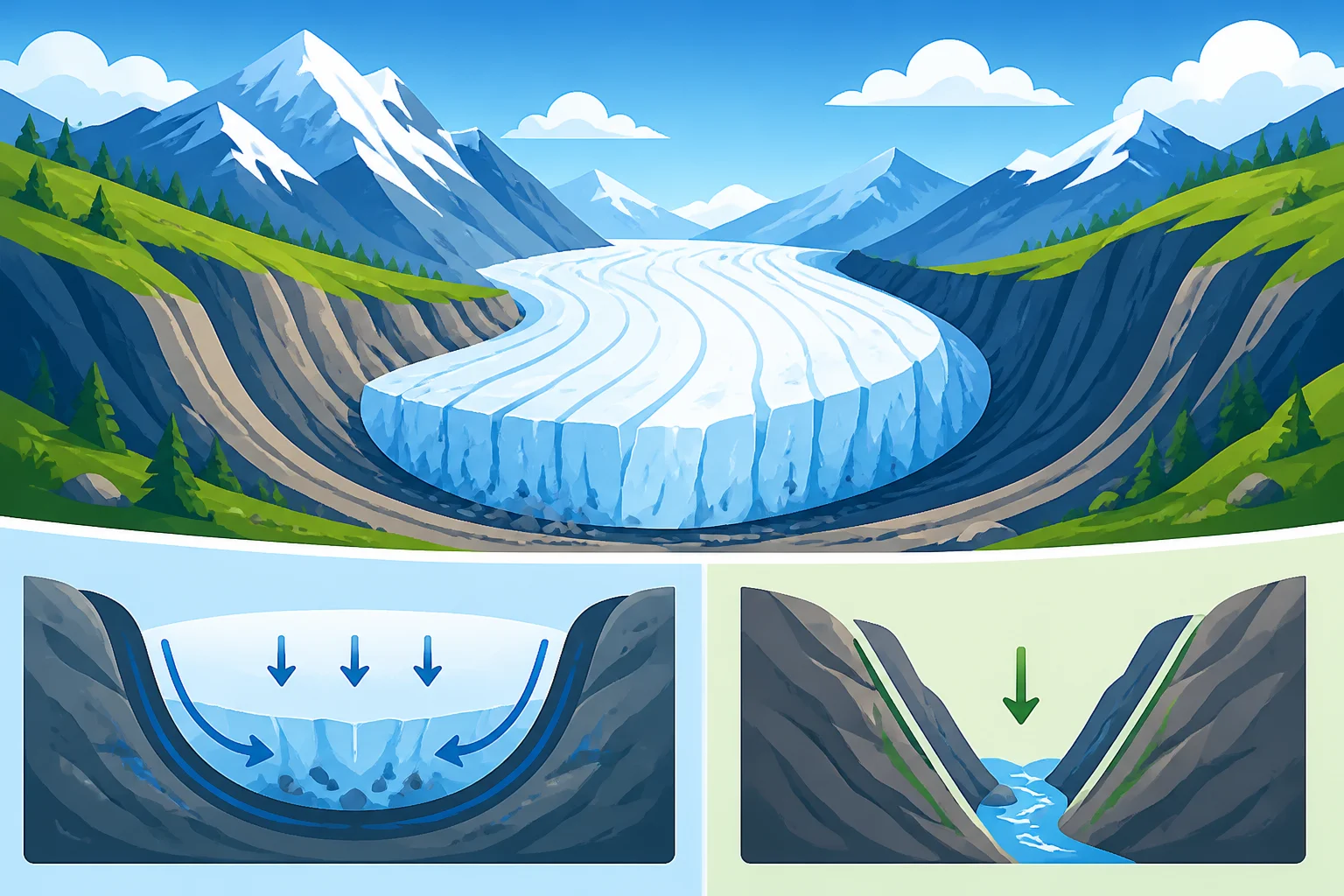
That is how river-cut V-shaped valleys become glacial U-shaped valleys, how fjords form where ice-carved valleys are flooded by the sea, and how moraines mark where a glacier dropped its load of rock debris. The glacier is both bulldozer and archive. It moves material, but it also leaves clues about where ice once stood, how thick it was, and which direction it flowed.
6. Calving is not the same as melting, but both can matter
When a glacier reaches a lake or ocean, chunks can break off. That process is calving. It looks like a collapse, but it is part of how tidewater and lake-terminating glaciers lose mass. NSIDC's science overview notes that tidewater glaciers are vulnerable where ice meets relatively warm ocean water. NASA's Oceans Melting Greenland mission focused exactly on that boundary: how ocean water around Greenland contributes to melting glaciers from below and affects sea-level projections.
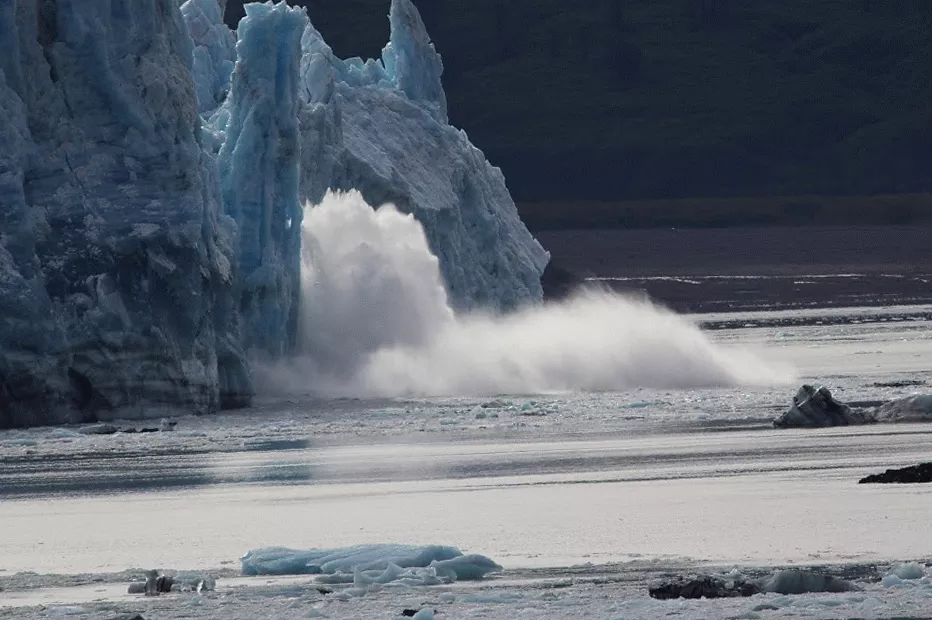
The key distinction is where the ice came from. An iceberg already floating in seawater is different from grounded ice flowing off land. The glacier's accounting system still comes back to mass balance: snow in, ice out, melt out, calving out. A single dramatic calving event may go viral, but the quieter question is whether the glacier is gaining enough new ice to replace what it loses.
What people usually miss
The usual glacier picture is backward. People imagine a glacier as a cold object that climate acts upon. The more useful picture is a moving system that translates climate, gravity, topography, ocean temperature, and time into visible evidence. A glacier's edge is a score, not the whole game. Its blue color tells you about compression. Its cracks tell you about stress. Its muddy water tells you rock is being ground underneath. Its retreat tells you loss is beating gain. The payoff is not "ice is melting"; the payoff is learning to read a frozen thing as a living measurement.
FAQ
What is the simplest definition of a glacier?
A glacier is a persistent mass of land ice, formed from compacted snow, that moves under its own weight. If the ice does not flow, it is better described as snow, firn, or an ice patch rather than an active glacier.
Why are glaciers blue?
Dense glacier ice has fewer air bubbles, so light travels farther through it. Ice absorbs more red wavelengths and lets more blue light return to your eyes, which makes deep compacted ice appear blue.
Do melting glaciers raise sea level?
Land glaciers do when their meltwater reaches the ocean. Floating sea ice is different because it already displaces ocean water. That land-ice versus floating-ice distinction is the part many people miss.
Are glaciers always retreating because they flow backward?
No. Retreat means the terminus, or front edge, is shrinking uphill or inland because losses exceed gains. The ice inside the glacier can still be flowing downhill while the front edge retreats.
What does this have to do with AIgneous Million Whys?
Glaciers are exactly the kind of "half-known" topic that makes curiosity work. You already know they are ice; the satisfying part is discovering the mechanism underneath: snow becomes pressure, pressure becomes motion, motion becomes landscape, and one answer opens the next why.
Curious? Try one 👇
Why is the sky blue?
Jump into the daily quiz →Keep Exploring

Related Posts
Facts About Ice: Why Frozen Water Gets Weird
Facts about ice: why frozen water floats, expands, makes six-sided snowflakes, turns slippery, rejects sea salt, reflects sunlight, and shapes life on Earth.
Fun Facts About Weather: Everyday Sky Physics
Fun facts about weather, explained through why raindrops flatten, clouds float, thunder rolls, snow survives warm layers, fog forms, and rainbows circle.
Fun Facts About the Earth: Why It Never Sits Still
Fun facts about the earth: why Earth bulges, moves plates, shifts its magnetic field, loses air, trades tides with the Moon, and stays hot inside.