

Why Does the Sun Look Yellow from Earth
On this page· 16
The Sun looks yellow from Earth because air scatters blue and violet out of its direct beam, leaving the remaining visible mix from roughly 390 to 780 nanometers looking warmer, not because the Sun emits only yellow light. Stop teaching kids to grab a yellow crayon and call that settled science. That popular shortcut turns a changing sky effect into a fixed fact about a star, and it leaves you stuck when the disk looks white at noon, brass in late afternoon, or orange through wildfire smoke.
You're not seeing the Sun change its output hour by hour. You're seeing the same broad beam after a different amount of air, dust, or haze has filtered it. Once you follow that path, the color you notice starts to tell you something useful about today's sky instead of something false about the Sun.
Why the Sun Looks Yellow and How Its Color Shifts Through the Day
From the ground, the Sun usually looks pale yellow or yellow-white because its light passes through air before it reaches your eyes. Above the atmosphere, that same visible mix looks white, because nothing has removed part of it yet.
That's the verdict to hold onto when you're asking why does the Sun look yellow on one day and almost white on another. The NOAA solar glossary material summarized in NOAA's Global Monitoring Laboratory glossary places visible light at roughly 390 to 780 nanometers, and in that range nitrogen and oxygen scatter blue and violet more efficiently than yellow, orange, and red. The direct beam loses some short-wavelength light, so what's left tilts warm.
Match the Disk to Today's Sky
Use height and air clarity before you use a color name. A high Sun in clean air, a low Sun over the sea, and a smoky noon are three different viewing conditions, so they shouldn't give you one color.
| Condition | Path through air | Typical disk color | Main cause |
|---|---|---|---|
| Above the atmosphere | None | White | Balanced visible wavelengths, no air filter |
| Near midday, clear air | Short | Nearly white or slightly yellow | Little blue and violet removed |
| Mid-morning or mid-afternoon | Moderate | Pale yellow or yellow-white | Rayleigh loss of short wavelengths |
| Low Sun, clear air | Long | Orange | More blue, green, and violet scattered out |
| Sunrise or sunset | Very long | Orange to red | Strongest short-wavelength loss |
| Smoke, dust, or haze | Variable plus particles | Deep orange, red, or muted | Rayleigh plus Mie scattering from aerosols |
Read the table from left to right, not as a set of labels to memorize. Path through air is the driver, disk color is the result, and the scattering cause is the reason the result makes sense. If you can't say how high the Sun is or what's in the air, you don't have enough information to explain the color.
One Clear Day From Morning to Evening
At breakfast, the Sun is still climbing and its beam slants through a moderate column of air. Some blue and violet have been scattered away, so the disk no longer reads as the clean white you'd expect above the atmosphere. Through a kitchen window or between buildings, it often looks soft yellow, especially against a pale blue sky.
Near midday, the path is shortest. The beam crosses less air, loses less of its short wavelengths, and the glare makes the disk hard to judge at all. That's why careful observers often describe a summer noon Sun as nearly white, even though school posters taught them to call it yellow.
If noon looks white and late afternoon looks yellow, your eyes aren't contradicting themselves. The beam took a different route.
In mid-afternoon, the slant grows again. More air sits between you and the Sun, more blue leaves the direct line of sight, and the remaining light shifts toward a clearer pale yellow. On a winter walk, when the Sun is already low through bare trees, that yellow can deepen toward brass because the path is long well before sunset.
By late afternoon, shadows stretch and the light on walls and faces turns warmer too. That change in the whole scene matters, because your visual system doesn't judge the disk in isolation. A beam that's lost more blue lights the ground with a warmer mix, so the world and the Sun shift together.
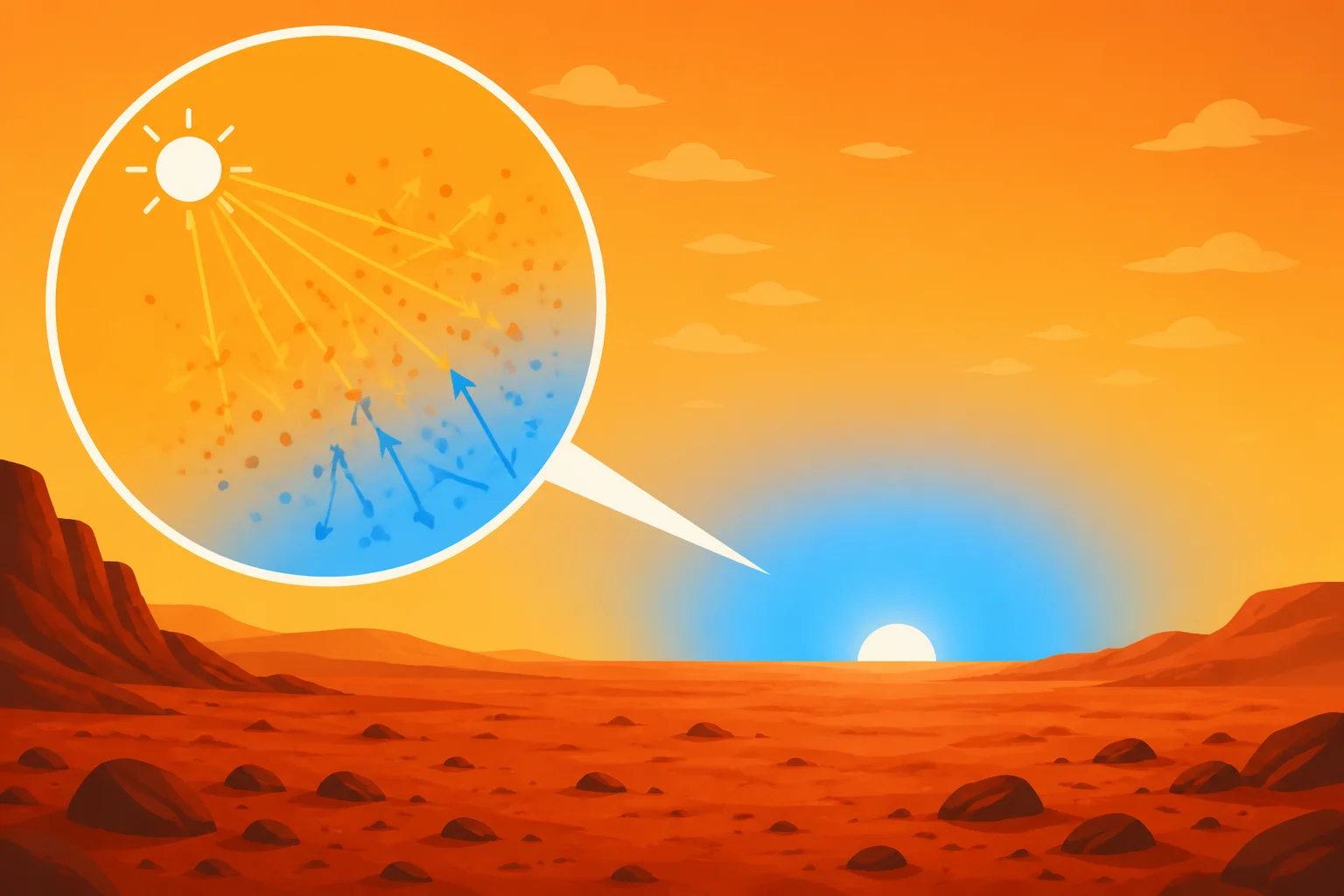
At sunset on a beach, the path is near its longest. The beam grazes through air for a far greater distance than at noon, short wavelengths are scattered out along the way, and the disk can turn orange and then red as it sinks. Turn around and the opposite sky can still hold blue, because you're now looking at scattered light from a different direction.
Sunrise runs the same film backward. A red disk near the horizon warms through orange as it climbs, then pales toward yellow-white as the path shortens. The star didn't heat up over breakfast. Your line of sight stopped crossing so much air.
Altitude and Place Change the Same Rule
Where you stand changes the filter. On a high mountain, you've left part of the atmosphere below you, so the beam reaches you after a shorter trip than at sea level at the same clock time. The Sun tends to look whiter up there, and the sky often looks a deeper blue because there's less air above you to scatter light back.
At sea level in humid air, the extra moisture and particles soften the scene. The disk can look paler at the edges, less crisp, and sometimes more yellow than the mountain view at the same hour. You're seeing the same physics with a thicker, messier filter in front of it.
Clouds complicate the picture without breaking the rule. Thin cloud can dim the disk so its color is easier to notice, while thick cloud hides it and leaves only a bright patch. A cloud edge near sunset can catch red light long after the ground is in shadow, which is a sign of the long path, not a sign that one part of the Sun turned red first.
What to Do With a Color That Keeps Moving
Teach the color as a clue, not as a name tag. Ask a child who's drawing the sky to pick the crayon after looking at where the Sun sits, then compare a morning drawing with an evening one. That small habit also gets everyone looking at the sky, and families building that kind of outdoor routine often look for practical ways to limit screen time so the observation happens outside instead of in a photo feed.
Adults can run the same check in seconds. High and clear points to white or faint yellow, mid-height and clear points to pale yellow, and low and clear points to orange or red. If the color doesn't fit the height, look for smoke, dust, or haze before you invent a new explanation.
Season helps you predict the timing. In summer, the Sun climbs higher and spends more hours in the short-path part of the table, so white and pale yellow dominate much of the day. In winter at many latitudes, it stays lower, so the warmer rows occupy more of your waking hours.
Latitude does the same kind of work. Near the equator, midday paths are short for much of the year, while far from the equator a noon Sun can still sit low enough in winter to look distinctly yellow or orange. The clock says noon in both places, but the air path doesn't agree.
The Sun's output isn't flickering between yellow, white, and red as Earth turns. Color here is a line-of-sight effect that moves with path length, particles, and humidity. Learn to read those three, and the daily shift stops looking like a contradiction.
Question 1 of 4
Why does the Sun look pale yellow-white when it is high overhead but deeper yellow or orange when it sits low in the sky?
How Air Scatters Blue Out of the Beam
A beam of sunlight reaches the top of the atmosphere carrying all its visible colors at once. It does not arrive painted yellow. Follow that mix down to your eye and the mechanism stops being abstract: air molecules sort the beam, and the sorting changes with how much air the light crosses.
The beam meets nitrogen and oxygen molecules. Those molecules are far smaller than the wavelengths of visible light, and that size mismatch drives the whole effect. Small obstacles disturb short waves much more than long ones.
A short ripple crossing a pond breaks apart when it hits a small stone, spreading in new directions. A long, slow swell passes the same stone with much less fuss, because the stone is tiny compared with the distance between its crests. Air molecules do the light version of that job.
In Stanford Solar Center's explanation of the Sun's color, when the Sun is low its short-wavelength colors, green, blue, and violet, are scattered out by the atmosphere, leaving relatively more reds, yellows, and oranges reaching the eye. Physicists call this wavelength-sensitive process Rayleigh scattering.
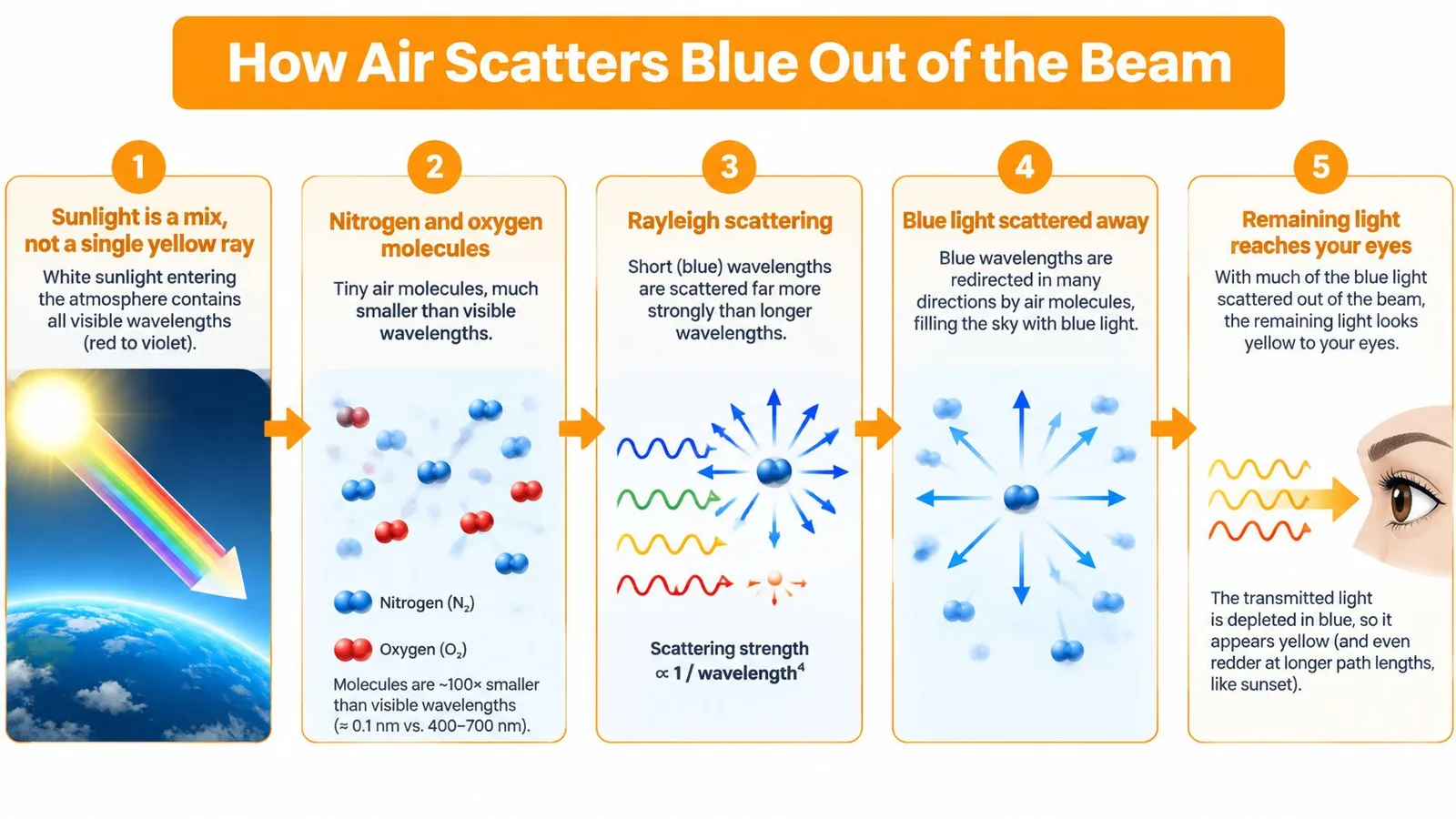
The scattered blue does not vanish. It leaves the direct beam in many directions, bounces around the sky, and reaches you from places where the Sun is not. That is why the dome overhead looks blue while the disk itself, seen along what is left of the beam, looks warmer.
If you want the fuller version of that detour, an explainer on why the sky is blue follows the scattered light after it leaves the beam. Here, the key point is bookkeeping. Blue gained by the rest of the sky is blue lost by the direct image.
One Process, Three Familiar Scenes
The same sorting produces the milestones you already know. It gives you a blue daytime sky, a yellowish disk when the Sun is higher, and orange-red light when the Sun sits near the horizon. One afternoon can show all three, and they do not need three separate explanations.
- Look at the sky away from the Sun: You see light that air scattered toward you, so blue dominates.
- Read the Sun's tint through a proper solar filter, or from the light it casts on nearby surfaces: You see the beam minus a little blue, so it reads white to pale yellow.
- Watch the light near sunset: You see the beam minus much more blue and green, so warm colors take over.
Students who want to test whether they have really got the wavelength idea, rather than just the vocabulary, can find physics practice questions and work scattering problems with different wavelengths side by side. The useful question is always comparative. Which wave gets redirected more, and where does the redirected light go?
Yellow, in this account, is not a nickname or a cultural habit. Visible light is a measurable stretch of the electromagnetic spectrum, and yellow sits inside it as a real band your eye can register. When the balance shifts because blue has been removed, your visual system reports that new balance.
Bookkeeping rule: Scattering does not create yellow light. It removes enough blue that the remaining mix looks yellow.
On an airless world, this sorting would not happen. With no nitrogen and oxygen molecules in the way, a beam would arrive with its visible balance intact, and the disk would not pick up Earth's yellow shift. The yellow belongs to the view from under an atmosphere, not to the star by itself.
The Spectrum Your Eyes Call Yellow
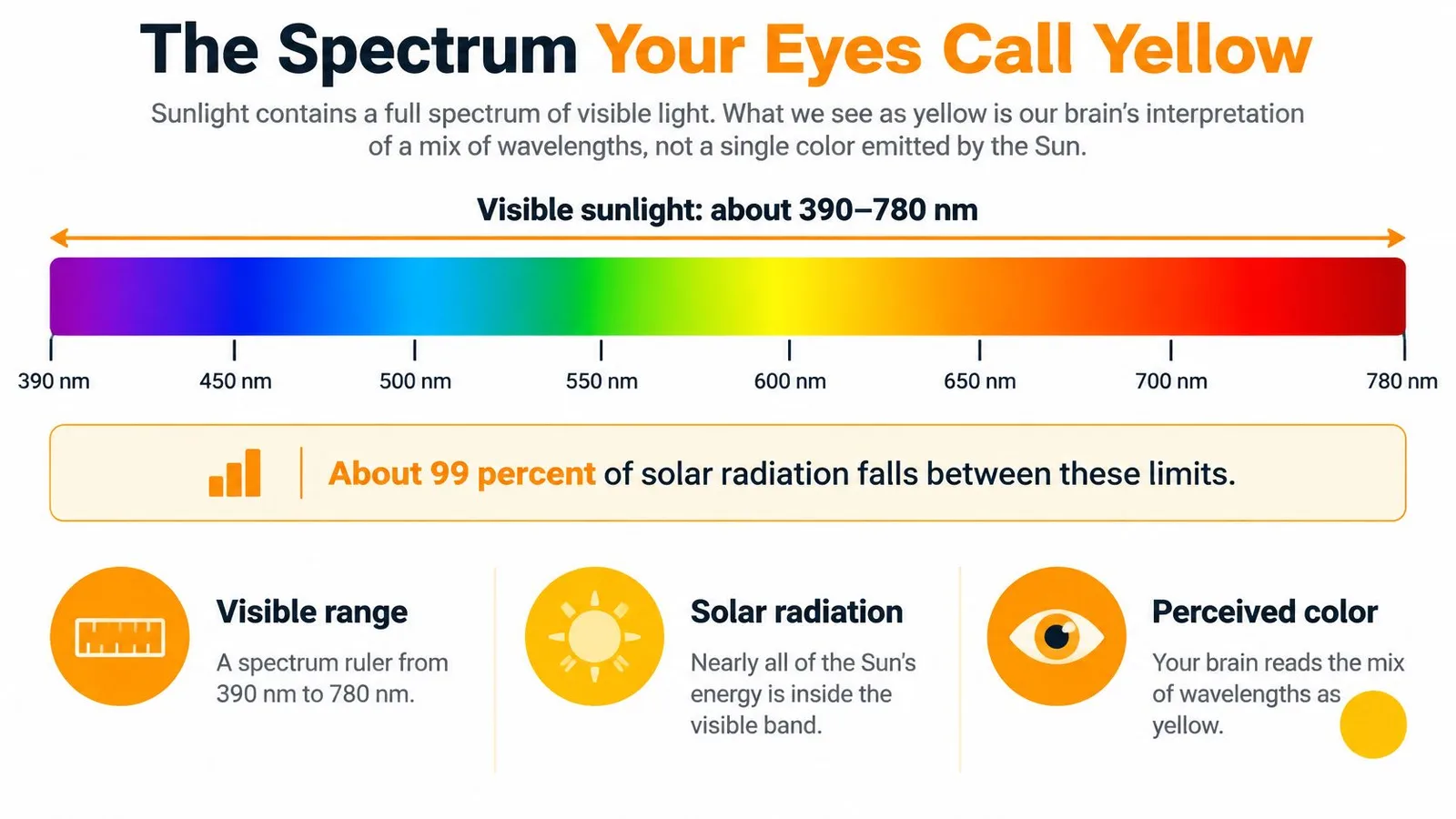
The Sun sends out far more than the slice you can see. The U.S. Energy Information Administration's 2026 solar-spectrum glossary defines visible sunlight as spanning approximately 390 to 780 nanometers and reports that about 99% of solar radiation lies between 300 and 3,000 nanometers. Your eye works with a narrow middle band of a much wider output.
That matters because most of the energy isn't the yellow band people name. According to NASA's solar irradiance data page, approximately half of solar energy is emitted at wavelengths greater than 700 nanometers. Much of that lies past the red edge in infrared, which warms your skin but never becomes a color you can see.
White Is a Balance, Not an Absence
Your eye doesn't report wavelengths one by one. It sends combined signals from cone cells that respond to short, medium, and long wavelengths, and your brain reads the pattern. When those signals arrive in a broad, fairly even balance, you perceive white.
Tip the balance and the name changes. Remove some blue through scattering and the remaining signals lean warm, so the same system reports pale yellow. Remove still more blue and green on a long path, and it reports orange or red.
Violet plays a smaller role than its place in the rainbow suggests. Air scatters it strongly, and your eye is not especially sensitive to it compared with blue and green. So even though violet is scattered at least as eagerly as blue, the sky doesn't look violet and its loss isn't the part you notice most.
A prism gives you a clean way to see the mix for yourself. It bends each wavelength by a slightly different amount and fans white sunlight into a rainbow band on paper. Nothing in that fan is a single yellow ray that was hiding inside the beam, and basic facts about light can help if the jump from wavelength to color still feels slippery.
Why Photos Disagree With Your Eyes
Cameras add a second interpreter. A phone guesses at white balance, trying to decide what should count as neutral in the scene, and it may push a disk toward clean white or theatrical gold depending on that guess. Two phones on the same beach can save two different sunsets from the same light.
Exposure changes the story too. A sensor that's protecting the bright disk darkens everything else, while one exposing for the beach blows the disk out to featureless white. Neither file is a direct readout of the spectrum, so don't settle arguments about the Sun's color with a screenshot.
Calling the Sun a yellow star, then, describes the filtered impression from under air. It doesn't mean the star emits one yellow line, and it doesn't mean yellow carries most of its energy. Once you separate emitted spectrum from perceived color, the white-versus-yellow argument mostly dissolves.
Question 2 of 4
Why does the sun appear yellow?
When Smoke and Dust Recolor the Disk
The clean-air story seems to fail on the day the Sun looks orange at lunch. It's high, the path should be short, and yet the disk hangs in a milky sky like a copper coin. That surprise usually means the air stopped being clean.
Smoke, desert dust, volcanic aerosol, and urban haze carry particles much larger than air molecules. Those particles scatter light through Mie scattering, which doesn't sort wavelengths as sharply as molecular Rayleigh scattering does. An overview of why the Sun looks yellow notes NASA's contrast that ordinary atmospheric gases scatter shorter wavelengths while longer wavelengths transmit more readily, but smoke particles add a separate scattering process and can intensify color effects at sunrise, sunset, or during the day.
What Changes the Sun's Color Besides the Hour
| What is in the air | Scattering | Typical extra effect | Disk can look |
|---|---|---|---|
| Clean molecular air | Rayleigh | Removes blue and violet | Pale yellow to white when high |
| Wildfire smoke | Mie plus Rayleigh | Extra loss across the beam | Deep orange or red, even midday |
| Desert dust | Mie | Warm, milky filtering | Copper or pale orange |
| Volcanic aerosol | Mie, often high altitude | Long-lived reddening | Red sunrises and muted disks |
| Urban haze and humidity | Mixed particles | Softens contrast | Dull yellow or gray-orange |
Wildfire smoke is the version widely recognized today. A plume can travel far from the fire, spread into a thin sheet, and turn a whole afternoon amber while the sky loses its blue. Shadows soften, distant hills fade, and the light indoors takes on a sepia cast that no lamp setting explains.
Desert dust does quieter work. It washes the sky toward cream or pale tan, mutes contrast, and can leave the disk looking coppery without the drama of smoke. After a dusty front, you may notice the grit on a car before you connect it with yesterday's strange light.
Volcanic aerosols can sit high and linger, reddening sunrises far from the eruption. Urban haze mixed with humidity tends to dull rather than dramatize, giving a gray-orange disk in a washed sky. The result depends on particle size, concentration, humidity, and the Sun's elevation, which is why two smoky days rarely match.
A red Sun is not a safe Sun. Color tells you about the air, not about whether the brightness can hurt your eyes.
The star didn't cool, age, or change its composition overnight. In most of these events, the change sits in Earth's intervening atmosphere, sometimes only a few kilometers above your street. If the color returns to normal when the wind clears the plume, you've watched the filter leave.
Judge the scene without staring at the disk. Check the color of shadows, the washed or deep blue away from the Sun, the visibility of distant buildings, and whether the light on white walls looks amber. For any intentional direct view, use proper solar filters made for that purpose, because a dim-looking red disk can still be dangerously bright.
Question 3 of 4
Why can wildfire smoke or desert dust turn the midday Sun orange even when it is high overhead?
Myths That Paint the Sun Yellow
Myth one says the Sun is yellow because every drawing shows it that way. School art, weather icons, and emoji need a simple symbol that reads at a glance, so they use a yellow circle with rays. Memory then overrules the glaring, nearly white disk you can't safely study at noon.
Myth two says yellow is the Sun's true color in space. The visible mix above the air is broadly white, and yellow is what your eye reports after air removes part of the blue. If you're sorting claims like this one, a roundup of common science misconceptions is a good place to see how many of them come from a picture learned early.
The Sunset and Smoke Versions
Myth three says a red sunset means the Sun is cooling down for the night. It isn't. The long path near the horizon strips short wavelengths from the beam, and the same red disk pales again the next morning as the path shortens.
Myth four says a copper Sun during wildfires means something changed on the Sun. Smoke changed, not the star. When the plume moves on, the color goes with it, which is hard to explain if the cause were solar temperature.
- Myth five: The blue sky is light the Sun failed to send.
- Correction: It's light the Sun sent that air redirected out of the direct beam toward you from other directions.
- Practical upshot: Blue overhead and a warm disk are two views of one sorting process.
Myth six says sunglasses or a phone screen make it safe to study the color. They don't. Sunglasses cut glare, not the hazard, and a phone's white balance invents part of the color anyway. Brightness and color are different problems, and solving the first with fashion lenses solves neither.
Researchers don't settle this by squinting. The TSIS-1 Solar Spectral Irradiance dataset, maintained by the Laboratory for Atmospheric and Space Physics and listed as updated in 2026, measures the Sun's full-disk spectral irradiance from 200 to 2,400 nanometers with instrument resolution ranging from 1 to 34 nanometers. Instruments track the spectrum while your eye tracks the filtered impression, and keeping those two jobs separate clears up most of the myths at once.
Question 4 of 4
Why can you see blue light coming at you from every patch of clear sky while the Sun itself looks warm?
Judge the Next Strange Sky Safely
When the disk looks odd, run three checks before you explain it. First, note how high the Sun is, because height sets the path length. Second, ask whether the air is smoky, dusty, or hazy, and third, look at whether the rest of the sky is deep blue or washed out.
Then match what you found. High and clear points to white or pale yellow, low and clear points to orange or red, and high but smoky points to aerosols doing extra work. If distant buildings have faded and white walls look amber, trust the air explanation over a story about the star changing.
Look at Everything Except the Disk
Never judge by staring. Stand where a building edge blocks the disk and read the color of the light around it, compare the shadowed and sunlit sides of a white wall, or take a photo and treat it as a rough record rather than proof. Keep proper solar filters for any intentional direct view, and put ordinary sunglasses back in the category of comfort, not protection.
Make a prediction before you check the explanation, because a wrong guess you correct sticks better than an answer you passively read. That same habit carries to the next question the sky hands you, whether it's about sunset colors skipping green or the Moon looking larger near the horizon. Million Whys fits that moment with a short why-question and an explanation on every choice, so you can test your next prediction in seconds.
You can keep that prediction habit going at Million Whys, where everyday questions like why the Sun looks yellow become quick choices with an explanation attached to every answer, including the tempting wrong ones. Make your guess about the next strange sky first, then open the answer and follow one follow-up question wherever it leads.
Keep Exploring

Related Posts
Why Is the Sky Blue? The Science of Light Scattering
Why is the sky blue? Follow sunlight through air molecules to see why noon turns blue, sunsets redden, Mars flips the palette, and blue oceans differ.
Facts About Light: Color, Shadows, Refraction
Facts about light get easier when you see the mechanism: visible wavelengths, refraction, scattering, shadows, and why color is a question your eyes answer.
Earth Day 2026: 12 Weird Whys About the Planet You Live On
From a 19.5-hour day stuck for 1.5 billion years to a mantle-wind black hole beneath Tibet, 12 mechanism-rich, verifiably true facts about Earth — each a 'small why' that changes how you see the planet. Earth Day 2026 edition.