

Interesting History Facts: 10 Surprising Stories Explained
On this page· 24
Which is closer in time to Cleopatra, the building of the Great Pyramid or the Moon landing? If you grouped Cleopatra and the pyramid together because both belong to ancient Egypt, you've made a reasonable guess. You've also confused a shared setting with a shared moment in history.
That's what makes interesting history facts worth exploring. The surprise isn't just an unusual answer. It's the chance to discover why an answer felt obvious, and which assumption led you astray.
Try making a prediction before each reveal. Then look for the mechanism, the definition, or the missing evidence that changes the story. An ancient machine becomes more interesting when you understand its gears, just as a financial frenzy becomes more useful when you separate actual trading from later exaggeration.
Make your guess specific. An answer you can explain is more useful than a lucky choice.
History also becomes clearer when you connect individual stories to institutions and decisions. For a related exercise, consider the Roman diplomacy lessons from Model Diplomat, and ask which negotiating problems would still feel familiar today.
Keep that same curiosity here. Some answers rest on physical remains. Others depend on how we define a beginning, interpret an account, or distinguish an invention from its descendants. You don't need to remember every detail. Start by noticing what changes your mind.
1. Oxford University Is Older Than the Aztec Empire
Make your prediction: Which came first, teaching at Oxford or the Aztec Empire?
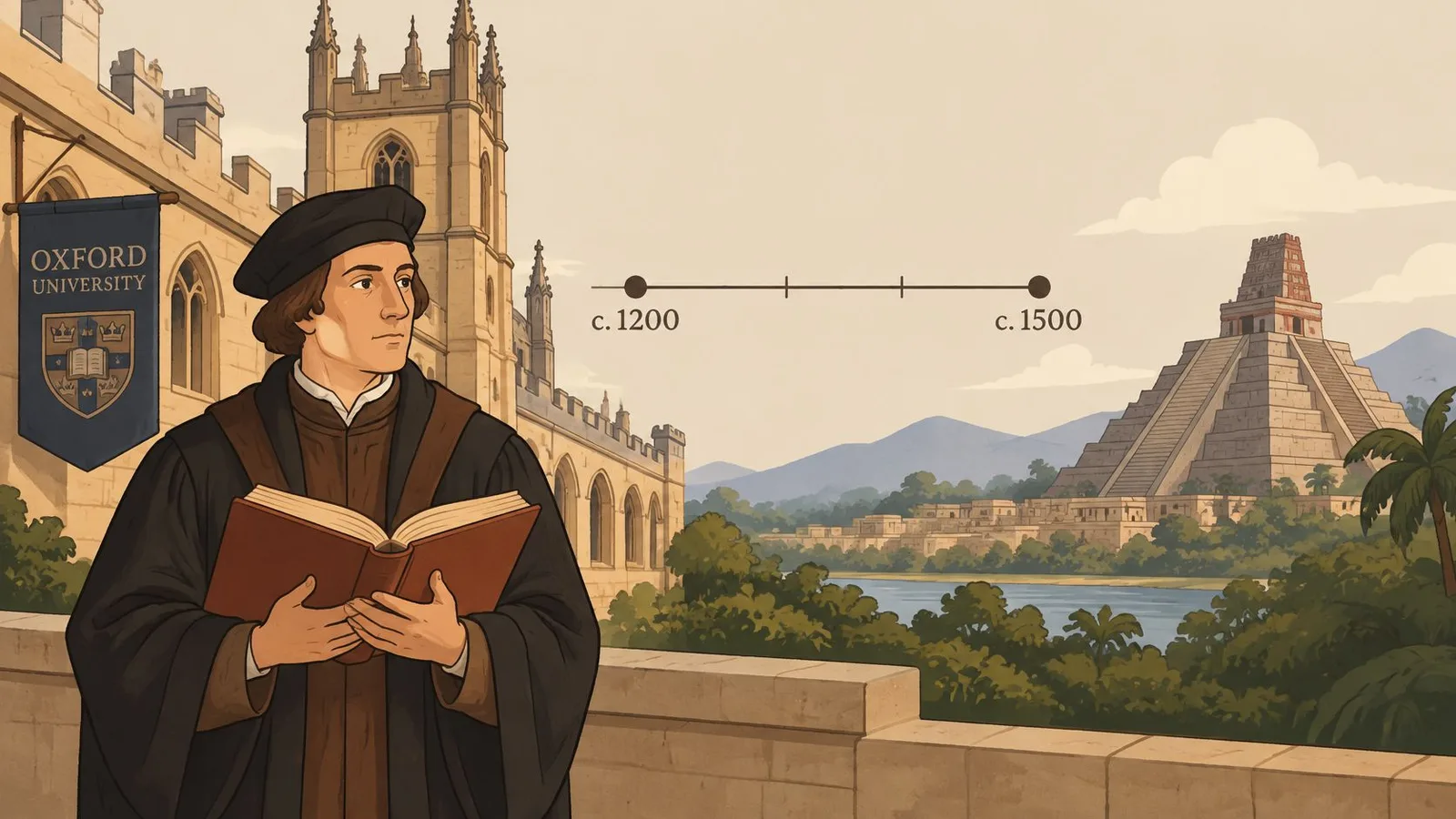
Oxford comes first. The surprising part is how easily we place a familiar university in the recent past while assigning an Indigenous American empire to a distant, undifferentiated antiquity.
But the comparison needs careful wording. A university's beginnings aren't necessarily a single founding event. Teaching can begin before an institution receives formal recognition, develops permanent administration, or acquires the buildings people associate with it.
The other side needs a definition too. The origins of a city, the history of its inhabitants, and the formation of an imperial alliance aren't interchangeable milestones.
What the Comparison Actually Teaches
The popular claim works as a chronology challenge. It doesn't establish that European learning preceded complex societies in the Americas, or that Oxford emerged fully formed.
For a classroom activity, give learners event cards labeled teaching begins, city founded, and political alliance formed. Ask them which cards would make a fair comparison before arranging them chronologically.
That turns a surprising answer into a lesson about historical definitions. When building a round from history trivia questions, specify the milestone you mean. Otherwise, players may disagree because they're answering different questions, not because someone misunderstands history.
2. Cleopatra Lived Closer in Time to the Moon Landing Than to the Great Pyramid
Choose before reading further: Was Cleopatra nearer to the pyramid builders or the astronauts?
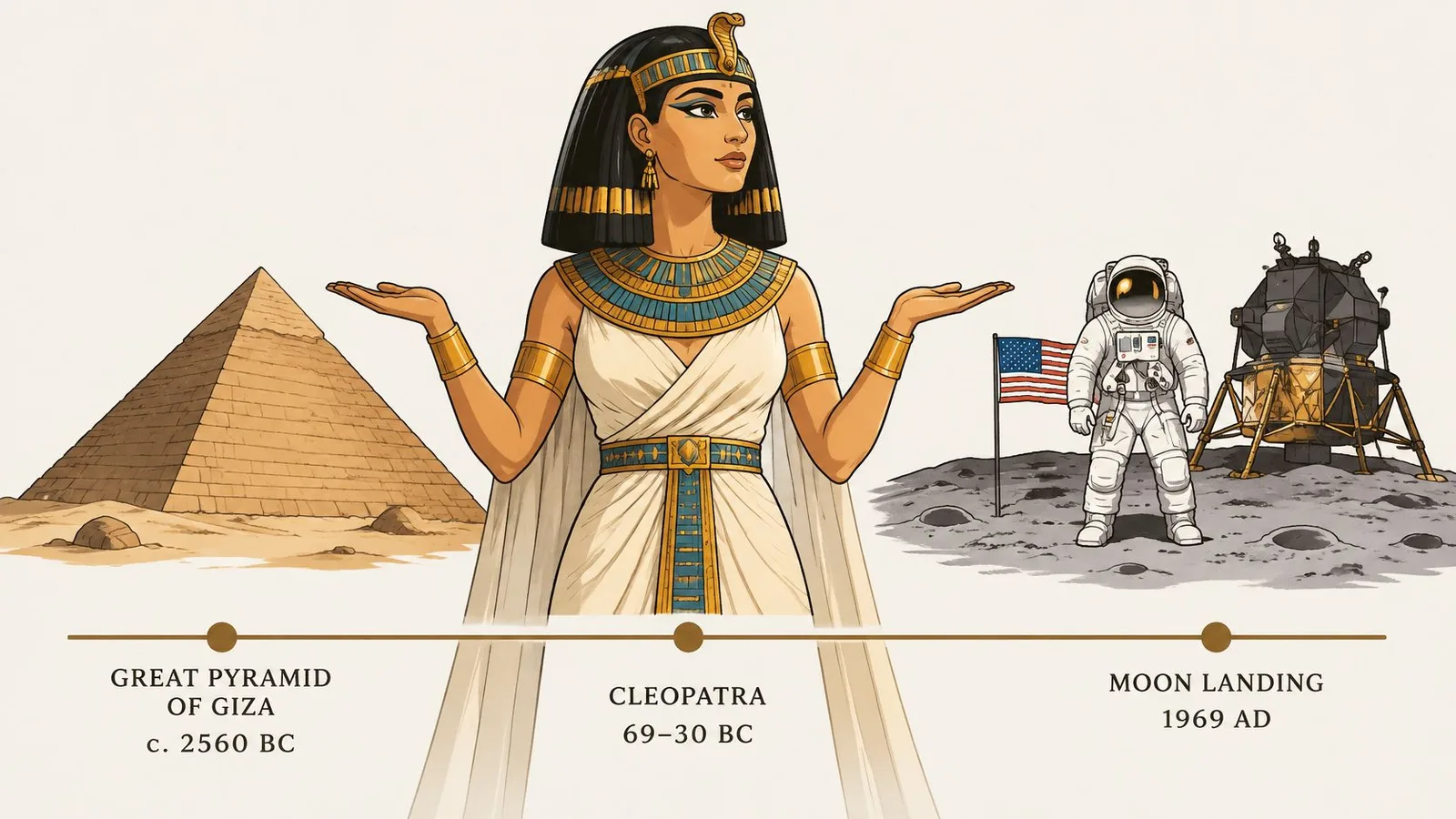
The Moon landing is closer. The explanation is straightforward: the Great Pyramid was already ancient during Cleopatra's lifetime. The shared Egyptian setting can hide the enormous interval between its construction and her rule.
Our mental categories cause the mistake. We often compress ancient Egypt into a single scene containing pyramids, pharaohs, temples, and Cleopatra. Those subjects belong together geographically, but they don't belong to the same historical moment.
Replace the Mental Picture With a Timeline
Draw a line with separate markers for pyramid construction, Cleopatra, and lunar exploration. Before checking a dated reference, place Cleopatra where you think she belongs.
The point isn't to make Cleopatra seem modern. It's to recognize how much history had already unfolded before her lifetime. People we call ancient also lived among monuments inherited from a much older past.
For another useful distinction, explore the differences between the Roman Republic and Roman Empire. Political labels can conceal transitions just as geographic labels conceal long stretches of time.
The exaggerated version treats this comparison as evidence that all familiar historical periods overlap strangely. The better lesson is narrower: calculate intervals rather than trusting the atmosphere of a name.
Question 1 of 6
Why is Cleopatra closer in time to the 1969 Moon landing than to the building of the Great Pyramid?
3. The Great Emu War
Soldiers have machine guns. Emus have speed, scattered movements, and open country. Which side would you expect to achieve its objective?
The Australian operation remembered as the Great Emu War failed to deliver the straightforward solution its supporters wanted. The birds weren't a concentrated target waiting for an army to engage them. They moved, dispersed, and made sustained shooting difficult.
The episode concerned crop protection and wildlife control, not a war between political opponents. Calling it a war makes the story memorable, but it also encourages an inaccurate picture of organized battles and an avian victory ceremony.
Why Firepower Wasn't Enough
A weapon's destructive capacity doesn't tell you whether it suits a particular problem. Operators still need to find targets, get within effective range, and produce results that matter across the affected area.
- Target behavior: Dispersing birds are different from a stationary, concentrated target.
- Operational success: Killing some animals isn't the same as preventing agricultural damage.
- Public retelling: A comic label can overshadow the practical reasons an intervention disappointed.
Try using the story as a planning exercise. Ask learners to propose a crop-protection strategy before allowing them to choose equipment.
They'll need to ask about bird movements, farm boundaries, maintenance, and unintended effects. That's a more useful question than whether an emu could defeat a soldier. The mismatch between method and objective explains the episode better than the joke alone.
4. Eratosthenes Measured the Earth With Shadows
Could you estimate the size of the Earth without traveling around it?
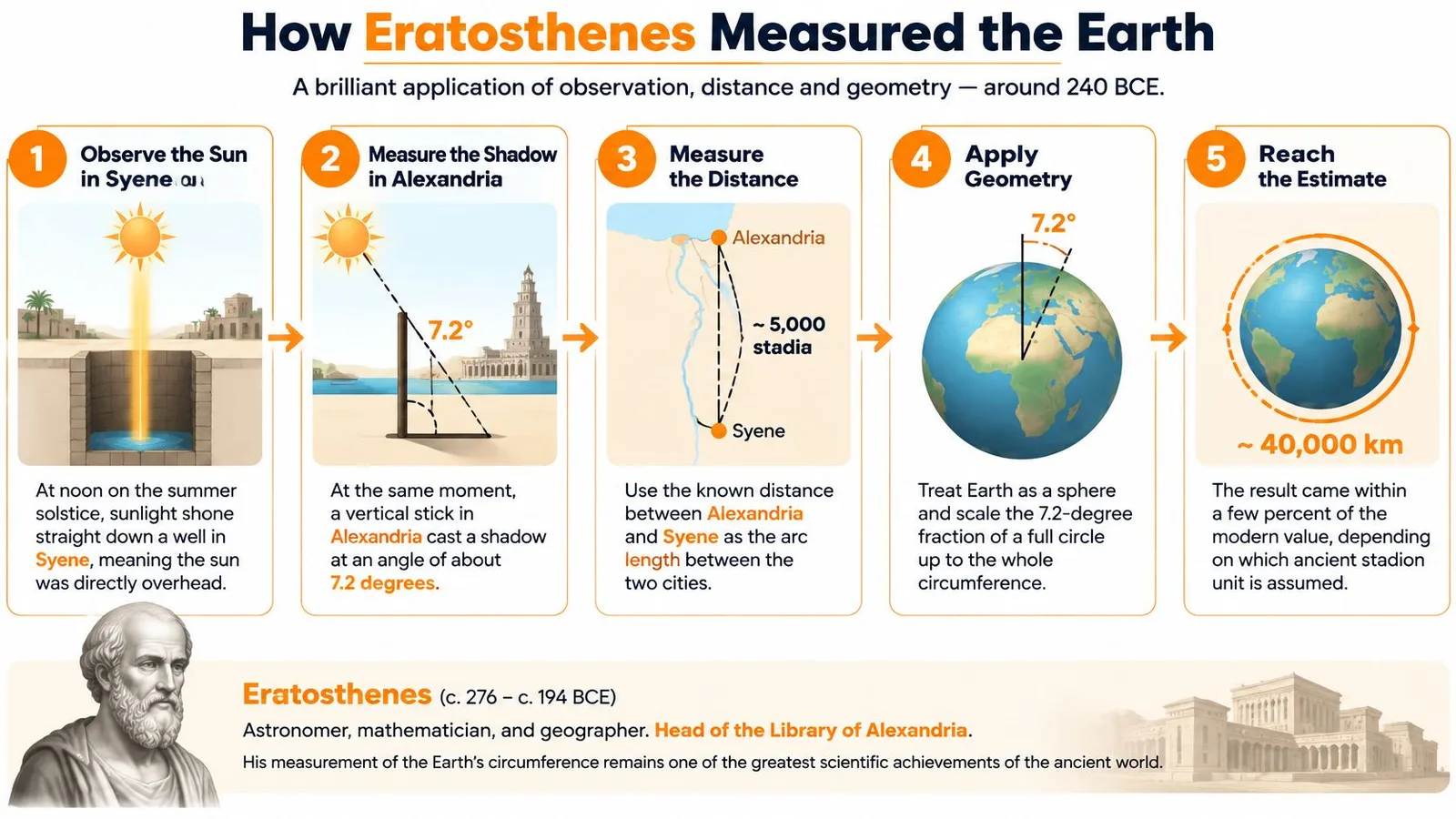
Eratosthenes used a relationship between sunlight, shadows, distance, and geometry. At different places, the midday Sun appeared at different angles. On a curved Earth, that difference can reveal how much of the planet's circumference lies between the locations.
The reasoning works in steps. Measure the angular difference, determine the distance between the observation sites, and scale that distance to a complete circle. The challenge lies in making the observations and distance estimates reliable.
A Brilliant Method Isn't a Perfect Measurement
Popular accounts sometimes turn the achievement into a claim of almost magical precision. The method and the accuracy deserve separate judgments. Interpreting the final estimate depends partly on how we understand the ancient unit of distance involved.
For a practical demonstration, stand a stick upright and measure its shadow. Ask a friend elsewhere to make a comparable observation at an agreed time, with attention to location and solar conditions.
You won't reproduce the historical procedure merely by comparing any convenient shadows. You will encounter its central insight: a local observation can help answer a planetary question.
The achievement wasn't proving that clever people can guess well. It was creating a chain of reasoning that someone else could inspect, repeat, and challenge.
Question 2 of 6
How did Eratosthenes use a shadow in Alexandria and a well in Syene to estimate the size of the whole Earth?
5. The Great Boston Molasses Flood
What sounds more dangerous, a burst water tank or a burst molasses tank?
Don't let the familiar kitchen ingredient make the decision for you. A large release of molasses can exert destructive force, knock people down, and leave them struggling in a sticky, difficult environment.
The Boston disaster is often presented as an absurd footnote. That framing misses the people harmed and the engineering questions involved. An ordinary substance can become hazardous when stored and released on an industrial scale.
Ask About the Container, Not Just the Contents
A useful prediction test starts before the tank fails. What would an engineer need to know about its construction, condition, loading, and inspection?
The exact history of an individual failure requires documentary evidence. The general lesson is easier to see: judging a storage system by whether its contents seem poisonous or explosive leaves out structural risk.
A familiar material isn't automatically a safe material when its volume, pressure, or storage conditions change.
For a classroom example, compare a spoonful of syrup with a sealed container pressing against its walls. Don't try to recreate a dangerous rupture. Ask instead what changes when the amount increases and the container becomes part of the problem.
Boston's archaeological work also offers a reminder that local history extends beyond famous disasters. Its Office of Historic Preservation year review records 2,216 artifacts cataloged in 2025, evidence of the patient work behind understanding a city's past.
6. The Dancing Plague of Strasbourg
If a group of people began dancing compulsively and some collapsed, what explanation would you test first?
The Strasbourg episode is associated with prolonged dancing and severe distress. The harder question is what caused it. Accounts of unusual behavior don't automatically establish a diagnosis, especially when the people involved can't be examined and the surviving descriptions require interpretation.
Stress, religious expectations, and mass psychogenic illness feature in explanations of the event. These aren't interchangeable terms, and listing them doesn't prove that any particular interpretation explains every reported detail.
Separate the Event From the Diagnosis
Try sorting claims into categories:
- Reported behavior: What do accounts say people did?
- Interpretation: What explanation does a historian or clinician propose?
- Uncertain detail: Which dramatic elements require stronger corroboration?
This exercise prevents a common mistake: treating the most vivid version as the best-supported version. Precise claims about participation, deaths, and symptoms deserve particular care.
For a discussion activity, ask learners to defend an explanation using only the evidence they've been given. Then introduce an alternative interpretation and ask which additional document would help distinguish them.
Historical uncertainty isn't a reason to abandon the question. It tells you where to look next. Scholarship on history education and global citizenship supports a broader approach that takes interpretation and inclusion seriously. A responsible answer can remain interesting without pretending to solve a disputed diagnosis.
7. The Antikythera Mechanism Was an Ancient Analog Computer
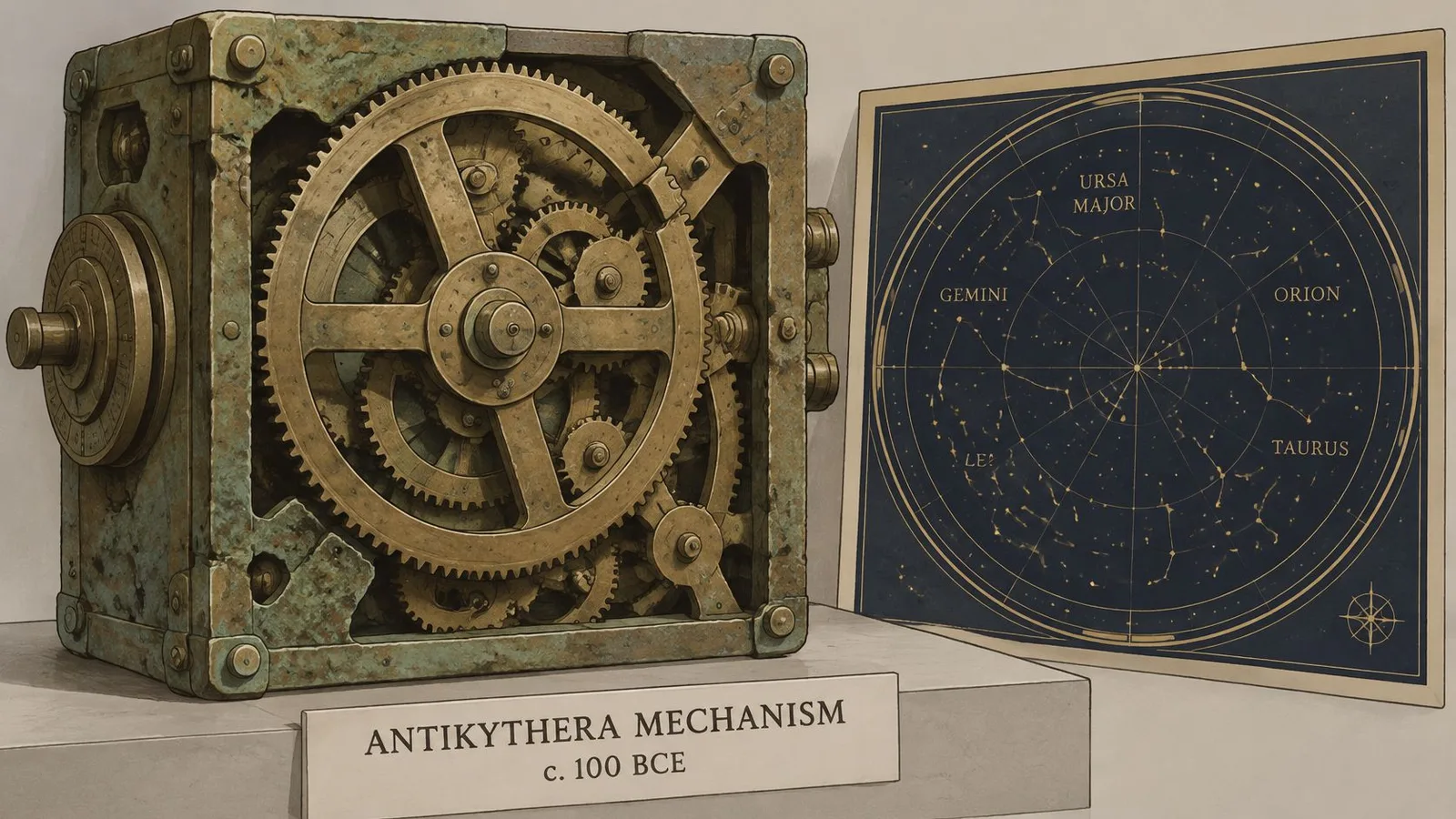
Before looking at the image, guess what an ancient astronomical calculator might contain. A chart? Sliding pointers? Interlocking gears?
Gears are the key answer. A Nature account of the Antikythera Mechanism dates it to the second or early first century BCE and describes how its gearing modeled astronomical cycles, including a pin-and-slot arrangement representing the Moon's nonuniform apparent motion.
That last feature makes the device more than a rotating calendar. Its builders translated an observed irregularity into a mechanical relationship.
What Makes It a Computer?
Here, analog computer means a device whose physical movements represent relationships being calculated. It doesn't mean an electronic, programmable machine like a laptop.
Think of turning a handle that drives connected gear trains. Different gear relationships produce coordinated movements corresponding to celestial cycles. The mechanical arrangement embodies the calculation.
For a quiz, ask which problem requires more complex gearing: advancing a calendar pointer or representing an apparent motion that changes speed. Then explain why an uneven output needs more than a simple uniform rotation.
Don't treat a polished reconstruction as identical to the surviving object. Missing parts leave room for disagreement about its full arrangement.
Pair the engineering question with a summary of Greek mythology to distinguish celestial stories from mechanical models. If material evidence sparks your curiosity, you can also discover artifacts that illuminate Scripture, while keeping each object's evidence separate from its interpretation.
Question 3 of 6
What did the Antikythera Mechanism's builders use to reproduce the Moon's uneven speed across the sky?
8. Hedy Lamarr Helped Invent a Frequency-Hopping System
Can an actor contribute to communications engineering?
Hedy Lamarr and composer George Antheil developed a frequency-hopping concept intended to make radio guidance harder to disrupt. The surprising part isn't that an entertainer could think technically. It's the practical problem they addressed: how can a receiver keep hearing an intended signal when someone tries to interfere?
Their approach involved coordinated changes in frequency. If transmitter and receiver follow the same pattern, they can move together rather than remain on an easily targeted channel.
Follow the Pattern
Use a classroom analogy. Give a sender and receiver matching instructions telling them which labeled station to use next, while another participant tries to block their communication.
The analogy isn't a working radio system, but it exposes the central requirement: both ends must stay synchronized. Uncoordinated hopping would prevent the intended receiver from following the message too.
The exaggerated version says Lamarr invented Wi-Fi outright. That skips the distinction between an earlier contribution, a family of technical principles, and a complete modern communications standard.
Recognition deserves scrutiny too. An EPJ Data Science study of Wikipedia biographies found disparities in biographical coverage by gender and geography. That doesn't establish why any particular inventor is remembered, but it gives you a useful follow-up question: Who else contributed, and whose work does the familiar story leave out?
Question 4 of 6
In Hedy Lamarr and George Antheil's frequency-hopping scheme, what actually made a radio-guided torpedo's signal so hard to jam?
9. Tulip Mania Was Real, but the Popular Story Is Exaggerated
Would you believe a story in which an entire country became obsessed with flower bulbs and destroyed its economy?
That's the version to question. Tulip speculation in the Dutch Republic was real, but historians dispute the sweeping picture of universal participation and nationwide financial ruin.
The mechanism is easier to understand than the legend. A buyer may pay a high price because they expect someone else to pay more later. If that expectation disappears, finding the next buyer becomes difficult.
A Price Isn't the Whole Story
Before accepting a dramatic account, ask what the reported transaction represents.
- Completed sale or agreement: Was money exchanged, or was future delivery promised?
- Rare variety or ordinary bulb: Does an exceptional example represent the wider trade?
- Participant or population: Did losses affect a specialized group or society broadly?
For a worked example, suppose collectors begin trading a scarce plant mainly because its resale price keeps rising. Ask what happens when they stop expecting another increase.
That explains speculation without requiring a claim that every household joined in. It also separates a striking price from evidence of broad economic damage.
The lesson isn't that financial bubbles are imaginary. It's that a useful historical example can acquire details that make it a cleaner morality tale than the evidence allows. Before using tulips to explain a modern market, establish which part of the comparison holds.
Question 5 of 6
Why did buyers in 1630s Holland pay such high prices for tulip bulbs?
10. Hawaiian Pizza Was Invented in Canada
Where would you place the origin of Hawaiian pizza: Hawaii, Italy, Greece, or Canada?
Canada is the answer. The familiar origin account credits Greek-born restaurateur Sam Panopoulos with experimenting with pineapple on pizza at the Satellite Restaurant in Chatham, Ontario.
The name is the trap. A food's name can suggest an ingredient, an association, or a marketing choice rather than the place where a cook assembled it.
An Origin Story Isn't a Complete Food History
There's another distinction worth making. Crediting a particular restaurant with a recognizable dish doesn't mean its cook invented every ingredient, technique, or possible combination resembling it.
Food history often asks several questions at once:
- Documented creation: Who receives credit for the named dish?
- Culinary influences: Which ingredients and practices were already available?
- Popularization: Who helped the dish travel beyond its original setting?
Try the same prediction game with a menu. Choose a geographically named dish and list what its name seems to promise before investigating its history.
You may discover that birthplace, ownership, and cultural identity don't line up neatly. That doesn't make the name fraudulent. It makes it a clue that needs interpretation.
And the pineapple argument? That's a matter of taste, not historical verification. You can dislike the topping while getting the origin right. Preference and evidence answer different questions.
Question 6 of 6
Where was Hawaiian pizza actually invented?
The 10 history facts at a glance
Ten predictions, ten checked answers. Read each row as a scorecard: what you guessed, what the record shows, and where the popular version stretches the truth. Two rows still carry real debates, the Dancing Plague's uncertain headcount and the true scale of Tulip Mania.
| Item | Date or Era | Location | Why It Surprises |
|---|---|---|---|
| Oxford University Is Older Than the Aztec Empire | Oxford teaching c. 1096; Tenochtitlan founded c. 1325 | Oxford, England; Tenochtitlan, Mexico | Oxford teaching began centuries before the Aztec capital was founded. |
| Cleopatra Lived Closer in Time to the Moon Landing Than to the Great Pyramid | Pyramid c. 2560 BCE; Cleopatra died 30 BCE; Moon landing 1969 CE | Egypt; the Moon | Cleopatra was closer in time to the Moon landing than to the pyramid's construction. |
| The Great Emu War of 1932 | November–December 1932 | Campion district, Western Australia | Soldiers with machine guns struggled to control fast-moving emus. |
| Eratosthenes Measured the Earth's Circumference Around 240 BCE | c. 240 BCE | Alexandria and Syene, Egypt | He estimated Earth's circumference using shadows, geometry, and the distance between two cities. |
| The Great Boston Molasses Flood of 1919 | January 15, 1919 | Boston, Massachusetts, United States | A huge wave of molasses caused deaths and major destruction. |
| The 1518 Dancing Plague of Strasbourg | July 1518 | Strasbourg, in present-day France | Dozens or possibly hundreds of people reportedly danced uncontrollably for days. |
| The Antikythera Mechanism, an Ancient Analog Computer | 2nd or 1st century BCE; discovered in 1901 | Shipwreck off Antikythera, Greece | An ancient geared device could model astronomical cycles with remarkable complexity. |
| Hedy Lamarr Co-Invented Frequency-Hopping Spread Spectrum | 1942 | United States | An actress and a composer patented a technology that later informed wireless systems. |
| Tulip Mania in the Dutch Golden Age | 1630s; market collapse in 1637 | Dutch Republic | Tulip trading became a famous bubble, though its scale may be exaggerated. |
| Hawaiian Pizza Was Invented in Canada | 1962 | Chatham, Ontario, Canada | The pizza was created in Canada and is not traditional Hawaiian cuisine. |
Turn Surprising Facts Into Questions You Keep Asking
The most useful response to an unexpected answer isn't just surprise. It's Why did my original answer seem so convincing? That question helps you distinguish a missing fact from a misleading assumption.
Perhaps you grouped everything Egyptian into the same period. Perhaps you assumed military equipment guarantees practical success. Or perhaps you recognized a technology's famous descendant and accidentally credited an earlier inventor with the entire modern system.
Those are different mistakes, so they need different corrections. A timeline helps with chronology. A diagram helps with a mechanism. Comparing accounts helps when the disagreement concerns evidence or interpretation.
Make the Explanation Part of the Game
When you answer incorrectly, read the explanation rather than rushing to another question. Look for the exact step where your reasoning stopped matching the evidence.
When you answer correctly, do the same. You might have understood the mechanism, or you might have recognized a phrase. Being right doesn't tell you which happened.
Keep the better question. Instead of remembering only that an answer surprised you, remember what evidence would let you explain it to someone else.
For a shared quiz, ask each player to explain a prediction before revealing the answer. Keep the discussion friendly and allow people to revise their view. The point is to make reasoning visible, not to punish uncertainty.
These habits also suit short digital lessons. Educators looking to keep online learners engaged can use a concrete prediction, a clear reveal, and an invitation to investigate further rather than relying only on a score.
Follow the Detail You Still Want Explained
Choose the fact that left you with a genuine follow-up. You might investigate how a gear train produces uneven motion, how historians reconstruct a university's beginnings, or how a food acquires a geographic name.
Then choose evidence suited to that question. A photograph can establish a surviving feature, but it can't independently prove an inventor's intention. A later retelling may reveal how people remembered an event without accurately describing everything that happened.
For a daily starting point, our Daily Wonder changes each day and pairs a featured question with a curated knowledge card, image, and detailed explanation. Use the reveal as a beginning rather than a stopping point.
You don't need to collect every interesting history fact. Make a prediction, inspect the explanation, and follow the uncertainty that interests you. That's how a brief encounter with trivia can become a deeper understanding of the past.
Million Whys offers short interactive questions across history and other subjects, with explanations for correct and incorrect answer choices. Visit Million Whys, try a history question, and follow the explanation behind the answer that surprises you most.
Keep Exploring


Related Posts
10 Crazy Facts About the World, Explained by Science
Discover 10 crazy facts about the world, from honey that never spoils to lightning hotter than the Sun. Each one comes with a clear, science-backed explanation.
Random Facts for Curious Conversations
Random facts for curious conversations, with quick answers about animals, science, history, food, psychology, space, everyday objects, and odd human behavior.
History Trivia Questions and Answers
History trivia questions with answers for curious adults: explore flags, aqueducts, armor, greetings, Easter customs, and Marco Polo in quick cards today.