

Differences Between Roman Republic and Roman Empire
On this page· 17
The Roman Republic lasted 482 years, from 509 BCE to 27 BCE, with power spread among magistrates, the Senate, and popular assemblies. The Roman Empire kept many republican forms after 27 BCE, but real authority concentrated in one ruler, Augustus, as princeps.
Why did Rome still hold elections, assemblies, and a Senate if power had already shifted? That question exposes the biggest mistake people make about the differences between Roman Republic and Roman Empire, because the change was not a clean break, it was a long constitutional transformation hidden inside familiar institutions.
| Feature | Roman Republic | Roman Empire |
|---|---|---|
| Core structure | Shared authority among elected magistrates, Senate, and assemblies | Power centered on the emperor, with republican institutions still visible |
| Top executive | Two consuls, serving annually and collegially | The emperor, with decisive control over major commands |
| Military logic | Citizen militia tied to civic status and seasonal mobilization | More professional, longer-term, and regularized forces |
| Provincial control | Senate allocated commands in flexible rotating arrangements | Provinces split between imperial and senatorial administration |
| Public participation | Assemblies voted, but influence was shaped by wealth and status | Assemblies continued, but central power sat with the emperor |
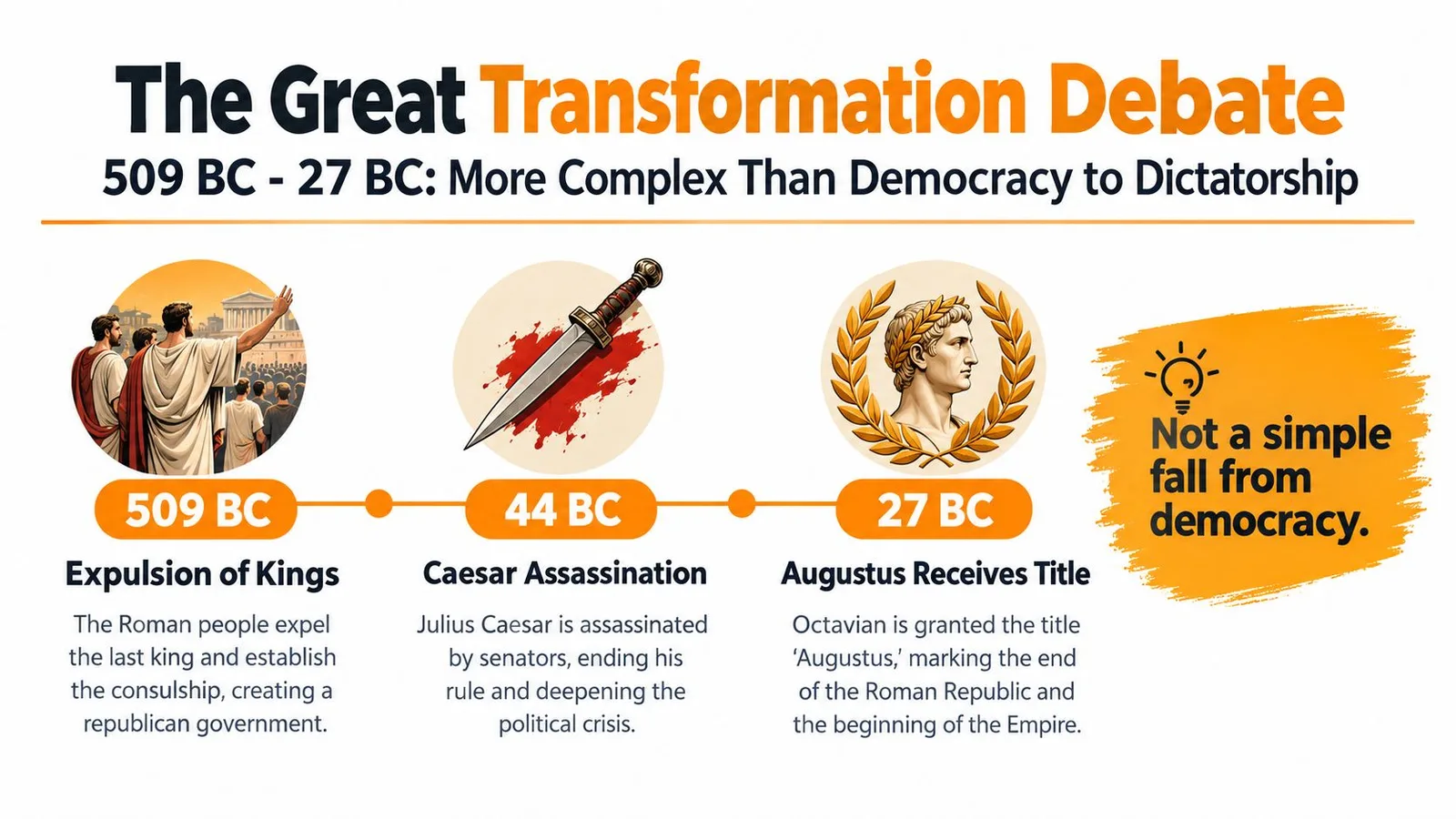
The Great Transformation Debate
Textbook summaries often compress the Republic into a democracy and the Empire into a dictatorship, but the constitutional record is more layered. Rome did change, yet it changed by degrees. Old offices stayed in place while real authority moved upward.
Why the transition was gradual
Civil war pushed that shift forward. The struggles linked to Marius and Sulla, Caesar's dictatorship, and the contest between Octavian and Mark Antony each weakened the older balance of power. By 27 BCE, Octavian kept republican language and offices in place while concentrating decisive authority in himself as princeps, or “first citizen” (Britannica on the Roman Republic). The forms remained visible, but the center of gravity had moved.
A second misconception is easier to miss. Elections can exist in a system that still gives unequal weight to different citizens. Roman voting was shaped by wealth, status, military organization, and citizenship, so participation concentrated influence in the hands of the wealthy (Britannica on the Roman Republic). The Senate was dominated by aristocratic families, which made the Republic a mixed constitution, not a level political field.
Practical rule: if people can vote but elite institutions still control most outcomes, the system is not simple democracy.
What Augustus kept and what he changed
Augustus did not abolish the old structure in one stroke. He preserved republican titles, senatorial prestige, and assemblies, while controlling the army, major provincial commands, state finances, and much of the legislative process (Britannica on the Roman Republic). The continuity was real, but it served a new center of command.
The best way to read the shift is as continuity plus concentration. The Republic already relied on competing offices and popular bodies, yet the Empire placed those forms under one ruler. That is why the transition is better understood as a gradual rebalancing of power than as a single constitutional switch.
Question 1 of 6
How did Octavian hold decisive power in Rome after 27 BCE while the old republican offices and titles were still in place?
Constitutional Power Structures Compared
How did Rome move from republic to empire without a clean constitutional break? The answer lies in a system that looked balanced on paper, yet gave unequal weight to its parts. The Republic distributed authority across several institutions, and that arrangement is the key to understanding its logic. Two consuls served as the main executive officers, while four major assemblies handled elections, legislation, judicial matters, and decisions on war and peace.
How the Republic distributed authority
The Senate stood at the center of elite politics. Aristocratic families dominated it, and its influence rested on social rank, experience, and continuity more than on formal democratic legitimacy. That is why calling the Republic “government by the people” can mislead readers. Citizens did take part, but property and status shaped how much that participation mattered.
The assemblies mattered too, though they did not operate like a modern one-person, one-vote system. They were the public arena for decision-making, yet their power moved through citizenship categories and voting arrangements shaped by inequality. The constitution balanced elites against elites while preserving elite power itself.
The Republic restrained permanent monarchy by making executive power annual and shared, while leaving society unequal.
How the Empire kept the shell but changed the engine
Under the Empire, the Senate and assemblies continued to exist, but real direction shifted upward. The emperor controlled the army, major provincial commands, state finances, and much of the legislative process. The older institutions were still there. They no longer decided the most important questions on their own.
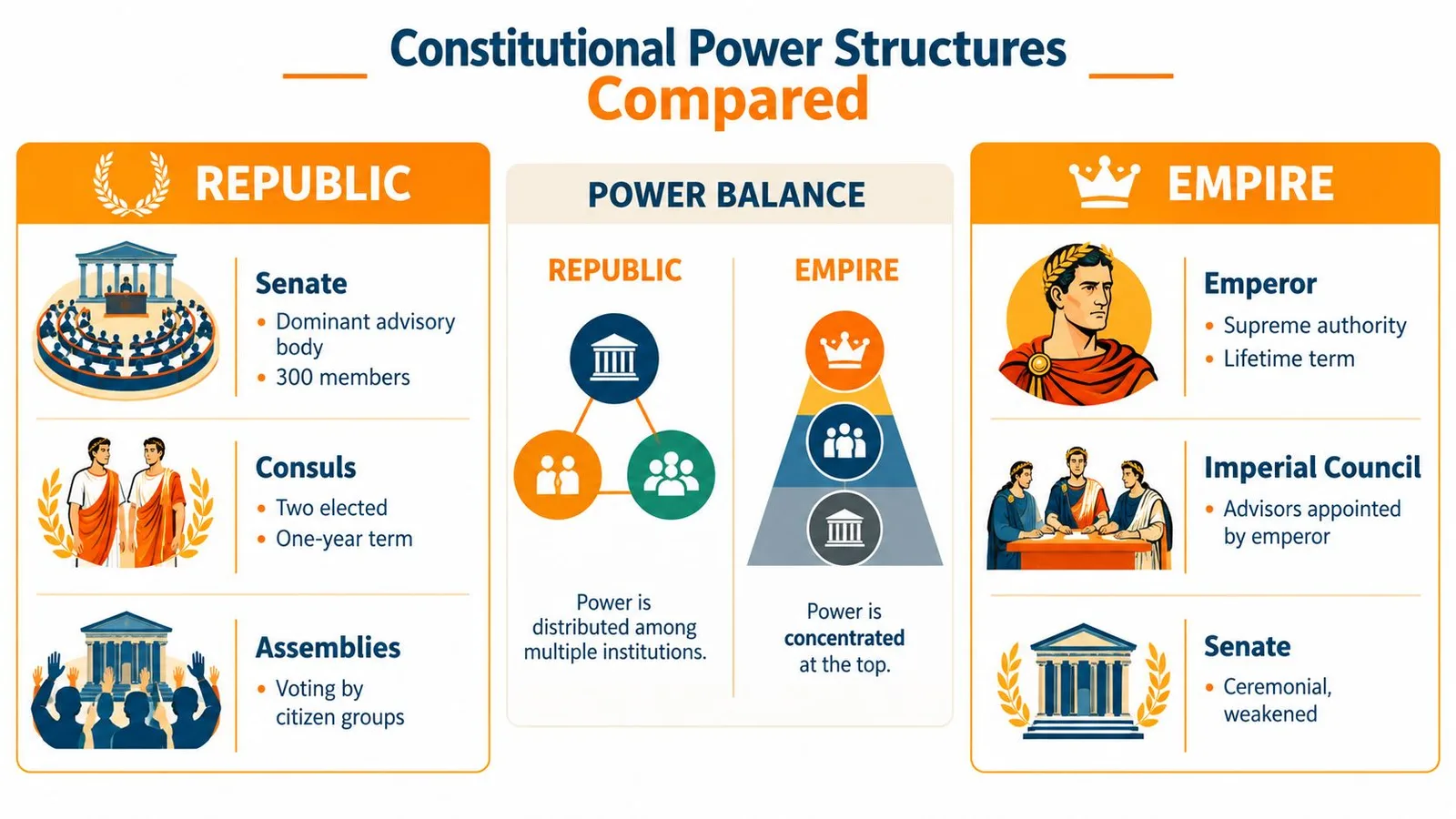
The larger shift was from competitive power-sharing to a monarch-centered system that kept republican forms in place while concentrating authority in one ruler. Augustus could also use tribunician power to present measures to the people and act through the old assemblies, which helps explain why the change felt gradual to many Romans. The outer structure stayed familiar, but the center of command did not.
Question 2 of 6
Why did the Roman Republic split executive power between two consuls who each served only one year, rather than having a single leader?
Military Organization and Political Risk
How did Rome move from a citizen militia to an imperial army without a clean break? The answer is gradual change. In the Republic, the army was formally a citizen militia drawn mainly from landed farmers and led by annually elected magistrates. A standard mid-Republican legion had about 4,200 infantry and 300 cavalry, with larger 5,200-infantry legions used for major campaigns (Oxford academic chapter).
Why long service changed politics
That arrangement fit short campaigns and a political order built on rapid rotation in office. Soldiers were called up for a civic duty, then sent home when the fighting ended. By the late Republic and early Empire, service became more regular, longer-term, and increasingly professional, with standardized equipment and fixed deployment practices replacing the older seasonal, property-based model (Oxford academic chapter). The point was continuity, not improvisation.
That shift carried political risk. Commanders who stayed with the same troops for long periods could build personal loyalty, and that weakened the late-Republican constitution. Britannica notes that army loyalty could attach to powerful generals rather than to the state itself. A soldier who depends on a commander for advancement and security may follow the man before the republic.
The Empire's military logic
The early Empire kept the legionary framework of the late Republic, but placed it inside a more regularized standing-force structure (Oxford academic chapter). That reduced dependence on annual elections and ad hoc levies. Military organization now followed the emperor's administrative system more closely than the old republican cycle of officeholding.
One consequence stands out clearly.
Soldiers' loyalty shifting from the state to individual commanders made civil war easier to trigger.
Military command stopped being a temporary extension of public office and became a permanent organ of the imperial state.
Question 3 of 6
Why did a mid-Republican Roman legion sometimes field about 5,200 infantry instead of its usual 4,200?
Provincial Administration and Fiscal Control
Provincial rule shows how Rome changed by degrees. Under the Republic, the Senate assigned provinces to magistrates and former magistrates through flexible arrangements that suited an aristocratic system of rotation, bargaining, and rivalry among officeholders. Authority existed, but it was still personal and temporary, which is why the same state could hold elections and yet remain unequal in practice.
How Augustus reorganized the provinces
In 27 BCE, Augustus divided the provinces into imperial provinces with major military forces and senatorial provinces left to the Senate (BMCR review). Imperial provinces were governed by legati Augusti answerable to the emperor, while senatorial provinces continued under proconsuls who worked from Republican precedent. The result was a cleaner chain of command in the places where military power mattered most.
Fiscal control followed the same logic. Provincial censuses helped estimate what each province could contribute, fixed sums were assigned, and those sums were then distributed among cities according to assessed capacity (Oxford academic chapter). Augustus also expanded census organization and shifted its administration toward the emperor, so revenue collection depended less on local improvisation and more on central oversight.
What changed in practice
A senatorial province such as Asia still looked familiar on paper, because it retained a place for elite republican forms. An imperial province such as Syria worked differently in practice, because a legatus Augusti tied military command and fiscal supervision more closely to the emperor. That contrast helps explain the larger transition. Rome did not sweep away the Senate. It redirected authority through it, while placing the most sensitive provinces under imperial control.
The effect was steadier revenue and tighter coordination across major provinces. The Republic had relied more on rotating officeholders, Senate allocation, and uneven local extraction. The Empire kept senatorial participation, but added a permanent imperial layer for command and assessment.
Question 4 of 6
When Augustus divided Rome's provinces in 27 BCE, what actually decided whether a province was run by the emperor's own deputy or by a proconsul?
Territorial Expansion Paradox
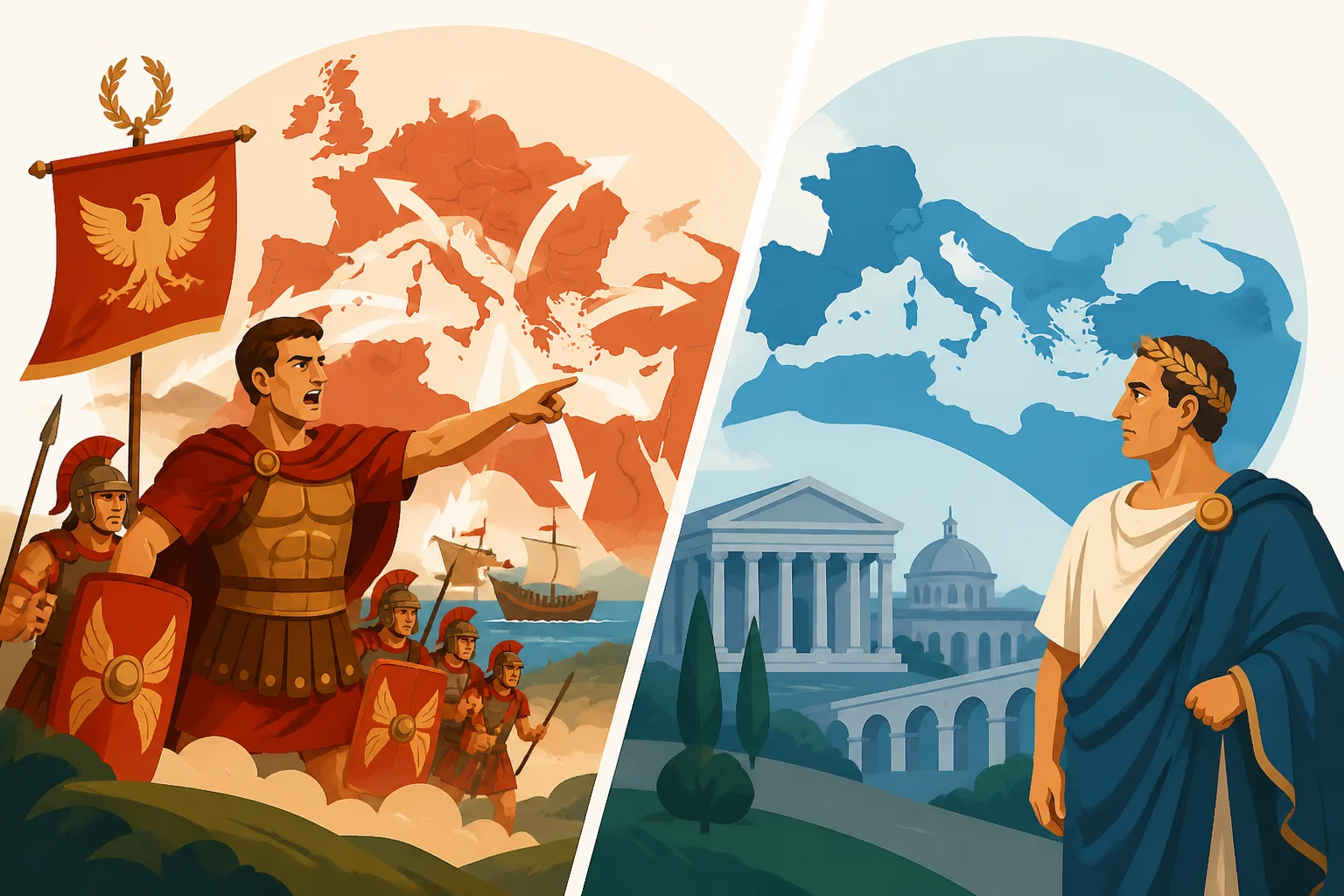
Many readers assume empires grow faster than republics. Rome is one of the clearest reasons to question that idea. A major historical overview argues that Rome's greatest territorial expansion came during the Republic, especially after the Punic Wars, while the early Empire expanded more slowly (University of California, Berkeley summary).
Why the Republic expanded so aggressively
The Republic repeatedly mobilized huge citizen armies after Hannibal's surrender. One overview estimates that for roughly 150 years after that point, Rome fielded armies of more than 100,000 regularly, involving about 13% of adult male citizens annually (Britannica on ancient Rome). That level of mobilization helped Rome conquer and hold vast territory.
The same system also strained the Republic at home. Long campaigns encouraged unequal access to land and increased the political influence of commanders whose soldiers depended on them. Late-Republican military competition became destabilizing for exactly that reason. The republic that expanded most dramatically also created the pressures that weakened its own constitution.
Why the Empire expanded more slowly
The early Empire inherited those conquests and focused more on durable rule than on relentless conquest. Political form and military tempo are independent variables, and Rome proves it. Power became more integrated across the provinces, while the center became less participatory.
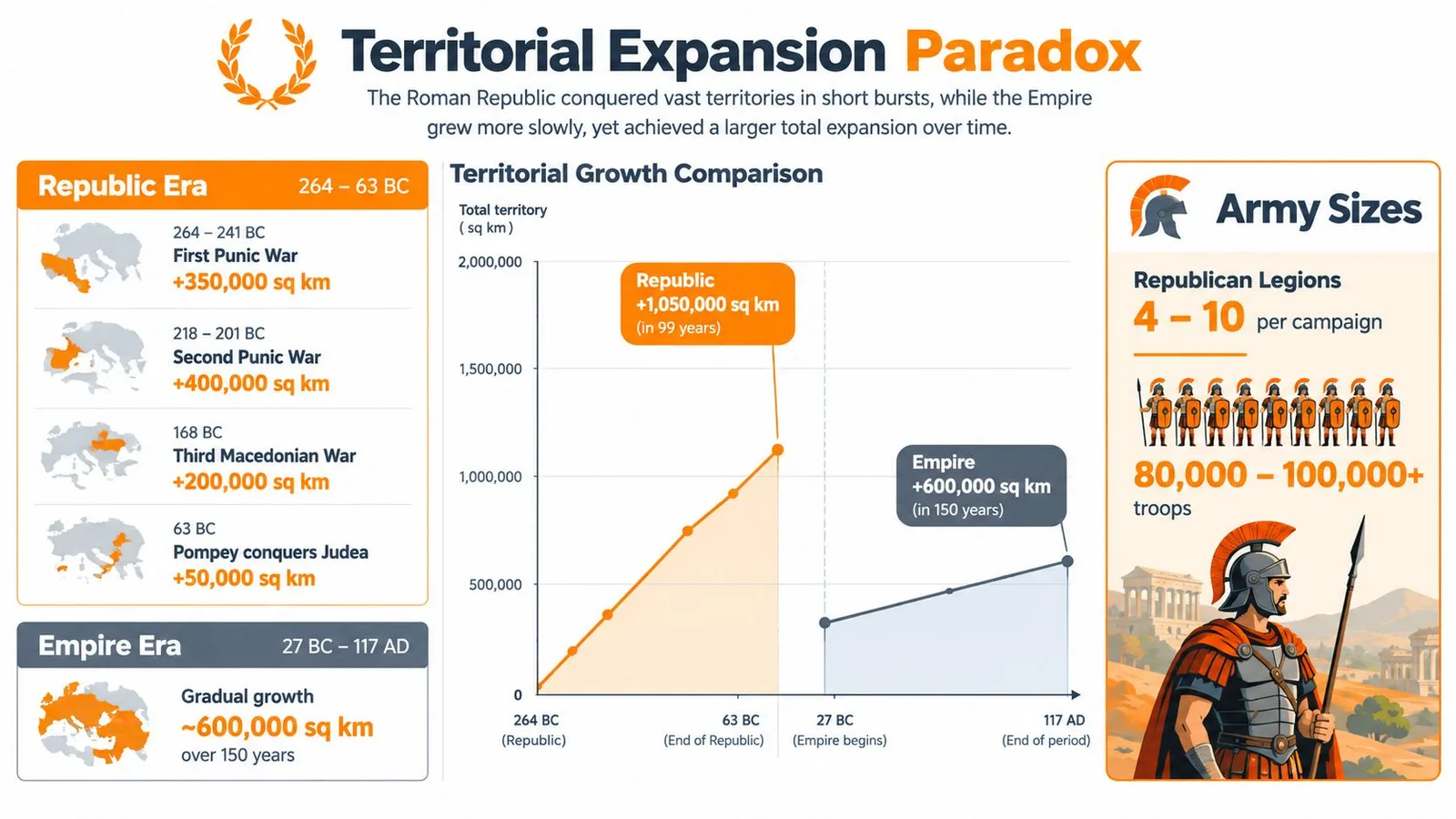
That is the point many learners miss. “Empire” sounds more expansionist, so it is easy to assume it must have conquered more than the Republic. The label, however, does not determine the pace of conquest. The Republic's expansion rested on citizen mobilization and elite rivalry. The Empire's stability depended more on administration and control.
Ancient societies also used stories to legitimize power, which is why a brief look at Greek mythology and cultural authority can clarify how Romans linked rule, identity, and tradition.
Question 5 of 6
After the Second Punic War, how did the Roman Republic keep putting armies of more than 100,000 men in the field for roughly 150 years?
Understanding Durable Imperial Rule
How did Rome keep such a large empire together for so long? The answer lies in gradual adaptation. Rome turned conquest into governance through recruitment, citizenship, taxation, and cooperation with local elites, not through a single constitutional break. Citizenship spread unevenly, sometimes bringing voting rights, sometimes only partial inclusion, and that unevenness was part of the system.
The four pillars of staying power
The first pillar was military organization. Rome relied less on short-term civic mobilization and more on forces tied to provincial administration, which made rule steadier across distance. The second pillar was citizenship. Rome treated citizenship as something it could extend step by step, binding communities and leading families to Roman authority. That process kept going into the imperial period and reached a major turning point with Caracalla's edict in 212 CE, which widened citizenship far beyond earlier limits.
The third pillar was taxation. A more regular fiscal system made revenue more predictable across the provinces. The fourth pillar was local cooperation. Rome usually worked through existing communities and local elites rather than replacing every local structure with a single uniform model. This is why a state could keep elections, offices, and local privileges in some places while remaining unequal in practice.
Bottom line: Rome held its empire together by calibrating participation, privilege, and obligation at different levels.
That framework clears up the usual confusion. The key question is not whether the Republic or the Empire was “better.” It is how Rome built durable rule over a vast territory while still leaving enough local flexibility for cities, elites, and soldiers to see advantage in the system.
Question 6 of 6
Why did the emperor Caracalla widen Roman citizenship so dramatically in 212 CE?
Keep Exploring
Why did Rome expand more under the Republic than under the early Empire?
History & Culture
Why did the Roman Empire collapse despite its impressive roads, aqueducts, and fortifications?
History & Culture
Why did the Roman Empire's military decline even though their engineering was so advanced?
History & Culture