

How to Ask Better Questions: A Five-Step Method That Works
On this page· 13
You type a question into a search box, ask a friend, or send it to an AI assistant. The answer sounds sensible, but you're still not sure what to believe or do. So you add more words to the question and try again.
Often, the missing ingredient isn't detail. It's a clear idea of what you need to find out. Learning how to ask better questions means noticing that gap, choosing a useful test, and letting each answer guide your next move.
What a Sharper Question Looks Like in Practice
Your morning coffee is half-finished when a worry surfaces: is this habit doing something to your health? You ask whether coffee is bad for you and get a sprawling answer covering sleep, alertness, digestion, and individual differences. All of it sounds relevant. None of it settles the question you had in mind.
Length adds nothing by itself. What sharpens a question is how clearly it describes what a useful answer would have to contain.
A vague question works like an unlabeled map: it points everywhere, so it leads nowhere in particular. A sharp one names a street. The table below pairs broad questions with versions that would produce more checkable answers.
Weak questions and their sharper rewrites
| Weak question | Sharper question | What changed |
|---|---|---|
| Is coffee bad for you? | Does drinking three cups of coffee a day raise resting heart rate in healthy adults? | Adds a dose, an outcome and a population |
| Why do onions make you cry? | What happens chemically when a knife breaks onion cells? | Targets a mechanism instead of a feeling |
| Is my plant dying? | What do yellow lower leaves on a pothos suggest about watering frequency? | Names a symptom and the variable to test |
| Should I learn Python? | What could I build in six months with Python that I cannot build in a spreadsheet? | Defines the outcome and the comparison |
| How do vaccines work? | How do vaccines train the immune system to recognize a pathogen without causing the disease? | Specifies the mechanism being asked about |
| What is the best laptop? | Which laptop can edit my camera's footage smoothly in Adobe Premiere Pro within my budget? | Sets a use case and the criteria that matter |
Read down the final column and a pattern appears: each rewrite names something observable, asks how it happens, or defines the situation and the comparison. You can use that column as a checklist of options and pick the single change that fits. One deliberate edit is usually enough to turn an answer into a starting point instead of a dead end.
That last part is the true test. A sharper question works as a diagnostic loop: the answer should reveal what to ask next. If the reply leaves you exactly where you started, the question gathered information without changing your reasoning.
Questions aimed at people work differently, because an honest reply matters more than a measurable outcome. Curated collections can help you find questions that encourage candid answers, and these questions to ask friends give you practice material for conversational curiosity.
A sharper question tells you what a good answer would have to contain.
How to Build a Better Question in Five Steps
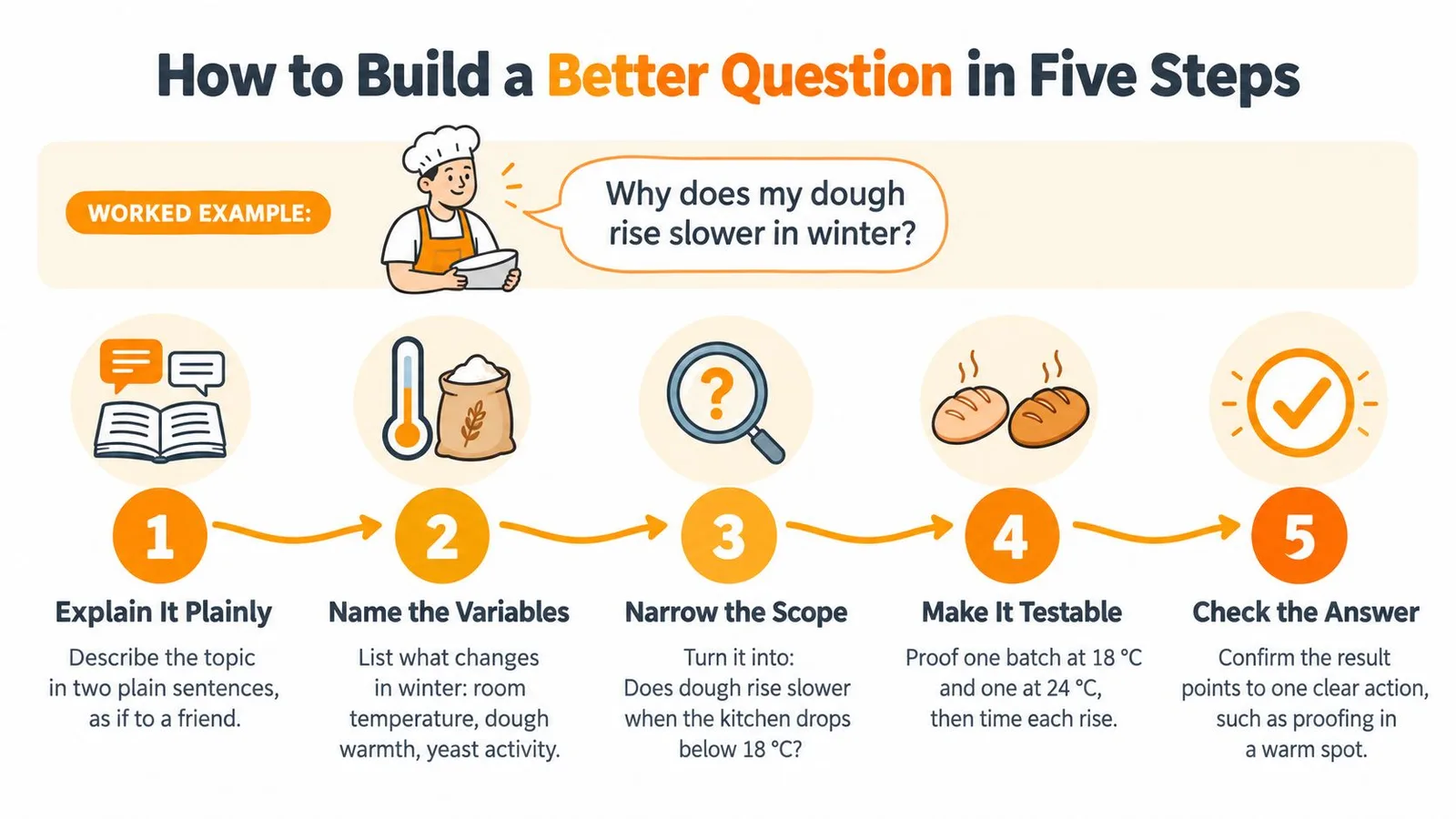
Suppose you're baking bread and ask why your dough rises more slowly in winter. That's a useful starting point, but several things might have changed: the room, the ingredients, the yeast, or your routine.
Build the question around what you don't yet understand, rather than jumping straight to a remedy.
Start with what you can explain
Explain the topic plainly. Tell a friend, or yourself, what you think happens. For the baker, that might be: yeast produces gas during fermentation, and the dough holds that gas as it expands. The question becomes: What part of this process changes in winter?
Explaining exposes the point where your understanding runs out. In an experiment with 152 participants, learners who taught scientific texts to others generated more higher-order, create-level research questions than peers using retrieval practice or concept mapping, according to the study indexed by ERIC. This doesn't mean you need an audience every time. A plain spoken explanation gives you somewhere useful to start.
Name the phenomenon exactly. Replace the general impression with an observation: Why does this dough take longer to reach the same rise in a cooler kitchen? Record elapsed time and use a consistent endpoint, such as the same marked level in a straight-sided container.
In a hypothetical kitchen measuring about 16°C, note that reading rather than relying on how cold the room feels. Don't treat the room reading as the dough's temperature; measure the dough separately.
Specify the unknown relationship. Ask: How does the dough's starting temperature relate to the time it takes to reach that marked level? You've separated a possible cause from the result you're trying to explain.
Keep the recipe and yeast amount consistent. Otherwise, you won't know which change matters.
Ask for a prediction and a fair test
Request a mechanism or prediction. Try: How might cooler conditions affect yeast activity, and how would you predict the rise time to change? A mechanism is the process connecting a cause to an outcome.
For an illustrative comparison, you could ask what doubling time to expect at 20°C compared with 16°C. Those are proposed test conditions, not a guaranteed baking timetable. A useful answer should explain its assumptions rather than invent a precise result.
Define evidence that separates explanations. Finish with: Would otherwise matching batches rise differently in cooler and warmer spots, and what would that tell me about temperature versus weak yeast? Use a food thermometer, mark the starting level, and record the time.
Decide beforehand what result would count against your preferred explanation. If you can reinterpret every possible result as support, you haven't designed a useful test.
For workplace practice, you can take an example from 1chat's practical AI ideas for teams and apply the same discipline: define the task, predict the outcome, and decide how you'd judge it.
The pass test: plausible explanations should predict different results. Your question is ready when the answer could help you distinguish between them.
Follow-Up Questions That Change the Conclusion
An answer isn't necessarily the end of an inquiry. It may give you a claim worth testing, a missing condition, or a comparison you hadn't considered. Treat questioning as a diagnostic loop: ask, inspect, narrow, and ask again.
Say your pothos has yellow lower leaves and an answer suggests overwatering. Before changing your routine, establish what supports that claim. Is the soil staying wet, or has someone inferred the cause from leaf color alone?
Follow-up goals and the prompts that serve them
| Follow-up goal | Prompt pattern | What it reveals |
|---|---|---|
| Test the claim | What would have to be true for this to fail? | Hidden assumptions |
| Find the cause | What mechanism produces this result? | The causal chain |
| Find the limit | Under what conditions would this stop working? | Exceptions and boundaries |
| Compare cases | How would this differ where the key variable is absent? | Which variable actually matters |
| Set a test | What observation would change your conclusion? | The evidence that settles it |
Follow the answer rather than mechanically asking every prompt. For the plant, you might ask how prolonged soil moisture affects roots, whether the explanation still fits dry soil, and what you'd expect to see in a comparable plant with good drainage.
Ask for a difference, not just more detail
A request to tell you more may produce another paragraph without changing your decision. Asking whether yellow leaves with dry soil support the same explanation is more useful because the response could redirect your next action.
Don't confuse a complete-sounding explanation with the ability to apply it elsewhere. The Carpenter and colleagues paper on prequestions describes learning benefits as most reliable for information directly addressed by the questions, with transfer to unrelated material less consistent. Try applying the explanation to a different setting before assuming you understand its reach.
At Million Whys, follow-up questions users ask on explanation screens become new questions for the next visitor. A well-aimed question can therefore help someone you'll never meet.
Stopping rule: Pause when another answer is unlikely to change what you believe or do, given the stakes.
For a plant, that may mean checking the soil. For a health concern, it may mean identifying what to ask a qualified clinician rather than continuing to search.
Question 1 of 3
When you're asked a question before reading a chapter, why does the memory boost mostly stick to the exact thing you were asked about?
Telling Whether a Question Built Your Reasoning
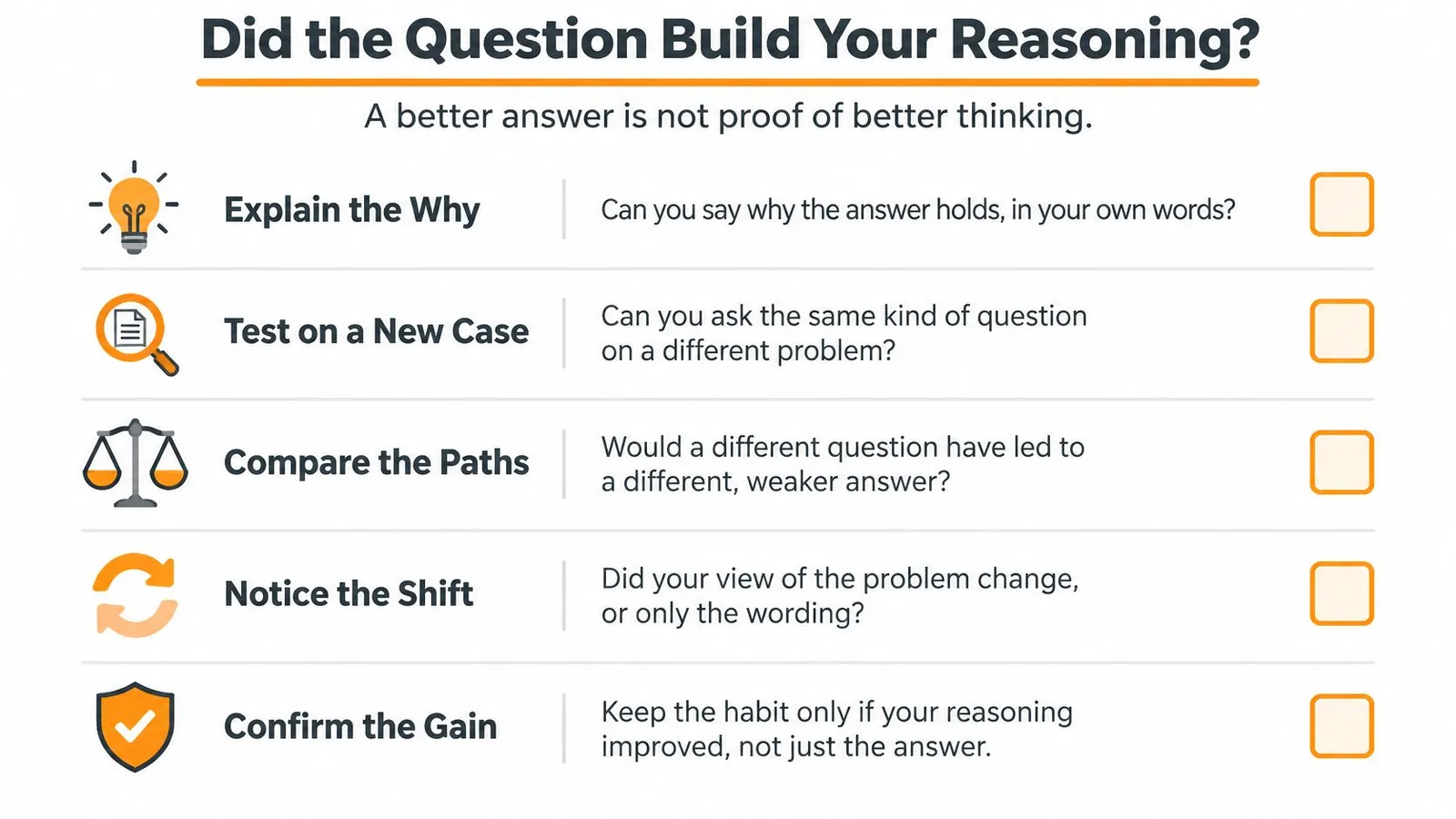
A polished answer can hide an unchanged understanding. You may recognize the vocabulary, agree with the conclusion, and still be unable to explain why it holds.
The more demanding test is whether you can reason without the answer in front of you. The education paper published by Universitas Nurul Jadid describes AI as more helpful for critical thinking when it provides support for learners' reasoning rather than replacing it, with teacher guidance and source verification shaping how learners evaluate evidence.
Check what you can now do
Use these checks after an explanation:
- Identify an assumption. Name something the conclusion requires to be true. A laptop recommendation, for example, may assume you mainly edit at a desk.
- Request supporting evidence. Can you distinguish a manufacturer's claim from a test using relevant footage and software?
- Compare alternatives. Explain why portability might justify a different choice from sustained editing performance.
- Explain it unaided. Close the answer and describe the trade-off in your own words, including what remains uncertain.
These checks aren't a validated scorecard. They're habits you can test by seeing whether they help you handle an unfamiliar problem.
Record the reason for changing your mind
Before reading an answer, write a prediction and label your confidence from low to high. Afterward, note the particular observation, comparison, or explanation that changed your view.
Suppose you expected the laptop with the most memory to be the best choice. After comparing relevant editing tests, you might decide that playback performance and cooling matter more for your workload. The gain isn't merely selecting another machine; it's understanding why your original rule was incomplete.
If your confidence changes but you can't explain why, you may have accepted an answer without understanding it.
Being persuaded isn't automatically a failure. Sometimes someone else has the expertise you lack, and relying on them is sensible. The important distinction is whether you know what you're relying on and where your own understanding stops.
Our position is that AI is for lookup and Million Whys is for exploring. Whatever tool you choose, keep ownership of the judgment: what you accept, what you question, and what would justify revising your view.
Question 2 of 3
What makes an AI study helper sharpen a student's critical thinking rather than just supply answers?
Common Questioning Mistakes and How to Fix Them
You don't need elegant wording to ask a useful question. You do need to notice habits that make an honest, relevant answer harder to give.
Stacking unrelated questions. Asking what causes a problem, whether it's dangerous, and how to fix it invites a scattered response. Split the questions and start with the cause when it's safe to do so; urgent safety concerns come first.
Assuming the answer. Asking why coffee is harmful embeds a conclusion that hasn't been established. Ask whether the effect you're concerned about occurs, for whom, and under which conditions.
Rephrasing instead of investigating. Generating a long list of near-identical prompts can feel productive while leaving the uncertainty untouched. Choose a workable question, examine the answer, and spend your effort checking something consequential.
Trusting fluent AI output. Confident prose isn't a reason to act. Ask for a competing explanation and the strongest counterargument, then verify important claims against an appropriate source. Workshop participants described needing alternative scenarios, justification, and different contextual framings while still substantially editing AI output in the Weaver and colleagues workshop paper.
Leaving good undefined. Asking whether a tool is good makes the respondent choose your priorities for you. Name the criterion first: accuracy, repairability, cost, speed, or ease of use.
Letting reputation substitute for judgment. A familiar brand or articulate speaker can make unrelated claims seem credible. Learning what the halo effect is can help you separate your overall impression from the evidence for a particular claim.
Check your favorite explanation first
The mistake to inspect first is protecting an explanation from every possible challenge. If you already believe a colleague missed a deadline because they don't care, almost any behavior can seem to confirm it.
Replace that judgment with a question about observable events: what blocked the handoff, when did the delay become apparent, and what information was missing? You'll have a better chance of identifying something you can address without pretending to know another person's motives.
Question 3 of 3
Why does a brand you already trust make an unrelated claim from that brand feel more believable?
Put One Stuck Question Through the Method Today
Choose a question you genuinely want resolved, not a topic you think you ought to study. It might concern an awkward work process, an unfamiliar household problem, or a claim you keep seeing online. Write it down before opening another tab.
Explain what you already understand, identify the uncertain relationship, and decide what a useful answer would let you predict. Then ask a follow-up based on the answer you receive, rather than the answer you expected.
Keep a small question log
Use a notebook or a spreadsheet with these columns:
| The question | Your prediction | What the answer changed | The next question it raised |
|---|---|---|---|
| Why do I keep postponing this task? | I think the task is too large. | Writing the first action revealed that I was waiting for information. | Who can supply that information? |
The entry doesn't need to be polished. Its purpose is to preserve the difference between what you thought before and what you can now explain.
We recommend five questions a day, roughly two to three minutes in total. You can download Million Whys to your phone to explore questions, and every answer choice includes an explanation, including the wrong ones. Treat the pace as an invitation to practice, not a quota that matters more than understanding.
If you're building a habit of learning new things, attach this practice to a moment you already have, such as a lunch break. Leave yourself permission to spend longer on a question that matters and to stop when you've learned enough to act.
After a week of practice, count the logged questions that changed a prediction or decision. That count, not the number you asked, is your most useful sign that the method is working.
Igneous AI, LLC develops Million Whys, a platform for exploring everyday curiosity through short interactive questions and explanations. Visit Igneous AI, LLC to choose a topic, make a prediction, and practice finding the question that takes your understanding further.
Keep Exploring
Why does asking questions help you learn better than just listening?
Psychology & Behavior

Why do people who ask more follow-up questions tend to be better liked by the person they were talking to?
Psychology & Behavior
Why does the Socratic method use questions instead of giving direct answers?
Philosophy & Ethics
Related Posts
Questions About AI: Learn by Asking Better Whys
Questions about AI work best when they expose a real gap. Use this guide to learn with AI without losing curiosity, judgment, or real closure in practice.
Understanding AI Through Better Questions
Understanding AI starts with better questions: patterns, training data, feedback, verification, and curiosity-first tools that give real closure today.
How to Keep a Conversation Going, Naturally
How to keep a conversation going without scripts: use real follow-up questions, small curiosity refills, better pauses, and graceful exits when energy fades.