What Is the Halo Effect? Definition, Examples, and Bias
On this page· 18
The halo effect is a judgment error in which one overall positive impression of a person spreads into ratings of traits that should be scored separately, first described by Edward L. Thorndike in 1920. It's the reason one strong quality can make everything else about someone look better than the evidence supports.
Why One Good Impression Skews Everything Else
A hiring manager opens a résumé and sees a famous employer, clean formatting, and confident wording. Within minutes, she's rating the candidate's teamwork and technical skill as strong too. She hasn't seen the candidate solve a problem, lead a meeting, or help a colleague yet.
That leap feels natural, and that's why it's hard to catch. You've probably made a version of it yourself. A teacher who likes a student's attitude may read a weak essay more generously. A shopper may trust a product more because its packaging looks premium, even before checking how well it works.
You're Probably Judging Several Things at Once
Most real judgments aren't single questions. They're bundles. When you review an employee, grade a student, interview an applicant, or choose a leader, you're scoring many traits in a short time. One vivid quality gives your brain an easy shortcut for the rest.
Imagine judging a meal after one excellent first bite. You may start assuming the ingredients are fresh, the kitchen is clean, and the dessert will be great. The first bite tells you something real, but it doesn't answer every question on the menu.
A useful warning sign: If one quality seems to explain everything about a person, pause and ask what evidence you actually have for each separate judgment.
This guide walks through a clear definition, the research that first named the pattern, and the experiment that showed how a global impression can rewrite specific judgments. You'll also see workplace and classroom examples, learn how to separate bias from valid inference, and consider whether AI systems can show the same pattern. By the end, you'll be able to name the bias, spot it in your own ratings, and tell when a positive impression is informative instead of misleading.
Defining the Halo Effect in Plain Terms
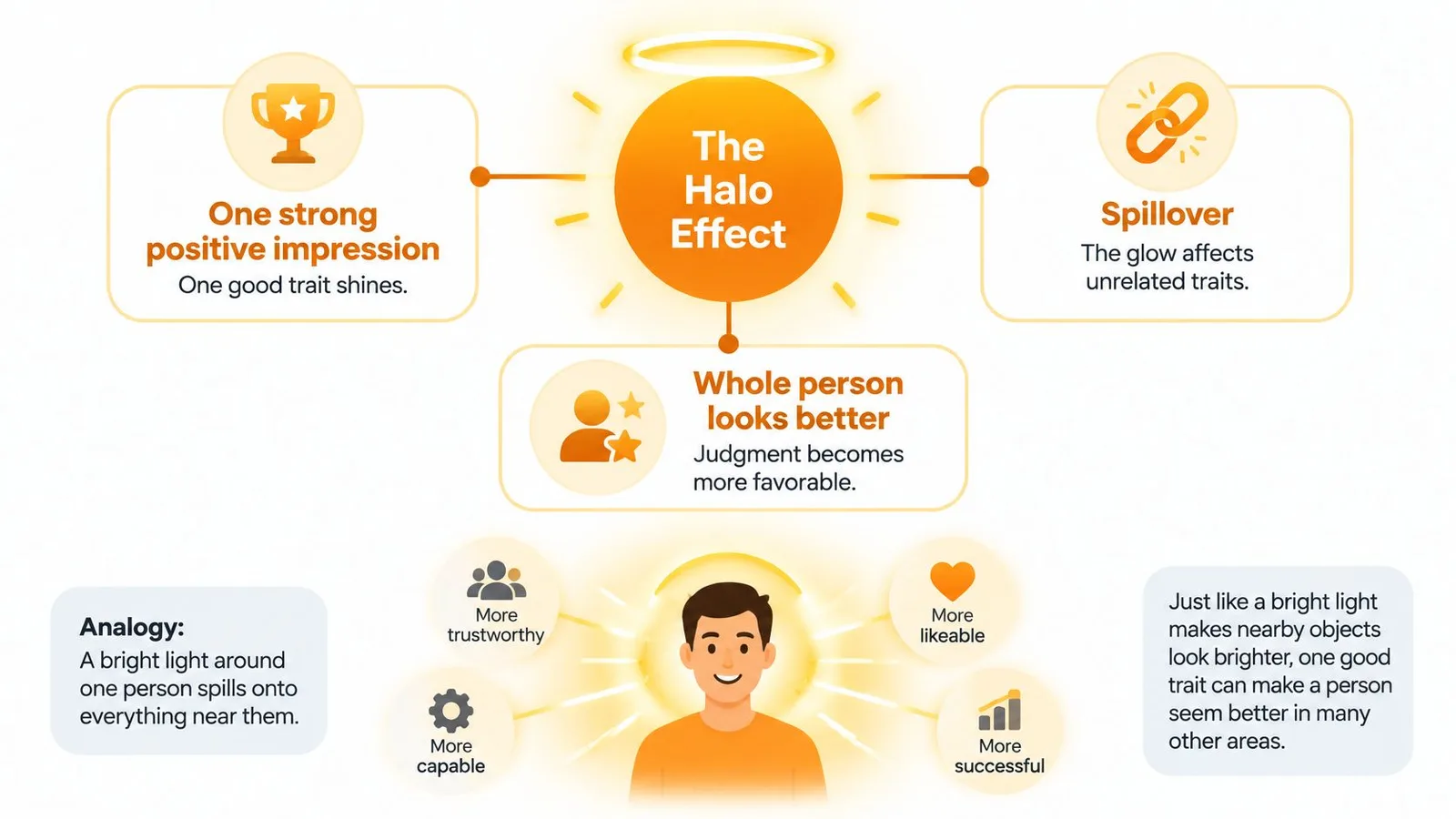
Start with a simple picture. A bright light shines around one person. The light spills onto everything near them, so objects in the glow look warmer and clearer than they would on their own. That spillover is the core idea behind what is the halo effect.
In plain terms, the halo effect is a judgment error in which one overall impression of a person influences evaluations of several supposedly separate traits. You notice one salient quality, meaning a quality that stands out, and that impression colors ratings of other characteristics that should be judged on their own evidence.
Where the Term Came From
Psychologist Edward L. Thorndike introduced the term in 1920 in his article “A Constant Error in Psychological Ratings,” published in the Journal of Applied Psychology, volume 4, pages 25 to 29, as summarized in Britannica's overview of Thorndike and the halo effect. Thorndike studied military evaluations. Commanding officers rated service members on characteristics such as intelligence, physique, leadership, and character, even though they were instructed to consider each quality separately.
The ratings didn't behave like separate judgments. They correlated more strongly and uniformly than you'd expect if officers had judged each trait independently. In one set involving 137 aviation cadets, a commander's ratings of intelligence correlated 0.51 with physique, 0.58 with leadership, and 0.64 with character.
A correlation tells you how closely two sets of scores move together. It doesn't prove that one trait caused the other. Here, the pattern suggested that an officer's broad impression of a cadet was lifting or lowering individual scores across the board.
Thorndike also observed that cadets viewed as taller or more attractive tended to receive more favorable judgments of intelligence and overall soldier quality. Height and appearance can be noticed quickly. Intelligence and character require different evidence. When the visible cue starts answering the harder questions, the halo is doing the work.
The Reverse Pattern
The negative mirror image is sometimes called the horn effect. One poor impression drags unrelated scores down. A candidate who arrives flustered may be judged as less organized, less capable, and less likable, even if the only observed problem was a rough start.
This concept matters wherever people evaluate employees, students, applicants, leaders, or products using multiple criteria at once. The risk isn't having an overall impression. The risk is letting that impression replace separate evidence.
Question 1 of 5
Why did a military commander's ratings of a cadet's intelligence, physique, and character all rise and fall together?
How a Single Impression Rewrites Specific Judgments
You might assume the halo only appears when information is missing. If you know little about someone, you fill gaps with a general feeling. That's part of the story, but later research showed something stronger. A global impression can alter judgments even when observers have enough information to evaluate attributes independently.
The Warm and Cold Instructor Experiment
In a classic study by Robert Nisbett and Timothy Wilson, published in 1977 in the Journal of Personality and Social Psychology, participants watched one of two filmed interviews with the same college instructor, as discussed in research on the attractiveness halo effect and social judgment. In one version, the instructor behaved warmly. In the other, he behaved coldly.
After watching, participants rated features that weren't the same thing as warmth. They judged the instructor's appearance, mannerisms, and accent. Those who saw the warm version rated these characteristics as appealing. Those who saw the cold version rated them as irritating.
Notice what stayed constant. It was the same instructor. Much of the available information was held steady. The main change was the overall behavioral impression created by warmth or coldness, yet ratings of separate features moved with it.
Why This Result Matters
If the halo only filled missing information, you could fix it by giving raters more facts. This study points to a deeper problem. A global evaluation can reshape how people interpret the facts they already have. The accent doesn't change, but your reaction to the accent does.
Think of two people tasting the same soup in different restaurants. One restaurant feels welcoming, so the soup seems rich and well seasoned. The other feels unfriendly, so the same soup seems bland. The setting hasn't changed the recipe. It has changed the tasting.
A halo doesn't just answer unanswered questions. It can change how you hear, see, and score evidence that's already in front of you.
Contemporary work adds an important detail. A 2023 research program on the attractiveness halo effect used three preregistered experiments with a combined sample of 1,131 participants. Preregistered means the researchers stated their plans before collecting data, which reduces cherry picking. Attractiveness influenced inferences about personality traits, and updating was especially pronounced for traits stereotypically associated with attractiveness.
That selectivity is key. The halo doesn't lift every score by the same amount. It travels along learned associations. If people culturally link attractiveness with social ease, attractiveness can more easily change judgments of social ease than judgments of unrelated qualities. The bias follows the mental shortcuts you've absorbed.
Together, these findings show a replicable mechanism, not casual favoritism. A person doesn't have to intend unfairness. Their overall impression can reorganize specific judgments while they believe they're being objective.
Question 2 of 5
Why did watching the same lecturer act warm instead of cold make students rate his appearance, mannerisms, and accent more highly?
Real-World Examples in Hiring, Grading and Reviews
A manager reviews an employee who presents beautifully in meetings. The slides are polished, the answers are calm, and senior leaders leave impressed. At review time, that strength spills into ratings for collaboration, reliability, and strategic thinking, even when the manager has thin evidence for those separate skills.
A classroom version looks similar. A student gives a confident presentation with neat visuals. The teacher then scores research depth generously, although presentation polish and research quality are different criteria. The student may have researched well, but the slides alone don't prove it.

What Field Evidence Shows
These aren't only classroom stories. Experimental evidence from two field experiments involving 600 public-sector managers and employees found that stronger ability on one performance dimension caused raters to assign higher average scores on another dimension, even when the dimensions should have been assessed separately, as reported in field research on halo bias in performance appraisal. That matters because appraisal forms often pretend each box is independent.
The effect was also moderated by rater gender. Moderated means the size of the effect changed depending on who was rating. So this isn't just random leniency, where a generous rater gives everyone high marks. The social context and evaluator characteristics can shape how strongly the spillover happens.
For candidates, understanding this helps you present evidence clearly without relying on one glossy impression, and hiring process tips for candidates can help you prepare specific examples for each part of an interview. For raters, the lesson is different. You need a process that slows the spillover down.
Controls You Can Recognize
- Score each criterion separately: Use behaviorally anchored evidence, meaning examples of observable behavior, before you calculate an overall rating.
- Write the reason down: Require justification tied to outcomes you can point to, not a general feeling of confidence.
- Compare raters: If every competency receives nearly the same score, treat that flat profile as a prompt to check the evidence again.
- Delay the global verdict: Form the overall view after dimension scores are complete, not before.
Uniform scores aren't proof of bias. Some people perform consistently. But when communication, teamwork, accuracy, and leadership all receive identical ratings with little distinct evidence, you've found a practical place to ask harder questions.
Question 3 of 5
Why did a strong score on one job dimension lift scores on a separate, independently judged dimension in field experiments with public-sector managers, with the effect depending on the rater's gender?
Telling Halo Bias Apart from Valid Judgment
Here's where many readers get stuck. If a candidate writes clearly, isn't it reasonable to think they'll communicate well in meetings? Often, yes. The halo effect isn't just being fooled by attractiveness, and a positive relationship between two traits isn't automatically an error.
The distinction matters because good judgment also uses overall impressions. Traits can provide relevant information about each other. Clear writing is relevant evidence of written communication. It's weaker evidence of honesty, technical depth, or leadership under pressure.
Three Cases to Keep Separate
First, there's valid inference. You use relevant evidence to make a limited conclusion. A teacher sees careful citations and infers strong research habits for that assignment. The evidence and the conclusion belong to the same task.
Second, there's spillover. One impression changes ratings of unrelated attributes. A polished accent makes a speaker seem more intelligent, or physical attractiveness changes perceived competence. As explained in an overview of halo bias and rating contamination, this spillover can artificially increase correlations among separate criteria and make multiple evaluation questions redundant.
Third, there's ordinary agreement. Different traits may receive similar scores because the person performed at a similar level, or because several raters observed the same consistent behavior. Similarity alone doesn't prove bias.
| Situation | What Drives the Rating | Halo Bias or Valid Inference |
|---|---|---|
| A manager rates writing highly after reading clear reports | Direct samples of the skill being rated | Valid inference |
| A manager rates honesty highly because reports look polished | Appearance of polish, not evidence of honesty | Halo bias |
| Several teachers rate a student consistently across subjects | Repeated performance observed in different settings | Ordinary agreement, unless scores ignore subject evidence |
| An interviewer assumes leadership from physical attractiveness | A visible cue culturally linked to status | Halo bias |
| A reviewer raises quality scores after seeing strong durability tests | Task relevant test results | Valid inference |
A Selective Pattern, Not a Blanket Boost
Appearance research helps sharpen the line. A cross-cultural review reports strong attractiveness halo effects for perceived social competence, potency, adjustment, and intellectual competence, while effects were close to zero for integrity and concern for others, as summarized in a review of face and body based evaluations. Strong means the pattern held up clearly across the reviewed evidence.
That pattern tells you the halo is selective. People don't add points everywhere. They infer traits that seem culturally connected to the first cue. Attractiveness may change perceived social competence more readily than perceived integrity because the mental link is stronger.
Use this contrast when you're unsure. Ask whether attractiveness predicts competence in reality, or whether attractiveness changes perceived competence in the rater's mind. Those are different questions. The first is about the person. The second is about the judgment process.
A fair test is simple. Cover the impressive cue and ask what remains. If the rating still stands on specific evidence, you're likely making a valid inference. If the rating collapses once the glow is removed, you've probably found spillover.
Question 4 of 5
Why do good-looking people get rated higher on some traits but no higher on others?
Can AI Systems Show a Halo Effect?
It's tempting to think software solves this problem. Remove the human interviewer, and you remove the flattering first impression, right? Not necessarily. A newer question is whether AI systems can display halo like patterns when they evaluate people.
Recent ACL research tested multimodal language models with hypothetical job applications, as described in ACL research on halo effects in multimodal models. Multimodal means the system can use more than one type of input, such as text and images. The models showed stronger halo effects when they received image based supplementary information. Text based assessments were comparatively more resistant.
Input Type May Matter More Than the Rater
That finding challenges a common assumption. Automation doesn't automatically make evaluation objective. If you give a system photographs, social media context, or extracurricular imagery, you may introduce construct irrelevant information, meaning information that isn't part of the quality you're trying to measure.
Imagine two applications with identical work history. One includes lively photos from prestigious looking activities. The other includes only text. If the system rates the first applicant as more competent, the extra images have influenced a judgment they shouldn't decide.
This doesn't mean every model behaves the same way, or that images always create bias. The magnitude isn't uniform across modalities, models, or tasks. It must be measured experimentally rather than assumed from the fact that a system is automated.
Design rule: Removing a human reviewer doesn't remove irrelevant signals. You still have to control what information enters the judgment.
If you're curious about why automated answers can go wrong in related ways, an explainer on why ChatGPT makes mistakes is a useful companion. The shared lesson is that outputs reflect inputs, training patterns, and task design, not a guarantee of neutrality.
For hiring, education, moderation, and recommendation systems, practical safeguards mirror the human ones. Choose inputs deliberately. Keep identity cues away from task evidence where feasible. Score criteria separately before producing an overall recommendation. Test whether adding an image changes outcomes when job relevant text stays constant.
The answer, then, is yes with a qualification. Models can display halo like associations. But you shouldn't ask only whether AI is biased in general. Ask which input, which trait, and which decision changed, then measure that pathway directly.
Question 5 of 5
In experiments where AI models graded hypothetical job applications, why did the versions with photos and social-media images score higher on skills those images say nothing about?
Spotting the Halo Effect in Your Own Judgments
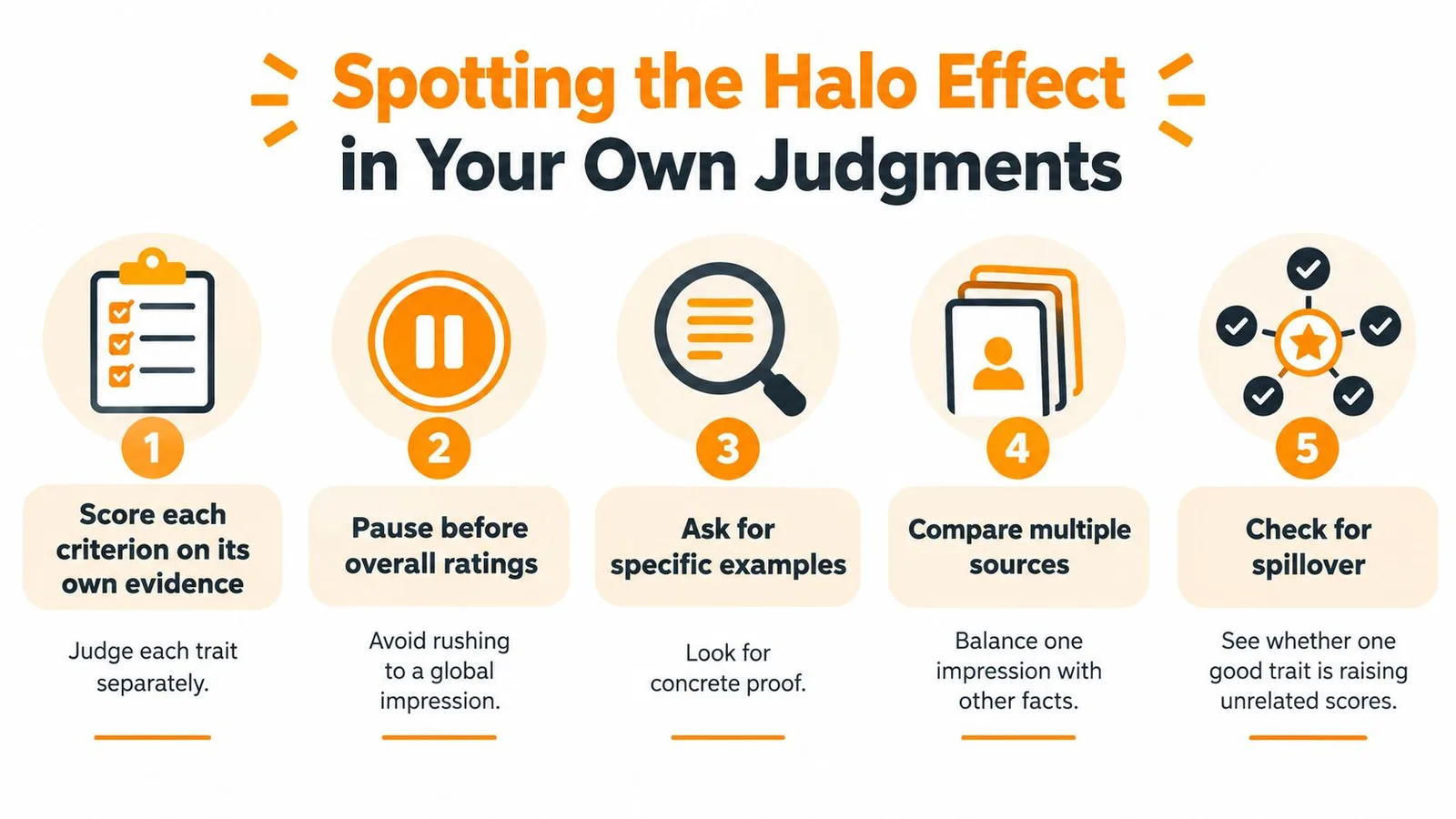
A hiring manager leaves an interview certain the candidate was outstanding. Ask which part was outstanding, though, and the answer gets vague. Strong handshake. Confident voice. Good school. None of those answer whether the person can do the job, yet the overall verdict already feels settled.
That feeling is the problem this checklist addresses. A positive reaction is sometimes honest information, a sign that the work earned it. The skill is separating that earned signal from a glow that has spread past its evidence, and the six steps below are built to do exactly that.
A Short Checklist Before You Decide
- Name the trait you're scoring: Say the criterion out loud, then look only for evidence that matches it.
- Score before summarizing: Complete each dimension before you write an overall recommendation or grade.
- Demand an example: Replace “seems capable” with one observable action, result, or work sample.
- Check the profile shape: If every score is nearly identical, revisit the weakest evidence instead of trusting the consistency.
- Test relevance: Ask whether the impressive cue would still matter if you removed appearance, branding, confidence, or presentation polish.
- Update on purpose: When contradictory information appears, rescore the affected trait instead of protecting your first impression.
These steps work because they interrupt the causal pathway. An early global impression changes how later information gets read. Separate scoring forces later information to speak for itself before the global verdict takes over.
Try a small exercise the next time you review anything. Write your overall impression in pencil, then hide it. Score three criteria using evidence only. Compare the two versions. Any gap shows you exactly where the glow may have done extra work.
That habit is also a curiosity skill. You're asking why you believe something, not just what you believe. If you enjoy training that reflex in small daily doses, a look at the neuroscience of curiosity connects the same questioning habit to how learning sticks.
For a concrete next step, Million Whys offers a daily 10 second why question and explains every answer choice, including the wrong ones. That format gives you low friction practice in separating a strong impression from a supported conclusion, and it makes the pause before judgment feel more natural.
Start with one decision this week. Slow down, split the criteria, and make each score point to its own proof. That's how the halo loses its grip.
If you want a simple way to practice pausing before a strong impression becomes a conclusion, try Million Whys from Igneous AI, LLC, where each daily why question explains every answer choice so you can see the reasoning, not just the result. Answer one 10 second question today, and use the explanation to check whether your first impression matched the evidence.