

Questions About AI: Learn by Asking Better Whys
On this page· 14
Questions about AI get better when they start from a real itch: something you half-understand, can almost explain, and still cannot quite close. The tool matters, but the question matters more. A blank chatbot can answer almost anything; a good learning app should help you notice the gap, test your guess, and leave with a little more structure than you had ten seconds ago.
TL;DR
Good questions about AI are not commands for instant homework. They are small experiments: ask for the mechanism, the exception, the misconception, the missing evidence, and the next sharper question. AI is useful when it helps you close a real information gap, not when it makes understanding feel frictionless.
The short answer: use AI as a curiosity amplifier, not a replacement for curiosity. Ask questions that force prediction, comparison, source-checking, and explanation. If the answer gives you closure and also reveals the next thing worth wondering about, the loop is working.
Curious? Try one 👇
Why is the sky blue?
Jump into the daily quiz →Start with the gap, not the tool
The phrase "questions about AI" sounds like a topic list, but for learning it is really a state of mind. You know enough to be puzzled. That matters. The curiosity literature keeps circling the same idea: people are most pulled toward information when they can sense a gap between what they know and what they want to know. A review in The Psychology and Neuroscience of Curiosity describes curiosity as a driver of learning and information-seeking, and Kang et al.'s fMRI study on trivia questions found that higher curiosity was associated with reward-related brain activity and better later memory for surprising answers (PubMed).

That is why a good AI learning question does not begin with "tell me everything." It begins with a guess. "I think large language models predict text, but why does that sometimes look like reasoning?" is stronger than "explain AI." The first version gives the model a target and gives you a way to notice whether the answer actually moved your understanding. The second often produces a polished encyclopedia paragraph that feels complete before it has earned closure.
MillionWhys' own education thesis says learning input is naturally fragmented: one question, then one answer, then the next question made visible. AI is useful here because it can help turn fragments into structure in the background. But the fragment still has to be alive. If there is no felt gap, the answer has nowhere to land.
Five AI questions that actually teach you something
Here is a small question toolkit. It works for artificial intelligence itself, but also for any topic you are exploring with an AI assistant.
| Question shape | What it forces | Example about AI |
|---|---|---|
| Mechanism | Moves from label to cause | Why can a language model sound confident while being wrong? |
| Boundary | Finds where the explanation stops working | When is an AI tutor worse than a human teacher? |
| Misconception | Surfaces the trap beginners fall into | What do people misunderstand about neural networks? |
| Evidence | Separates claims from vibes | What source would confirm whether this AI feature is real? |
| Compression | Tests whether you can explain it simply | Turn this into one quiz question with three choices and a clear answer. |

The best version is active. Before asking for the answer, make a prediction. Then ask the AI to compare your prediction against the mechanism. A simple prompt like "Here is my guess; where is it right, where is it wrong, and what question should I ask next?" makes the interaction less like receiving a lecture and more like closing one loop of curiosity.
Where current AI learning tools fit
Different AI learning products answer different kinds of questions. OpenAI's education material positions ChatGPT for education as a broad assistant for learning and teaching workflows, and the ChatGPT Edu announcement says institutional conversations and data are not used to train OpenAI models (OpenAI). That makes it powerful as a general workspace: brainstorm, ask, revise, explain, compare, check.
Khan Academy's Khanmigo is narrower by design. Khan Academy describes it as an AI-powered personal tutor and teaching assistant that guides learners to find answers instead of simply handing them over (Khan Academy). That Socratic shape is useful when the learning goal is not just "what is the answer?" but "can I reason my way there?"

Quizlet's current Ask Quizlet page says it gives step-by-step explanations, helps find relevant study sets, and can turn chats into flashcards (Quizlet). That is useful when you already have material to work from. Duolingo's Explain My Answer feature, now free for all learners according to the Duolingo blog, gives personalized vocabulary and grammar feedback after selected exercises (Duolingo). That is useful inside a fixed language path.
Those are good tools for their jobs. The missing job is different: a curiosity-first loop for adults who are not following a course and are not trying to memorize a deck. Sometimes you do not have a syllabus. You just have a small question about the world, and you want enough closure to feel smarter than you were a minute ago.
Fixed curriculum is not the same as living curiosity
Many learning apps begin with a catalog. Brilliant teaches through interactive lessons in math, science, and computing, and its help center describes Premium as unlocking unlimited lessons and practice sets (Brilliant). Khan Academy begins from a large academic library. Duolingo begins from language courses. Quizlet begins from study materials and sets. These are all valuable because the structure is known before the user arrives.
Curiosity often arrives in the opposite order. You notice a thing first: a chatbot hallucinating, a friend using AI to draft an email, an app explaining a wrong answer, a headline about AI tutors. Only after the question is answered does a larger structure begin to form. That is bottom-up learning. It starts as a fragment and compounds into a map.
This is where MillionWhys' positioning is specific. The product is not "AI for studying" and not a course about AI. It is a 10-second question loop: predict, get feedback, understand why, move on with a sharper sense of the world. The curriculum is emergent because the boundary is what people actually wonder about, not what an editor decided belongs in chapter one.
What people usually miss
The first thing people miss is that the prompt is not the primitive. The question is. A prompt can be long, optimized, and lifeless. A question can be tiny and productive because it carries uncertainty. "Why did the model make that mistake?" is often more valuable than a perfect prompt template.
The second missed point is that AI smoothness can be dangerous. A confident answer can remove the itch before you have done the work of understanding. That is why good AI learning should leave room for prediction, friction, and checking. Ask the model to show assumptions. Ask where it might be wrong. Ask for the source. Ask for the smallest test that would change your mind.
The third missed point is social. One person's question about AI is rarely only theirs. If someone asks why a chatbot invents citations, thousands of other people are probably stuck at the same edge. Turning those questions into visible, answerable units creates a demand-side knowledge commons: a map of what people are actually trying to understand.
Related videos
FAQ
What are good questions about AI for beginners?
Start with mechanism questions: why AI can sound confident, how a model learns patterns, what hallucination means, why prompts change answers, and when an AI answer should be checked against a source.
Should I use ChatGPT to learn about AI?
Yes, if you use it actively. Make a guess first, ask for the mechanism, request sources for factual claims, and ask what would make the answer wrong. Passive reading is the weak mode.
Is an AI tutor better than a fixed learning app?
It depends on the job. Fixed apps are strong when the sequence is known, such as a language course or a math path. AI tutors are strong when you need adaptive explanation. Curiosity apps are strongest when you do not yet know what you want to know.
How do I avoid fake confidence from AI answers?
Ask for source links, uncertainty, counterexamples, and a simple test. If a claim matters, verify it outside the chat. A good answer should make checking easier, not unnecessary.
What does this have to do with AIgneous Million Whys?
AIgneous Million Whys turns curiosity into small answerable loops. Instead of treating AI as a shortcut around thinking, it uses AI to help one real question become a fact-checked card that can give the next curious person real closure.
Curious? Try one 👇
Why is the sky blue?
Jump into the daily quiz →Keep Exploring
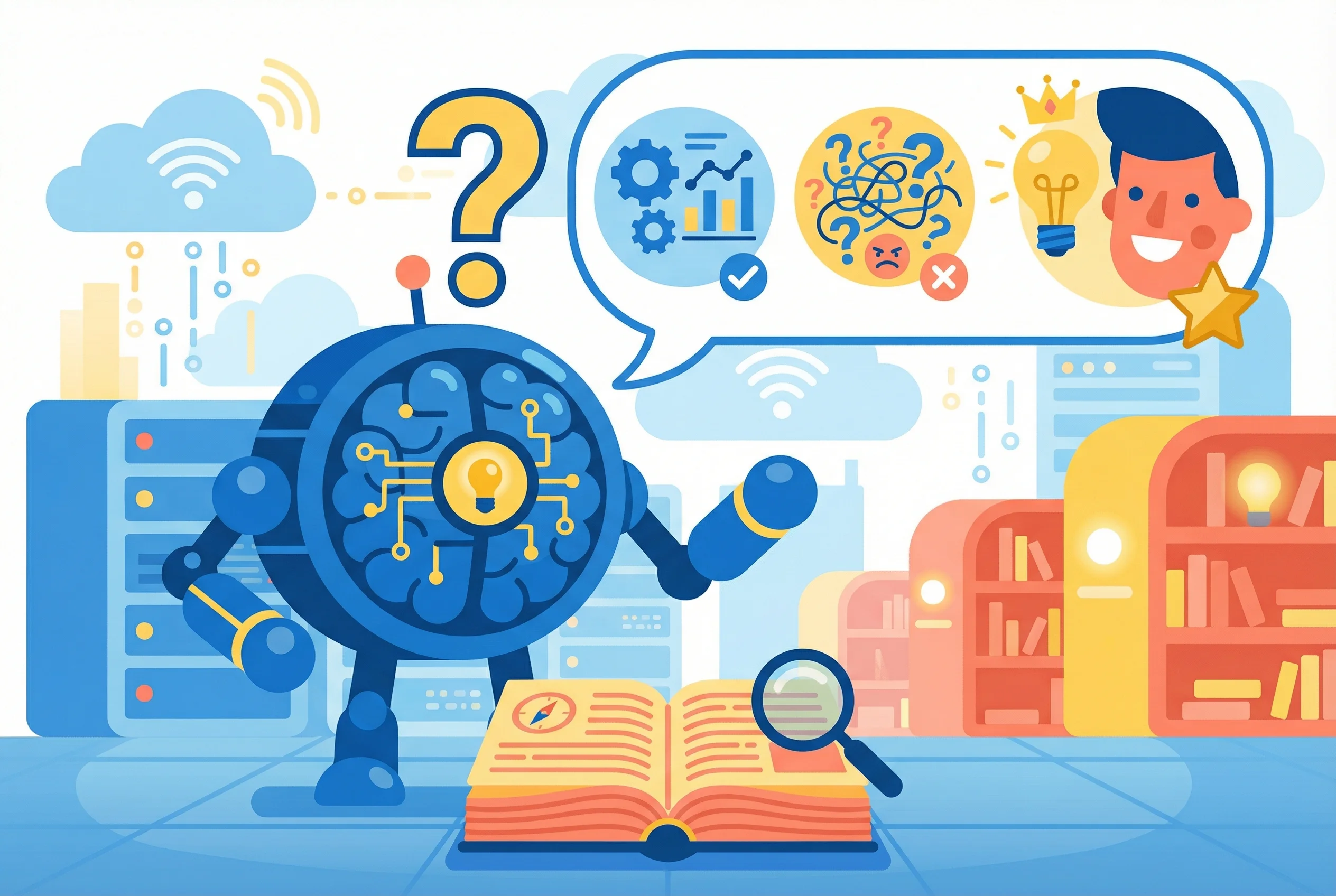
Why can't AI always give you the 'best' answer to every question?
Technology
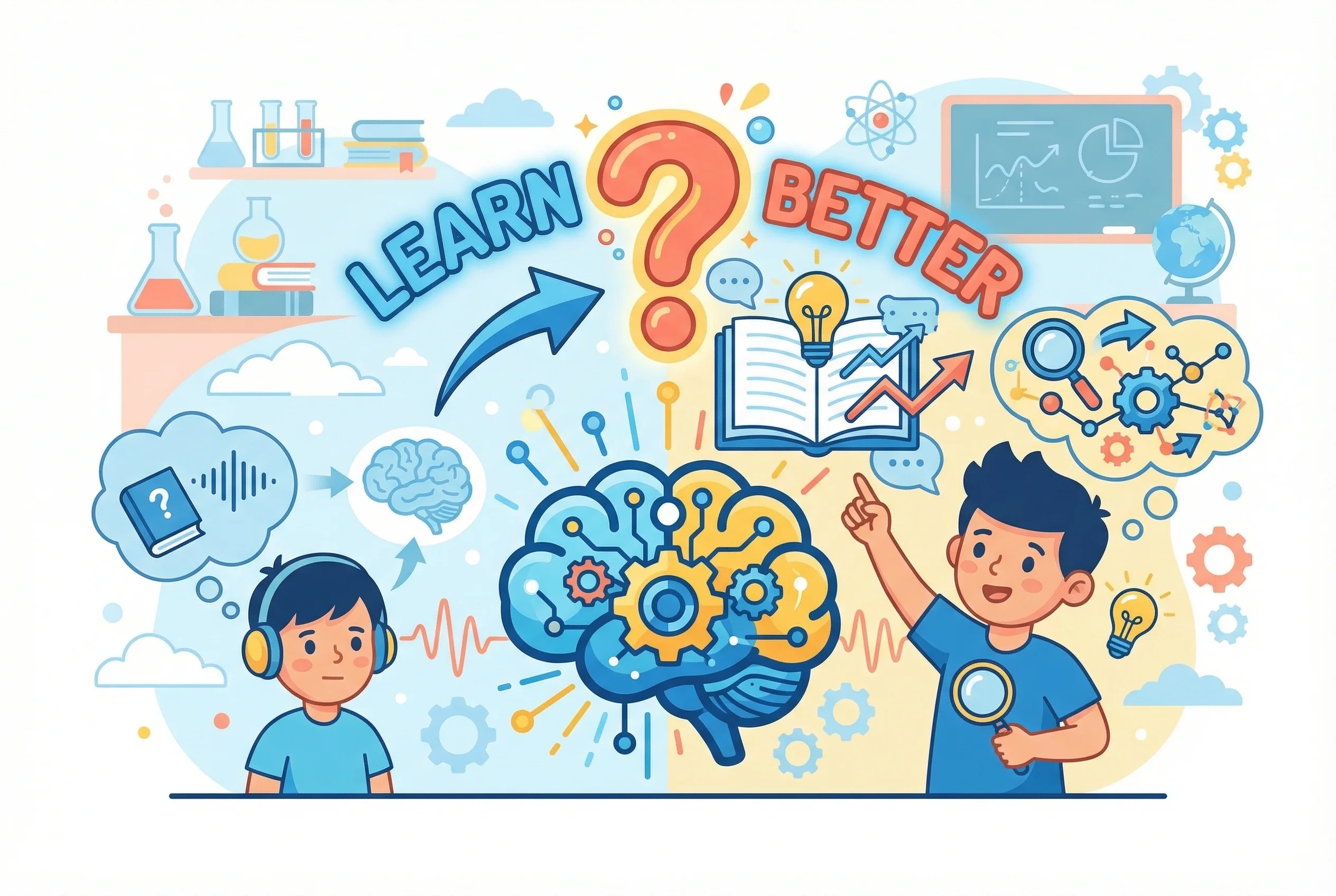
Why does asking questions help you learn better than just listening?
Psychology & Behavior

Why would a learning app invite users to submit their own "why?" questions, instead of only publishing the facts its editors pick?
Psychology & Behavior
Related Posts
AI for Learning Works When Curiosity Leads
AI for learning works when curiosity leads: use AI to expose gaps, close them with real explanations, and turn each answer into a better why, not a shortcut.
Understanding AI Through Better Questions
Understanding AI starts with better questions: patterns, training data, feedback, verification, and curiosity-first tools that give real closure today.
Learning Anything Starts With Tiny Questions
Learning anything works better when the unit is a tiny question: curiosity opens the gap, real answers close it, and knowledge compounds over time.