
History Trivia Quiz: 10 Questions with Answers
On this page· 21
A confident history guess often fails because the familiar name is the trap, not the timeline. You remember the United States, a famous queen, or a single spark, and the quieter first, the earlier technology, or the long cause drops out. This history trivia quiz is ten ready-to-run multiple-choice questions. Guess first. Then read why every choice holds up or falls short. The point is the reasoning, New Zealand versus the United States, or a trigger versus a long cause, not a score you can brag about.
In 2024, only 1% of Canadian adults earned an A on Historica Canada's history quiz, defined as at least 24 correct answers out of 30. That gap is not a lack of interest. People meet history in fragments, then treat the fragment as the whole story. If you want a fresh prompt before you start, pull a date from this day in history tool and ask what else was true that week.
1. Which country was the first to grant women the right to vote nationwide?
Question. Which country was the first to grant women the right to vote in national elections?
- A. United States
- B. United Kingdom
- C. New Zealand
- D. Finland
Answer: C. New Zealand.
Say you are hosting a pub round and three people shout “America.” They are thinking of the Nineteenth Amendment in 1920, which barred the United States from denying the vote on the basis of sex. That federal rule mattered, and it came late. New Zealand's Electoral Act, passed in September 1893, let women vote in national elections while the country was self-governing. Voting and standing for office were not the same right. Women in New Zealand could not stand for Parliament until 1919.
Why the other choices feel right
The United States is the loud answer because textbooks and films treat 1920 as the suffrage ending. It was a national rule for one country, not the first national electorate to include women.
The United Kingdom moved in steps. Some women gained the vote in 1918. Equal suffrage with men arrived in 1928. A partial bill is easy to remember as “women could vote,” which flattens two different laws.
Finland is the common wrong guess. In 1906 Finnish women gained both the vote and the right to stand for parliament, earlier than Britain or the United States on that combined package. New Zealand still comes first on nationwide voting in national elections.
Nationwide means the whole national electorate: If the question only says “the vote,” someone can cite a state, a colony, or a local board and still be half right. Write “nationwide” or “national elections,” then use each wrong option as a date on the suffrage timeline.
In 2025, history was the top content demand among American adults in a national survey of 10,000 people, selected by 19%, according to City Square Associates. A suffrage item earns that attention when the explanation shows uneven reform, not a single victory year.
Question 1 of 6
New Zealand became the first self-governing country where women could vote nationwide in 1893, so why could women there not stand for Parliament until 1919?
2. Who was the last active ruler of the Ptolemaic Kingdom of Egypt?
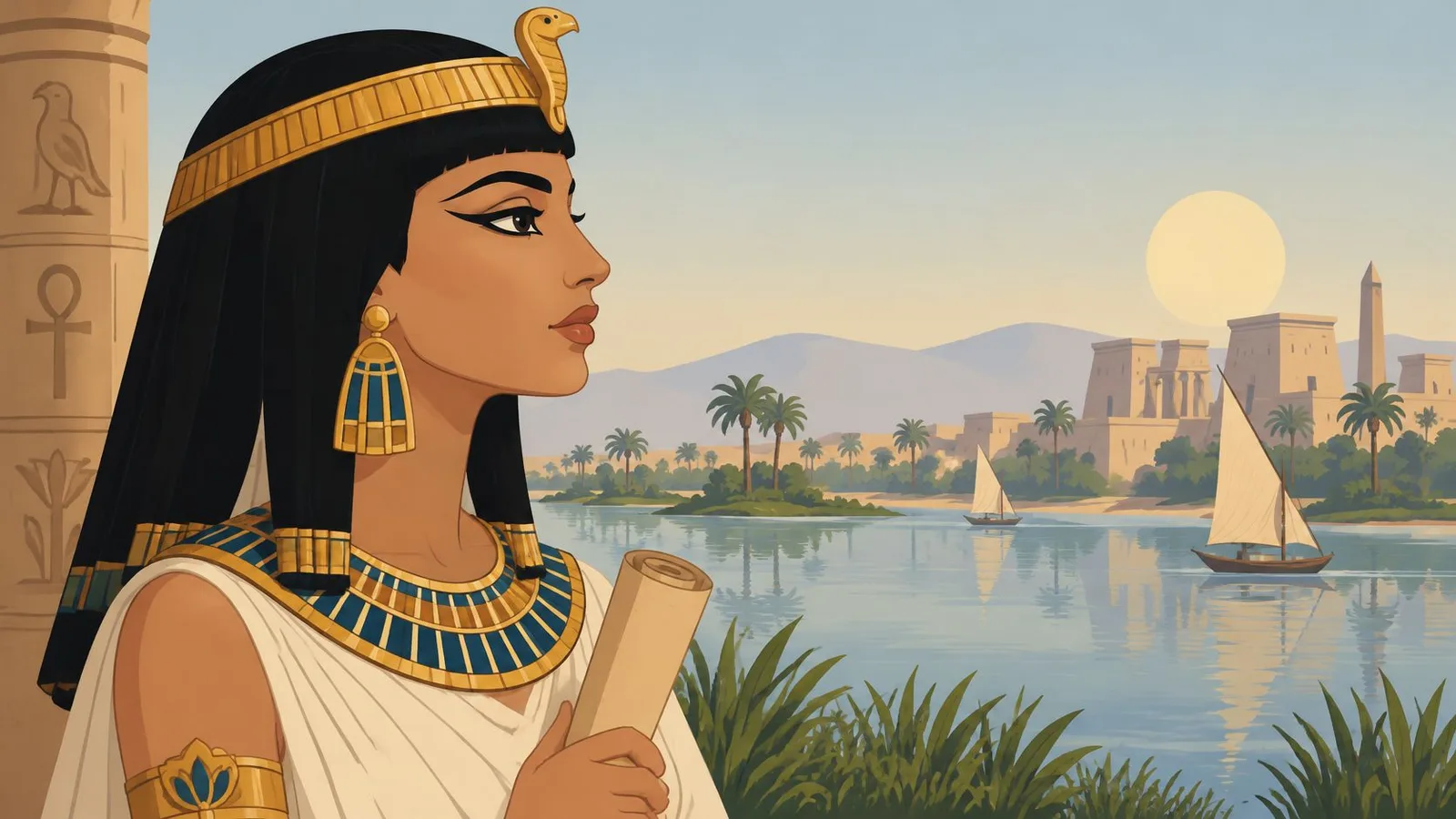
Question. Who was the last active ruler of the Ptolemaic Kingdom of Egypt?
- A. Nefertiti
- B. Cleopatra VII
- C. Ptolemy XIII
- D. Hatshepsut
Answer: B. Cleopatra VII.
Picture a classroom where half the room picks Nefertiti because the bust is famous. Nefertiti lived in the Eighteenth Dynasty, many centuries before Rome controlled the eastern Mediterranean. Cleopatra VII ruled the Ptolemaic line, a Greek-speaking dynasty based in Egypt after Alexander's generals carved up his empire. She was the last active ruler of that kingdom. After her death, and after Mark Antony's defeat by Octavian at the Battle of Actium in 31 BCE, Egypt became a Roman province in 30 BCE.
Ptolemy XIII is the family-tree trap. He was Cleopatra's brother and co-ruler, not the last active monarch of the kingdom. Hatshepsut was a powerful earlier pharaoh, which makes her a strong distractor for anyone who equates “famous Egyptian woman” with “last queen.”
Dynasty, language, and alliance
Cleopatra's popular image often skips the politics. She needed Roman allies because Egypt's grain and location sat inside a civil war among Roman leaders. She spoke several languages and ruled as a Ptolemaic monarch, not as a generic “ancient Egyptian” cut off from the Mediterranean. If you want a wider set of surprises in the same vein, the collection of interesting history facts is a useful next card after this one.
A follow-up keeps the round alive. Ask who Octavian became after he consolidated power, and you have walked from one kingdom's end into the Roman Republic's last crisis. Teams that like a physical version of the same puzzle trail can compare notes with the Chronos One Escape Rooms Eltham puzzle.
The portrait on the poster is not the reign. Ask which dynasty ended, and which battle made the ending stick.
3. Which war holds the record for the shortest in recorded history?
Question. Which conflict is widely cited as the shortest war in recorded history, and about how long did the fighting last?
- A. The Hundred Years' War, about 116 years
- B. The Thirty Years' War, about 30 years
- C. The Anglo-Zanzibar War, roughly 38 to 45 minutes
- D. A single naval duel with no political stake
Answer: C. On 27 August 1896, the Anglo-Zanzibar War was fought between the United Kingdom and the Sultanate of Zanzibar. Sources differ on the clock, so “roughly 38 to 45 minutes” is the honest span. The sultan refused to step down in favor of a British-backed claimant. British ships fired on the palace. The mismatch in force ended the fighting almost as soon as it began.
The Hundred Years' War and the Thirty Years' War are the comic opposites. One name hides well over a century of campaigns. The other names a generation of European war. Both teach you to distrust the number in a title. Neither is short.
A short war can still be a colonial story
The surprise answer is not a joke about clocks. It sits inside East African colonial politics, a succession dispute, and a very unequal fight. A quiz can name Zanzibar and still frame the whole past as European expansion plus a punch line.
University history courses have shown how narrow that frame can get. Authors from the Global South made up only 15% of assigned readings on average, with just one treated as a central theorist, in research discussed by Cogitatio Press. Counting country names on a quiz card does not fix that. Ask whose decision started the crisis, who had the guns, and who lived with the result.
Worked round. Give players two minutes. Accept any answer inside the 38 to 45 minute band. Then ask one extra: what did Britain want the sultan to do? If they only remember the minutes, they missed the politics.
Question 2 of 6
Which war is commonly cited as the shortest in recorded history, lasting roughly 38 to 45 minutes?
4. What was the first major book printed with movable metal type in Europe?
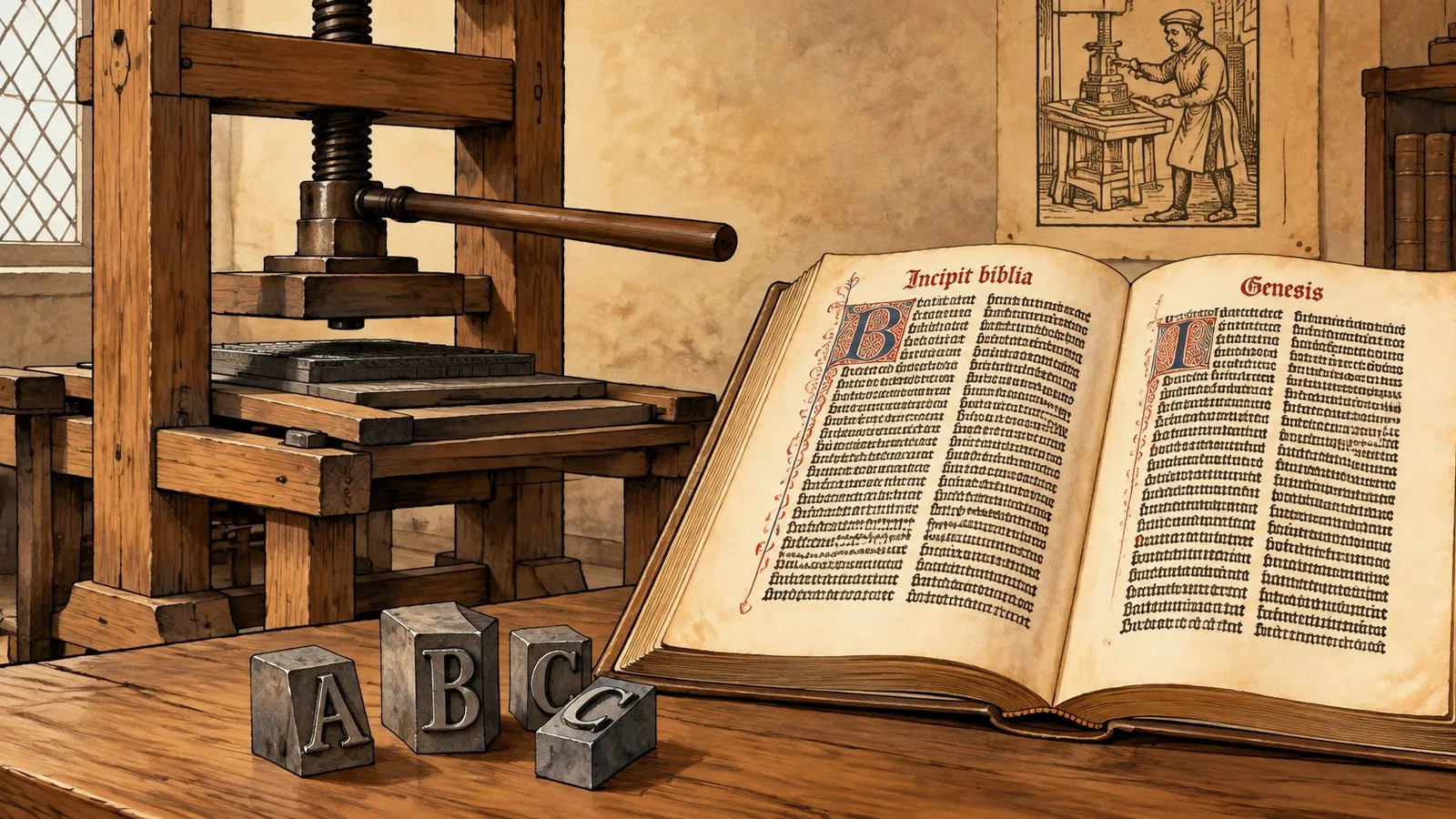
Question. What was the first major book printed with movable metal type in Europe?
- A. A book set with Bi Sheng's movable clay type
- B. The Gutenberg Bible
- C. Korea's Jikji
- D. The first European newspaper
Answer: B. The Gutenberg Bible, printed around 1455 by Johannes Gutenberg in Mainz.
Drop the words “in Europe” and the question becomes false. Bi Sheng used movable clay type in 11th-century China. Jikji, printed in Korea in 1377, predates Gutenberg. Those are not wrong histories. They are wrong answers to a question that was narrowed on purpose. The Gutenberg Bible is the first major European book in movable metal type, and it helped carry print shops across the continent. Cheaper copies changed who could meet a text, which later fed arguments over scripture during the Reformation. Technology, religion, and distribution sit in one object.
Guessing is an old mass habit
Question-and-answer entertainment was already a mass habit long before a phone quiz. The Brooklyn Daily Eagle launched the Brooklyn Eagle Quiz on Current Events on radio in 1923, and by 1940 about 50 quiz shows were on the air in the United States, as Encyclopedia.com's game-show history records. Short factual prompts and ordinary contestants are old. What changed is whether the host explains the near miss.
Try this at a table. Read the question with “in Europe” underlined. After the reveal, ask which earlier technology the metal-type story leaves out. Anyone who said Jikji has already done the harder thinking. Credit that, then show why the geographic limit still makes Gutenberg the keyed answer.
5. Which ancient cities were buried by the eruption of Mount Vesuvius in 79 CE?
Question. Which ancient cities were buried by the eruption of Mount Vesuvius in 79 CE?
- A. Athens and Sparta
- B. Pompeii and Herculaneum
- C. Carthage and Rome
- D. Alexandria and Byzantium
Answer: B. Pompeii and Herculaneum.
Mount Vesuvius erupted in 79 CE and buried those cities under volcanic ash, pumice, and pyroclastic flows. The sites still show streets, shops, and houses, so a trivia card can open onto Roman daily life instead of stopping at a date. Athens, Sparta, Carthage, Rome, Alexandria, and Byzantium are famous, and none of them was buried by that eruption. Fame is the distractor.
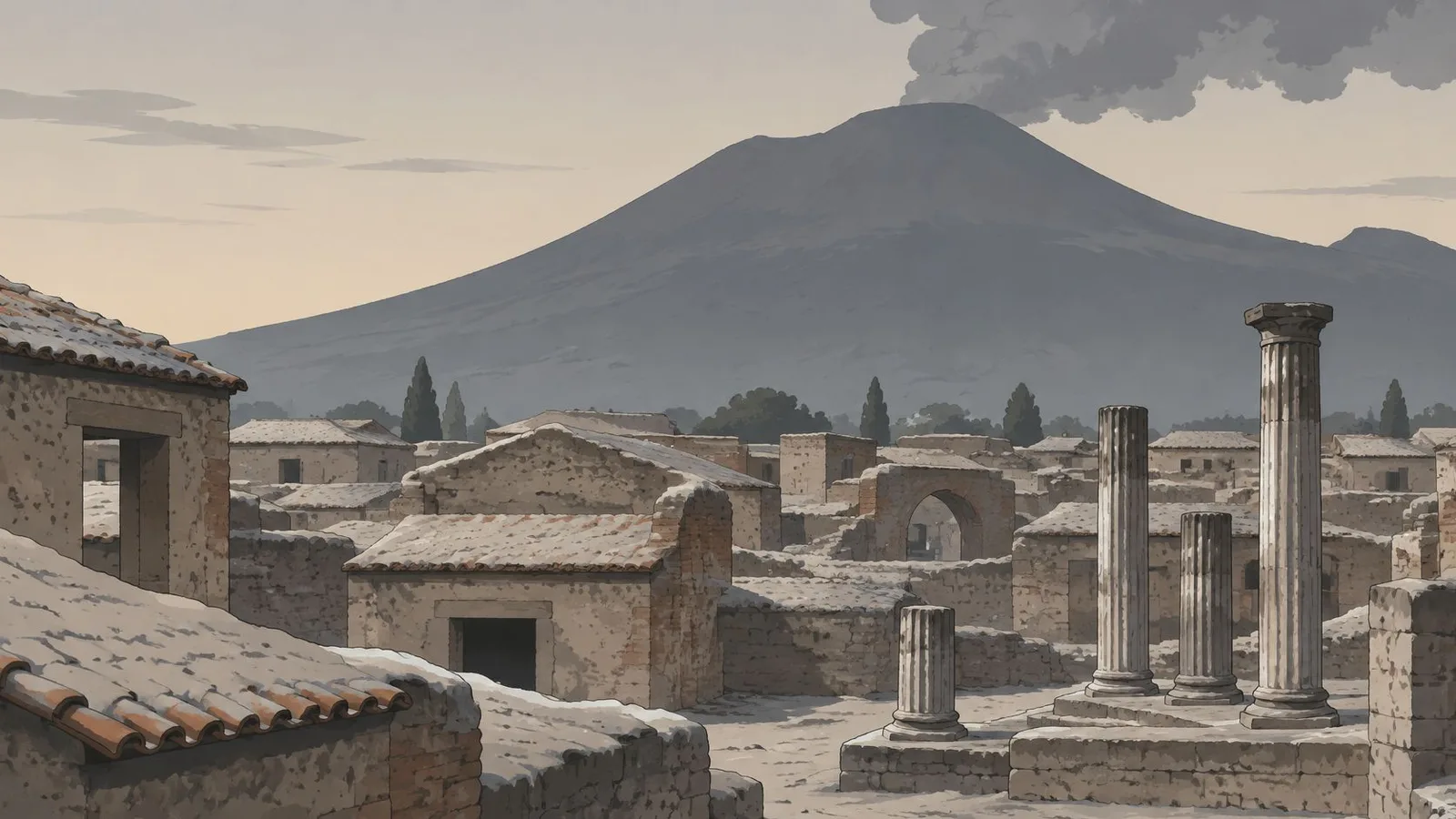
What the ash preserved, and what the date still debates
Archaeologists argue over the exact day inside that year, so a careful explanation says 79 CE and admits the calendar detail is debated. Players do not need a fake precision of hours. They need the mechanism. An explosive eruption, a tall column of ash, then hot flows that sealed organic traces.
That is also a geology question wearing a history costume. After the reveal, send curious players to why volcanoes erupt and ask what kind of volcano can bury a city rather than only spill lava. A homeschool parent can split the round: one learner maps the Bay of Naples, another lists what ash preserved that writers did not.
Wrong-choice script you can read aloud.
- Athens: a Greek political center, untouched by Vesuvius.
- Carthage: destroyed in earlier wars, not by this Italian volcano.
- Rome: the capital that heard the news, not the city under the ash.
Question 3 of 6
Which group of cities was actually buried by the 79 CE eruption of Mount Vesuvius?
6. Which document, sealed in 1215, first limited the power of an English king?
Question. Which document, sealed in 1215, first limited the power of an English king through written law?
- A. The English Bill of Rights (1689)
- B. Magna Carta
- C. The Declaration of Independence (1776)
- D. The U.S. Constitution (1787)
Answer: B. Magna Carta, sealed by King John at Runnymede in 1215.
Many clauses dealt with feudal duties, ransoms, and baronial grievances. The lasting idea was narrower and stronger. The king was subject to the law. Later reissues revised the text, so “the 1215 charter” and “Magna Carta as later governments used it” are not identical objects. A good explanation says both.
The Bill of Rights (1689) limited a later English monarchy after a different crisis. The Declaration of Independence (1776) rejected British rule for American colonies. The Constitution built a new government. Each is a real limit on power. None was sealed in 1215, and none is an English medieval charter.
That is the quiz mechanism: sort by date, place, and kind of document. The trap is treating every famous limit on power as the same answer. A ready-to-run history question earns its keep when the wrong choices teach those boundaries.
Myth, evidence, or unresolved
Popular quiz questions can carry bias, factual errors, or ambiguous wording. A date alone can make a claim sound settled when later use changed the meaning. Label confidence.
Magna Carta did not invent modern democracy in one afternoon. It did put royal authority under a written deal that later lawyers kept citing. That is why the answer needs more than a name. It needs the difference between an original medieval settlement and a later constitutional symbol.
Ask which clause still matters, and which clause was a baron's tax dispute. Both can be true.
Table use. Put the four documents on slips. Players match each to a year and a country. The person who matches 1689 correctly has not failed. They answered a neighboring question. Show them the slip, then return to Runnymede.
7. Which woman was the first to win a Nobel Prize?
Question. Which woman was the first to win a Nobel Prize?
- A. Bertha von Suttner
- B. Marie Curie
- C. Dorothy Hodgkin
- D. The first woman to win two Nobels, as a separate “first”
Answer: B. Marie Curie.
In 1903 she shared the Nobel Prize in Physics with Pierre Curie and Henri Becquerel for work on radioactivity. In 1911 she won the Nobel Prize in Chemistry. That second award made her the first person to win Nobels in two different sciences. “First woman to win” and “first person to win twice, in two sciences” are different claims. Say which one you mean or the card teaches a muddle.
Bertha von Suttner won the Peace Prize in 1905. She is early, and she is not first. Dorothy Hodgkin won Chemistry in 1964, a landmark for structural chemistry, decades later. Both names reward a player who knows women laureates beyond one household name. The explanation should thank that knowledge and still keep the timeline.
Television had already taught audiences to treat a factual reveal as drama. Britannica's account of quiz shows notes that the high-prize era began in 1955, that one episode of The $64,000 Question drew 55 million viewers, and that U.S. household television ownership moved from about 9% in 1950 to roughly 90% by the end of that decade. A Curie item works in that lineage when the suspense is the distinction, not a buzzer.
Radioactivity is the follow-up worth keeping. A short explainer on whether radium is a radioactive element connects the 1903 prize to later medical uses and to real hazard. Guess the laureate, then ask what the prize was for.
Question 4 of 6
What made Marie Curie the first person to win Nobel Prizes in two different sciences?
8. Why did the Titanic sink on its maiden voyage in April 1912?
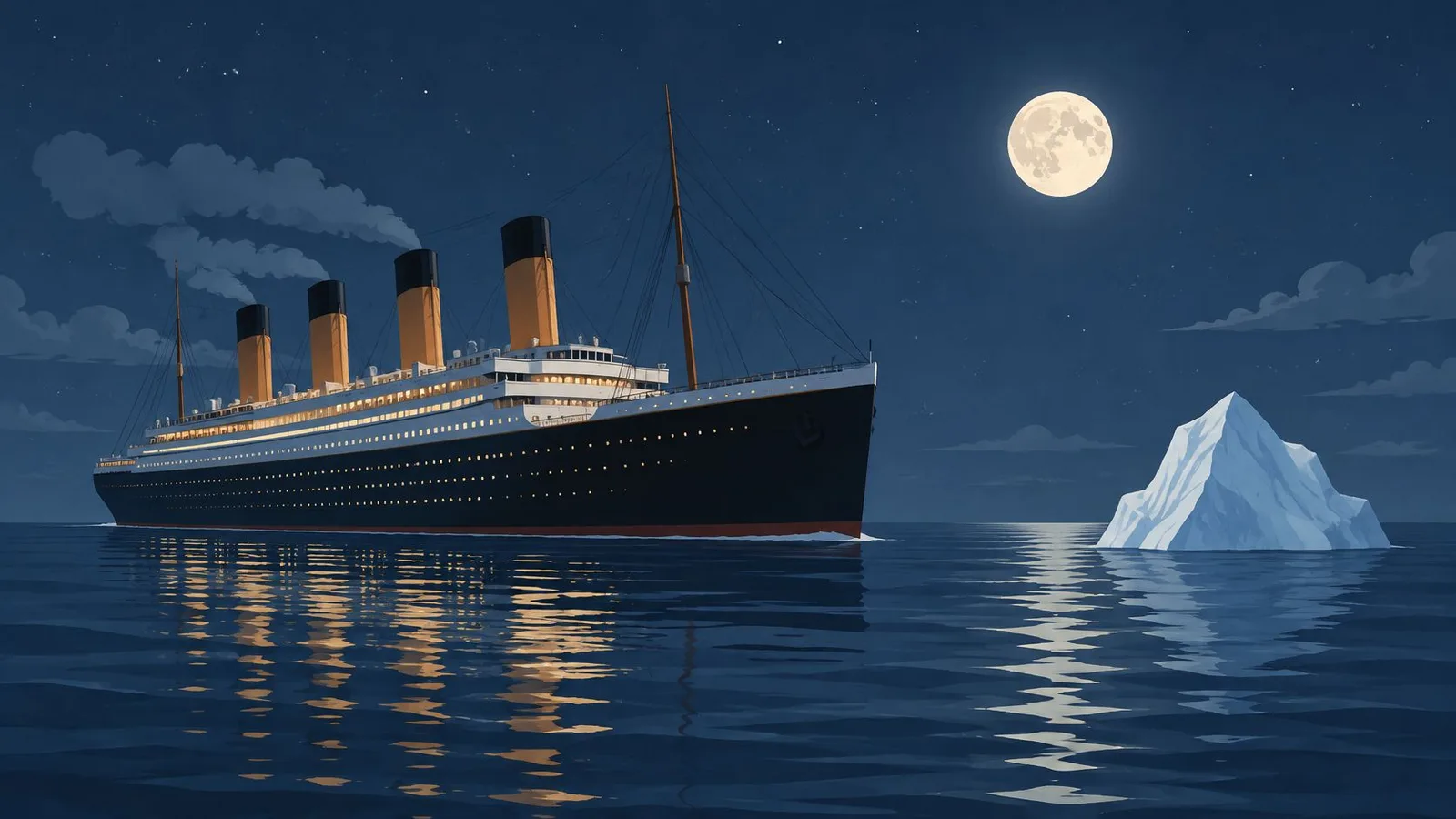
Question. Why did the RMS Titanic sink on its maiden voyage?
- A. The hull broke in two before any iceberg strike
- B. A collision with an iceberg, plus speed in icy water and too few lifeboats
- C. A boiler explosion with no ice involved
- D. A wartime torpedo in 1912
Answer: B.
On the night of 14 April 1912, in the North Atlantic, the ship struck an iceberg. It sank in the early hours of 15 April. The collision, speed through icy water, and lifeboat capacity interacted. The boats could carry roughly half of the people aboard. One sentence that says only “iceberg” is true and thin. One sentence that says the ship snapped before it ever hit ice is a myth.
Several causes, one sinking
A why-question should list contributing factors as options, not disguise a date as a puzzle. Players pick the best bundle. Then you unpack the bundle.
Corrective feedback is what makes that bundle stick. A synthesis of classroom retrieval-practice research covering 222 studies and 48,478 students reported an overall benefit of about g = 0.50. Quizzes with corrective feedback reached g = 0.54, against g = 0.37 without it, in the summary published by Rapunzl. For this card, feedback is a short note on each option. The pre-break myth fails because the strike came first. The torpedo fails because this was a peacetime maiden voyage. The boiler story fails because ice damage is the documented start.
After the wreck, the rulebook. The disaster pushed maritime safety rules on lifeboats, drills, and radio watch. Ask what changed for the next ship, not only what happened to this one. That second question is the one people still get wrong a week later.
Question 5 of 6
Why did the Titanic sink on its maiden voyage in April 1912?
9. Why did the Great Fire of London spread so rapidly in 1666?
Question. Which set of factors best explains why the Great Fire of London spread so fast in 1666?
- A. The Great Plague of 1665 set the buildings alight
- B. A long dry summer, strong easterly winds, packed wooden buildings, and narrow streets
- C. A single lightning strike on stone palaces
- D. Invasion by a foreign fleet in the Thames
Answer: B.
The fire began on 2 September 1666 in a bakery on Pudding Lane and burned for several days. Weather, materials, and street layout did the spreading. A dry summer left timber ready. Easterly wind pushed flames. Wooden houses stood close. Lanes were too narrow for a clean firebreak.
The Great Plague of 1665 is the classic mix-up. It was a separate disaster the year before. Plague did not light the oven, and it did not explain the wind. Stone palaces and a hostile fleet are cinematic and untrue for this fire.
In 2024, 43% of Americans watched shows with historical content often or very often, according to the American Academy of Arts and Sciences. Those shows often hand you one cause. A quiz can ask which factor contributed most, then refuse a single winner. Dryness without wind is slower. Wind without timber runs out of fuel. The street plan trapped both.
What the city did next
The fire pushed changes in building rules and fire-fighting practice. Rebuilding brought new street ideas and new churches, with Christopher Wren among the designers people still name. Walk the same question onto a modern map using London's historic sites and stories and ask which surviving fabric is pre-fire and which is the replacement.
Family version. Give each person one factor card: drought, wind, wood, lanes. They must argue for two minutes that their card mattered, then admit it could not act alone. That is the explanation, acted out.
10. Why did the Berlin Wall fall on 9 November 1989?
Question. Why did the Berlin Wall fall on 9 November 1989?
- A. It was built that night and failed immediately
- B. A muddled announcement opened a rush on the crossings, on top of protests, economic strain, and Soviet-bloc reform
- C. German reunification was signed that afternoon
- D. A single foreign army demolished it with no local crowd
Answer: B.
On 9 November 1989, East German official Günter Schabowski told a press conference that border restrictions would ease, and he left the timing sounding immediate. Crowds went to the crossings. Border guards, facing numbers and unclear orders, opened the gates. That press conference is the trigger. It is not the whole cause.
The wall had stood since 1961. People had pushed for years through protests, a strained East German economy, and wider reform across the Soviet bloc. German reunification came in 1990, not on the night the gates opened. An army-only story erases the crowd that stood at the checkpoints.
Trigger, then the long cause
A 2021 review synthesized 49 effect sizes and 5,374 participants and found retrieval practice improved learning across levels, subjects, formats, delays, and feedback schedules, with 57% of experiments reporting medium or large benefits. Only 6% of those experiments were in non-WEIRD countries, a limit the Educational Psychology Review article states plainly. For this question, retrieval means you predict the trigger, then meet the long cause, then see the same idea a day later in another region's 1989.
Tomorrow's card. Ask what Schabowski thought he was announcing, and what the guards decided when the crowd arrived. If you only remember “the wall fell,” you still have the gap this round was built to close.
Question 6 of 6
What turned a routine East German press conference on the evening of 9 November 1989 into the night the Berlin Wall opened?
How These History Trivia Questions Compare
| Question | Era | Correct answer | Common wrong guess | Best follow-up |
|---|---|---|---|---|
| Which country was the first to grant women the right to vote nationwide? | 1893 | New Zealand | United States or United Kingdom | Compare when women gained voting rights and the right to stand for office. |
| Who was the last active ruler of the Ptolemaic Kingdom of Egypt? | 30 BCE | Cleopatra VII | Ptolemy XIII or Nefertiti | Explore how Egypt became a Roman province. |
| Which war holds the record for the shortest in recorded history? | 1896 | Anglo-Zanzibar War, lasting roughly 40 minutes | Hundred Years' War | Examine the conflict's colonial context and why reported durations vary. |
| What was the first major book printed with movable metal type in Europe? | Around 1455 | Gutenberg Bible | Jikji | Compare European printing with earlier East Asian movable type. |
| Which ancient cities were buried by the eruption of Mount Vesuvius in 79 CE? | 79 CE | Pompeii and Herculaneum | Carthage or Athens | Explore how volcanic material preserved Roman daily life. |
| Which document, sealed in 1215, first limited the power of an English king? | 1215 | Magna Carta | English Bill of Rights | Discuss the charter's later revisions and its connection to the rule of law. |
| Which woman was the first to win a Nobel Prize? | 1903 | Marie Curie | Bertha von Suttner | Learn how Curie's two Nobel Prizes recognized different scientific work. |
| Why did the Titanic sink on its maiden voyage in April 1912? | 1912 | It struck an iceberg; speed, ice conditions, and limited lifeboat capacity contributed to the disaster. | It sank because it hit an iceberg alone, with no contributing factors | Explore the maritime safety regulations introduced after the disaster. |
| Why did the Great Fire of London spread so rapidly in 1666? | 1666 | Dry weather, strong winds, and densely packed wooden buildings helped it spread. | The Great Plague directly caused the fire | Examine how the fire changed London's building and fire-safety practices. |
| Why did the Berlin Wall fall on 9 November 1989? | 1989 | A confusing announcement about border restrictions prompted crowds to gather; guards then opened the crossings amid wider political pressures. | German reunification happened that day | Compare the immediate trigger with the broader causes and later reunification. |
Keep the Next Why Going
Take the choice you missed and turn it into tomorrow's question before the detail cools off. If you said the United States on suffrage, ask which country let women stand for parliament first, and answer it without looking. If you said the plague caused London's fire, ask what a dry summer does to a wooden street. One missed option is a better assignment than another list of dates.
We built Million Whys for that pause. You make a prediction, then you see why each choice fits or fails, including the wrong ones. A question takes about 10 seconds. The pace we recommend is 5 questions a day, roughly 2 to 3 minutes, so the round stays quick without dropping the reasoning. Topics run through science, nature, psychology, technology, economics, history, and internet culture. Some cards are hand-curated and AI-assisted, and every one is fact-checked.
History is one of those fields, not a separate product you have to assemble. Start with something familiar, a wall, a ship, a vote, and follow the puzzle into another field the next day. A daily streak counts days when you answer at least one question. You do not need a long syllabus to keep the why alive.
Use your missed Berlin option tonight. Write the trigger in one line and the long cause in a second line. Bring both to a five-question session tomorrow and see which line you can still retrieve.
Million Whys is a daily micro-learning quiz for people who would rather explain a wrong guess than collect bare facts. You get a short history question, a fast prediction, and a reason for every choice, correct or not. Visit Million Whys and run a five-question history round the next time a familiar name tries to pass for the whole story.
Keep Exploring

Why do free daily quiz apps make you commit to a guess before they explain the answer?
Psychology & Behavior

Why does finally getting the answer to a trivia question help you remember not just the answer but also some unrelated details from that moment?
Psychology & Behavior
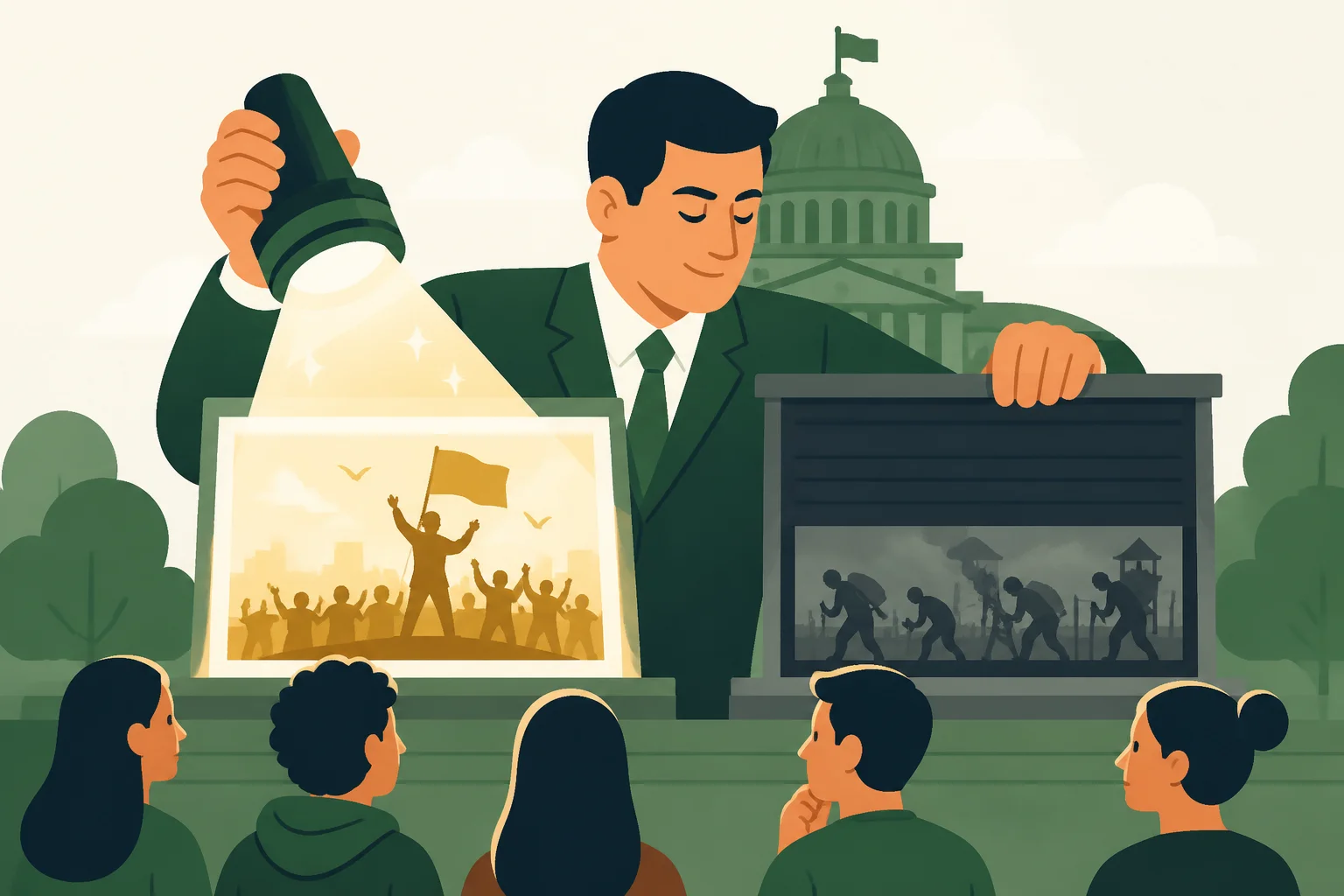
Why do governments often highlight some historical events while ignoring others?
Politics & Law
Related Posts
History Trivia Questions and Answers
History trivia questions with answers for curious adults: explore flags, aqueducts, armor, greetings, Easter customs, and Marco Polo in quick cards today.
Hard Trivia Questions With Answers
Hard trivia questions with answers across space, science, geography, sports, history, and logic, each with the reason behind the answer.
Random Trivia Questions With Answers
Random trivia questions with answers from science, space, animals, weather, sports, money, and technology, each with the quick why behind it.