Why Do Volcanoes Erupt? the Forces Underground Explained
On this page· 25
If heat alone makes volcanoes erupt, why doesn't every pocket of molten rock reach the surface? The missing explanation is movement and pressure: molten rock must form, rise, find a route through the crust, and overcome whatever holds it underground. Asking why do volcanoes erupt becomes much more useful when we follow that whole chain rather than stopping at “because Earth is hot.”
A Better Way to Ask the Question
A better question is: What allows molten rock to escape from underground? That wording separates the existence of magma from the conditions needed for an eruption. Having something hot beneath your feet isn't the same as having an open route to the surface.
Think of a pressure cooker as a limited analogy. Heating its contents matters, but so do the pressure inside and the availability of an outlet. A volcano isn't a kitchen appliance with a lid and valve, yet the comparison helps distinguish the source of energy from the conditions that control its release.
Separate the ingredients from the trigger
Keep these connected questions in mind:
- Generation: What conditions produce magma beneath a particular place?
- Ascent: What makes that magma move upward?
- Gas expansion: What happens to dissolved gases during the journey?
- Escape: Can the material overcome the surrounding rock and resistance along its route?
This is a useful way to approach common science misconceptions: replace a familiar short answer with a chain of causes. “Heat causes eruptions” points toward part of the explanation, but it doesn't tell you why one underground system erupts while another remains below the surface.
A useful distinction: Making magma and making an eruption are different problems.
Build understanding before memorizing vocabulary
You don't need to recognize every rock name to understand the mechanism. Start with familiar ideas such as floating, dissolved gas, and resistance to flow, then attach geological terms to them.
If this kind of explanation sparks an interest in formal study, Access Courses Online's guide to how adults start a science degree offers a route for exploring that next step. The learning habit is the same at any level: ask what changes, what moves, and what prevents movement.
How Magma Forms Beneath the Surface
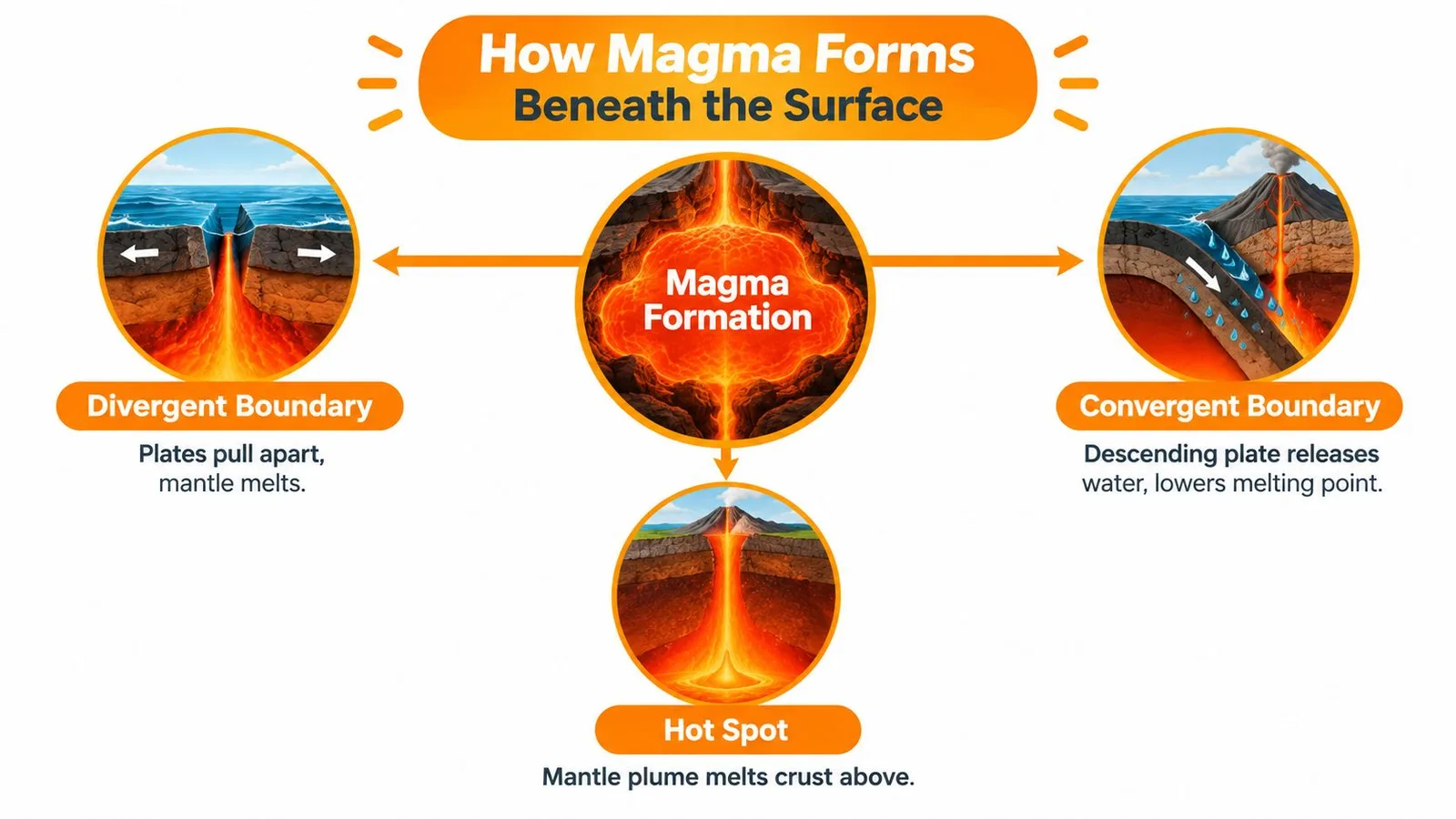
Magma generation depends on conditions underground, not on the presence of heat. Earth's internal heat supplies energy, while tectonic settings help determine where molten material forms and where it can travel. The important contrast is between plates moving apart, plates converging, and unusually hot material rising beneath a plate.
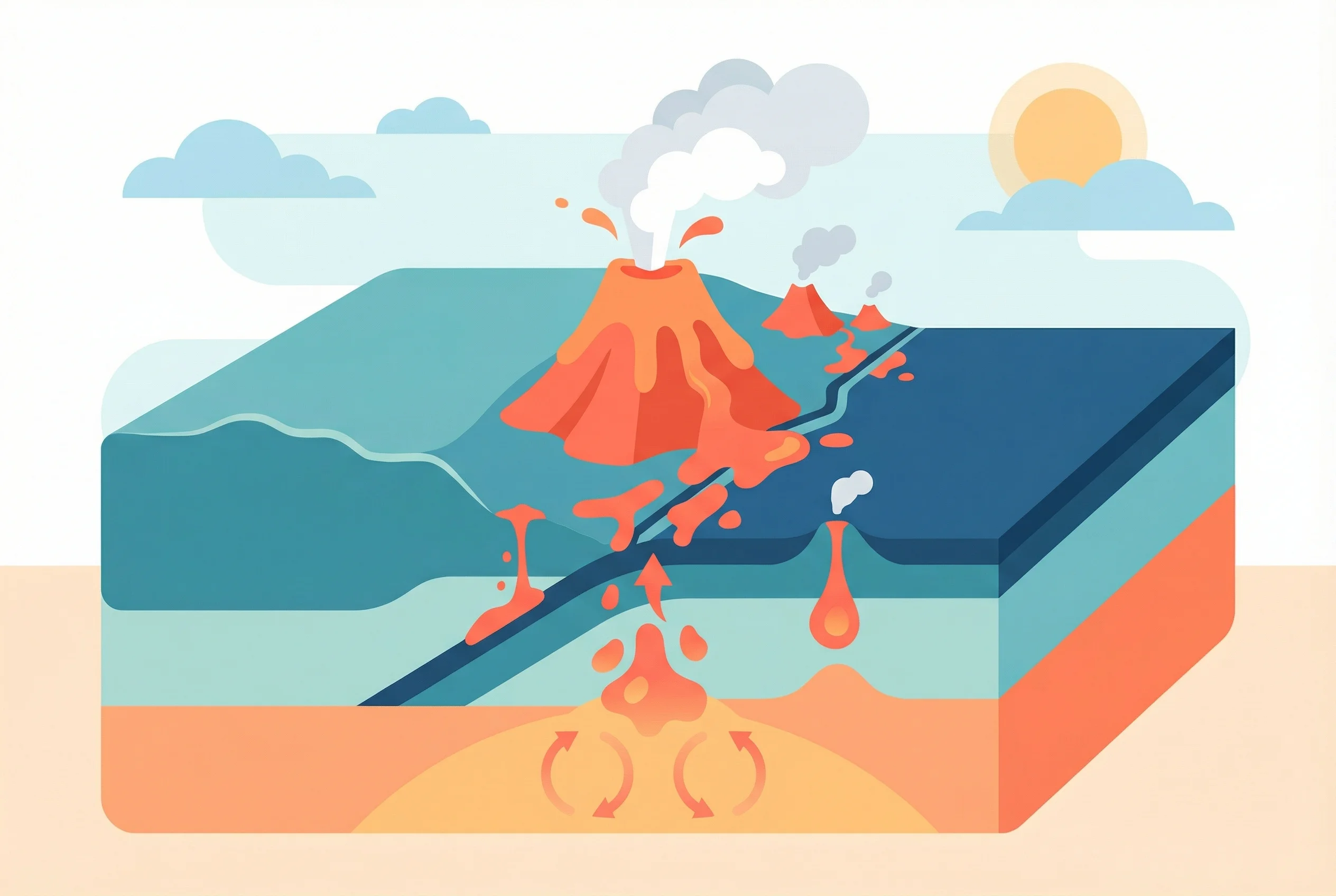
Where plates separate or converge
At a divergent boundary, tectonic plates pull apart. Magma rises toward the opening, creating a setting in which molten material has a route upward. The connection to remember is the relationship between separation, changing pressure conditions, and rising mantle material, rather than the idea of friction heating the edges until they melt.
A convergent boundary works differently. A descending oceanic plate releases water into the mantle, and that water lowers the melting temperature of mantle rock. New magma can therefore form without requiring the surrounding rock to become hotter in the simple way we might expect.
That last point often causes confusion. Water's role here isn't comparable to pouring cold water onto a hot surface. Under these underground conditions, adding water changes the conditions under which rock can melt.
| Setting | Important condition | Connection to magma |
|---|---|---|
| Divergent boundary | Plates pull apart | Magma rises toward the opening |
| Convergent boundary | A descending plate releases water | Water lowers mantle rock's melting temperature |
| Hotspot | Unusually hot material rises beneath a plate | Magma can form away from a plate boundary |
Why Hawaii doesn't need a plate edge
At a hotspot, unusually hot material rises beneath a tectonic plate. Hawaii illustrates why a volcano doesn't have to sit at the meeting point of plates. Plate boundaries account for much volcanic activity, but they aren't the only setting.
Most volcanoes cluster around plate boundaries, especially the Pacific Ring of Fire. NOAA figures cited by NASA describe about 1,300 known eruptions during the past 10,000 years, roughly 550 volcanoes with historically documented eruptions, and around 20 volcanoes probably erupting at any given time, placing this activity in a continuing global context rather than an isolated regional one (NASA's explanation of volcanoes).
The distinction between these settings matters because there isn't a single underground recipe. Different routes can produce magma, but producing it still doesn't guarantee that it will escape.
Question 1 of 6
Why does magma form above a sinking oceanic plate at a convergent boundary?
The Buoyancy and Pressure Behind Every Eruption
A pocket of magma isn't waiting to boil over. Its upward movement involves buoyancy, while the transition toward eruption often involves gases changing from dissolved material into expanding bubbles.
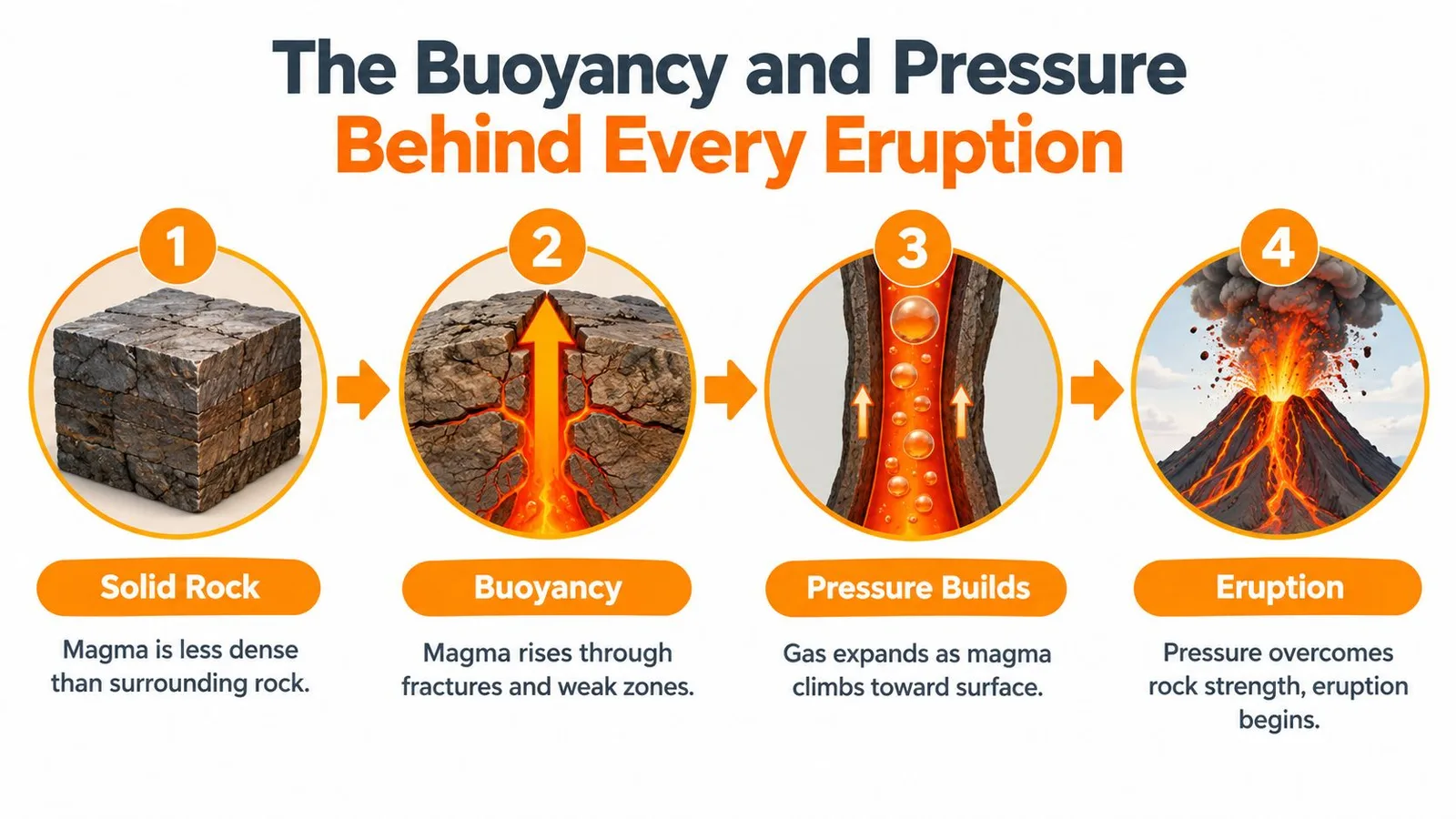
Magma is less dense than the surrounding solid rock, so it tends to rise through fractures and weak zones. Think of an object that floats because it is less dense than the material around it. The analogy explains the direction of movement, although magma must negotiate resistant rock rather than drift freely through water.
Gas can be present before bubbles appear
Magma contains molten rock, crystals, and dissolved gases, including water vapor, carbon dioxide, and sulfur gases. At depth, the pressure of overlying rock keeps much of that gas dissolved. “Dissolved” is important: the gas doesn't have to occupy a large underground cavity to matter.
As magma rises, the pressure confining it decreases. Gas separates from the melt and forms bubbles, a process called vesiculation. Those bubbles expand and help propel material upward.
USGS compares this with opening a carbonated drink: lowering the pressure allows dissolved gas to form expanding bubbles, and volcanic bubbles can expand to thousands of times their original size during ascent (USGS on dissolved gases and eruptive processes).
You don't need to shake the drink for the comparison to work. Opening it changes the pressure, which is the key connection. Nor does the analogy mean that underground magma behaves exactly like soda; it isolates one useful part of a much more resistant system.
Falling pressure and growing pressure aren't a contradiction
Readers often ask how pressure can fall while an eruption is driven by pressure. The answer is that these descriptions refer to different things.
- Confining pressure decreases: Rising magma has less overlying rock pressing on it.
- Gas bubbles expand: Previously dissolved gas occupies more space as bubbles develop.
- Resistance still matters: The moving mixture must overcome surrounding rock and restrictions in its route.
Less pressure holding gas in solution can produce more expansion pushing magma outward.
That distinction prevents the misleading image of a volcano as a container that gets hotter until it bursts. The process involves changing conditions during movement, not heat acting alone.
The infographic's “pressure builds” label is best understood in that local sense. Expanding gas can push against confined material even while the broader pressure associated with depth is decreasing.
An eruption requires the combined effects of buoyant magma and expanding gases to overcome the forces keeping material underground. An available crack helps, but a crack alone isn't a guarantee of escape.
Question 2 of 6
What makes dissolved gases in rising magma turn into bubbles that help push it upward?
Quiet Flows and Explosive Blasts
Compare pouring a thin liquid with trying to squeeze a thick paste through an opening. Both can move, but they resist movement differently. That resistance is viscosity, and it helps explain why volcanic gases sometimes escape relatively readily and sometimes remain trapped.
Low-viscosity basaltic magma allows bubbles to migrate and gases to escape comparatively easily, favoring flowing lava and fountains. More silica-rich magma is generally thicker, inhibiting bubble escape until gas pressure can fragment the magma into ash, pumice, and volcanic gases (USGS on how volcanoes erupt).
What Drives Quiet Versus Explosive Eruptions
| Property | Effusive (Quiet) | Explosive |
|---|---|---|
| Typical magma tendency | More fluid, commonly basaltic | More viscous, often silica-rich |
| Resistance to flow | Lower | Higher |
| Gas behavior | Bubbles can migrate and escape more readily | Bubbles have greater difficulty escaping |
| Pressure release | More readily vented | Can accumulate before fragmentation |
| Typical erupted material | Flowing lava and lava fountains | Fragmented magma, ash, pumice, and gases |
Effusive means that eruption mainly involves the outpouring of lava. It doesn't mean nothing energetic happens, nor should “quiet” be interpreted as a safety assessment. Here, quiet describes a contrast with explosive fragmentation, not permission to approach.
An explosive eruption isn't merely an effusive eruption moving faster. The important change is that gas pressure breaks magma apart. Instead of remaining largely together as a flowing mass, the material becomes fragmented.
Composition isn't a complete forecast
The table describes tendencies, not fixed rules for every volcano. Explosivity also depends on magma supply, volatile concentration, and pressure changes within the conduit. Volatiles are the gas-forming components involved in the expansion process.
A useful question is therefore not just “How much gas is present?” but “Can that gas get out?” A system releasing gas through an open route presents a different mechanical situation from one in which gas remains confined beneath resistant material.
- A fluid route: Gas can separate and move without forcing the entire magma body to fragment.
- A resistant route: Sticky magma or an obstruction can make pressure release more difficult.
- A changing supply: Incoming magma can alter the amount of material and gas within the system.
The pressure-cooker analogy is helpful again, provided we remember its limits. An outlet changes how a pressurized system behaves, but volcanic outlets can themselves change as magma moves.
Reading rule: Treat viscosity as a control on gas escape, not as a stand-alone prediction of eruption size.
That gives you a decision framework rather than a vocabulary test. Ask about movement, gas escape, and confinement together. A rock name is useful, but it can't replace an explanation of what the material is doing.
Question 3 of 6
Why does runny basaltic magma usually ooze out as lava while thicker, silica-rich magma often blasts apart into ash and pumice?
Famous Eruptions and What They Reveal
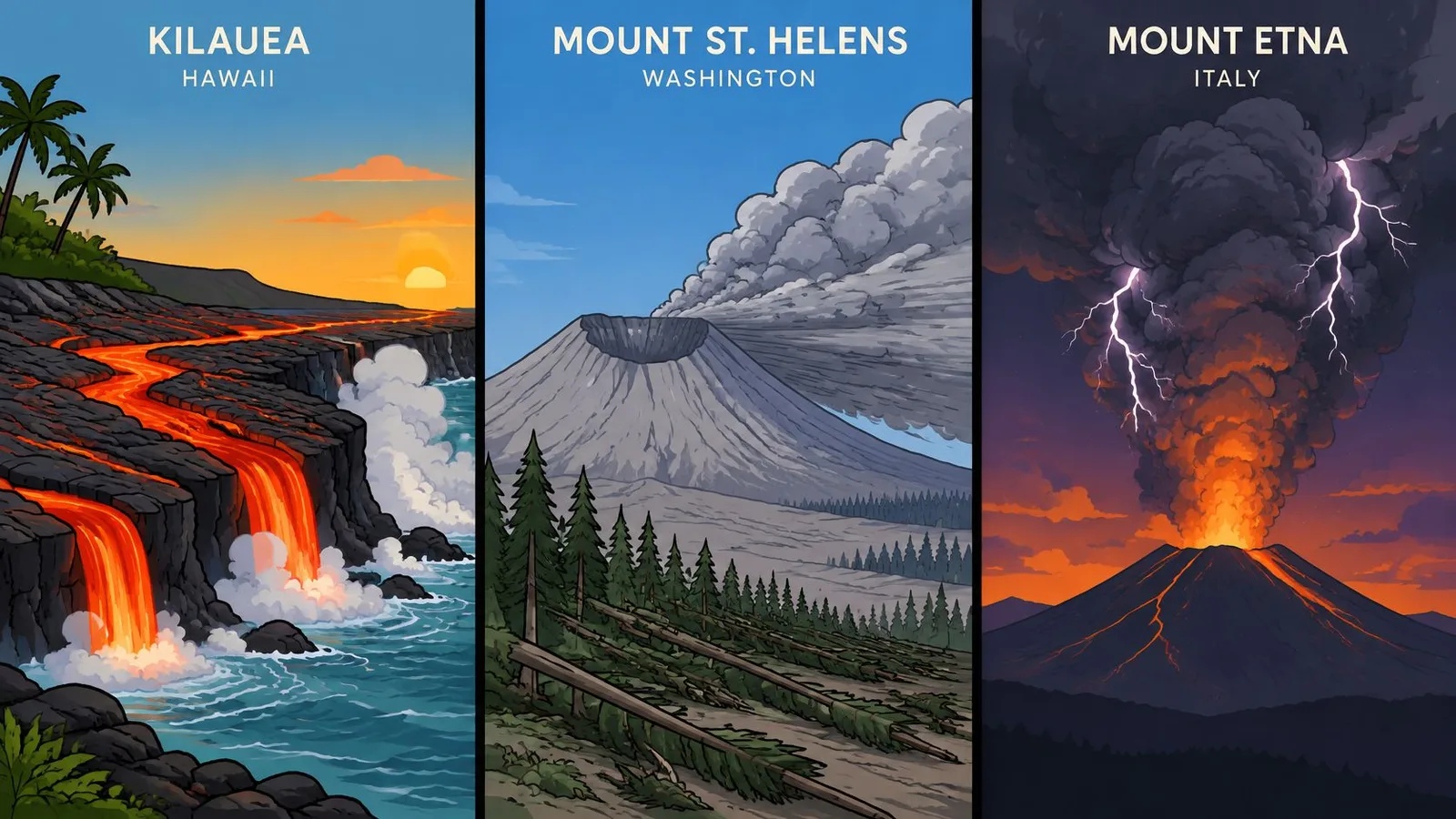
Famous volcanoes make the subject memorable, but a familiar name isn't a mechanism. Seeing Kilauea, Mount St. Helens, or Etna in an illustration should prompt questions about the underground system rather than an assumption that each volcano has one permanent behavior.
Read an eruption as a sequence
When examining an account of an eruption, separate what people observed from what those observations reveal about the mechanism. A photograph of flowing lava answers a different question from a measurement of ground movement before material reaches the surface.
Use these prompts to read an eruption account more carefully:
- Before the eruption: What evidence suggested that material or pressure was changing underground?
- At the surface: Did the description emphasize flowing material or fragmentation?
- During changes in activity: What evidence supported an explanation involving gas escape, supply, or confinement?
This approach avoids turning a memorable event into a universal rule. An explanation should connect observations to physical conditions, rather than assign every dramatic image to “too much heat.”
Keep places and processes distinct
Names also need care. A resource about a community isn't a substitute for information about a volcanic system. For place-based context, the ReloMaps location report for St Helens is a separate resource from the geological explanation of Mount St. Helens; it shouldn't be treated as an eruption-monitoring reference.
The same care applies when exploring fun facts about the Earth. A striking fact is a starting point for asking how something happened, not a replacement for the causal explanation.
Rising magma can fracture surrounding rock, deform the ground, and release gases. Changes such as new magma entering a shallow reservoir or increasing volatile content can also bring a system closer to eruption, which is why the pressure state matters alongside visible activity (USGS on suitably pressurized magma).
The lesson to carry into any famous eruption story is simple: identify the evidence, then ask which underground conditions could explain it. Don't infer the entire sequence from the most dramatic photograph.
Question 4 of 6
Why does the ground around a volcano sometimes swell upward before an eruption?
Why Warning Signs Are Probabilistic, Not a Countdown
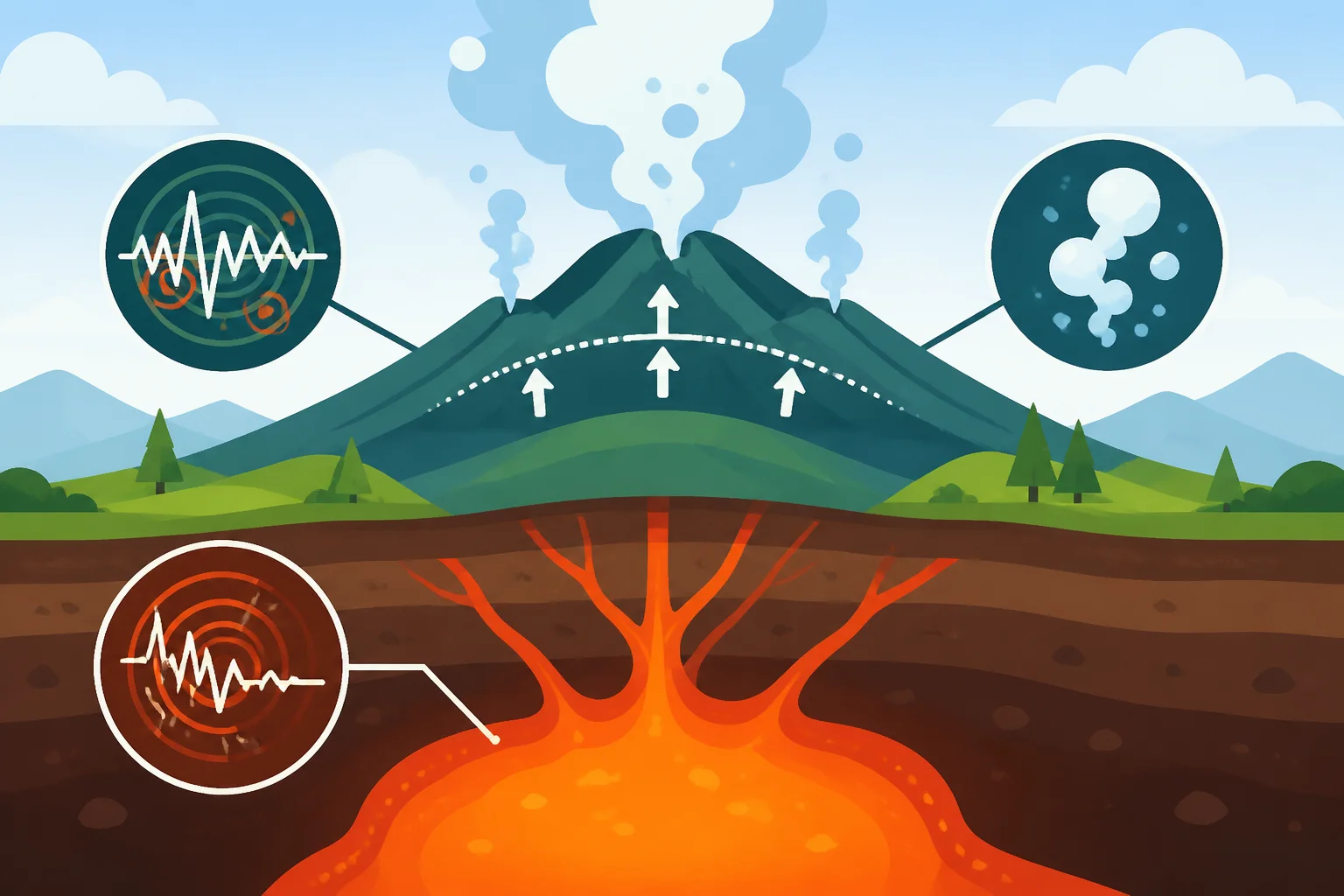
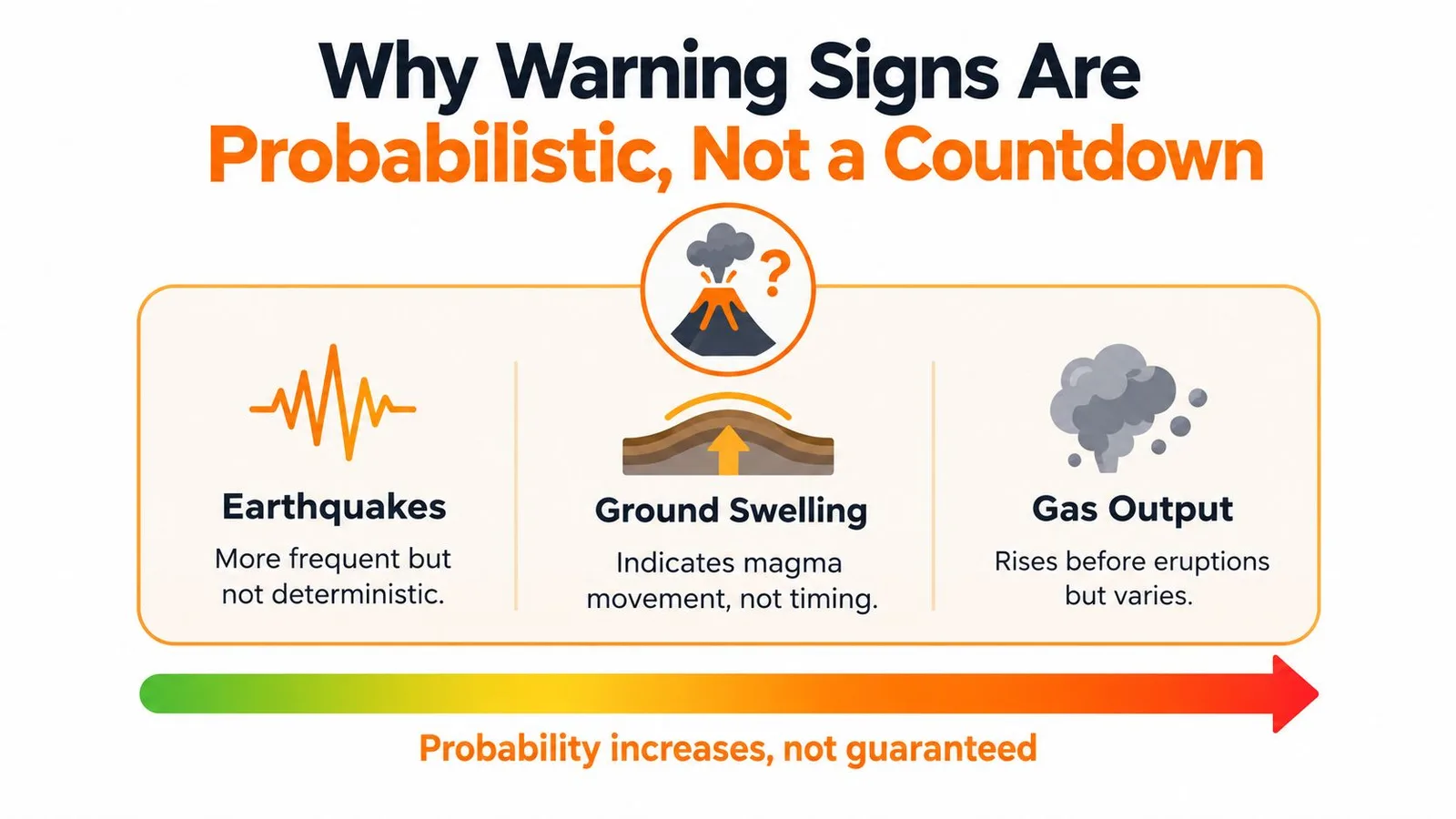
A restless volcano isn't necessarily a volcano about to erupt. Increasing gas emissions, earthquake swarms, and ground deformation are important monitoring indicators, but they can reflect magma ascent or pressurization without guaranteeing an imminent eruption (USGS volcano monitoring overview).
That distinction explains why scientists can recognize meaningful change without supplying an exact eruption time. Instruments measure evidence of a changing system. They don't directly establish that every remaining obstacle to eruption will be overcome.
Why unrest can stop short
Magma can stall underground, lose heat, crystallize, or fail to develop enough pressure to reach the surface. A blockage can also interrupt its route. Evidence that movement occurred doesn't prove that movement will continue.
- Earthquakes: Rock fracturing can indicate underground disturbance, not a scheduled surface event.
- Ground deformation: Changing shape can indicate movement or pressure without fixing the outcome.
- Gas measurements: Their meaning depends on how gases are supplied, transported, and released.
Scientists therefore interpret these measurements together. A change in one signal needs the context provided by the others and by the evolving condition of the volcanic system.
Uncertainty doesn't make monitoring useless
A forecast can be informative without being certain. It can identify conditions consistent with increasing concern while still allowing for magma to remain underground. Conversely, the shallow-system changes described earlier can make escalation comparatively brief.
Practical implication: An eruption that doesn't follow unrest doesn't make the unrest imaginary.
It's tempting to call every non-eruptive episode a false alarm. That wording can obscure the difference between correctly detecting underground change and incorrectly claiming that an eruption is inevitable.
The probability bar in the infographic should be read as a teaching aid, not a universal scale. Warning signs require interpretation; they aren't interchangeable marks on a countdown clock. For personal safety, follow official monitoring updates and local instructions rather than trying to forecast an eruption from an isolated sign.
Question 5 of 6
Why can a volcano show earthquake swarms, bulging ground, and rising gas without ever erupting?
Putting the Whole Chain Together
The complete explanation is a connected system: generation, ascent, gas expansion, and resistance to escape. Viscosity helps determine the form that escape takes. Monitoring provides evidence about changes within that system, not a direct view of its eventual outcome.
This mental model helps you separate questions that are often blended together. Why is magma present? Why is it moving? Why might it fragment? Why might movement stop before an eruption?
The useful answer isn't “hot rock rises.” It's “under the right conditions, molten material can overcome what confines it.”
You can test your understanding without memorizing an eruption classification. Take a hypothetical change, such as an easier gas escape route, and ask which part of the explanation it affects. Then resist jumping from that single change to a complete forecast.
That habit extends beyond volcanoes. The questions collected in Earth Day's weird whys about our planet offer other starting points for practicing causal thinking. The aim isn't to collect surprising answers, but to understand which conditions make those answers possible.
Common Questions About Volcanic Eruptions
Is magma the same as lava?
The distinction is location: molten material underground is called magma, while material that reaches the surface is called lava. Changing the name doesn't mean every eruption produces a smooth lava flow.
Can scientists predict the exact moment of an eruption?
Not reliably as a countdown. As the monitoring discussion explains, scientists assess evidence of changing conditions, but unrest doesn't determine a unique outcome or an exact time.
Does an eruption that seems sudden have no warning signs?
Don't assume that “no warning noticed” means “no underground change occurred.” An eruption account needs information about monitoring and the sequence of observations before you can draw that conclusion; the appearance of suddenness alone isn't enough.
Are hotspot volcanoes necessarily more dangerous?
Their tectonic setting alone doesn't answer that question. Hawaii demonstrates that volcanism can occur within a plate, but evaluating eruption behavior still requires the gas, magma, and pathway conditions discussed earlier.
Does weather explain why a volcano erupts?
Weather isn't a substitute for the underground mechanism. A claim that weather triggered a particular eruption would need specific evidence connecting it to that event, rather than a coincidence between conditions at the surface and activity below.
For short, interactive explanations like this, Igneous AI, LLC offers Million Whys, a curiosity-based quiz platform with explanations for correct and incorrect answer choices. Visit to try a science question, make your prediction, and use the explanation to check the reasoning behind your answer.
Question 6 of 6